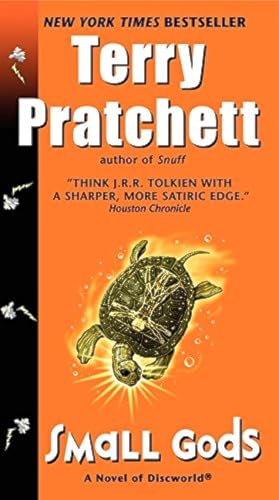
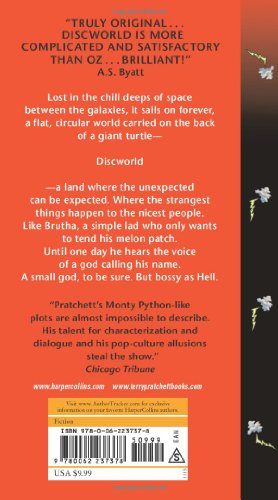


Small Gods: A Novel of Discworld [Pratchett, Terry] on desertcart.com. *FREE* shipping on qualifying offers. Small Gods: A Novel of Discworld Review: Timely, Absurd, Satirical, Thought Provoking - Small Gods is a novel of Discworld where the world is a flat disc, balanced on the backs of four elephants which are standing on the back of a giant turtle. There are many novels set in Discworld, and most of them are clever, witty, and rapid-fire novels. Almost all of the Discworld novels fall into different categories: Tiffany Aching, Rincewind, the three witches, Sam Vines and the guards, and Death. Each book in a group focuses on one of them, although they cross over and pop up in each others' books all the time. This book is one of the few that stands alone. There are only the fleeting mentions or appearances of the familiar such as Ankh- Morpork (a familiar setting in Discworld), Lu Tse (an ancient monk), and the librarian from the Unseen University (an orangutan). Death has a more substantial appearance, but I would not consider this book to be a novel of Death. This is a story of faith, religion, philosophy, war, loyalty, and integrity. That sounds a bit highfalutin, but do not forget that this is a Terry Pratchett book so it is also satirical, absurd, and occasionally silly. Brutha, the main character, is a naïve novice monk in Omnia. Vorbis is a scheming high priest and head of state of Omnia who dominates through fear and directs their version of the inquisition. These story begins when an eagle drops a turtle in the garden where Brutha is working. The turtle is currently the manifestation of a small god (Om) who regains his consciousness on the descent. Only Brutha can hear the god speak. Antics, diplomacy, treachery, prayer, and great adventure ensue. There is method to the madness. Terry Pratchett does a wonderful job of maintaining the integrity of his absurd world and his characters while keeping everything fresh and creative. As always, the humor is wrapped around serious themes. The discussions of religion, faith, and philosophy are absurd, but thought provoking. Actually, there is a large cast of characters in this book with gods, philosophers, monks, priests, torturers, soldiers, sailors, a turtle, foreign leaders, a fisherman, and so on. I cannot read too many of them in a row, but when I need something different, a Discworld novel is the perfect metaphorical palate refresher. Like all the Discworld books, the tone is satirical and clever. While it makes sense to generally read the books in order, this book can stand alone. These books do not contain any scenes, language, or images that would rate even a PG-13 rating at the movies. If a reader does not have sufficient maturity, much of the book will be wasted, because you won’t get the jokes or understand the satire. It should be impossible to write such pure nonsense that ends up making great sense. Review: Funny, and It Makes You Think - Logging in at number 13 in the Discworld series, Small Gods is the first of the truly great Discworld novels (as opposed to even some of the other stronger early entries in the series which are merely good to very good). It is also the first Discworld book in which Terry Pratchett largely eschews parody in favor of satire - and, as clever a parodist as Pratchett is, this book amply demonstrates that he is an even better and more clever satirist. (If you happen to be a fan of parody, however, have no fear - while the book itself is not parodic in form, it does include ample parodies of religious and philosophical thought and discourse, providing nice spins on various old chestnuts and conventional wisdom.) Small Gods follows the adventures of Brutha, a simple monk with simple aspirations who also happens to be the last true believer in his god, Om. In the Discworld universe, gods rely on the belief of their worshippers for power, an idea which makes passing appearance in previous Discworld novels (and which is also a central idea in Neil Gaiman's American Gods), but which is employed in Small Gods as a vehicle to explore what happens when people no longer really believe in the Man behind the Curtain but only in the curtain itself, when the church becomes more important than the god, and when the institution becomes more important than the ideas around which it originally arose. While the main target of Pratchett's satire in Small Gods is institutionalized religion which favors its own perpetuation over the well-being of its followers, the novel more broadly addresses what happens when ideas, even good or noble ideas, hit up against the realities of implementation - that when the idea becomes a tool, there are those who will see it as only a tool and, like all tools, potentially a weapon. The problem isn't the ideas but the people trying to put them into action. And, like any good satirist, Pratchett is well aware of the weakness of men. But, like any great satirist, Pratchett is also well aware that such weakness is just one aspect of our humanity. Small Gods holds its own with the best books of the Discworld series and should delight Discworld fans as well as anyone with an appreciation for clever and incisive satire. This book is largely a one-off in the Discworld universe and requires no familiarity with the previous books in the series to follow.
| ASIN | 0062237373 |
| Best Sellers Rank | #464,148 in Books ( See Top 100 in Books ) #463 in Fantasy Action & Adventure #593 in Humorous Fantasy (Books) #1,821 in Action & Adventure Fantasy (Books) |
| Book 13 of 41 | Discworld |
| Customer Reviews | 4.6 4.6 out of 5 stars (9,157) |
| Dimensions | 4.19 x 0.9 x 7.5 inches |
| Edition | Reprint |
| ISBN-10 | 9780062237378 |
| ISBN-13 | 978-0062237378 |
| Item Weight | 2.31 pounds |
| Language | English |
| Print length | 400 pages |
| Publication date | October 29, 2013 |
| Publisher | Harper |
C**R
Timely, Absurd, Satirical, Thought Provoking
Small Gods is a novel of Discworld where the world is a flat disc, balanced on the backs of four elephants which are standing on the back of a giant turtle. There are many novels set in Discworld, and most of them are clever, witty, and rapid-fire novels. Almost all of the Discworld novels fall into different categories: Tiffany Aching, Rincewind, the three witches, Sam Vines and the guards, and Death. Each book in a group focuses on one of them, although they cross over and pop up in each others' books all the time. This book is one of the few that stands alone. There are only the fleeting mentions or appearances of the familiar such as Ankh- Morpork (a familiar setting in Discworld), Lu Tse (an ancient monk), and the librarian from the Unseen University (an orangutan). Death has a more substantial appearance, but I would not consider this book to be a novel of Death. This is a story of faith, religion, philosophy, war, loyalty, and integrity. That sounds a bit highfalutin, but do not forget that this is a Terry Pratchett book so it is also satirical, absurd, and occasionally silly. Brutha, the main character, is a naïve novice monk in Omnia. Vorbis is a scheming high priest and head of state of Omnia who dominates through fear and directs their version of the inquisition. These story begins when an eagle drops a turtle in the garden where Brutha is working. The turtle is currently the manifestation of a small god (Om) who regains his consciousness on the descent. Only Brutha can hear the god speak. Antics, diplomacy, treachery, prayer, and great adventure ensue. There is method to the madness. Terry Pratchett does a wonderful job of maintaining the integrity of his absurd world and his characters while keeping everything fresh and creative. As always, the humor is wrapped around serious themes. The discussions of religion, faith, and philosophy are absurd, but thought provoking. Actually, there is a large cast of characters in this book with gods, philosophers, monks, priests, torturers, soldiers, sailors, a turtle, foreign leaders, a fisherman, and so on. I cannot read too many of them in a row, but when I need something different, a Discworld novel is the perfect metaphorical palate refresher. Like all the Discworld books, the tone is satirical and clever. While it makes sense to generally read the books in order, this book can stand alone. These books do not contain any scenes, language, or images that would rate even a PG-13 rating at the movies. If a reader does not have sufficient maturity, much of the book will be wasted, because you won’t get the jokes or understand the satire. It should be impossible to write such pure nonsense that ends up making great sense.
S**D
Funny, and It Makes You Think
Logging in at number 13 in the Discworld series, Small Gods is the first of the truly great Discworld novels (as opposed to even some of the other stronger early entries in the series which are merely good to very good). It is also the first Discworld book in which Terry Pratchett largely eschews parody in favor of satire - and, as clever a parodist as Pratchett is, this book amply demonstrates that he is an even better and more clever satirist. (If you happen to be a fan of parody, however, have no fear - while the book itself is not parodic in form, it does include ample parodies of religious and philosophical thought and discourse, providing nice spins on various old chestnuts and conventional wisdom.) Small Gods follows the adventures of Brutha, a simple monk with simple aspirations who also happens to be the last true believer in his god, Om. In the Discworld universe, gods rely on the belief of their worshippers for power, an idea which makes passing appearance in previous Discworld novels (and which is also a central idea in Neil Gaiman's American Gods), but which is employed in Small Gods as a vehicle to explore what happens when people no longer really believe in the Man behind the Curtain but only in the curtain itself, when the church becomes more important than the god, and when the institution becomes more important than the ideas around which it originally arose. While the main target of Pratchett's satire in Small Gods is institutionalized religion which favors its own perpetuation over the well-being of its followers, the novel more broadly addresses what happens when ideas, even good or noble ideas, hit up against the realities of implementation - that when the idea becomes a tool, there are those who will see it as only a tool and, like all tools, potentially a weapon. The problem isn't the ideas but the people trying to put them into action. And, like any good satirist, Pratchett is well aware of the weakness of men. But, like any great satirist, Pratchett is also well aware that such weakness is just one aspect of our humanity. Small Gods holds its own with the best books of the Discworld series and should delight Discworld fans as well as anyone with an appreciation for clever and incisive satire. This book is largely a one-off in the Discworld universe and requires no familiarity with the previous books in the series to follow.
B**N
Intriguing Read That's Fun and Raises Real Questions
This was my first Terry Pratchett book, and I found it intriguing and would recommend it. It doesn't fit neatly into a category, bearing plenty of humor, fantasy, and social commentary along with religion, theology, and philosophy - as a minister, the latter was of great interest. The characters were interesting, from the innocent, challenged young novice to the darkly sinister Deacon to the curious little god and its frustrations. In winding through his story, Pratchett brings the reader on a journey into areas of great contradictions, revealing them in different places and making connections that are worthy but not obvious. The book got me asking many questions in contexts that I had not truly considered before. It was not predictable and the reader was invariably wondering where we might be headed, how and why. Pratchett's style at times seems unnecessarily flippant at first encounter, but it becomes more familiar and less disconcerting as you stay with the story. Other reviewers familiar with the series picked up nuances that a newbie like me would not. Perhaps that explains some of the unexplained, assumptions, and seemingly random items that would pop up and seem more distracting than helpful. I'll probably re-read this, and may sample more of Pratchett's writing. There are questions that got produced that I want to go back and look over further. Try "Small Gods." It has a lot to offer.
J**W
Amazing books, amazing author
I will never rate a Terry Pratchett book anything less than 5 stars. They're amazing, and short of the the book literally falling apart in my hands I have nothing bad to say about them.
K**E
Terry Pratchett composed a novel, written some time ago, which in the actual situation in our Roundworld could be of utmost importance, that makes ends of humor and philosophy meet in a literally enjoyable way. It is a page-turner of a unique style, you want to turn the page either to keep on laughing or due to thrill.
V**A
This one should be read in public every day everywhere. Especially in these days. It would only do good to mankind.
K**O
Book is great. Never expected a book could make me laugh this much. Also very thought provoking
A**P
Elegant writing, funny and dropping now and then some very deep reflection underneath the narrative. Wonderfully read also in the audiobook version by Andry Serkis.
A**R
A very fun and interesting read.
Trustpilot
4 days ago
2 days ago