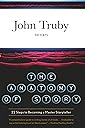
The Anatomy of Story: 22 Steps to Becoming a Master Storyteller
Product ID: 65828503
Desertcart purchases this item on your behalf and handles shipping, customs, and support to Senegal.
Buy The Anatomy of Story: 22 Steps to Becoming a Master Storyteller Reprint by Truby, John (ISBN: 9780865479937) from desertcart's Book Store. Everyday low prices and free delivery on eligible orders. Review: Very Useful - This book is insightful and very useful on how to create good stories. Where as Mckee's Story is informative and at times wordy, this book is practical and to the point. Where as Edson's Story Solutions is very formulaic, the structures here are more general. That said, all of these are great to read. I found this book's handling of the central characters problem/weakness/need/desire better than any other. Truby also zero's in on the key plot elements, character types, and goes a step further. For example he talks not just about the the ally but the fake or opponent ally. I actually found the insights here on story revealing about psychology in general. The top rated negative review is imo, quite a distraction from the point of the book, which is a criticism on gender pronouns. This book was written in 2007 when I believe "he" was still tought as the default pronoun in the USA and this is not an essay on gender issues, nor does the author suggest heroes must be men. My one criticism is, like other books on the subject, the hero structure outlined by Truby where he/she overcomes their fatal flaw does not always hold true. A classic counter example is Silence of the Lambs where the main character does not really have an arc - she believes the same thing at the end as at the beginning, ie. save the weak from predators. At the end she's won the battle but nothing has changed, she's saved a lamb, but there will be more. Hard to say the majority of 007 movies involve overcoming a fatal flaw. That said, there's a ton of valuable info in this book, it may be the best on the subject. Review: There are some excellent, very succinct ebooks that begin you on the ... - If you're going to buy a 'how to write books' book, this is the one you should buy. There are some excellent, very succinct ebooks that begin you on the 'how to' journey by pointing out that writing novels is a craft as well as an ability, and that craft can be learned. These are heartening because they offer a series of easy to follow 'steps' for structuring novels so that they work as novels. However, they are often cobbled together accounts of a range of theories on novel-writing, and they might lead one to believe that taking more than a month on a novel is a waste of time. Truby's book presents a coherent, depth account of what makes a good novel/film and why, and the steps he suggests build towards a far more comprehensive and intelligent sense of how writers can make their novels work in very clear and manageable ways. I had innumerable lightbulb moments, and it was a real pleasure to read something that doesn't dumb down what novels are but instead gives credit to smart writing and smart readers. The power of this particular book is that it looks at the range of writing, both literary and genre, novel and screenplay, in a way which allows one to see how good quality structure and therefore writing can be achieved in both. It's a much longer book than others in this field, which makes the reading experience far more satisfactory and fulfilling. A real find and now a cornerstone of my library.
| Best Sellers Rank | 18,272 in Books ( See Top 100 in Books ) 6 in Film Screenwriting |
| Customer reviews | 4.6 4.6 out of 5 stars (3,246) |
| Dimensions | 13.97 x 2.95 x 20.96 cm |
| Edition | Reprint |
| ISBN-10 | 0865479933 |
| ISBN-13 | 978-0865479937 |
| Item weight | 363 g |
| Language | English |
| Print length | 464 pages |
| Publication date | 14 Oct. 2008 |
| Publisher | Farrar, Straus and Giroux |
N**L
Very Useful
This book is insightful and very useful on how to create good stories. Where as Mckee's Story is informative and at times wordy, this book is practical and to the point. Where as Edson's Story Solutions is very formulaic, the structures here are more general. That said, all of these are great to read. I found this book's handling of the central characters problem/weakness/need/desire better than any other. Truby also zero's in on the key plot elements, character types, and goes a step further. For example he talks not just about the the ally but the fake or opponent ally. I actually found the insights here on story revealing about psychology in general. The top rated negative review is imo, quite a distraction from the point of the book, which is a criticism on gender pronouns. This book was written in 2007 when I believe "he" was still tought as the default pronoun in the USA and this is not an essay on gender issues, nor does the author suggest heroes must be men. My one criticism is, like other books on the subject, the hero structure outlined by Truby where he/she overcomes their fatal flaw does not always hold true. A classic counter example is Silence of the Lambs where the main character does not really have an arc - she believes the same thing at the end as at the beginning, ie. save the weak from predators. At the end she's won the battle but nothing has changed, she's saved a lamb, but there will be more. Hard to say the majority of 007 movies involve overcoming a fatal flaw. That said, there's a ton of valuable info in this book, it may be the best on the subject.
H**S
There are some excellent, very succinct ebooks that begin you on the ...
If you're going to buy a 'how to write books' book, this is the one you should buy. There are some excellent, very succinct ebooks that begin you on the 'how to' journey by pointing out that writing novels is a craft as well as an ability, and that craft can be learned. These are heartening because they offer a series of easy to follow 'steps' for structuring novels so that they work as novels. However, they are often cobbled together accounts of a range of theories on novel-writing, and they might lead one to believe that taking more than a month on a novel is a waste of time. Truby's book presents a coherent, depth account of what makes a good novel/film and why, and the steps he suggests build towards a far more comprehensive and intelligent sense of how writers can make their novels work in very clear and manageable ways. I had innumerable lightbulb moments, and it was a real pleasure to read something that doesn't dumb down what novels are but instead gives credit to smart writing and smart readers. The power of this particular book is that it looks at the range of writing, both literary and genre, novel and screenplay, in a way which allows one to see how good quality structure and therefore writing can be achieved in both. It's a much longer book than others in this field, which makes the reading experience far more satisfactory and fulfilling. A real find and now a cornerstone of my library.
S**U
A decent alternative to other structure options
First a quick note about me: I'm a ghost writer by profession with more than thirty-five novels under my belt at this point, some of which have done quite well. I need to understand the craft of writing to do my job, and this is as good a starting place as any. I first read this at university, when I was working on one of my first novels. I liked Truby's emphasis on using the strength of the premise to keep other story elements such as plot, character, setting and so on coherent. I still find his seven basic structure steps quite useful when I'm in a hurry and if you're looking to learn how to approach structure in a formal way, this is a clear, straightforward, reasonably practical guide that offers a valid alternative to options like the Hero's Journey approach. In terms of voice and presentation, I generally like the book. Most of what is here is quite clear, and most of it makes a certain amount of sense. Seemingly inevitably in this kind of structure book, Truby suggests that his approach is the only one that 'really' works, which is one of my pet hates, since people can and do produce beautiful works with all kinds of different approaches. More than that, I don't think anyone can ever really claim they're giving you a magic paint by numbers set with which to produce Old Masters. So there are the usual general warnings with this sort of thing. Remember that when writers like this analyse stories and find their own system at their heart, you could just as easily turn around and find several others. Remember that an analysis of great storytelling does not necessarily equate to a guarrantee that by following those steps you will produce great work. Remember that like all books in this genre, this one is necessarily general. And remember that you can overdo it. Having said that, I do like this book a lot, both because its approach is slightly less formulaic than some others, encouraging you to think about your story for yourself until at least the back end of it, and because it shows that there are other analyses out there beyond the standard ones.
1**R
Best book on writing out there!
This book has been the best on plotting and making your writing organic. I don’t agree that it is patronising - the language is very accessible, there are several examples and the chapters split to give you just the right amount of information. This also has some exercises accompanying the text, which I found really useful. I have read some of the most popular books on writing, but I think this is my favourite because it’s not using overly flowery language but has all the essential information.
T**X
Your just need this. Buy it. And the Anatomy of the Genre
P**E
Was sceptical in reading this book as there are so many claiming to have the answers to storytelling at a publishable level. Also relevant to film scriptwriting as many of its examples attest. This isn't an easy book to fully digest, but worth the effort I reckon and one I will study further.
P**R
As a writer who wants to improve my writing, I've read many books on writing (to learn how to stuff another 'writing' into an overburdened sentence) and John Truby's book is often mentioned as the gold standard of how to write a great story. I can see why, as John is incredibly thorough, going in depth into all the aspects of story telling from premise to character to scene construction. What is appreciate is the organic approach he advocates with many examples from great movies and tales. However, that depth makes it hard to grasp the whole of the approach and sitting down to implement his concepts into a practical structure is challenging. I think it would take a few reads to get his ideas integrated into an author's process but well worth doing. Perhaps it's best to view his concepts as guideposts to make sure you have not wandered far off the path of a great story.
C**R
Mükemmel
A**V
Excelente libro y el servicio de Amazon!
Trustpilot
2 months ago
2 months ago