
DOWNLOAD THE APP


Customer Services
Copyright © 2025 Desertcart Holdings Limited
DOWNLOAD THE APP
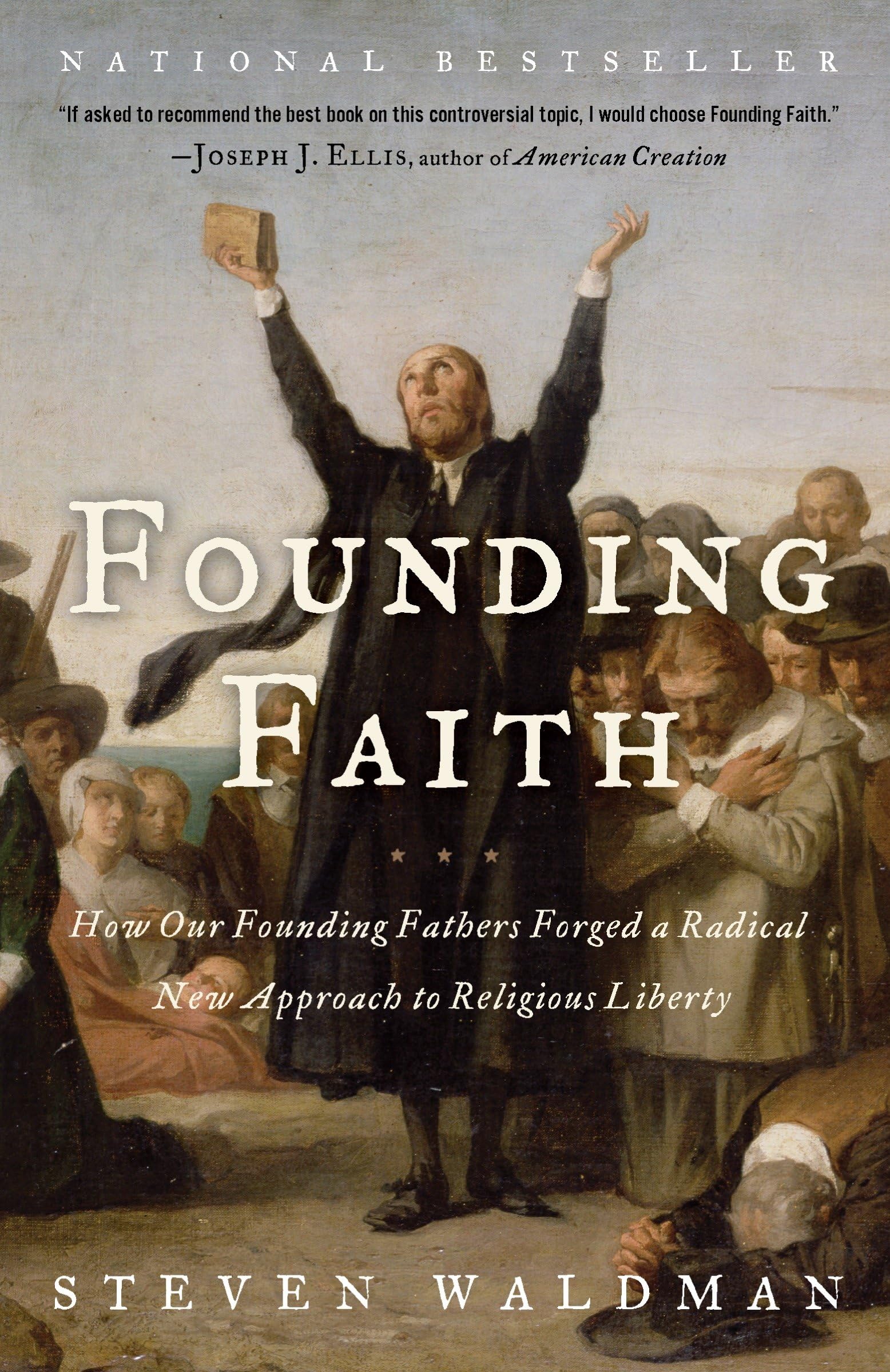
Founding Faith: How Our Founding Fathers Forged a Radical New Approach to Religious Liberty [Waldman, Steven] on desertcart.com. *FREE* shipping on qualifying offers. Founding Faith: How Our Founding Fathers Forged a Radical New Approach to Religious Liberty Review: The Multifarious Founders and Their Religious Views - There are few questions that can get legal scholars, jurists, and ideologues as excited as the question of what the attitude of the American founders towards religion was. For the last fifty-or-so years, the issue has had no shortage of opinions written on the issue. Some feel that the founders advocated for complete seperation between religion and government. Others believe that the founders only wished to prevent establishing a national religion; anything short of that would have been acceptable. This book (along with several others, like American Gospel) take the middle view. Profiling the seperate views of Franklin, Washington, Adams, Jerfferson, and Madison, Waldman an attempt to show that the founders themselves may have been of a divided mind on the question of how much religion and state should intermingle. The conclusion the author comes to: (a) the founders were as confused on the subject as we are, and had as many different opinions; (b) myths abound on both sides of the current church/state debates. Waldman debunks two myths simulteneously myths. The founders were neither deists as the "left" supposes, or Christians of the variety that the "right" commonly supposes. While most of the founders were Christians, most were quite liberal by any conservative Christian standard. (Of Washington, Waldman notes that he was the type of Christian who would have gone to church "unless there was a good football game on." Of Jefferson, Waldman notes that he was a Christian only in the sense that he believed Christ to be a good moral philosopher.) While all the founders seemed to believe in a God active in the world (ruling out deism), most (excepting Adams) took the bible as highly metaphorical, rarely referred to Jesus Christ in writings, and made disparaging comments in private letters to do with organized religion. Waldman's book is well-researched, very readable, and hard to argue with. He takes us from the early days of the colonies (where all but two states had strong political support for religion), through the Revolution and Constitutional Convention (where discussion of religion was always brief), all the way through Madison's death. The drafing of the first amendment is focused on quite heavily, and Waldman does a good job in showing how our Bill of Rights was more an act of political compromise than ideeological zest. (The first amendment went through multiple drafts, the final of which is the one using the vaguest, and thus most politically expedient, language.) In the end, Waldman concludes that hoping for any "original intent" of our Founders on religion is hopeless. Like Jack Rakove's book "Original Meanings," Waldman reminds us through astute historical analysis that not only were their too many heads to have any single intent, but that even the founders (namely Franklin and Adams) had quite evolving and not always consistent internal views. They are not Gods whose views were fully formed, but humans whose views were nuanced and evolving. A very good read for those who want a well-researched and -argued book on the Founding Faiths. Review: Beyond Propaganda. - I approach this book from a rather different point of view than some other reviewers. I'm a Christian apologist. My most recent book, The Truth Behind the New Atheism, attempted to refute Richard Dawkins and allies. One of the chapters of that book, "What About the American Taliban?" tackled the allegation that conservative Christians are a threat to democracy. Despite Chris Rodda's claim below that "historical misconceptions and misquotes used by the 'secularists' can be counted on one hand," counting dubious claims by that great scholar of American history, Richard Dawkins, alone might wear out the toes on a centipede. And an ACLU poster glibly suggests that the Constitution built a "wall of separation" between church and state -- which as Waldmon shows, is at least an exageration, if not a fantasy. On the other hand, I'm also leery of books like "Sea to Shining Sea," and the gross exagerations Christians are also sometimes guilty of. Steven Waldman does a good job of going beyond propaganda for either side. While honest and pretty balanced, he is also passionate, engaged, and not afraid to write well, or to add interesting asides. He concentrates on five figures: Washington, Franklin, Jefferson, Adams, and Madison, and tells their stories fairly. He weaves these stories in with a general history of how the new American idea of church and state evolved. He doesn't try to pin a halo on anyone's head, but he clearly respects these men, and explains why he thinks their solution was best. The book is to the point, pithy, and readable -- I zipped through it in two or three days. The question that often came to mind, while reading, was "Why didn't Christians get this earlier?" Sociologist of religion Rodney Stark makes a strong case for a market view of religious organizations -- any "church," whatever it's ideology, will oppress, just as Ma Bell will give bad service, given a monopoly. Jesus seemed to understand that from the get-go. And some Christians -- Francis Bacon, John Locke, Edmund Burke -- figured it out again, over time. But as Waldman shows, sometimes we Christians have to learn the implications of our own faith from those who, like Franklin, Adams, Madison, and Jefferson, have in some sense already left the faith, or like Gandhi, who never claimed it. Sometimes we have to be hit over the head with oppression to see what is in front of our eyes. [...]But after reading the book, I'm inclined to agree with the principals that Providence was working through its chosen instruments over the course of the American revolution. I'm also inclined towards a stricter view of separation, not on legal grounds -- as Waldon shows, those are fairly muddled -- but because to paraphrase Madison, with friends like Big Government, who needs enemies? An important part of the truth.
| Best Sellers Rank | #312,162 in Books ( See Top 100 in Books ) #334 in U.S. Colonial Period History #513 in U.S. Revolution & Founding History #1,277 in History of Christianity (Books) |
| Customer Reviews | 4.5 out of 5 stars 136 Reviews |
K**T
The Multifarious Founders and Their Religious Views
There are few questions that can get legal scholars, jurists, and ideologues as excited as the question of what the attitude of the American founders towards religion was. For the last fifty-or-so years, the issue has had no shortage of opinions written on the issue. Some feel that the founders advocated for complete seperation between religion and government. Others believe that the founders only wished to prevent establishing a national religion; anything short of that would have been acceptable. This book (along with several others, like American Gospel) take the middle view. Profiling the seperate views of Franklin, Washington, Adams, Jerfferson, and Madison, Waldman an attempt to show that the founders themselves may have been of a divided mind on the question of how much religion and state should intermingle. The conclusion the author comes to: (a) the founders were as confused on the subject as we are, and had as many different opinions; (b) myths abound on both sides of the current church/state debates. Waldman debunks two myths simulteneously myths. The founders were neither deists as the "left" supposes, or Christians of the variety that the "right" commonly supposes. While most of the founders were Christians, most were quite liberal by any conservative Christian standard. (Of Washington, Waldman notes that he was the type of Christian who would have gone to church "unless there was a good football game on." Of Jefferson, Waldman notes that he was a Christian only in the sense that he believed Christ to be a good moral philosopher.) While all the founders seemed to believe in a God active in the world (ruling out deism), most (excepting Adams) took the bible as highly metaphorical, rarely referred to Jesus Christ in writings, and made disparaging comments in private letters to do with organized religion. Waldman's book is well-researched, very readable, and hard to argue with. He takes us from the early days of the colonies (where all but two states had strong political support for religion), through the Revolution and Constitutional Convention (where discussion of religion was always brief), all the way through Madison's death. The drafing of the first amendment is focused on quite heavily, and Waldman does a good job in showing how our Bill of Rights was more an act of political compromise than ideeological zest. (The first amendment went through multiple drafts, the final of which is the one using the vaguest, and thus most politically expedient, language.) In the end, Waldman concludes that hoping for any "original intent" of our Founders on religion is hopeless. Like Jack Rakove's book "Original Meanings," Waldman reminds us through astute historical analysis that not only were their too many heads to have any single intent, but that even the founders (namely Franklin and Adams) had quite evolving and not always consistent internal views. They are not Gods whose views were fully formed, but humans whose views were nuanced and evolving. A very good read for those who want a well-researched and -argued book on the Founding Faiths.
D**L
Beyond Propaganda.
I approach this book from a rather different point of view than some other reviewers. I'm a Christian apologist. My most recent book, The Truth Behind the New Atheism, attempted to refute Richard Dawkins and allies. One of the chapters of that book, "What About the American Taliban?" tackled the allegation that conservative Christians are a threat to democracy. Despite Chris Rodda's claim below that "historical misconceptions and misquotes used by the 'secularists' can be counted on one hand," counting dubious claims by that great scholar of American history, Richard Dawkins, alone might wear out the toes on a centipede. And an ACLU poster glibly suggests that the Constitution built a "wall of separation" between church and state -- which as Waldmon shows, is at least an exageration, if not a fantasy. On the other hand, I'm also leery of books like "Sea to Shining Sea," and the gross exagerations Christians are also sometimes guilty of. Steven Waldman does a good job of going beyond propaganda for either side. While honest and pretty balanced, he is also passionate, engaged, and not afraid to write well, or to add interesting asides. He concentrates on five figures: Washington, Franklin, Jefferson, Adams, and Madison, and tells their stories fairly. He weaves these stories in with a general history of how the new American idea of church and state evolved. He doesn't try to pin a halo on anyone's head, but he clearly respects these men, and explains why he thinks their solution was best. The book is to the point, pithy, and readable -- I zipped through it in two or three days. The question that often came to mind, while reading, was "Why didn't Christians get this earlier?" Sociologist of religion Rodney Stark makes a strong case for a market view of religious organizations -- any "church," whatever it's ideology, will oppress, just as Ma Bell will give bad service, given a monopoly. Jesus seemed to understand that from the get-go. And some Christians -- Francis Bacon, John Locke, Edmund Burke -- figured it out again, over time. But as Waldman shows, sometimes we Christians have to learn the implications of our own faith from those who, like Franklin, Adams, Madison, and Jefferson, have in some sense already left the faith, or like Gandhi, who never claimed it. Sometimes we have to be hit over the head with oppression to see what is in front of our eyes. [...]But after reading the book, I'm inclined to agree with the principals that Providence was working through its chosen instruments over the course of the American revolution. I'm also inclined towards a stricter view of separation, not on legal grounds -- as Waldon shows, those are fairly muddled -- but because to paraphrase Madison, with friends like Big Government, who needs enemies? An important part of the truth.
D**L
Solid dispelling of facile myths about the Founders and religious freedom
Waldman studies the issues around religious freedom in the pre- and post-Revolutionary period, disposing of myths both Left and Right (the Founders to the dubious extent that they can be generalized in their religious beliefs, were neither a gang of radical secularists and Deists, nor were they fervent Christians of the sort that today's Religious Right would be likely to hang out with; the Founders were not of a mind as to full separation of Church and State, as half were dedicated to that separation and the other half were afraid of Federal intervention into state-level establishments and religious support; on the other hand, it is largely that 14th Amendment that paved the way for most of the court rulings in the later 20th Century that the Right lambastes, not the whims of activist judges). Along the way, Waldman explores the contradictory characters not only of the big names in the Constitutional debate -- Washington, Adams, Jefferson, Franklin, Madison -- but of numerous other Founders. He describes what they saw around them in terms of religious establishment and discrimination prior to the Revolution, how the Revolution itself was driven as much by anti-Catholic flame-fanning targeting the Church of England, and how the fight for religious freedom was supported as much by evangelical Baptists (to protect them against established and mainstream faiths) as by rationalists like Jefferson. He also details the Constitutional debates around religious freedom, including the varying degrees that the Founders supported, opposed, and balanced involvement of the state in the support of religious denominations and institutions. In short, it's a far more nuanced and complex explanation for the legal conditions behind the "Culture Wars" of the last few decades -- but, in the telling, Waldman makes it clear (and celebrates) that the US has a vibrant, diverse, and powerful religious culture, not despite the Right-derided separation of Church and State, but because of it. I like the book so much, and there's so much fine primary material in it, that I've added the print version to my Wish List, so that I can reread it that way (though David Colacci's narration of the book is clar, interesting, and pleasant to listen to). Highly recommended for anyone with an interest in the topic of religious freedom, the Constitution, and American History.
A**R
Excellent overview
Highly useful book on the religion of the Founding Fathers, and their intent concerning religious freedom and the separation of church and state. Founding Faith is a fair and balanced book, puncturing liberal and conservative myths about the topic with equal cheer, and more importantly, placing the discussion squarely within the historical context of what the Founders were doing and what it was possible for them to accomplish. So were the colonies Christian? Yes, of course, and more, predominantly Protestant with considerable anti-Catholic bias. Most colonies did have an established church, mostly Anglican or Congregationalist, yet, after the revivalism of the Great Awakening period in the mid-1700s, the colonies were more religiously diverse than ever. The fear that the British Crown would force all the colonists to be Anglican was a factor in the Revolution. Some of the factors leading the young nation into religious tolerance were pragmatic. George Washington, for example, was trying to forge a unified fighting force out of a religiously diverse group of soldiers. He had to quell the level of anti-Catholicism because he was trying to persuade the French Catholics in Canada to join in the Revolution. Were the Founders Deists? No, they weren't, as even Jefferson and Franklin acknowledged the hand of Providence in the affairs of men. But neither were the five Founding Fathers that Waldman profiles orthodox Christians. Franklin flirted with a variety of religions, including Deism (the philosophy that God created the Universe like a watchmaker creates a watch, and then retreated from participation in his creation), but he also was was interested in the Great Awakening and thought the influence of Christianity upon the morals of people was a good one. Adams was more likely than the others to support government involvement in religion, but he moved more towards Unitarianism the older he got and rejected much of orthodox Christianity, thinking that the much that was good in it had been corrupted, but that its founding principles were still the best. Jefferson was similar but more so. Like Adams, he despised the influence of clerics throughout history. He rejected the divinity of Jesus and the miracles, but was so enthralled by the moral teachings of Jesus he twice cut apart Bibles and pasted the parts he thought uncorrupt into new documents and apparently read them often. Washington was the most silent about religion, rarely attended church, yet often used the religious rhetoric of his day. He did, though, speak of religious equality (for Jews specifically) . Most important of all was James Madison, who was the primary writer of the Constitution and the Bill of Rights. Madison did not leave behind a clear record of his religious views, but from what there is, he seems to have been more orthodox than the others. He was, however, of all of them, the most devoted to the idea of religious toleration. One of the factors that shaped this was his knowledge of the Baptist preachers in Virginia who were often jailed and beaten, and who had to go through lots of hoops to even be able to perform marriages. Madison believed that religious support for one church over others was BAD FOR RELIGION, as well as the state, that it oppressed some religions while making the dominant one lazy. He also thought it a weak faith than needed government support, as well as believing it was bad to force anyone to profess and be taxed to support a religion in which they did not believe. The original language of what is now the First Amendment refers to the "rights of conscience", an even broader formulation than what is in the current amendment. One of the important historical points that Waldman made is that Madison was a politician, who had to be able to get the votes of other Congressmen to get the Bill of Rights passed. Madison did not get everything he wanted, and what was passed enabled those who wanted some religion in politics to interpret the result their way, as well as those who wanted a strict separation to interpret it their way. Most importantly, Madison did not get a law that applied the Bill of Rights to the states. This meant, for example, that states were perfectly free to establish churches, which most did, though they gradually disappeared during the first half of the nineteenth century. It wasn't until the 14th Amendment was passed after the Civil War that the Bill of Rights did apply to the states. Waldman's most important point, perhaps, is that many religious people did then and do now support religious toleration. "He [Madison] and his Baptist allies would be mystified by the assumption that being pro-separation means being anti-God." (p. 201). It seems no coincidence that the United Sates is one of the most religiously free, religiously diverse, and religiously flourishing nations on earth.
A**N
An excellent book, required reading for both sides!
This is truly an excellent book. It's really the first non-hysterical treatment of church-state separation I've ever read. Written in a very readable style, the book is easily accessible to a high school student or even a bright middle-schooler, yet the wealth of footnotes and references, and the extensive bibliography, provide ample starting places for those interested in digging deeper. Moreover, as a Christian, I found this a very encouraging book. If you've already made up your mind on either side of the debate, the book will probably just irritate you. But if you're concerned and trying to make sense of the discussion, this book is great. It made clear, for starts, that the culture wars we have now on the separation of church and state started with the founding of the country (and actually before). "Founding Fathers" on both sides of the issue had well-thought-out reasons for their positions, which the author articulates. Most interesting of all, perhaps, is that much of the drive for church-state separation came from Christians who felt that the interaction of government and religion harmed faith, which, after some discussion, turns out to be a compelling view. In short, I found the book quite valuable, and will keep it instead of donating it to the public library where most of my purchased books go. I wish that I could make those I know on both sides of the issue read this thing.
R**A
Myth Busting - Clearly Outlines The Beliefs And The Disagreements Of The Founding Fathers Without Political Bias.
Steven Waldman presents a refreshingly balanced view of what the key founders truly thought about the issues of religious freedom and the separation of Church and State in this well researched and documented book. By examining the religious beliefs and backgrounds of Franklin, Washington, Jefferson, Adams and Madison in the context of both the increasing diversity of belief and the framing of the constitution and the first amendment he sheds light on the misuse and mythology that both sides of the current culture wars engage in when claiming the Founding Fathers intended this or that in relation to what was for them and remains a very complex issue. His discussion of the 14th amendment and its expansion of the establishment clause to the state level is rarely discussed in the debates today but is a critical juncture in the road the nation has traveled to its current status on the issues involving faith and the government. Excellent and well written , Founding Faith packs a powerful assessment of an important topic into 200 pages.
B**N
We're too prone to gods, must step outside our points of view
A History of Modern Political Thought: Major Political Thinkers from Hobbes to Marx This is an excellent review of American history and the nation shaping forces on hand in Philadelphia as the Constitution was written. I thank my fundamentalist friends for inspiring me to research and think about religion. This book dwells on the details contemporary society denies yet invites us to step back and seek another POV. I understand we were blessed that the writers had a stronger sense of history, had seen the bloody and discriminatory results in their own states and genuinely wanted a union untainted by dogma. Theocracy was much worse than King George's tyranny. The awful deep bloodletting of the French Revolution had the sticky hands of the Reformation and class on it's blades. Yet religion thrived here because of the separation of church and state. I remember that Carl G Jung warned Americans that we too could fall victim to extremists if we didn't resist their rise. This great book both arms us with history and supplies us with a middle ground. With Ehreman's "Misquoting Jesus" recommended for questing, thinking hearts.
M**L
Informative, but not completely balanced.
It’s a decent book. Very informative! However, while the author attempts to show a balanced approach to our religious origins, he gives his opinion that may not be factual. He leaves much to be desired in terms of the religious struggle our founders went through in their personal lives and ends up assuming what most secularists believe: we are not a Christian nation in any sense and separation of church and state ad it means today is exactly what the founders intended. This view is skewed. That said, this isn’t the worst book on the topic.
Trustpilot
5 days ago
3 weeks ago