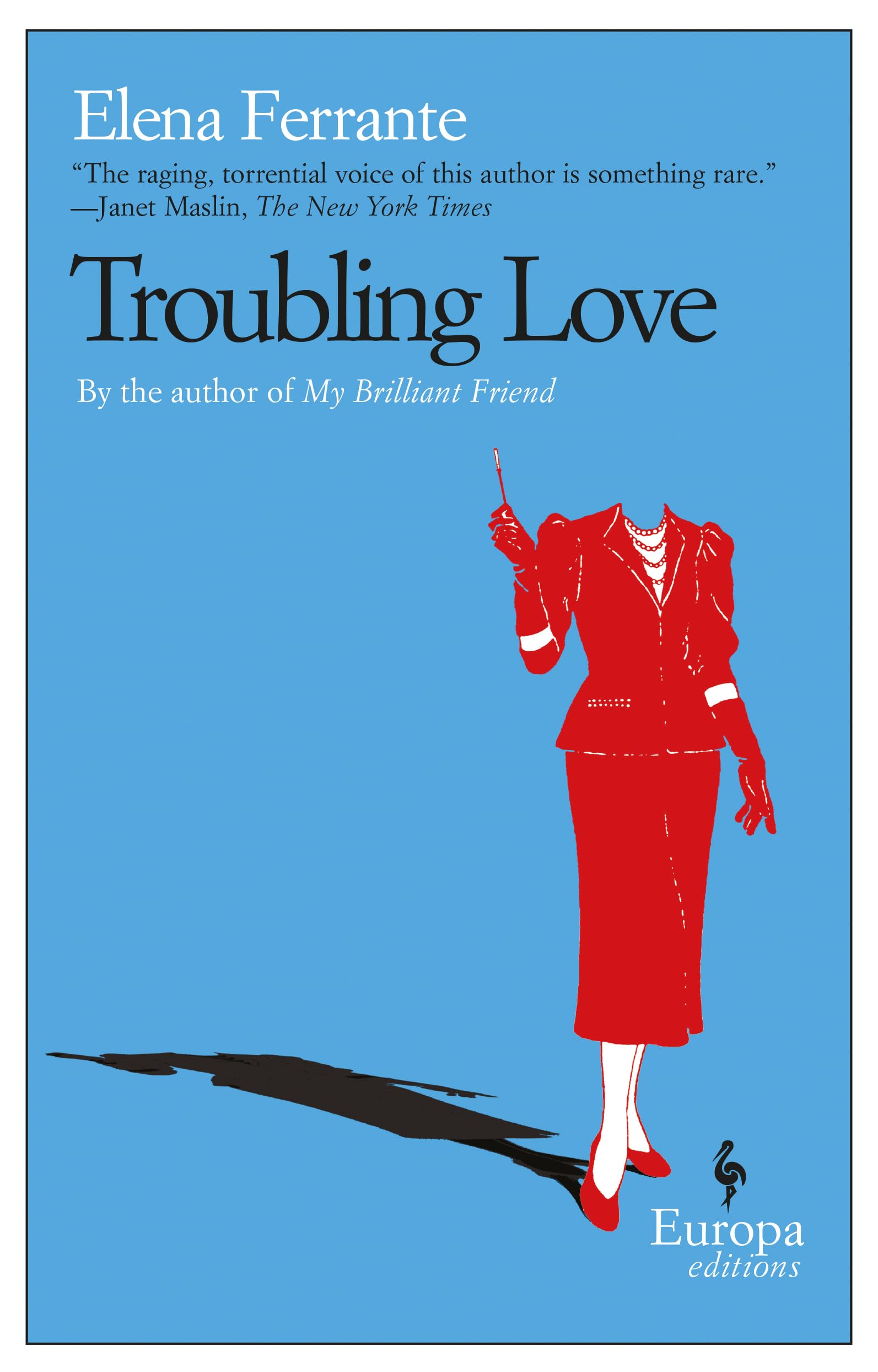
Buy Troubling Love: The first novel by the author of My Brilliant Friend by Ferrante, Elena, Goldstein, Ann (ISBN: 9781933372167) from desertcart's Book Store. Everyday low prices and free delivery on eligible orders. Review: A really enthralling read - I felt like I was right inside the protagonist's head - A really enthralling read - I felt like I was right inside the protagonist's head! Such great writing, great descriptions and characterisations! Review: Disturbing, unpleasant and unsettling; a surreal anatomy of loss - I have very mixed feelings about this book. Some scenes are so compellingly vivid and beautifully written the images just wouldn't leave my mind. The unexpected and unexplained loss of one's mother is enough to transform the world into something hostile and unfamiliar. Through the eyes of grief everything seems unreal, unstable and ugly, and this is how the protagonist experiences Naples and the people she encounters. A lot of very unpleasant details and sensory descriptions seemed designed primarily to evoke disgust. Of course, I recognise that Ferrante also wants to explore and expose the terrible vulnerabilty of women in a violent, patriarchal society, but I found this aspect overdone and slightly neurotic. The male characters are all horrific caricatures, ugly, violent and completely lacking in humanity. But the mother - who displays astonishing resilience despite her awful life story - is not terribly interesting or sympathetic. In the end perhaps she amounts to not much more than the old blue suit left on a hanger, and some sad pieces of ragged underwear. Since our protagonist is not very likeable either, I sometimes felt I was being dragged along to places I didn't want to go, and I just wanted it all to be over.
| Best Sellers Rank | 727,321 in Books ( See Top 100 in Books ) 1,704 in Later in Life Romance 2,507 in Women's Literary Fiction (Books) 4,352 in Psychological Fiction (Books) |
| Customer reviews | 3.5 3.5 out of 5 stars (1,585) |
| Dimensions | 13.72 x 1.14 x 20.96 cm |
| ISBN-10 | 1933372168 |
| ISBN-13 | 978-1933372167 |
| Item weight | 181 g |
| Language | English |
| Print length | 144 pages |
| Publication date | 10 Sept. 2012 |
| Publisher | Europa Editions |
T**T
A really enthralling read - I felt like I was right inside the protagonist's head
A really enthralling read - I felt like I was right inside the protagonist's head! Such great writing, great descriptions and characterisations!
S**M
Disturbing, unpleasant and unsettling; a surreal anatomy of loss
I have very mixed feelings about this book. Some scenes are so compellingly vivid and beautifully written the images just wouldn't leave my mind. The unexpected and unexplained loss of one's mother is enough to transform the world into something hostile and unfamiliar. Through the eyes of grief everything seems unreal, unstable and ugly, and this is how the protagonist experiences Naples and the people she encounters. A lot of very unpleasant details and sensory descriptions seemed designed primarily to evoke disgust. Of course, I recognise that Ferrante also wants to explore and expose the terrible vulnerabilty of women in a violent, patriarchal society, but I found this aspect overdone and slightly neurotic. The male characters are all horrific caricatures, ugly, violent and completely lacking in humanity. But the mother - who displays astonishing resilience despite her awful life story - is not terribly interesting or sympathetic. In the end perhaps she amounts to not much more than the old blue suit left on a hanger, and some sad pieces of ragged underwear. Since our protagonist is not very likeable either, I sometimes felt I was being dragged along to places I didn't want to go, and I just wanted it all to be over.
A**A
Played false by memories
In this short, pacy novel of often overpowering intensity, “Troubling love” refers to the narrator Delia’s ambiguous feelings for her mother Amalia, a mixture of love and hate, brought to a head by her death by drowning, an apparent act of suicide. Delia is not only driven to find out how her mother died but also to make sense of the chain of confused, even false memories which have blighted her life. Was Amalia the innocent victim of violent abuse at the hands of a jealous husband, in a Naples where casual sexual harassment seems to be the norm, or was she responsible for provoking him with her flirtatious manner and possible adultery with his former business partner Caserta? Apart from her unlikely career drawing comic strips, and the fact that, approaching forty, she seems to be unattached and childless, we learn little about Delia’s adult life, but she appears to be mentally unstable. Apparently traumatised by her upbringing, did some childish action on her part make matters worse and how reliable a witness is she now? Part of the magnetic pull of the writing stems from the way in which the facts, which initially seem bizarre or dreamlike, are revealed or made clear, like the pieces of a jigsaw fitting into place. A strong sense of Naples is created: the heat, furious commotion, squalor, decay, and sea like a “violet paste”. The book has been made into a film, and I found it much easier to read once I grasped the cinematic quality of many of scenes, with their emphasis on visual detail through which deeper meaning may become apparent. For instance in a sustained incident in which various characters pursue each other through the streets of Naples and onto a funicular, there is a purely visual image of someone “as if… skating on the metallic grey of the pavement, a massive yet agile figure against the scaffold of yellow painted iron bars at the entrance to Piazza Vanvitelli”. Alighting at the “dimly lit concrete bunker” of Chiaia Station, Delia imagines or perhaps partly remembers how it was nearly forty years ago, with her mother waiting there, mesmerised by three figures advertising clothes, symbolising the freedom of another world, and wondering how she and her daughter could escape into it. Particularly for a first novel, this is original and brilliant, but bleak. It also repelled me in its gratuitous focus on the sordid side of life: too much about the mess of menstruation, masturbation and sexual beatings. What lies behind the author’s dedication of this novel “for my mother”? Is it a mark of admiration or a reproach? A reviewer’s humorous comment, “My money is on Elena Ferrante being male, with slightly perverted sexual tastes” also strikes a chord. The brutal passion and frankness of the writing may illustrate the cultural difference between Italian and British literary fiction. This compulsive read assaulted my senses, and left me feeling tainted.
W**R
Having thoroughly enjoyed the Neapolitan Quartet
Having thoroughly enjoyed the Neapolitan Quartet, I was looking forward to the back catalogue. However, this one disappointed. Translation was stilted, the plot laboured and the narrative flow did not serve to develop the persona on the protagonist in any way. I struggled to the end hoping to discover some redeeming resolution - but did not. How irksome. Maybe there are several Elena Ferrante's?? We should be warned!
D**O
Well written as usual but really boring.
I loved the Neapolitan novels but could not make any sense of this one. It was boring and tiring. I really did not understand what was going on. Was she imagining everything? I finished it because I don’t like to stop a book in the middle of it and, since it was short, I decided to go on.
D**4
Worth reading
I enjoyed reading this book. There are similarities to her other books and I feel that this one is not quite as strong as the Neapolitan novels but still well worth reading.
M**.
Tres mediocre compare surtout a ses quatre livres que j'avais lu auparavant sur la vie de ces deux amies ! La je me suis purement ennuyée !
D**N
I Trembling Love first. this was one of the few books that I have read (as a Palliative Care physician) that illustrates in words the sensual and visual images that remain with the living following the death of a loved one by any process. Be it disease or suicide. Many people are too afraid to talk about 'seeing the loved one' after death because they will be considered crazy or mad. The vivid portrayal of the events in this book suggest the author has an intimate knowledge of these experiences and as Ferrante herself states, "it is allin the words, I do njot have to be known" (paraphrase)
F**R
Fascinating, complex!
L**K
If you love Elena Ferrante this is a must read. This was her first work - difficult to read in some areas, but worth it. Ferrante's writing are so descriptive that you feel immersed in her story. Book in excellent condition and shipped fast.
E**T
Reading this was like finding a used tissue in a pocket with nowhere to dispose of it. Not one sympathetic character in the entire story. Very disappointing.
Trustpilot
2 weeks ago
5 days ago