

Desert Online General Trading LLC
Warehouse # 7, 4th Street, Umm Ramool, Dubai, 30183, Dubai
Desert Online General Trading LLC
Warehouse # 7, 4th Street, Umm Ramool, Dubai, 30183, Dubai

Full description not available
A**Z
well worth reading
The book helps understand the complex issue of migration and first of all reactions to it.
H**F
Five Stars
Great and fast
D**R
Four Stars
Good, mainly because he was a respectable philosopher. Did not agree with all his thoughts
M**N
Essential reading
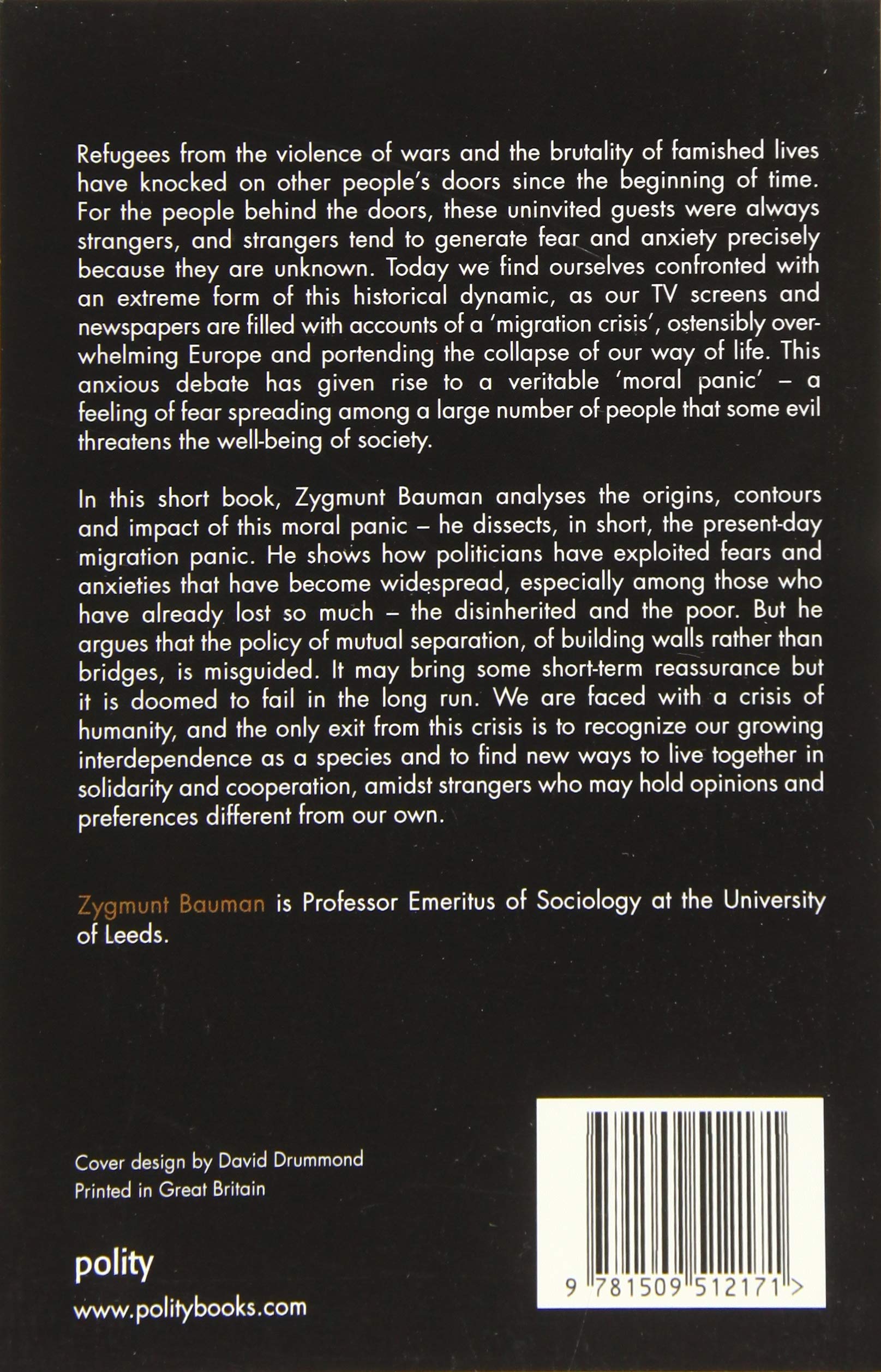
“Strangers at Our Door” by Zygmunt Bauman is simply essential reading in our contemporary ‘liquid modern’ times. Professor Bauman, whose long life has witnessed Fascism, Communism and global capitalism, is arguably the Western world’s most important living philosopher. This powerful, humane and deeply informed book masterfully contextualizes the current refugee crisis; including what we must do about it.Professor Bauman brilliantly connects inequality with the panic over migration, which he believes is a symptom of working class precariousness. Strongmen exploit our public insecurities for political gain even as states lose control over the multinational corporations that determine their economic fates. Professor Bauman is highly critical of self-serving politicians in the EU and U.S. for championing divisive policies that, in the end, merely feed terror networks, the police state, and public anxieties.Professor Bauman cites the wisdom of Pope Francis who has implored humanity to come together. The strangers at our door have much to offer if we engage them constructively, compassionately and lovingly. Professor Bauman is hopeful that an awakened human consciousness will challenge the status quo and open the door to a better future.I highly recommend this indispensable book to everyone.
I**E
Overly flowery, obscure writing style hinders the message
The message of this book is important, but the writing style is tedious, which leads me to recommend that there are much better books that offer the same message in a more readable, and also more thorough, way.Some examples of ideas that could have been presented more clearly: “Alas, the fate of shocks is to turn into the dull routine of normality – and of moral panics to spend themselves and vanish from view and from consciences wrapped in the veil of oblivion.” “But this is precisely the kind of arrangement that the modern edition of official fear, conscripted and redeployed by secular political powers, rejects in its practice – even if it hardly ever neglects to perform a lip service to its precepts. In a blatant violation of the modern intention and promise to replace the blind games of fate (that is, the annoyingly confusing disconnection of human doings from their consequences for the doers and others around them) by a coherent, relatively unambiguous order of things guided by moral principles of justice and responsibility – assuring thereby a strict correspondence between the plight of humans and their behavioral choices – humans are nowadays finding themselves exposed to a society overfilled with risks yet void of certainties and guarantees.”And one last example: “Devoured by that diffuse, dissipated and scattered fear that infiltrates and penetrates the whole of the life setting and the totality of life pursuits, as capillary vessels do the totality of the living body, humans are abandoned to their own resources – puny and miserable flimsy assets by comparison with the grandiosity of existential liabilities.”The author would benefit from reading Stephen Pinker’s The Elements of Style.Overall, the writing style overpowers the message. The basic message, that society is becoming increasingly global and that fear of others is harmful, is not a new one. There is no new insight in this book, so no need to wade through the elaborate writing style.
J**G
solidarity as mankind as an antidote to fear and rootlessness
Strangers at Our Door is a sociological work that has as its central thesis that a present crisis in the world today, the mass migration and disruption crisis, present an opportunity to show solidarity and express common humanity to all. Bauman argues that now is precisely not the time to wall off ourselves with a fear and anxiety that cannot be satiated. I am most familiar with Bauman's work of about 17 years ago, Liquid Modernity, where he described the condition of post modern man as liquid, not rooted and fearfully uncertain. He applies some of the thinking in that work to this long essay, to show how a way out of being liquid, or uncertain without roots, is to reject fear of the other. That a real consequence of today's world, where the world's events and information are available in a variety of instant ways, is that the hearer and reader are more easily manipulated. This does nothing but make liquid man more fearful and less secure.Bauman, a Jewish Pole and insurgent against NAZI Germany in his youth, and later sociology professor in England, wrote this penultimate book (he died in January of 2017), as a commentary on the rise of populist nationalist political forces that are gaining increasing power in the western world. In Strangers at Our Door, he shows that one negative solution that many seek to social and cultural insecurity is the ideal of the 'strong - man', whether in politics or culturally, who is certain and who can speak and act against those outside while providing security in a time of what he calls moral panic.His writing can be very complex and at times, quite flowery. His points are made as someone trying to cram everything he knows into his argument to make it as compelling as possible. This work may lose some readers in this attempt. But as an extended argument that a moral panic led by an failing to know who we are and our place in a throwaway and rapidly changing time, this is well worth considering and thinking deeply over.
Trustpilot
1 month ago
5 days ago
1 day ago
3 weeks ago