🔊 Elevate your sound game—because your audio deserves to be heard loud and clear!
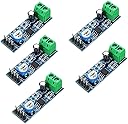
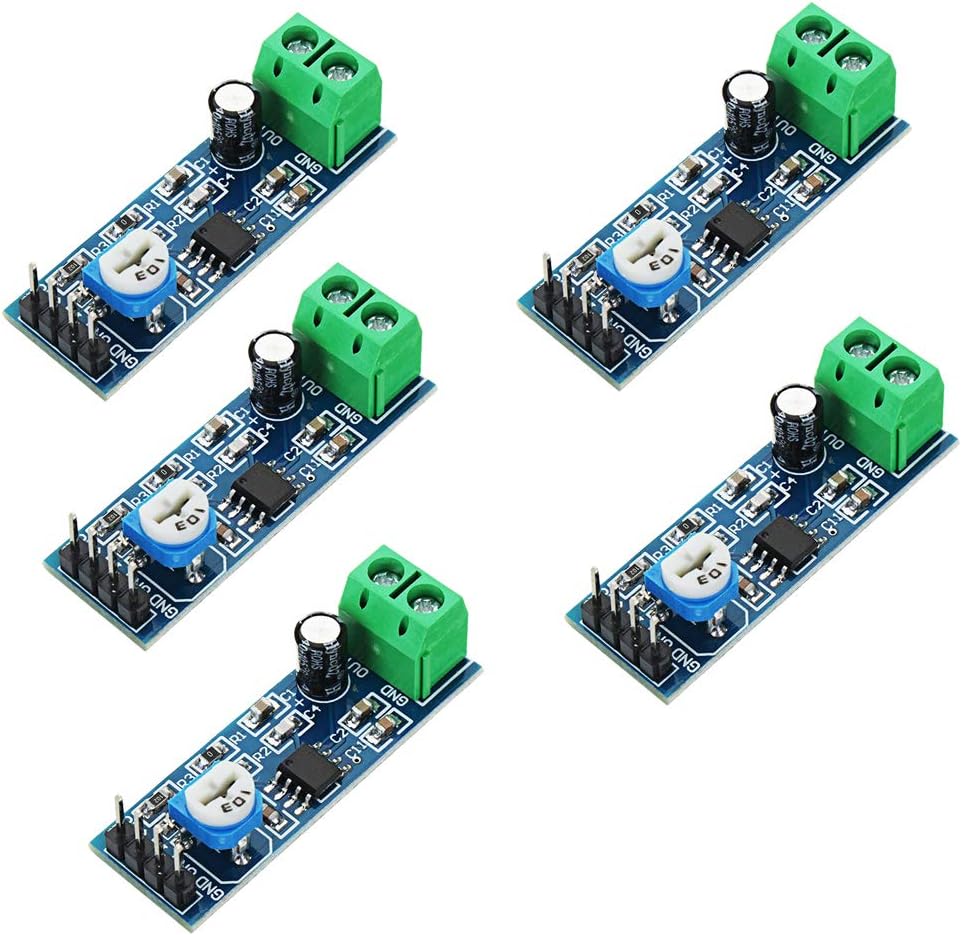
The HiLetgo LM386 Mono Audio Amplifier Module delivers up to 200 times amplification within a compact 41x13mm board. Operating on a flexible 5-12V power supply, it features an onboard 10K variable resistor for precise volume control and a built-in speaker wiring block for easy integration. Ideal for DIY audio projects, this module combines professional-grade performance with user-friendly design, making it a must-have for audiophiles and tech enthusiasts alike.
| ASIN | B00LNACGTY |
| Customer reviews | 4.4 4.4 out of 5 stars (118) |
| Date First Available | 15 September 2014 |
| Department | unisex-adult |
| Is Discontinued By Manufacturer | No |
| Item model number | 3-01-0073 |
| Manufacturer | HiLetgo |
| Package Dimensions | 13.6 x 9.2 x 3.7 cm; 28 g |
A**R
This is a great little amplifier for anyplace you need to boost signal levels. One helpful hint: If the gain of 200 is too high (and it usually is for me) just remove C1 to drop the gain to 20.
A**S
Perfect for what my son needed for his at home to it Project the functioning was perfect and gave great sound. There’s a lot of product for your money. The wiring provides flexibility for easy usage they were actually larger than expected.t gives the interior of the project. A nice sleek look as well. The product can be used for other purposes also, so you’re getting a lot more usage for the price you’re paying which is a great deal
D**I
There's no schematic diagram available for this item, and it had some strange performance issues. The volume control pot went from very low to extremely high in just a tweak. Looking at the application notes for the LM386 amplifier chip, I saw that most of the reference circuits had a small resistor in parallel with the loudspeaker. When I put a 10-ohm resistor in parallel with my speaker, the amplifier behaved normally.
A**A
I teach junior high science, and in one of my lessons, I connected an LED to the audio output of my laptop so students could observe that the current changes directions inside a speaker. (LEDs have positive and negative terminals, so they only light up when the current is connected in the correct direction. So regular LEDs flicker on and off as the current changes, and two-color LEDs change colors). But the directions provided in the curriculum didn't work. Upon further reflection, LEDs require more current than my computer's audio output provides, so I needed an amplifier. But the amplifier sent with the curriculum didn't work either. So I brushed off my electronics skills and began preparing to build an amplifier using my capacitors, resistors, etc. One of the components I was lacking was the LM386 audio amplifier (which is one component of this piece of hardware). But this device was less expensive than buying all the missing components and building my own amplifier. Plus, you get 5 of them. I connected this amplifier to my LED and the experiment worked. (I had to bend the input pins so that the alligator clips from my audio-to-alligator-cable clips and wires from the battery could all connect, but there are circuit diagrams for this device easily found online). The sound quality wasn't great, but it would probably be better if this device were used as intended, soldered into a larger electronic device, rather than connected to other components using a breadboard. Also, the low-quality speaker I attached in parallel with the LED might have been part of the problem.
F**K
Great product. My Weak signal oscillator output was boosted greatly with this Amp to levels that could drive other loads. Very pleased with quality and performance. buy more.
Trustpilot
2 months ago
1 month ago