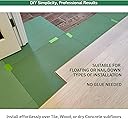
🌟 Elevate your floors with silent strength and natural finesse!
STEICO’s 3mm wood fiber underlayment delivers premium sound insulation certified by US acoustic standards, crafted from 100% natural, VOC-free wood fibers. Featuring Vapor Open technology, it manages moisture effectively while protecting your flooring from squeaks and wear. Lightweight and easy to install, this eco-friendly underlayment covers 90 sq ft, enhancing comfort and durability for laminate, vinyl, LVT, and hardwood floors.


| ASIN | B01LD0RC24 |
| ASIN | B01LD0RC24 |
| Batteries Included? | No |
| Batteries Required? | No |
| Color | Green |
| Coverage | 90 square feet |
| Customer Reviews | 4.1 4.1 out of 5 stars (200) |
| Customer reviews | 4.1 4.1 out of 5 stars (200) |
| Date First Available | 4 February 2017 |
| Date First Available | 4 February 2017 |
| Finish | Vinyl |
| Is Discontinued By Manufacturer | No |
| Item Package Quantity | 1 |
| Item Weight | 5.9 Kilograms |
| Item model number | PR16005955 |
| Item model number | PR16005955 |
| Manufacturer | STEICO |
| Manufacturer | STEICO |
| Measurement System | Metric |
| Number Of Pieces | 15 |
| Part number | PR16005955 |
| Product Dimensions | 60.96 x 5.08 x 91.44 cm; 5.9 kg |
| Product Dimensions | 60.96 x 5.08 x 91.44 cm; 5.9 kg |
| Shape | Rctangular |
| Size | 1/8 thickness |
| Special Features | Easy to Install |
| Specific uses | Commercial/Residential |
| Specification met | [Yes] |
| Style | 90 Sq Ft |
K**N
leider wurden nur ca 8,5 qm geliefert anstatt der wie beschriebenen 90qm, das liegt vermutlich daran das die einheiten falsch bzw gar nicht umgerechnet wurden ich habe wie schon beschrieben 90sqft erhalten. ALLE PRODUKTE VON STEICO KANN ICH NUR EMPFEHLEN....
M**E
I'm just going to start out by saying that I am a DIYer, not a professional of any kind! Ioriginally purchased this from Lowes in the 6mm thickness, and have installed it in 2 bedrooms and a hallway so far. I find it very easy to install and it works really well over my slightly uneven floors (my house is 91 years old so there's only so much that can be done!). It does make a lot of green dust when you cut it and walk on it, and I really detest the way it feels on my feet, but once you install your flooring over top that isn't an issue anymore. I will definitely update this review if I run into any future problems! I needed one more package of this and decided to purchase from Amazon because I thought it would be faster. It probably was, but shipping did not do my underlayment any favors. The box was partially open, and I'm not sure if it was just damaged in shipping or if they sort of wrapped the package in cardboard and sent her out. Anyways, the plastic covering the underlayment was torn open, the ends are all chipped off and the box was basically falling apart when I received it. It's usable, but I will definitely not be purchasing this from Amazon when I get around to redoing my downstairs office.
B**L
It is hard to write a complete review of this product because I am in an upstairs condo unit and can't really say how the neighbors below feel about the noise transmission. Let's just say that they have made no complaint. These pieces of underlayment are easy to put down (I have to confess that I didn't put them in at a 45 degree angle to the flooring). The first package gave us a lot of green dust, but later packets seemed not to. I suspect that the difference was that after box 1 (I used 8 boxes), I figured out that the best way to "cut" these pieces was by using a straightedge and scoring the piece with a chisel or screwdriver and then just folding on the scoring -- easier, cleaner and faster than using a blade. This product also had the highest Delta IIC rating I could find for an underlayment. The ratings for underlayment are very misleading. They show ratings for IIC and STC that are based on particular configurations of concrete and wood joist subfloors that may exist somewhere, but probably not in my 1980's condo. The Delta IIC, on the other hand, provides a rating that indicates how the underlayment performed in deadening impact noise when added to a subfloor. Thus it is a measure of how the product adds to a subfloor configuration. Maybe this isn't the best way to judge, but when 1/4" of cork has a Delta IIC of 24, you get a pretty good picture that perhaps this 3mm with a Delta IIC of 25 is the real deal for sound deadening. I had used some roll foam underlayment in two closets and it was a pain in the butt to roll out and get to lie down. These lie flat from the get go and it was much easier to lay down.
F**U
There is something not right going on here. When I first ordered this a year ago, these were 6mm (¼ inch) thick boards. All I did was hit the re-order button as I was a few boards short, what arrived were 3mm (⅛ inch) boards that I now have to double up, which makes them even more expensive then they were before. The only reason why I was short about 5 boards to begin with was because my last order of boards came severely banged up, dented and even opened and repackaged. One batch had been rewarded with some sort of movers plastic wrap, which, after removal, there were chunks missing from one side and tire treads on the other side. It took so long to get them here (they were delivered a week late for next day prime back in January 2018) that I didn’t even use them for the remodel that I had originally purchased them for and had to shelve all 9 packages for 11 months since I new I would be working on renodeling another apt in this building once it became available. I own a 90 year old 7 apt tenement building. And honestly, this stuff has been a nightmare to work with. It works okay on the first floor, but does not significantly reduce impact noise significantly when used with laminate. It does help give you a more level surface without flaws in the subfloor, but it doesn’t have enough mass to significantly benefit the IIC rating of the flooring system on an upper level in a wood frame building. Do yourself a favor and get some rolled sheets of rubber underpayment at 5mm-6mm with a lb of weight per square feet. It’ll cost you exactly the same amount as the 6 mm Steico, and it will actually work at reducing transfer of sound. And that needs to only be part of a multi-layer flooring system. If you’re remodeling and planning on a floating laminate floor, the layers should be as follows: laminate flooring ———————————————————— Floating 5-6mm rubber underpayment taped to subfloor at joints with double sided carpet tape or attached with polyurethaning adhesive ———————————————————— ½-¾” plywood or osb sub flooring layer #2: laid perpendicular to layer #1 without any joints lining up with layer #1, and with ⅛” gap between each board, with the gap filled in with acoustical flexible caulking as well as the perimeter of the entire subfloor. This layer will be stapled or nailed to, and green glued to the layer beneath to create one solid board that spans the entire floor for the entire house. None of the fosters should be long enough to make it pass layer #1. ———————————————————— Green glue ———————————————————— ½-¾” plywood or osb sub flooring layer #1: Do not mechanically attach this layer or layer #2 to the structure. This is a floating subfloor. Just caulk between the joints of every adjacent board and around the perimeter, then add the green glue attach layer #2 to layer #1 ———————————————————— Another layer of sound absorbing underpayment: you have multiple options here. You can use another 5-6mm rubber underlayment, or you can use cork/rubber mix, or Steico. But don’t use cork by itself. Don’t use a foam underpayment. And if you do use cork/rubber mixed underpayment, add an additional layer of that paper roll used to protect floors when you paint or do drywall, like ram board or rosin core paper or even that tar house wrap paper. The reason is that even though cork may diffuse airborne sound, as should Steico, it’s still a fibrous material that breathes, and you want to separate the air space that this porous underpayment layer exists in from the one where the floating subfloor exists. And unfortunately, plastic sheets for covering furniture when painting is just too fragile. Overlap all the paper or ram board and use duct tape to ensure the air space above and below are completely separated. If you’re using rubber underpayment here, you don’t need this paper layer as rubber already does this for you, so long as you properly tape the edges together. Don’t overlap the rubber. ———————————————————— If you have concrete subfloor: You’re done If you have wood sub flooring: There needs to be ½-¾” plywood or osb subflooring layer here that’s flat and free of obstructions, level, blah blah blah. This should be mechanically attached to your joist using galvanized deck screws (do not use stainless steel as they will not be able to withstand the sheer force over time without snapping) so that each screw penetrates the wood joist by ¾” attached at the recommended spacing between screws 8” in the field, 6” along the two edges and around the perimeter of the room. If like my building you have diagonally lain 4” wide subfloor boards, screw the subfloor in every 4” wherever there’s a joist just to make sure every one of those diagonally laid boards sandwiches between this subfloor and the joist each has it’s own screw squeezing that 4” board in place so it doesn’t move and squeak in the future. ———————————————————- Joist. Any extra soundproofing added underneath this is your choice. At least add some pink batts. Screw the Roxul. You don’t need something twice as expensive for 1-2 dab in STC. Everything above should cover you for most if not all normal residential STC noise attenuation between floors. But do add 2 layers of ⅝” drywall with green glue downstairs for the ceiling, with or without RSIC clips and hat channels, and don’t use z-channels. They’re too easy to short out accidentally whether you’re a professional or DIYer. Final notes: -on this floor layering system, you should be able to install any finished flooring except for LVT or virgin vinyl as contact with rubber will cause staging to bleed thru. If. That’s the flooring you want, switch out the top layer of rubber underlayment with a foam underlayment. -always use a perimeter isolation strip. They’re foam, they go around the rooms against the walls to prevent all the layers of subflooring, floating or otherwise from making hard contact with any of the walls, thus preventing any flanking noise from traveling thru the structure. -yes you van carpet on top of this entire flooring club sandwich monstrosity, and yes, even with the rubber underlayment right below the carpet padding. Or you could adhere carpet tiles. It should still stop impact noise from traveling downstairs. -lastly be realistic. If someone stomps hard upstairs, they will hear it downstairs. But with this system, it should only sound like a soft thud thud thud. I’m talking about 9 year old with a temper tantrum banging and kicking and stomping in circles with smoke coming out of the ears. Otherwise, normal walking with heals on should pretty much be nonexistent noise. Luxury apts have a floor/ceiling assembly with a IIC rating of 65, I believe, and a minimum IIC of 50 for non luxury apts. go for the luxury. It’s worth it!
D**H
Excellent product!! Installed myself with a friend under 5mm LVT click-lock planks. I am very happy with this choice. First, underlay comes in sheets and it is so much less headache than rolls. Second, I really loved the sturdiness of the boards, floor feels very stable. A few years ago I used somewhat “foamy” underlayment and it was so annoying how locks slightly but noticeably bended and squeaked while walking, so now I decided to choose something else and it worked as advertised. Third, I did not do any leveling of the concrete and that saved me both money and time. At the beginning I was little skeptical because the concrete was a bit uneven, so we tried it on a small area. It worked great and we decided to go ahead and install it all. This fiber material absorbs the bumps from the downside and keeps it straight from the top level. For the sound transmission we have noticed that running steps of our boys sound softer, but it was not an issue from the beginning. Overall, installation took one day and it was easy, recommend!
Trustpilot
1 month ago
1 day ago