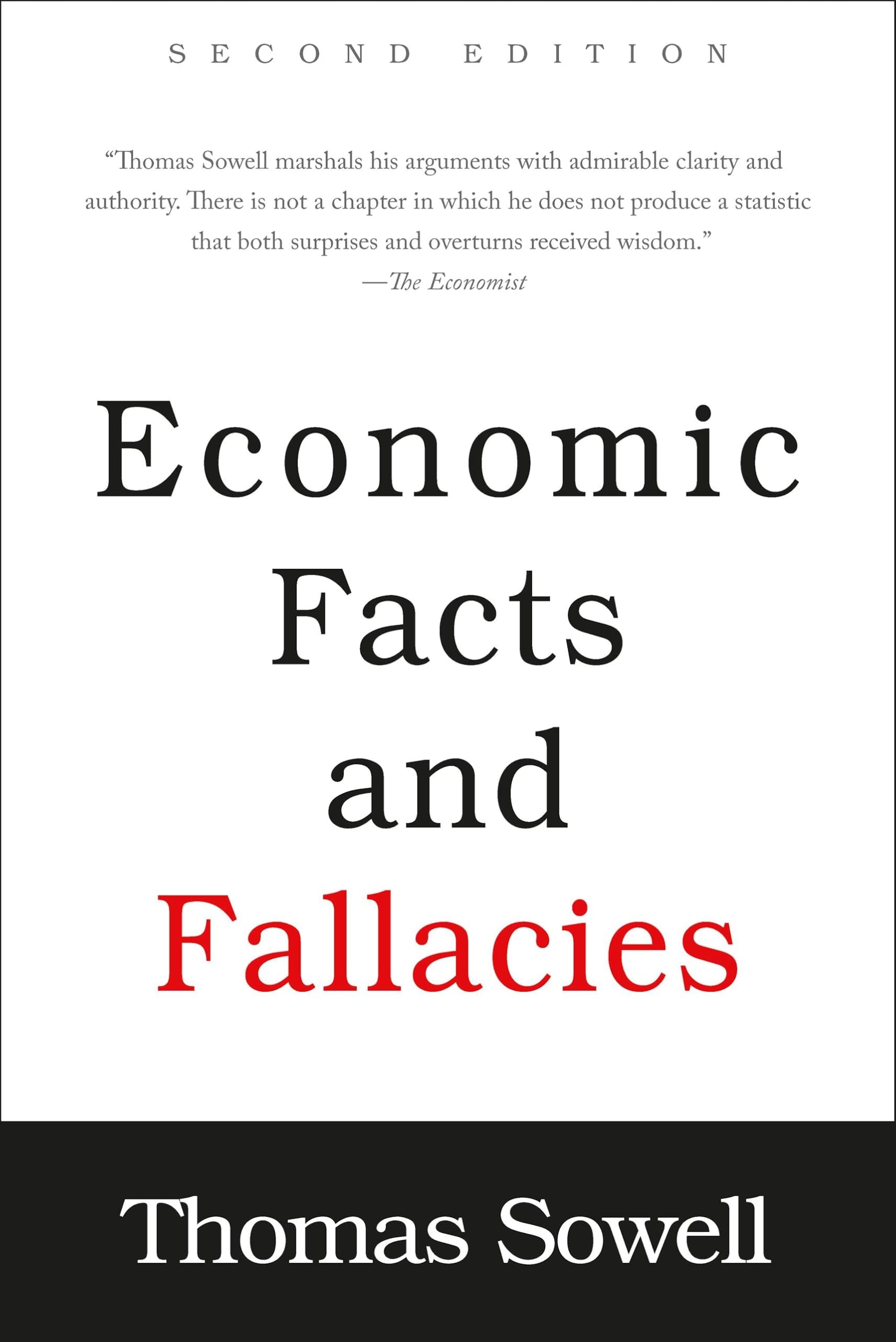
Economic Facts and Fallacies: Second Edition
Product ID: 276436222
Desertcart purchases this item on your behalf and handles shipping, customs, and support to Senegal.
Economic Facts and Fallacies: Second Edition : Sowell, Thomas: desertcart.ae: Books Review: This book consistently surprises and delights the reader with hard facts neglected by popular commentators, talking heads in the media, and those whose political self-interest lies in painting a picture of growing economic inequality. It's a real pleasure to be shown the other side of the argument in so many cases, and to witness how selective presentation of evidence has distorted the debate on identity politics for so long. For example, - there is a popular myth that household income has fallen in the last 50 years in some communities. But Sowell shows us that this is because household sizes have shrunk, not because wages have fallen. - The gap in income between the bottom 20% and the top 20% has risen. But this is partially because government benefits are not factored into "income". Neither are assets or the benefits accruing from them; a 70 year old homeowner may have a lower income than a 20 year old apartment renter, but it is fallacious to say the former is "worse off" than the latter. - Very few of the same people in the top 20% 30 years ago are still in the top 20% - most have fallen out of it. And many who were in the bottom 20% 30 years ago have risen out of it. The same applies to countries too. A couple of criticisms; - Firstly, Sowell often discusses only his side of the argument in an effort to prove his point. This kind of protectionism isn't needed; his arguments are stronger than those he is criticising. He should be more willing to present both sides with equal prominence and let the reader realise where the balance lies. But you can't really blame him for doing this given the highly politicised academic environment he works in. Secondly, the prose style is a little abstruse. Sowell doesn't indicate the start - or end - of his sub-clauses very clearly, so you occasionally have to re-read sentences a few times to fully understand them. But this is nit-picking. Overall this book is a welcome, refreshing antidote to the groupthink infecting our education system. Conservatives will welcome the solid intellectual nourishment. Liberals will benefit from some variation in their diet. Review: Good book


| Best Sellers Rank | #30,361 in Books ( See Top 100 in Books ) #24 in Macroeconomics #42 in Theory & Philosophy of Economics #47 in Economic Conditions |
| Customer reviews | 4.8 4.8 out of 5 stars (1,761) |
| Dimensions | 13.97 x 1.91 x 20.96 cm |
| Edition | 2nd |
| ISBN-10 | 0465022030 |
| ISBN-13 | 978-0465022038 |
| Item weight | 1.05 Kilograms |
| Language | English |
| Print length | 304 pages |
| Publication date | 22 March 2011 |
| Publisher | Basic Books |
N**2
This book consistently surprises and delights the reader with hard facts neglected by popular commentators, talking heads in the media, and those whose political self-interest lies in painting a picture of growing economic inequality. It's a real pleasure to be shown the other side of the argument in so many cases, and to witness how selective presentation of evidence has distorted the debate on identity politics for so long. For example, - there is a popular myth that household income has fallen in the last 50 years in some communities. But Sowell shows us that this is because household sizes have shrunk, not because wages have fallen. - The gap in income between the bottom 20% and the top 20% has risen. But this is partially because government benefits are not factored into "income". Neither are assets or the benefits accruing from them; a 70 year old homeowner may have a lower income than a 20 year old apartment renter, but it is fallacious to say the former is "worse off" than the latter. - Very few of the same people in the top 20% 30 years ago are still in the top 20% - most have fallen out of it. And many who were in the bottom 20% 30 years ago have risen out of it. The same applies to countries too. A couple of criticisms; - Firstly, Sowell often discusses only his side of the argument in an effort to prove his point. This kind of protectionism isn't needed; his arguments are stronger than those he is criticising. He should be more willing to present both sides with equal prominence and let the reader realise where the balance lies. But you can't really blame him for doing this given the highly politicised academic environment he works in. Secondly, the prose style is a little abstruse. Sowell doesn't indicate the start - or end - of his sub-clauses very clearly, so you occasionally have to re-read sentences a few times to fully understand them. But this is nit-picking. Overall this book is a welcome, refreshing antidote to the groupthink infecting our education system. Conservatives will welcome the solid intellectual nourishment. Liberals will benefit from some variation in their diet.
D**A
Good book
M**I
ottimo, illuminante, scritto con linguaggio semplice e chiaro, usando dati e ragionamento, dimostra che molte delle teorie economiche imperanti sono fallaci e frutto di ideologie politiche e come tali ostacoli alla crescita economica.
E**M
Excellent read - full of actual facts that counter false narratives.
D**K
I took 3 economic coursed in college and considered majoring in it, but I had never put together most of the pieces that the author did in this book. His careful analysis of different statistics on the economy was a real eye-opener. So much of the casual analysis in the media comes to the wrong conclusion because they don't go beyond the aggregated numbers. For example, men, on average, earn more than women, but when you consider those who have never married or had children (no child-bearing effects or spousal support of their education or careers) and have similar education and experience, women earn a similar or in some cases higher salary than men. Blacks earn less than Caucasians, but are also younger, on average. Since salary trends upward with age/experience, the agregate numbers need to be broken out by age, education, etc. Once this is done, one finds that factors other than race basicly explain the salary difference. The author gives many other examples in an easy-to-read and well-organized format. A great introduction to how we as a society can end up trying to fix a problem that doesn't exist, and then be disappointed when the solution is ineffective.
Trustpilot
4 days ago
2 weeks ago