🛠️ Fix it once, drive forever — the ultimate head gasket hero!
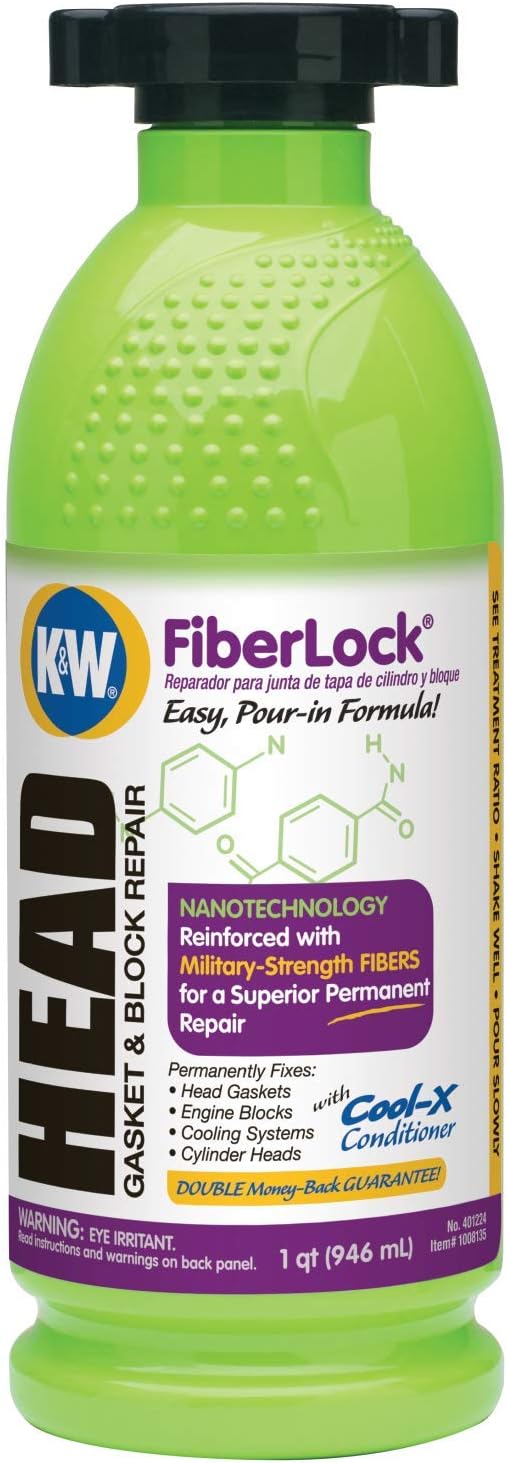
K&W 401224 FiberLock is a 32 fl oz permanent head gasket and block repair solution featuring 3 advanced technologies: military-strength fibers, nanotechnology, and Cool-X Conditioner. Designed to seal cracks, holes, and leaks in engine blocks and cooling systems, it lowers operating temperatures and works with all antifreeze or water types. Lab-tested for superior sealing with minimal fluid loss, this easy pour-and-go formula is trusted by pros and DIYers alike to extend engine life and prevent costly repairs.


| ASIN | B006OW2PIS |
| Best Sellers Rank | #97,048 in Automotive ( See Top 100 in Automotive ) #318 in Automotive Fillers, Adhesives & Sealants #2,408 in Oils & Fluids |
| Brand | K&W |
| Customer Reviews | 4.1 4.1 out of 5 stars (799) |
| Date First Available | 21 September 2023 |
| Item Weight | 1.11 Kilograms |
| Item model number | 401224 |
| Manufacturer | CRC |
| Manufacturer Part Number | 401224 |
| Model | 401224-6 |
| Product Dimensions | 8.64 x 8.64 x 24.23 cm; 1.11 kg |
S**E
used this to fix a hairline crack somewhere in the block or timing cover. so i have a 2010 jeep grand cherokee with a 5.7 hemi motor, bought it real cheap due to haveing a head gasket issue due to an overheat , im a tech for 40 years and know these hemi's well ,i did all the work myself , replaced both head gasket heads were sent out and resurfaced and i did a valve job , the motor fired right up and ran perfect when finished , however i noticed my coolant level was dropping slowley with know external leaks , after investigating i found coolant in my catch can so know i knew that it was getting into the crankcase, after i drained out about 8 0z of oil from the sump i saw a little bit of coolant in there but not to bad and not a lot . the coolant seemed to be entering the crankcase but more as a vapor if anything because most was in my catch can. there was a hairline crack somewhere . i decided to try this but was very skeptical . and low and behold it worked ! i couldn't believe it , no more coolant in my catch can or in the bottom of oil sump , i was amazed it actually worked , its been a year now with about 7k miles and still holding up! no coolant loss ,no heater core or radiator issues, i did put a new thermostat in it after about 100 miles running on it and found some hardened material around it but i wasn't worried about it after i installed a new one . i recommend this if you have a small leak due to a crack .
P**H
I have a suspicion that the bad reviews of this product are coming from people who are using it incorrectly. I had a blown head gasket (confirmed by repair shop when they replaced my timing belt, water pump, and thermostat) on a 1995 1.5L Honda Civic engine. The only reason I picked up a bottle of this sealant was because the mechanic recommended it after I told him that I couldn't afford a $500 dollar repair bill for replacing the head gasket. The mechanic told me that he'd used this stuff before and that it was pretty much the only head gasket sealant on the market that he'd ever seen work and told me that he would never recommend any other but this stuff actually works. So I ordered a bottle and gave it a try. The first thing I noticed was that the instructions clearly state that you should read the entire label before starting and that you should know exactly how much fluid your radiator and engine block hold and to use a specific amount based on the volume. It also clearly states that if your water pump or thermostat are not properly working that it will not work properly and could cause uneven distribution of the product. It states clearly on the label to use the proper amount and to add it very slowly into the properly diluted radiator fluid and not to add the product until the fluid level is high enough not to touch the fins on the inside of the radiator. After doing just that, letting the engine run and the coolant cycle and then topping it off, and then letting it idle for over 15 minutes with the heat on, I could already tell that the engine was running as smoothly as it did before the blown gasket. After several days of driving, it no longer overheats, no longer produces white smoke from the coolant leaking through the gasket into the engine, no long is leaking oil into the coolant and is no longer running rough. The stuff is very clumpy and can look worrying but when the proper amount (for me 1/3 a bottle) is added to properly mixed 50/50 fluid, it cycles through and smooths out. I plan on letting it stay in the engine until I get ready to flush the radiator out and get the rest off the product out but the bottle clearly states that you can leave it in without flushing and that it will not cause clogging or sludge. So far it has work perfectly and seems to have sealed the gasket completely but even if it does begin to leak slightly, it says that you can add more which I plan to do if it does, though so far it after 4 days of daily commuting for 36 miles, it has had no problems and works perfectly. I'd recommend it to anyone who can properly follow instructions but I would imagine that if you added it to the wrong coolant type or mixture or if you added way more than was intended that it would cause major problems with clogging up your system. Having a new water pump probably also helps, as I would imagine that if your water pump wasn't properly cycling the stuff that it would clog up in the system and prevent the sealant from reaching the leaking points and possibly clog up the radiator or heater coils. Use it as intended and it should turn out just fine.
G**Z
Doesn’t Work I bought this because I had a hose blow out and caused head gasket issues. Bought this product taking a gamble that it would seal. Unfortunately doesn’t work. Don’t waste money on this product. Very unhappy with the product. Wish I would have saved time and money on this.
R**N
I had a cracked head/leaky head gasket, could only drive about one mile before car would overheat and spue out coolant. Installed product according to directions and ran engine again according to directions. The leak was stopped, but the radiator was completely clogged by product, but, replacing radiator was a lot cheaper than replacing head or head gasket. I have driving car several months since treatment, and it is working fine. I give it a good product star. Now have driven car many thousands of miles and is working fine. Again, great product.
J**Y
My daughter's 2006 CIVIC developed the micro crack block leaks inherent in the Honda engine recall this last winter, (2018/2019) well out of warranty of course. I debated for quite some time about using this as many were commenting about dealing with clogged cooling systems. At the peak of the issue we were replacing a gallon of antifreeze every two weeks, so needless to say, it was a pain. I finally bit the bullet this month and put 1/3 of a bottle into her cooling system. As a precaution I clamped off the hoses traveling to and from her heater core. The radiator would absolutely not take the pea-soup consistency of this product, so I had to gain access to the large top hose feeding the block from the radiator. It too would not ingest but I found that running the engine for 10 to 15 minutes made it start to pull the liquid into the block. After lots of mess and trial and error I finally got it all in there. The leaks stopped almost immediately, and I ran the engine for a good 20 minutes like this. No overheating was apparent. I cleaned it all up and reattached the top hose but left the heater core clamps on to prevent any of the gunk from clogging things up. After running around in the car for a week my daughter unfortunately reported that it was overheating and she said she could only run for about 10 to 15 minutes without it spiking. We put more antifreeze in the system to be sure, but it still overheated regularly. I looked into other products to dissolve the leak stopper infused coolant but decided against that in favor of flushing the system first. The next weekend I spent half a day installing flush valves and unclamped her heater core hoses. I flushed for a good 40 minutes until no sign of the solution was left in the system, then I flushed some more. We crossed out fingers and put new coolant into the system and I ran the car for 20 minutes in the driveway without any sign of overheating. Its now been over a month and the car runs better than it has for a while according to my daughter. If we can get another few years out of it, I’m a happy customer!
Trustpilot
5 days ago
3 weeks ago