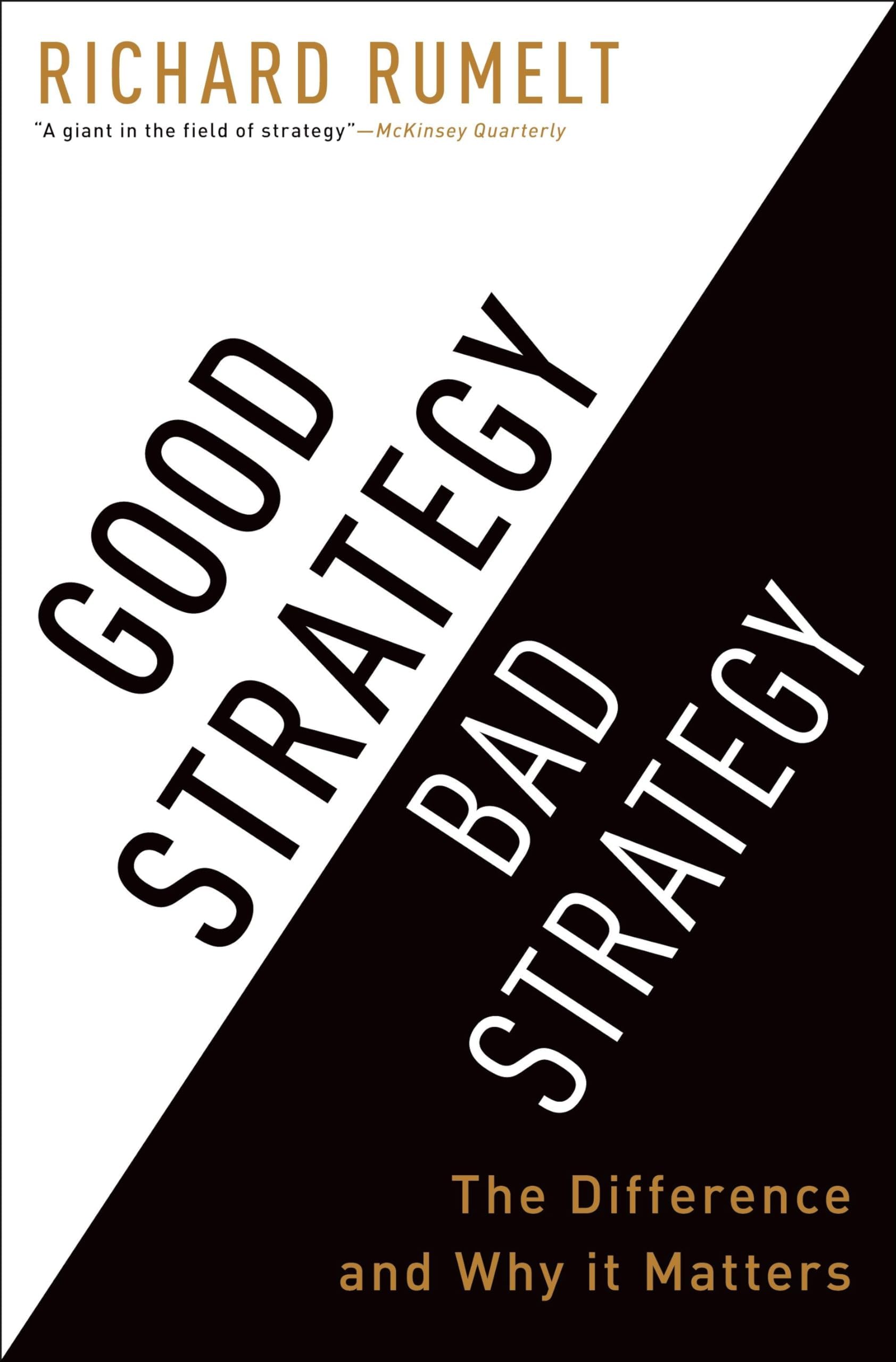


desertcart.com: Good Strategy Bad Strategy: The Difference and Why It Matters: 9780307886231: Rumelt, Richard: Books Review: A roadmap for creating good strategy and how to spot and avoid bad strategy - I thought I remembered my friend Art Petty saying that he liked Good Strategy Bad Strategy: The Difference and Why It Matters by Richard Rumelt. So, I emailed him and asked if that was true. Here’s his reply. “Like is an understatement. Rumelt’s kernel of Strategy is the most powerful, supple approach for creating clarity and coherence on strategy I’ve yet encountered.” Art’s no novice. He’s been an effective executive and an effective consultant for decades. He works with clients on strategy. And, guess what? The book lived up to Art’s recommendation and then some. The kernel of Strategy that Art referred to is a great reason to read the book, even if that’s all you get out of it. Here’s Rumelt’s description of the kernel. “A good strategy has an essential logical structure that I call the kernel. The kernel of a strategy contains three elements: a diagnosis, a guiding policy, and coherent action. The guiding policy specifies the approach to dealing with the obstacles called out in the diagnosis. It is like a signpost, marking the direction forward but not defining the details of the trip. Coherent actions are feasible coordinated policies, resource commitments, and actions designed to carry out the guiding policy”. The kernel isn’t a magic formula. It’s a guide to the most important hard work you will do to create a strategy. If you’re a consultant, it’s a quick way to help you figure out if your client has a strategy or not. As Rumelt points out in the book, a lot of things masquerade as strategy. Plans and slogans and goals can look like strategy until you analyze them with a tool like the kernel. What makes creating a great strategy hard is that it involves choices, and we don’t like choices. We also don’t like hard work, so we skip the hard parts and just do the parts that are fun. In my experience, an awful lot of companies spend a day or so developing their strategy. They substitute discussion for diagnosis. Talk replaces analysis. Then they trot out some fine-sounding generalities instead of taking time to craft guiding principles. Biz-speak often replaces clear language here. There’s a lot of talk about what to do, but precious little about how to coordinate activities. Most of those companies spend most of their time on what they’re going to do, after skipping the hard parts of diagnosis and guiding principles. Art says that, since reading Rumelt, he spends more time on the strategy process. He spends half of the time on diagnosis, another 40 percent on what Rumelt calls the guiding philosophy, and 10 percent on coherent actions. It’s much harder to do it that way than it is to go off to an offsite and whip up some generalities that sound good but don’t have much impact on day-to-day work life. Here’s what it comes down to. The kernel is the way you develop a good strategy. The kernel is also the way that you identify bad strategy, whether it’s yours or someone else’s. Now that I’ve read this book, I won’t think about doing strategy the same way ever again. Rumelt has helped me know some danger signals to watch for. And he’s given me a language for guiding the process of creating and evaluating a strategy. The kernel is reason enough to buy and read this book, but there are lots of other goodies here, too. There’s analysis of many business situations that I found both absorbing and compelling. There’s one other thing you can take away from this book. Even when you do the work to create and execute a good strategy, you can still not succeed. You can make bad choices, even with a good process. Luck still plays a role. Unforeseen events play a role. The competition plays a role. This book was written in 2006. Rumelt makes several predictions about how some things will play out in the years ahead. He gets some of them right, some of them wrong, and some of them a mix of both. That’s a good thing because it demonstrates what’s true in real life. There are times when you can do everything wrong and have things turn out right. And there are times when you can do everything right and still go down in flames. One of my favorite quotes about life is from the American writer and horseplayer, Damon Runyon. It goes like this: “The race may not always be to the swift, nor victory to the strong, but that’s the way you bet.” Developing a good strategy is the hard work of figuring out how to bet. In A Nutshell Good Strategy Bad Strategy: The Difference and Why It Matters by Richard Rumelt gives you a roadmap that will help you develop better strategy. Ironically, that will make your work harder. Thankfully, it will also increase your odds of success. Review: An experienced practitioners thoughtful reflections - There are two things we often notice when helping a company craft their strategic story: 1) the strategic story process helps executives clarify what they really think the strategy should be; and 2) way too many executives can't actually tell you their company's strategy without reaching for a document. It's only since reading Richard Rumelt's new book, Good Strategy Bad Strategy, that I can see both observations are symptoms of not having a story to tell about the company's strategy. The second point came quickly to us because we know stories are memorable and therefore if your strategy was a story then you have a better chance of remembering it. Ipso facto (I'm not 100% sure of what this means but it felt right to put it here). The first point, however, goes to the heart of Rumelt's thesis: good strategy comprises a kernel made from a diagnosis of what's happening that's causing a challenge; a guiding policy on how the company will overcome this challenge; and a coherent set of actions that will translate the strategy into reality. Most strategies are defined as a set of aspirational goals, which Rumelt argues is a big mistake that has resulted from the template view of strategy creation: create a vision, state a purpose, set some goals, bingo, you now have a strategy. An effective strategy is all about action, about getting something done, it's concrete, plausible and doable. These attributes are much the same for stories. So from a story perspective, the kernel consists of the story of what's happening, the story of what will be done, and then the unfolding stories that emerge from the actions. These stories then help leaders decide how they will adapt to the inherent complexity of business.This is not just Shawn's story-coloured glasses making this connection. Rumelt says himself that, "The diagnosis for the situation should replace the overwhelming complexity of reality with a simpler story, a story that calls attention to its crucial aspects. This simplified model of reality allows one to make sense of the situation and engage in further problem solving." (p. 81) Rumelt's book is divided into three parts. Part 1, Good & Bad Strategy, describes the differences between what makes a good'ne and what makes a stinker. Part 2, Sources of Power, describes a series of approaches the strategist can adopt to improve their strategy. It includes topics such as focus, leverage, advantage and growth. This section finishes with a chapter on putting it all together that examines the graphics chip maker NVIDIA and their strategy, which incorporates many of Rumelt's sources of power. As suggested by Rumelt, I skipped to the NVIDIA chapter before reading each source of power in detail. The last part, Thinking Like a Strategist, has three chapters which explore what is mean to reflect on how you think about strategy. The book is very Gladwellesque in the way Rumelt tells stories. Each chapter is full of personal anecdotes, stories from history and Rumelt does a lovely job of telling stories that include analogies which he links to important strategy concepts. For example he tells the story of meeting a friend in Baja California who was a combat helicopter pilot. In some musing over a beer Richard (I bet he is know to his friends as Dick) says it would be better to be in a helicopter than a plane if the engines died because the rotors would keep turning and act like a parachute. He friend chuckled and said "only if the right actions are done within a second of losing power and, most importantly, without thinking about it." Rumelt uses this analogy to discuss how companies have intuitive capabilities gained from experience which allows them to do things other companies just can't. One type of competitive advantage. GS/BS is full of these interesting analogies. Just a note on book architecture. I love endnotes. I'm always following those suckers to find out the original references and other tidbits hidden behind those superscripted numbers. But here's the thing: if your end notes are arranged by chapter with a new set of endnote numbers then you need to have the chapter number/name on each page of your book otherwise I have to thumb back through the chapter to the chapter title page just to work out where the hell I am. This is not just a criticism of Rumelt's book, this is most business books out there. Publishers and book designers, please note. OK, rant over. This book is a bloody ripper. It has a really practical feel without getting dot pointy. The stories carry the book and keep it interesting and because many of the stories are personal anecdotes you develop a deep admiration for Rumelt's character and experience. Well worth getting yourself a copy.


| ASIN | 0307886239 |
| Best Sellers Rank | #9,376 in Books ( See Top 100 in Books ) #17 in Systems & Planning #34 in Business Management (Books) #52 in Leadership & Motivation |
| Customer Reviews | 4.5 4.5 out of 5 stars (5,420) |
| Dimensions | 6.56 x 0.96 x 9.54 inches |
| Edition | Illustrated |
| ISBN-10 | 9780307886231 |
| ISBN-13 | 978-0307886231 |
| Item Weight | 1.35 pounds |
| Language | English |
| Print length | 336 pages |
| Publication date | July 19, 2011 |
| Publisher | Crown Currency |
W**K
A roadmap for creating good strategy and how to spot and avoid bad strategy
I thought I remembered my friend Art Petty saying that he liked Good Strategy Bad Strategy: The Difference and Why It Matters by Richard Rumelt. So, I emailed him and asked if that was true. Here’s his reply. “Like is an understatement. Rumelt’s kernel of Strategy is the most powerful, supple approach for creating clarity and coherence on strategy I’ve yet encountered.” Art’s no novice. He’s been an effective executive and an effective consultant for decades. He works with clients on strategy. And, guess what? The book lived up to Art’s recommendation and then some. The kernel of Strategy that Art referred to is a great reason to read the book, even if that’s all you get out of it. Here’s Rumelt’s description of the kernel. “A good strategy has an essential logical structure that I call the kernel. The kernel of a strategy contains three elements: a diagnosis, a guiding policy, and coherent action. The guiding policy specifies the approach to dealing with the obstacles called out in the diagnosis. It is like a signpost, marking the direction forward but not defining the details of the trip. Coherent actions are feasible coordinated policies, resource commitments, and actions designed to carry out the guiding policy”. The kernel isn’t a magic formula. It’s a guide to the most important hard work you will do to create a strategy. If you’re a consultant, it’s a quick way to help you figure out if your client has a strategy or not. As Rumelt points out in the book, a lot of things masquerade as strategy. Plans and slogans and goals can look like strategy until you analyze them with a tool like the kernel. What makes creating a great strategy hard is that it involves choices, and we don’t like choices. We also don’t like hard work, so we skip the hard parts and just do the parts that are fun. In my experience, an awful lot of companies spend a day or so developing their strategy. They substitute discussion for diagnosis. Talk replaces analysis. Then they trot out some fine-sounding generalities instead of taking time to craft guiding principles. Biz-speak often replaces clear language here. There’s a lot of talk about what to do, but precious little about how to coordinate activities. Most of those companies spend most of their time on what they’re going to do, after skipping the hard parts of diagnosis and guiding principles. Art says that, since reading Rumelt, he spends more time on the strategy process. He spends half of the time on diagnosis, another 40 percent on what Rumelt calls the guiding philosophy, and 10 percent on coherent actions. It’s much harder to do it that way than it is to go off to an offsite and whip up some generalities that sound good but don’t have much impact on day-to-day work life. Here’s what it comes down to. The kernel is the way you develop a good strategy. The kernel is also the way that you identify bad strategy, whether it’s yours or someone else’s. Now that I’ve read this book, I won’t think about doing strategy the same way ever again. Rumelt has helped me know some danger signals to watch for. And he’s given me a language for guiding the process of creating and evaluating a strategy. The kernel is reason enough to buy and read this book, but there are lots of other goodies here, too. There’s analysis of many business situations that I found both absorbing and compelling. There’s one other thing you can take away from this book. Even when you do the work to create and execute a good strategy, you can still not succeed. You can make bad choices, even with a good process. Luck still plays a role. Unforeseen events play a role. The competition plays a role. This book was written in 2006. Rumelt makes several predictions about how some things will play out in the years ahead. He gets some of them right, some of them wrong, and some of them a mix of both. That’s a good thing because it demonstrates what’s true in real life. There are times when you can do everything wrong and have things turn out right. And there are times when you can do everything right and still go down in flames. One of my favorite quotes about life is from the American writer and horseplayer, Damon Runyon. It goes like this: “The race may not always be to the swift, nor victory to the strong, but that’s the way you bet.” Developing a good strategy is the hard work of figuring out how to bet. In A Nutshell Good Strategy Bad Strategy: The Difference and Why It Matters by Richard Rumelt gives you a roadmap that will help you develop better strategy. Ironically, that will make your work harder. Thankfully, it will also increase your odds of success.
S**N
An experienced practitioners thoughtful reflections
There are two things we often notice when helping a company craft their strategic story: 1) the strategic story process helps executives clarify what they really think the strategy should be; and 2) way too many executives can't actually tell you their company's strategy without reaching for a document. It's only since reading Richard Rumelt's new book, Good Strategy Bad Strategy, that I can see both observations are symptoms of not having a story to tell about the company's strategy. The second point came quickly to us because we know stories are memorable and therefore if your strategy was a story then you have a better chance of remembering it. Ipso facto (I'm not 100% sure of what this means but it felt right to put it here). The first point, however, goes to the heart of Rumelt's thesis: good strategy comprises a kernel made from a diagnosis of what's happening that's causing a challenge; a guiding policy on how the company will overcome this challenge; and a coherent set of actions that will translate the strategy into reality. Most strategies are defined as a set of aspirational goals, which Rumelt argues is a big mistake that has resulted from the template view of strategy creation: create a vision, state a purpose, set some goals, bingo, you now have a strategy. An effective strategy is all about action, about getting something done, it's concrete, plausible and doable. These attributes are much the same for stories. So from a story perspective, the kernel consists of the story of what's happening, the story of what will be done, and then the unfolding stories that emerge from the actions. These stories then help leaders decide how they will adapt to the inherent complexity of business.This is not just Shawn's story-coloured glasses making this connection. Rumelt says himself that, "The diagnosis for the situation should replace the overwhelming complexity of reality with a simpler story, a story that calls attention to its crucial aspects. This simplified model of reality allows one to make sense of the situation and engage in further problem solving." (p. 81) Rumelt's book is divided into three parts. Part 1, Good & Bad Strategy, describes the differences between what makes a good'ne and what makes a stinker. Part 2, Sources of Power, describes a series of approaches the strategist can adopt to improve their strategy. It includes topics such as focus, leverage, advantage and growth. This section finishes with a chapter on putting it all together that examines the graphics chip maker NVIDIA and their strategy, which incorporates many of Rumelt's sources of power. As suggested by Rumelt, I skipped to the NVIDIA chapter before reading each source of power in detail. The last part, Thinking Like a Strategist, has three chapters which explore what is mean to reflect on how you think about strategy. The book is very Gladwellesque in the way Rumelt tells stories. Each chapter is full of personal anecdotes, stories from history and Rumelt does a lovely job of telling stories that include analogies which he links to important strategy concepts. For example he tells the story of meeting a friend in Baja California who was a combat helicopter pilot. In some musing over a beer Richard (I bet he is know to his friends as Dick) says it would be better to be in a helicopter than a plane if the engines died because the rotors would keep turning and act like a parachute. He friend chuckled and said "only if the right actions are done within a second of losing power and, most importantly, without thinking about it." Rumelt uses this analogy to discuss how companies have intuitive capabilities gained from experience which allows them to do things other companies just can't. One type of competitive advantage. GS/BS is full of these interesting analogies. Just a note on book architecture. I love endnotes. I'm always following those suckers to find out the original references and other tidbits hidden behind those superscripted numbers. But here's the thing: if your end notes are arranged by chapter with a new set of endnote numbers then you need to have the chapter number/name on each page of your book otherwise I have to thumb back through the chapter to the chapter title page just to work out where the hell I am. This is not just a criticism of Rumelt's book, this is most business books out there. Publishers and book designers, please note. OK, rant over. This book is a bloody ripper. It has a really practical feel without getting dot pointy. The stories carry the book and keep it interesting and because many of the stories are personal anecdotes you develop a deep admiration for Rumelt's character and experience. Well worth getting yourself a copy.
S**G
Cuts through fluff with real strategic clarity
Bought this to level up my thinking around business and product strategy. What I like • Breaks down what real strategy is—clear, focused, and actionable • Uses memorable examples from business, military, and sports • Helps spot vague “bad strategy” in the wild (and avoid it) What could be better • Some sections repeat the same ideas in different ways • Not many step-by-step frameworks for building your own strategy Bottom line: A must-read for understanding what makes strategy actually work. Perfect for product leaders and founders, but look at Playing to Win if you want a more hands-on, build-your-strategy guide.
B**E
Commençons par éliminer tout effet de surprise inutile : Good Strategy / Bad Strategy est un excellent bouquin, qui s’adresse à une population bien plus vaste que le cercle restreint des « élus », « managers » et autres « leaders » d’entreprises. Cela dit, il m’a quand même fallu quelques jours de digestion avant de réellement comprendre pourquoi. Le but de cette review est de vous armer de mes conclusions en amont de l’achat, pour que vous puissiez profiter pleinement du voyage et surtout, pour que vous sachiez exactement où vous mettez les pieds. Car GSBS est spécial. Sans le bon état esprit, vous risquez de vous y perdre. Et croyez-moi, ce serait dommage. Première chose, l’ouvrage ressemble davantage à un recueil de mémoires qu’au traditionnel textbook d’école de commerce. Si vous cherchez une mise à niveau sur le SWOT et les modèles de Porter, vous êtes clairement au mauvais endroit. Choisir GSBS, c’est se préparer à passer 350 pages avec un gars qui a voué sa vie à la stratégie. Une vie qu’il a pris soin de documenter au fil des années sous la forme de cas et d’anecdotes, qui s’étendent du monde de l’entreprise au domaine militaire en passant par la finance, l’économie ou encore la politique. Le récit de cette vie très riche, prestigieuse - et esclave d’aucun domaine - sert à la fois de trame au bouquin, et de socle à la description pas à pas de la « pensée stratégique » que Mr Rumelt se propose de vous transmettre. Oui, je parle bien de « pensée stratégique » et non de boîte à outils tout terrain. C’est probablement pourquoi certains reprocheront à la trame de manquer d’organisation, de pédagogie ou de pragmatisme. Il est vrai que, si l’auteur présente un certain nombre d’outils et de mécanismes, il ne leur collera presque jamais de définitions claires et figées. C’est justement là son parti-pris. Vous aider à comprendre ces outils par vous-même en vous montrant comment ils peuvent être sélectionnés et utilisés dans un monde complexe et dynamique, où rien n’est jamais « clair et figé ». Le temps que vous passerez avec GSBS se rapprochera donc plus d’un débat animé que d’un cours magistral. Pas de tout repos donc, mais autrement plus efficace. Et puis, qui a dit que le travail de la stratégie était une promenade de santé ? En revanche, quel que soit le niveau d’investissement que vous mettrez dans cette lecture, vous en sortirez quoi qu’il arrive avec plusieurs grands enseignements clés. Le premier doit vous sembler quasi-évident à ce stade. Si Richard Rumelt vous laissera construire votre propre définition « pragmatique » de ce qu’est la stratégie, vous serez rapidement d’accord avec moi sur le fait qu’il s’agit avant tout d’un état d’esprit. Une démarche intellectuelle qui permet d’aborder un problème fondamental [quel que soit son contexte ou son origine] efficacement. Les outils que l’on nous apprend à l’école ne sont en fait que de maigres facilitateurs dans la construction très personnelle de cette démarche, qui repose principalement sur un regard ouvert et curieux sur le monde, le courage d’assumer ses intuitions et bien sûr, les années d’expérience. Tout cela, l’auteur ne peut pas le bâtir à votre place. Il vous proposera néanmoins une méthode de travail - le « Kernel » - qui guidera vos pas dans la recherche, le diagnostic et la résolution des problèmes fondamentaux de votre organisation, ainsi que dans la communication de vos solutions au reste des collaborateurs. Si une partie de GSBS est concrète et pragmatique, c’est bien celle-là. Ca n’en fait pas pour autant la plus déterminante à mon sens. L’enseignement le plus solide - qui est aussi le troisième et dernier que j’évoquerai ici - reste la prise de conscience de la valeur d’une vraie démarche stratégique. A l’aide de ses nombreux cas et anecdotes, Rumelt vous fera toucher du doigt les opportunités - souvent invisibles à l’œil profane - qu’une bonne stratégie est capable de révéler et d’exploiter. Mais surtout, il exposera les ravages que son double maléfique - la mauvaise stratégie - peut faire sur son passage [je pense entre autres à son analyse de la crise des subprimes, qui à elle seule, mérite l’achat du bouquin]. Ce volet critique, il le mène avec une condescendance si tranchante et experte qu’il vaccinerait n’importe qui contre la tentation du bullshit et de l’imposture [souvent forte, à l’ère du web]. Si j’ai bien fait mon boulot, vous aurez donc bientôt entre les mains un bouquin à la fois optimiste et motivant. Optimiste car il prouve que la stratégie - bien loin d’une fonction honorifique réservée aux « leaders » - est avant tout un état d’esprit qui certes, se travaille et s'aiguise, mais comporte également une part d’inné. Ce qui signifie que le bon stratège n’arrive pas toujours d’où on l’attend. Et motivant car le niveau de finesse que Mr Rumelt atteint dans ses analyses est très très au-dessus de ce que l’on a l’habitude de voir [et bien sûr, de pondre :-]. Mais au lieu d’écraser son lecteur, il lui donne envie de travailler plus, de creuser plus, d’assumer encore plus de choix… en lui montrant avec élégance que la stratégie est, avant tout, un Art.
S**C
The book is good, but it could be more concise and some of the examples better analyzed. Especially when given example of good strategies, one has to wonder why was it different for similar companies in the same industry and time.
D**D
This book must be essential reading for captains of industry, ministers, and generals! The lessons are clear and manifold, and the books is very readable. The question is how much the principles can be be applied by smaller businesses? I think quite a lot. The fundamental point is that a good strategy is simple and honest, and must not be conflated with goals, aims or spurious targets. By all mean have a PR machine, but recognise the truth for yourself! The tricky bit is having the insights needed to be a good strategist is not easy. My only slight criticism is that the book finishes with the recent financial crisis, and the hubris of what went wrong. In such a context I am still not quite sure how it could have been "done right"? I would like to have seen the author's analysis of how say Bush or Bernanke could have acted differently with very complex jobs to do and avoided these crises. At the core of it you can get down to whether democracy is the problem, and certainly to nuances of the US system of government. The US economy does seem to produce a near catastrophic bubble just about every 20years. Not comfortable thoughts. Clearly people could have made different decisions, but to do so there would have been little choice but to abandon their jobs. Mind you along with impunity for banks it is clearly absurd that Paulson, Bernanke or Geithner kept their jobs. They should presumably all be in jail, along with a selection of the CEOs and presidents of the big banks and AIG, for falling culpable asleep at the wheel.
M**D
كتاب لا غنى عنه انك تقرأه اذا تحب الأستراتيجيات.
C**N
Richard Rumelt begins his book by pointing out how much of what is written on strategy, promoted, and passed as strategic thinking is none of the sort. It’s not strategic nor is it strategy. He then spends the entire book picking apart the various plastic, vacuous claims of others by demonstrating what strategy actually looks like in practice and how to think and act strategically in our work. As a professional consultant I see this all the time where what is called ‘strategy’ is usually a wish or some motivational statement of intent, but not a real plan backed with resources, some goal or destination, and a means to connect it together. This is the book that everyone who uses strategy, studies it, or provides services and support for strategic thinking, planning, and action can benefit from. It’s hands-down the best book on this topic you’ll read.
Trustpilot
1 week ago
2 days ago