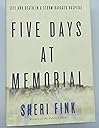

⚡ Uncover the storm of ethics and survival in a hospital’s darkest hours!
Five Days at Memorial is a critically acclaimed, ALA Notable Book that chronicles the true story of a New Orleans hospital’s struggle during Hurricane Katrina. Sheri Fink meticulously investigates the chaos, moral dilemmas, and legal consequences faced by medical staff, offering a gripping, ethically charged narrative that challenges readers to rethink life-and-death decisions in disaster scenarios.
| Best Sellers Rank | #331,699 in Books ( See Top 100 in Books ) #6 in Disaster Relief (Books) #78 in Murder & Mayhem True Accounts #3,609 in U.S. State & Local History |
| Customer Reviews | 4.4 out of 5 stars 4,561 Reviews |
N**R
A morally complex and divisive read - SPOILERS IN REVIEW
Simplistically, this is a story of how a hospital full of doctors, family and patients dealt with and sustained through Hurricane Katrina. However, the story that focuses mainly on Dr. Anna Pou is a moral conundrum that is as divisive a subject as I can imagine. Sherri Fink treads through public files, personal testimonies and witness accounts to bring us a wide look at what took place at a New Orleans hospital as chaos ensued and governmental and corporate response languished. This lack of emergency response seems to be caused by a deadly combination of negligence and incompetence by the staff of the hospital and everyone they seemed to reach out to. Consequently, important decisions had to be made under stress , exhaustion and unbearable heat: Who among us gets to leave/receive critical care first? The oldest? The sickest? The ones with the best chance to survive? The ones with best quality of life chance? Triage was set up and days passed by slowly as people's lives hung in the balance. Thus enters Dr. Anna Pou. Fink goes into incredible detail of her background and character and gives us a sympathetic/ hard working, no-nonsense type of doctor who delegates authority amongst the nurses and charges at Memorial. Ultimately, it seems according to the book, that Dr.Pou would make important decisions to euthanize certain patients in what seems like a badly-kept secret that morally divided the staff. This is the central focus of the book and how you feel about Dr. Pou's actions will polarize the reader and have you second-guessing your original feelings. I must say, immediately I felt that euthanasia was completely acceptable. I believe that if somebody is to the point where pain and suffering renders somebody to the point that they are alive in the most basic definition only, I feel it acceptable for them to want to end their life. And, I did indeed feel this way throughout the book about Dr. Pou until you realize that these particular patients never consented. And there in lies the rub: euthanasia should never be put in the hands of the doctor without consent of the patient or family. Furthermore, in the case of Mrs. Burgess and Emmett Everett, not only did they not wish to die, they very much wanted to live. The fact that they were killed on the same day the mass evacuation was taking place only makes it more the tragedy. The second half of the book focuses on gathering evidence , the politics of prosecuting staff that risked their lives and otherwise behaved heroically during a disaster that most , including myself, got to watch from a distance. It's riveting and I think Fink presents every possible ethical possibility on what happened and what COULD have happened. I feel like she was objective and fair and if anything, only really painted LA attorney general in a negative light. It's no doubt controversial and there seems to be two camps: those that think that Dr. Pou is an amazing doctor who appears to have killed (with help of other staff, mind you) patients, even if ending their suffering was paramount in her mind. The other half is those that take Fink's reporting as factual. Perhaps the truth lies somewhere in between , but to those who deride Fink as trying to make a buck by sensationalizing , you have to consider both sides. Dr. Pou obviously has a lot to lose, including her freedom, if these accounts are accurate. She would literally have gotten away with murder. I don't, however, think she meant to kill with malice but rather with compassion. What does make me lose respect for her , though, is her continuing to lie about small details to exaggerate the conditions of the hospital ( lack of water, food, helicopters not being able to fly at night). If there was more of a consensus, or even if there was a moral consensus taken before she made the injections, I'd sleep better. Unfortunately for the victims, it seems like their deaths were carried out clandestinely. Meanwhile, their was an equal conspiracy of disapprovers who did nothing but express outrage over the possible euthanasia amongst themselves while not lifting a finger to stop it. I could go on and on about this with points both for and against all parties involved and not come within a mile of satisfaction. It's an astounding read that will test your preconceived notions of right and wrong and I'm not quite sure I'm qualified to judge anybody during a situation as hellish as this.
J**E
A must read for healthcare staff
I very rarely write reviews of books. My father bought 5 Days at Memorial, read it quickly, and gave it to me, wanting my opinion. I'm an RN, and I work at a hospital in which we have mostly long term patients, and approx 200 of them are ventilator dependent. WARNING: NUMEROUS SPOILERS AND DISCUSSION OF EVENTS DURING THE STORM!!!!! The author does an excellent job of putting the reader in the situation...and almost from the 1st page you can see the tragedy that is going to unfold. No flood disaster plan in place. Knowing the generators were going to fail. And complete communication breakdown between the incident commander, the CEO of Tenet, and the Lifecare staff. As I was reading, I certainly questioned myself as to what I would have done as each situation presented itself. The ethical questions were raised quickly by the author..It was apparent that all the patients were not movable and would not be being evac'd. Discussing the different methods of triage and which patients should be moved 1st. Keeping the patients who were listed as DNR behind. The alleged discussions of euthanasia between doctors. The book keeps on hitting you with the bad decisions made by those "in charge". It was heartbreaking and frustrating to read. However, it did, for myself, force me to consider, A.) what would I have done if I was in that or a similar situation, and B.) look at my beliefs on end-of-life care The second half of the book consists of the legal ramifications/charges brought against the staff members who allegedly gave lethal overdoses to patients at Memorial. Again, extremely well written, researched, and thought provoking. This book should be required reading for healthcare professionals in an Ethics seminar. For the general reader, it gives an idea of just a tiny slice of the chaos of what was going on in New Orleans directly after Katrina, and the complete breakdown of societal norms that occurred there. This one will stay with me forever.
B**S
a superb thought provoking look at the potential for disaster in all our hospitals.
I had not followed Dr Pou's case when it was occurring, but I was aware that there was a female MD being investigated for practicing euthanasia during Katrina. When this was published, I wanted to learn the story. I have read two other books about medical care during Katrina- the first was CodeBlue, the second a collection of nurse's stories about working during the storm and its aftermath. Both were interesting, but not challenging in the way Five Days at Memorial has been. First, let me say that Ms Fink writes very well. Her excellent prose made the story very clear. I was horrified to learn just how dreadful the conditions became at Memorial hospital. This despite reading the two previous books. Reading this, I could smell the fetid odors, feel the heat and humidity and actually imagine myself in the nurse's shoes. I could clearly understand the terrible dilemma the staff faced as DAYS passed in 100 degree heat with no electricity and the chaos of no plan for rescue of patients, staff and family members stuck in Memorial hospital. I have been an RN for 37 years, and thankfully have never experienced a disaster. What Fink's excellent book has done is shocked me into the awareness that a disaster could occur at my hospital. It would most likely be an earthquake here; all our disaster drills focus on an earthquake. I have never before considered what would we do for our patients after we got them out of a presumably badly damaged building? I work in a free standing psychiatric hospital; fortunately none of our patients are on life support. But all our medical records are computerized. The medicines are dispensed through a electronic computerized dispensing machine. We would not be able to even give anyone a Tylenol, let alone their regular meds. We are on a hill; water is pumped uphill to us, so we wouldn't have much water. I was just informed there's some drinking water stored for the patients but none for the staff. The upshot of my reading this superb book is I am going to ask our upper administration to read Five Days at Memorial. Then I plan to be nosey and find out what are the plans for care for our emotionally fragile patients after the shaking stops. I am feeling very passionate right now about making certain there is a plan for the care of our patients afterwards, and that there is an organized well worked out evacuation program prepared now, before we need it. Where will we go? How? How will we get meds? How will we tell families where their loved one is? What will we do with the few patients who are dangerous? I thank Ms Fink for opening this nurse's eyes to the potential for horrific things happening to my patients. Because of this book, I am getting involved to prepare as best I can for what I hope never happens. I HIGHLY recommend this book to hospital nurses and their administrators everywhere. It is also an invaluable eye opener for those who have loved ones with chronic illness, who could face the same fate as the poor souls in LifeCare or Memorial hospital. This book is a life changer. I will say I was surprised by the legal findings. But I understand how they came to be. I will do my very best to protect my patients from a similar fate, by preparation.
R**R
Good product love it.
Love this book. Good quality with several pictures inside of this horrific hurricane. Excellent writing. Love this.
J**N
Misses the mark
This book, concerned with the handling and care, or lack thereof, of patients at Memorial Medical Center in New Orleans in 2005 during Katrina, is both a jumbled account of what transpired over five days at the hospital and thought provoking commentary regarding end-of-life issues. After days of chaos, deprivation, and the failure of medical technology and orders on the fifth day to completely evacuate the hospital, some last remaining, very ill patients were given large doses of palliative medications, resulting in their deaths. The big question of the author is whether a rather zealous attorney general was justified in placing under arrest a well-respected female cancer surgeon and two nurses for homicides allegedly committed on that last day. Context is all important in this story. The author does not avoid it, but her coverage is either insufficient or far too disjointed. The simple fact is that the hospital was criminally unprepared for Katrina, and it could have been. Pure neglect found supplies and key elements of the electrical system in the basement where anyone could predict flooding could occur. Evacuation plans were virtually nonexistent including the use of the helipad. The physical layout of the facility with its multiple stairs and passageways was a nightmare to navigate in deplorable conditions. And the author’s coverage of the medical personnel trying to deal with this mess is as chaotic as what was experienced on the ground. It’s impossible to keep track of what person is doing what; whether helicopters are coming or going with or without patients; etc. Although mentioned, the author does not hammer home the sheer ineptitude of the corporate giant who owned this hospital and could have invested in making it safe and offered far more help during the crisis. Secondly, the author devotes almost no time to the utter failure of various levels of government and agencies to make sure that the flood control systems of New Orleans would not break down under strong storm conditions. And this is in a city where large segments of it are below the water levels of huge bodies of water. The residents of New Orleans and Louisiana most definitely share in the blame. Where is their political willpower in ensuring their own safety and the safety of the vulnerable, like those in hospitals? In short, the medical personnel of Memorial Medical Center were essentially abandoned to operate in nightmarish conditions. The care of all patients was terrible by normal standards, not just for those who perished. After five days of hellish conditions there was tremendous uncertainty about how to end this horrendous situation. Under extreme duress, perhaps some made poor decisions at the end, but it is a large leap to claim murder in this situation. In the last of the book there are inconclusive discussions about what should be permitted under dire circumstances in regard to deciding how various groups of patients should be handled. Overall, the book sheds light on a very trying situation, but in many ways misses the mark, suggesting blame in the wrong places.
M**N
Compelling
I think everyone should read this book. This raises important questions about morals and ethics that prevail in current medicine and society that are as true today as they were present in the aftermath of Katrina. This book does a wonderful job presenting all sides of what occurred and demonstrates how crucial every step that was taken before and after the storm was to the outcome of how the public perceived these events. I really felt for everyone affected by the storm and everyone who was a part of putting together the pieces to understand the actions that occurred. My heart is broken for the patients, healthcare professionals, families, and those who couldn't make it out of the city. We so often want the world to be black and white, especially in medicine, where the outcomes of what happens to a patient is not as simple as a single treatment, where the repercussions of actions to patients can create a ripple effect not only years into their lives but into their loved ones lives and even the country. But the reality is far from black and white and is even more grey than I had realized. It really makes you understand how ill-prepared we are to face extremes, that most agencies we trust to look for answers in distaster are often as clueless as those facing its consequences head on. Even when thought goes into disaster planning, resource guarding—can it truly be done in a way that is fair and equitable? And how do you begin to define what is deemed fair or equitable when it comes to medicine in such circumstances? This book is highly thought provoking and I cannot recommend it enough to everyone.
V**M
Amazing, infuriating reporting, but not well written
A deep investigation of an infuriating story - but not the easiest to get through. The story shines. The author clearly put in *years* of work, and uses an amazing amount of detail to paint a devastating picture. I plowed the first 200 pages of it in a single sitting, unable to put it down, and walked away changed by what it says about the human race. READ THIS BOOK! Now, about the writing.... The author absolutely bogs down in all those details, and spends most of the first hundred pages giving a laundry list of characters, biographical details, and scene details (what types of plants were on the lobby, what they ate at the reception, what color the walls were), without any way for the reader to know which parts will be important later. This is made worse by the fact that, ironically for a newspaper writer, she does not ever give a good 10,000-foot overview, or set a broader scene - "this is the chessboard, and these are the pieces." Instead, she just jumped straight into introducing you to character after character after character. She does *try* to start with an anecdote that tells the whole story, in the prologue - but then she sets that character down and doesn't meaningfully return to him until almost 100 pages in. As a result, I honestly started to skim or even skip the paragraphs about how 'mamie johnson was known for her colorful draperies....' A real shame that an editor couldn't whip this amazing reporting into slightly better shape, but still 100 percent recommend.
D**O
Heroism Amidst Insanity
If this were fiction, it would seem so far fetched that an editor would probably tell the author to tone it down. No government is THAT inept! This book is one that needed to be written and the author has put it together chronologically and in such a way that even though you know the outcome, it still seems unbelievable. This is a story about government's failure to plan for an emergency that was bound to happen and its inability to react once it did and the "trickle down" blame from those who weren't there to those who were. For those medical professionals and patients marooned for five days as the water breached the levees of New Orleans after Hurricane Katrina with no power to operate essential machinery and no way to get out, common sense would dictate that they all did the very best they could under the worst possible circumstances. If these dedicated health professionals had simply left when evacuation was ordered, then what would have happened to the patients who could not leave as they needed medications, were not ambulatory, and/or were dependent on equipment for survival? Obviously, what would have happened is that these patients would have died, many in great pain and alone. Perhaps they would have starved to death, lying in their own waste? The hospital employees had no direction nor help from the corporate entity that owned the hospital and were left to do the best they could in the worst imaginable circumstances. Then, the very City that had no plan in place to deal with major hurricanes even though much of that City is below sea level, decided to accuse physicians of murder when patients who could not possibly be rescued and were dying anyway were given large doses of morphine to ease the process. Thankfully, the jury who heard the evidence, agreed with almost everyone on the planet except the authorities in New Orleans and understood that these physicians did something we would hope they would do for us if we were left in the middle of a disaster in great pain and the alternative was to go peacefully into the night or spend many hours or days in agony with the end result the same. The official failure of the government at every level to have any plan in place to deal with disaster is evident, as is the pathetic waste of resources building a case for murder against physicians? If the truth were told, there were probably dozens of violent crimes committed in the midst of all that chaos that were never pursued, either because the victims were dead or the evidence was destroyed. If you aren't angry after reading this book, you should be. Kudos to this author for a truly outstanding account of the wretched situation at Memorial Hospital in the aftermath of Katrina.
Trustpilot
1 month ago
3 weeks ago