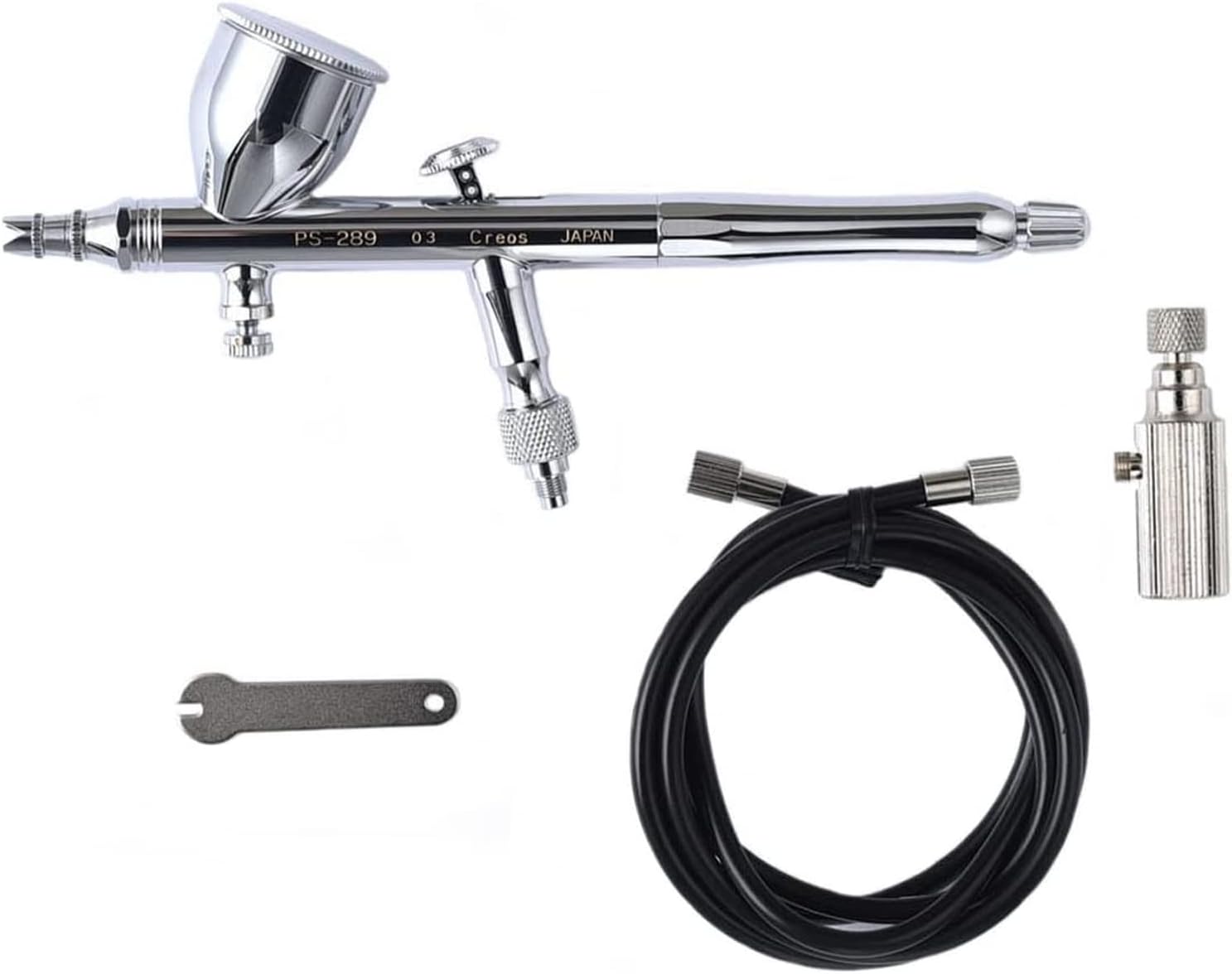
Mr. Procon Boy WA Platinum Airbrush with Air Up System 0.3mm, Mr. Hobby
Product ID: 1825747
🎨0.3mm precision nozzle
⚙️Double action smooth trigger
🛠️10ml gravity feed cup
Desertcart purchases this item on your behalf and handles shipping, customs, and support to Senegal.
🎯 Elevate your craft with precision and control that pros swear by!
The Mr. Procon Boy WA Platinum Airbrush (0.3mm) is a professional-grade, double action airbrush featuring a finely machined 10ml gravity feed cup and an adjustable MAC valve for precise airflow control. Designed for modelers and hobbyists seeking flawless detail, it offers smooth trigger action to prevent splatter and a durable build that ensures consistent, clog-free spraying. Highly rated for its value and performance, this Japanese-made airbrush is the upgrade that transforms your painting experience from basic to brilliant.

| Customer Reviews | 4.6 out of 5 stars 863 Reviews |
A**G
Major improvement over Kit Airbrushes
If you're unsure how an airbrush can be different, or better, because you can get by with your included kit airbrush... you're not alone! I too wondered what could possibly be different enough to warrant spending $100 on an airbrush, let alone $150 for the much recommended Iwata Eclipse. The reviews for $100+ airbrushes all mention things that don't sound very integral to the experience, but if you're doing figure/miniature/gunpla painting, they absolutely are. I feel that learning on a bad airbrush helped me get over my fears, but it taught me to be afraid of doing detailed work. I haven't used more expensive brushes than this, and my skill level isn't at a place to appreciate the differences to a $400 brush, but I recommend this airbrush to all beginners/intermediates. This air brush is that line where the tool will no longer hold you back; it's all on you from here on out. What makes this air brush different than a Master or generic kit brush? 1. The trigger has a smooth action. This didn't seem all that important because, again, I got used to my airbrush. I figured a little bit different wasn't a huge deal. I was wrong. A smooth action and no slightly grainy texture helps prevent you from making splatter mistakes. Letting go of the trigger too abruptly causes splatter when the needle smacks into the nozzle. That doesn't happen with this brush because the margin for error is much higher since it has a great spring and smooth pull. 2. The modulation on the paint spray is much greater. What I mean is, you have more degrees of spraying paint when pulling back than with the other brush. I know what you're thinking: "I'm fine". But it's a game changer. Instead of your airbrush basically having 3 settings: Dry "I'm testing it out" Spray, "For-real this time Spray", and "Torrential Downpour", it feels like you now have way more freedom. It actually took me some time to get used to it because now I could actually be precise and move in close with the brush to get primer in small nooks. 3. The cap doesn't get clogged because the needle is higher quality. I had to buy a new needle for my kit brush ($12 for a set of 3) because it arrived SLIGHTLY bent. My spray was leaning upwards which meant the cap kept getting clogged. This brush's cap isn't circular and even if you mess up and get paint in it, it won't pool it up in front of your needle. 4. The cup is easier to clean. It's actually well finished all throughout. I'll guess your kit brush looks chrome all through but has slight ridges towards the bottom. Or maybe it's super cheap and looks like unfinished brass towards the end. That's because it's machined cheaply. A fully finished and well made cup equates to a huge time saver. Changing colors is now no longer a 3-4 minute activity but 30-40 seconds. Full clean only at the end of the session. 5. Lack of nozzle leaks means it atomizes paint like a champ. Let's be straight, my cheap brush with a decent compressor can atomize paint. However, because it leaks air near the nozzle (check by putting soapy water near the nozzle cap and needle cap) it means I can expect it to spit every so often. Not to mention additional clean up and o-ring damage. My old airbrush spit tiny, tiny dots of paint once in awhile. Speckles ruin the finish. If you want to do any sort of slight detail work like pre-shading you probably gave up already. I didn't realize this was a solvable problem. I've primed over 40 pieces today and not a single sputter or speck. What fresh hell have I been putting myself through? If you're looking to stop fixing your models and get to actually painting them, I suggest you start here. Just comparing the specs with the Iwata Eclipse HP-CS this air brush blows it out of the water for $50 less. Nozzle/Needle replacement ready, perfect needle size for all the hobbies I listed above, and you get a mac valve! Just make sure you invest in a real compressor with tank first (The standard $79-89 kit compressors are more than fine).
J**S
Best value in Japanese airbrushes?
It's not perfect, but it takes five stars for value. For less than $100 you are getting a very nicely machined, reliable, Japanese airbrush. It is well worth it to upgrade from the typical Chinese budget model to this gun. It's not without some drawbacks, though. GSI Creos uses its own hose system instead of the industry standard Iwata style. I never use the hose, which means I am paying for something that is useless. Also, this is a heavy airbrush. If you are doing t-shirt work or illustration where you are standing up and supporting the airbrush, it will have some drag on your hand as you work. The MAC valve on this airbrush allows you to set the airflow within the body of the airbrush itself. I never use these. Instead, I use a quick disconnect that has a MAC valve on the air hose. The MAC valve here just adds weight and additional cost. There is a version without the MAC valve, thankfully. The fit and finish are really good, as you would expect from the Japanese factory. I have 9 of the airbrushes from this series and they all perform well. Replacement parts are more of an issue, as you'll have to hunt around a bit. Trigger action is fine... not light, not super heavy. You can get a nice fine spray pattern out of the 0.3mm. Most users (particularly modelers, who are complete idiots when it comes to airbrush technique) will be well served by the 0.3mm. There's no need to get a 0.18mm or 0.2mm unless you are doing illustration.
D**S
This is THE airbrush you are looking for!
A very well designed and manufactured piece of Japanese engineering. I stand by the Mr. Hobby/GSI Creos brand and use most of their other products. I primarily use this airbrush for painting Bandai gunpla and Tamiya kits with their line of Mr. Color lacquers. I also occasionally spray Tamiya solvent based acrylics. My first airbrush was a syphon fed Badger. I loved that old airbrush, but compared to the Procon the difference is like night and day. The Procon airbrush feels solid and hefty in your hand. It feels very balanced and is comfortable with any grip. It sprays very smoothly and I love the tactile feedback of the soft trigger. The built in backwash function is a nice touch too (just unscrew the nozzle head a couple of turns and you can backwash the cup WITHOUT covering the tip!). The crown tip allows for up close fine painting while still protecting the needle. The built-in MAC valve is also a bonus. You can fine tune the pressure at the gun instead of reaching for the regulator valve on your compressor. This Procon PS-289 replaces my existing Sparmax Max-3 airbrush as my main airbrush. I also use a Master Airbrush Cool Runner II air compressor with tank by TCP Global and the brush uses the standard 1/8 fitting. I plan to purchase a GSI Creos mini water trap / dust and drain catcher for added protection from condensation. I'm already thinking of getting another Procon SQ (0.4 nozzle) for broader base and top coats. Just get one. You won't regret it.
C**D
Great Airbrush for the money.
I had been dragging my feet for about a year now with replacing my Iwata HP-CS and Paasche Talon with a different airbrush. I'd been looking at the CSI Creos PS series for awhile now until deciding on this particular one. Really, I wanted the PS-771 which is over $200+ but decided I'd give this model a try before making a more expensive decision. First off, I'm a scale modeler who primarily builds armor and the occasional WWII fighter aircraft and do a lot of camo patterns and weathering detailing..ie: fading of panels etc. I tested this airbrush with the top three paint brands I use; Tamiya, Ammo Of Mig and Vallejo Model Air, trying out different air pressures and each brand atomized really well during spraying. The trigger action IMO is more smooth than my Iwata HP-CS and leagues better than my Paasche Talon. I also have the Paasche Raptor, which is about the same as the Talon in terms of trigger action. I'll be keeping those three for primers and base coating and will primarily use the PS-289 for detail work and camo patterns. For under $100, the finish and quality of the CSI Creos PS-289 is extraordinary. Inside the paint cup is smooth, the chrome finish is flawless. I've not seen a better airbrush for this price range that's made this well and functions like the more expensive airbrushes like Harder & Steinbeck. I highly recommend this airbrush to anyone from a beginner to and advanced user.
C**W
Definitely worth the money and the shipping time
I haven't had a chance to really use this brush long but I did spray with it and it did a great job. I have a Creos PS-770 that has a much smaller needle and it's awesome for detail work but I wanted something a little more middle of the road and just easy to spray with. Based on the build quality of the 770 I decided to give this a try. For approx $80 this thing is a phenomenal buy. I'm not a pro so I can't compare this to dozens of brushes. I just don't have that experience level but using this was easy and it sprayed really well right out of the box. I'm really looking forward to using it on the several model aircraft I was gifted last Christmas. I took the nozzle cap off and it sprayed a nice clean line a little less than 1mm wide. I would really recommend this as a great first airbrush or a general all-around tool for anyone. I plan to use this to lay down a couple of coats over wider surfaces or for priming and using the 770 for fine details.
F**K
High quality in fit and finish
Firstly, I'm a longtime Badger user. That said, you'll need an adapter to get this airbrush to work with your compressed gas source. I use CO2, and the fitting that came with this airbrush would not work with my CO2 regulator. Mr. Hobby sells a set of three adapters I purchased through Spraygunner's Ebay store, one of which adapts this airbrush to my Badger hose. I found this airbrush to be of high quality, it fits my hand very well and its heft is welcome but will not make your hand weary. Disassembly and cleaning is easy and again, the quality of the machining and fit of the parts is first rate. I build models and paint them with lacquers and enamels for the most part. Lacquer thinner used to reduce almost all my paints. No ill-effects were seen in the airbrush. The very nicely chromed body of the airbrush makes spills easy to clean up. The nozzle has a feature where you unscrew it slightly and you can backwash into the color cup - a handy thing to have. The MAC valve feature is still lost on me; perhaps with more use and experimentation, I will get some value from it. The airbrush comes with an air source adapter (but I'm unsure what it will fit), a hose and a wrench and is shipped in a foam-cutout within a sturdy plastic box. Instruction sheets are also included. All told, this is a very nice airbrush at an excellent price and should serve my needs for quite some time.
W**E
Research leed me to this airbrush.
Researched best quality starter airbrush you can get if you want something nicer to start. This is the only airbrush ive used but from a learning perspective, I rate, this high. There are cheaper brands but their reviews and ratings suggest they don't last like this one. There are a couple versioms of the procon. PROCON 298- 0.3 sized is a good inbetween the .02 version finer point for small detail but clogs easier and .5 more paint for more coverage, but harder to get fine detail. I wanted to try a bigger trigge using gun.action and there is a procon 0.3 that has a trigger on it, but it doesn't have the platinum adjustment valve. The valve only comes on the platinum, it's made learning how to use the aitbrush much easier than I think.It would have been not having it. You can use the included hose on a c 02 canister but for correct, consistent pressure, I got a compressor with tank, plus with new hose extra, as the hose included only works well with the co2 cans. Right now both ways work well with the valve adjustment system and is easy enough clean up. Would recommend.
J**W
Absolutely fantastic, leagues better than my Talon
This has been a game changer for me, night-and-day better than my Paasche Talon. For the money, you won't get much better until you start shopping in the $200+ range. Pros: - Some of the best price to performance you'll see in airbrushes. - Does a great job atomizing the paint, effortlessly sprays Gaia EX Black to a reflective finish. - MAC valve built right into the gun, leave the tank's regulator at ~20PSI and call it a day. - Wider cup is easy to clean with a microfiber towel. - Standard sized threads hooked right up to my No-Name Spraygunner tank (also highly recommend). No adapters needed unlike Paasche. Cons: - I genuinely have none. Coming from a Paasche Talon, everything it did, this does better. Better features, better atomization, better build quality, less aggressive curve in how much paint you spray vs how far back you pull the trigger. I've had this for around 2-3 weeks now and have been using it almost every day since and haven't found a thing to complain about it.
C**.
Nice airbrush
For the price a really nice airbrush - perfect for the intermediate and advanced modeller
D**A
Qualité !
... ou plutôt - QUALITÉ ! Jour et nuit à côté de mon ancien aerographe à 25€. Pourquoi je ne l'ai pas acheté avant ?
A**N
Un aerografo profesional a precio accesible.
Llevaba un año utilizando un aerografo genérico de esos que tienen un mini compresor cuadrado incluido para adentrarme a este mundo y ver si me gustaba lo suficiente para después hacerme de uno de mayor calidad/más caro. Después de practicar lo suficiente con él aerografo genérico y de hallarle a sus mañas, decidí actualizarme, pero mi presupuesto estaba apretado y al final estaba indeciso si irme por un Iwata Eclipse, un Neo, o por este modelo, el GSI Creos PS-289. Al final elegí el GSI Creos ya que leí maravillas de el, y en que prácticamente es catalogado como un Iwata Eclipse disfrazado, pero a un precio mucho menor por el simple hecho de no ser marca Iwata, pero eso si, con la misma alta calidad, ya que este aerografo también es fabricado en Japón (Y en el que incluso se afirma que son fabricados en el mismo recinto en el que se fabrican los aerografos Iwata, a diferencia del Neo, el cual está fabricado en China y en el que Iwata unicamente presta su nombre para ese modelo. En fin, eh estado probando el PS-289 por varios días de forma exhaustiva y wow. WOW! De lo que me estaba perdiendo al no haber adquirido un aerografo de alta calidad, amikos! Es esplendido y simplemente no se compara en lo absoluto al aerografo genérico ya que para empezar, con ese me era muy difícil atomizar la pintura de forma precisa, si no es que imposible y yo se lo atribuía a mi falta de practica, pero con el PS-289 lo puedo realizar de forma natural y con una facilidad que asusta! Además gracias a su real acabado pulido en el interior del vaso, es súper fácil de limpiarlo una vez que terminas de pintar, por lo tanto si requieres cambiar de colores de forma rápida, solo basta con una pequeña enjuagada y listo además de que es capaz de pulverizar la pintura sin necesidad de diluir en exceso las pinturas (Yo utilizo pinturas acrílicas comunes diluidas con agua destilada y sin problemas). En resumen, si estas buscando dar el siguiente paso en adquirir un aerografo de alta calidad sin gastar mucho, este es el aerografo que buscas ya que básicamente estarás adquiriendo un Iwata Eclipse pero tres veces más barato. Realmente me sorprende como un aerografo de nivel profesional puede costar prácticamente lo mismo que un Neo de Iwata, pero con una calidad mucho mayor en todos los aspectos.
R**U
Best airbrush
Good quality, best for beginner or experienced professionals
D**M
Great value and quality for the price
Great value for the price. The finishing is flawless and impressive it is MIJ at this price.
Trustpilot
1 week ago
1 month ago