🔴 Elevate your sound game—studio quality, zero compromise.
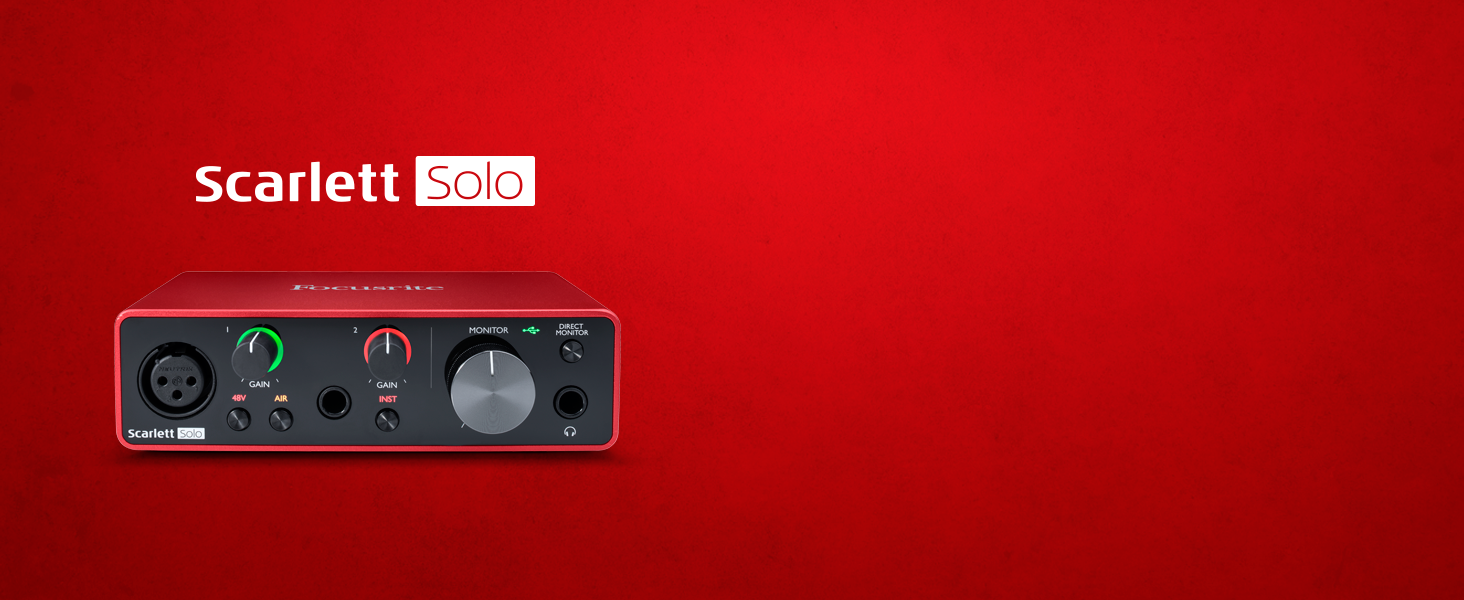
The Scarlett Solo 3rd Gen USB Audio Interface delivers professional-grade recording with Focusrite’s best-ever mic preamps, 24-bit/192kHz converters, and a high headroom instrument input. Designed for guitarists, vocalists, podcasters, and producers, it features a switchable Air mode for enhanced vocal clarity, low-noise balanced outputs, and a powerful headphone amp. Compatible with Windows, macOS, and Linux, it includes easy setup tools and bundled software, making it the ultimate portable studio solution for creators seeking premium sound without the bulk.




| ASIN | B07QR6Z1JB |
| Best Sellers Rank | 50 in Musical Instruments & DJ ( See Top 100 in Musical Instruments & DJ ) 2 in Computer Audio Interfaces |
| Colour | Red |
| Compatible Devices | Computer, Digital Audio Workstation (DAW) |
| Customer Reviews | 4.7 4.7 out of 5 stars (46,351) |
| Date First Available | 2 July 2019 |
| Hardware Interface | USB 2.0 |
| Item Weight | 349 g |
| Item model number | AMS-SCARLETT-SOLO-3G |
| Mixer Channel Quantity | 2 |
| Operating System | Linux, Windows, macOS |
| Product Dimensions | 4.34 x 14.35 x 9.58 cm; 349.27 g |
| Software Included | Ableton Live Lite, Hitmaker pack (now includes Massive and Fast Balancer), Splice Sounds subscription |
| Supported Software | Compatible with major audio recording software |
| Voltage | 240 Volts |
S**N
Wonderful and Easy.
Two initial disclaimers before I go onto my review: Firstly, that I have nothing added additionally to the interface (such as a cloud lifter) other than the XLR cables which connect my Shure SM7B, to my interface and into my computer. Secondly, it should be know that although I do like to consider myself to be relatively 'tech savvy', this won't be the most technical review but more so my experience with the affordable interface and the little bits and bobs that could be beneficial to you having understood. Hardware: As expected, there is a rather niche amount of hardware within this product, especially when you're comparing it to the later editions such as the 4th gen. With this said, it still consists of everything that you need and expect to get started as a beginner using an XLR microphone! -XLR input (corresponding gain dial besides it) -phantom power and air mode on the XLR input -TRS input (corresponding gain dial besides it) -0.25 inch headphone jack (large corresponding gain dial besides it) -direct monitoring button Audio Quality: The headphone output within the Solo delivers a quite significant amount of power and allows for good recording capabilities; offering a flat frequency response and having an ultra-low noise from the mic preamp, along with the 'air mode' allowing for an easier high-frequency boost that could be beneficial to some people. Overall, the product is definitely on the more affordable side and although it does slightly show, the demographic being on the beginner end, the product is wonderfully fitting. The product offers a wide array of different technical features that are greatly beneficial to you as a user and, once used, it becomes really self-explanatory why this is used amongst many independent musicians and YouTube/Twitch live streamers to get the most out of their microphones. I hope this helps!
M**O
Hard to fault
I won't bury the lede here, this is an amazing piece of kit. With gain at maximum the level of background noise from the digitiser is effectively inaudible even when supplying 48V DC to drive a "phantom" powered microphone. I'm using mine to develop a new microphone adapter to upgrade those cheap Chinese imported microphones that make decent donor bodies. I won't ask Amazon to link to the project as it's off-site and you can't buy the board here (yet) but it's on the DIY Perks projects so it's easy to find if you're in a rush. Why would I do this? Well the problem with Phantom power is that a lot of (early) stage mixers are noisy... and I mean really noisy. Studio gear is a lot quieter (live performances are have so much background noise that no one can hear the background hiss). In the studio (or perhaps, outside recording something like birdsong when every dB counts) that hiss is going to get in the way of the really quiet stuff. I paired mine with DT990 Pro headphones and it sounds delicious. The 990's 4.5 rating on Amazon's >15,000 reviews speak for themselves. They're very, very good. While they don't seem sufficiently robust to take the abuse I'd expect in a professional studio, sound-wise, they'd be right at home. And this is where the Scarlett shines. Focusrite produces some of the world's top quality studio gear and that heritage has trickled down to the Solo. When I was into this stuff in a big way, the idea that I could get a studio-quality setup for under a couple of hundred quid (headphones, mic and digitiser) was laughable. And yet, here we are in 2025 and it's not just practical, it's here - and fully portable too! Just add a laptop (Windows, as per usual, is preferred) but it does work with Debian Linux and Audacity albeit with more limited features. And that is the only real "gotcha" that I've noticed. You really have to use a computer to power this little fella or you won't get full functionality - including 48V phantom which is... odd but Waveshare clearly knows what its doing so I'll forgive it that. Getting 48V at up to 12mA (the P48 standard is limiting and demanding) from 5V is no mean feat I can tell you but Focusrite has achieved that without the hideous squeal from a simple Schmitt-trigger inverter and voltage multiplier. (That's technical detail of course, but there ARE cheaper 48V pre-amps that run from little wall warts from the Chinese that add a lovely background whine, replete with harmonics up the wazoo to every recording you make.) So ... bad. Yes. It's details like this that make the Focusrite an absolute MUST BUY for anyone serious about their recording particularly where that instruments like acoustic guitars and human voice is concerned. For rock where volume is the name of the game, a cheaper unit will suffice but most people would outgrow it. But there's more! The Focusrite is beautiful to use too. It just "feels" like a quality product that's going to last. The ability to monitor what you've recorded while recording a new track is an essential for many solo musicians but it's baked in! And better yet (for duffers like me who don't pay anywhere near as much attention to the level meters as I should) the gain control has a VU meter built in. You just set the level by running a test and setting it so the average is just flashing a green ring and you're good. As the level exceeds 3dB the ring goes amber and then red - which means the recording is clipping. A feature that doesn't make sense to me (but will to others) is "Air" which appears to be a treble boost. Something that former Rode chief designer Doug Ford calls "whoohoo" - for "flat" microphones. Focusrite has an excellent reputation and if the rest of its products are as good as this *budget* model that's clearly well-deserved.
V**E
Hay esfuerzos encomiables en las tarjetas de sonido e interfaces USB, pero en cuanto te pones un poco en serio no hay otro modelo al que acudir: durante tres generaciones las interfaces Scarlett de Focusrite son recomendaciones de referencia para músicos en un estudio casero o hacer un podcast serio. Este modelo 2i2 cuenta, como su nombre indica, con 2 entradas XLR y soporta alimentación Phantom P48 de 48 V. Normalmente los micrófonos de calidad como el Rode Procaster (enlace) funcionan sin averiarse si conectas la alimentación, pero en lo posible mejor quítala si no la vas a usar. La preamplificación de esta interfaz es legendaria, como lo es la confianza que ofrece: es uno de esos productos que, sencillamente, hacen lo que dicen y no dan problemas. Que se conecte con un solo USB y su reducido tamaño la hacen ideal para meter interfaz y cables en una mochila e ir a grabar a cualquier sitio, además de la extrema sencillez de uso del panel de control de Focusrite y el valor añadido del software que obtienes con la compra. Para los que ya conozcan las Scarlett, en esta 3ª generación Focusrite ha ampliado las ya excelentes cualidades técnicas de la interfaz, pero la mayor novedad reside en que ahora se conecta con un puerto USB tipo C, más opciones de configuración de E/S y un "Air Mode" que potencia las pistas de voz emulando la amplificación de un amplificador analógico. Además, las ruedas de ajuste de ganancia se iluminan con un código semáforo: verde cuando la ganancia está bien configurada, ámbar cuando nos estamos pasando y roja si la estamos saturando. Todas estas características más la sencillez de uso la hacen ideal para auténticos principiantes pero con la posibilidad de obtener un resultado profesional con poco tiempo de aprendizaje. Instalar la interfaz es trivialmente sencillo: la conectas por primera vez y ya arranca la instalación, que te guía para registrar el número de serie en la web de Focusrite y obtener el software añadido. Este software permite hacer de todo y tiene la ventaja de que te ayuda a familiarizarte con herramientas que son estándar de la industria incluyendo una versión personalizada de Avid ProTools First. Si ves que estás un poco perdido con tu nueva interfaz, échale un vistazo a los vídeos de la guía rápida, que explican todo muy detalladamente con guías paso a paso que imprimir - eso sí, en inglés. Sin ninguna duda, la 3ª generación de interfaces Scarlett es la mejor que haya producido Focusrite y, a su vez, son posiblemente las mejores interfaces que pueda comprar un usuario doméstico que se ponga en serio. Tal vez si ya tienes una el cambio no merezca la pena salvo para pasar a un modelo con más E/S pero es un producto intachable, con cambios que mejoran la vida al usuario y que no estropean ninguna de las características a las que deben su éxito. Recomendadísimo.
O**Ğ
Kayıt teknolojilerinde orta segment sayılan bir model. Benzerleri arasında en sıcak ses kalitesine sahiptir. Yıllardır kullanıyorum. Bunu da arkadaşıma aldım. Çok uzun zamandır sorun olmadan kullanıyoruz.
A**M
I’m using this to record mediations using an audiotechnica mic with FL studio, it works well and I’ve had no problems , although sometimes it needs to be restarted but I’m not sure if that’s fl studio glitching or the device
P**N
Fidèle à la réputation
O**K
Ok
Trustpilot
2 weeks ago
5 days ago