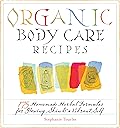

🌿 DIY your glow: Organic beauty, crafted by you!
Organic Body Care Recipes offers 175 easy-to-follow homemade herbal formulas for skin and body care, featuring clear instructions, practical ingredient guides, and customizable recipes that empower millennials to create natural, effective, and gift-worthy beauty products at home.


| Best Sellers Rank | #330,643 in Books ( See Top 100 in Books ) #244 in Organic Cooking #464 in Grooming & Style #607 in Herbal Remedies (Books) |
| Customer Reviews | 4.5 out of 5 stars 640 Reviews |
A**R
Easy success with DIY body care
Hands-down the best make-it-yourself nature beauty care book I've used. It's a great starter book. The Pros: The recipes use familiar measurements, the directions are easy to follow, and everything I've made from this book has turned out really well. The instructions are so much better than in The Other Beauty Book that I purchased that I'm using the directions from this book to modify the recipes from the other one, which are much harder to make but this book has shown me that it doesn't need to be difficult for a lotion to turn out really well. It covers a wide range of beauty products you can easily make at home with easy to acquire, non-scary ingredients. Most of the recipes are very practical and the selection of products isn't horribly skewed to one or two types of products (only 18 pages on masks, as opposed to 40!), and there's a wider range of skin cleansers than I've found elsewhere. A great feature is that each recipe lists several very important and useful details, including recommended uses, prep time, tools needed, type of storage container, and recipe yield. Compared to other natural beauty books, this puts it heads and shoulders above the competition. Seriously. You won't realize how important this is until you try to use the books that don't provide it! The Cons: The Table of Contents and Index are terrible - basically useless, a librarian's nightmare. The TOC does not list individual products, only chapters in which to find them, and even those subsections of each chapter are not listed with a page number/ The Index does not list products by name, or even keywords within product names; I have to flip page by page through nearly the whole book if I didn't write down the name and page of the item I want to make. This book needs a TOC and Index like those in The Joy of Cooking - far more cross-indexing is really needed and the titles of each product should appear in the TOC and in the Index, no exceptions. These are recipe books, after all, and should be produced as such. However, every other DIY body care book has the exact same problem, so I'm not knocking the ratings down for that. It's not the author's fault that the editor/publisher did a terrible job on front and back matter, right?
P**S
this is making me a body care addict :)
everything from the soothing colors, layout, and explanations make the book itself a real joy to read. her recipes are simple, diverse, and really good! i've tried the face scrubs, body washes and creams, lip glosses, and now i'm collecting the ingredients for a delicious-sounding 'love potion', which i described to a woman in the grocery store, so that even she wants to go out and get the book (i don't know if it was the recipe itself that got her or the idea of using it on her husband!). in one chapter, she gives a very helpful description of all of the ingredients that she uses in her recipes, what they do, what kind of skin (or hair) they're best for, and what possible substitutes can be used, which i find really helpful since i don't have every ingredient on the planet.in each recipe, she tells just how to make the product, what kind of skin it's best for, how to apply it. and how to store it. she also gives helpful hints on how to give these products as gifts, which has come in handy because there's no way i can use all the stuff i've made! my friends and family have all really liked what i've made for them too and eagerly ask for more--even my brothers! that's because the skin cream, for example, is much better than anything i've ever gotten in a store. this stuff is really hydrating and long-lasting, and you can scent it whatever way you like or not at all. in our cold dry winters, this is just the ticket. i was actually getting back online to see what other books stephanie tourles has written, but i thought i'd stop and write a product review first. as you can see, this has quickly become a really enjoyable hobby, and this book has made it easy to do.
B**E
Love the writing style and organization.
I really like this book. I especially enjoy the reference section and simplistic explanations. It's written in an organized, easy-to-understand format. The recipes are broken down into skin and hair types and address specific problems. It's a great book if you're just getting started with herbs and essential oils and are tired of spending money on products that don't work. I've made my first batch of lotion and absolutely love it. I also like the idea that my skin is absorbing things that are actually good for me. (I threw away a bag of dog treats that contained propylene glycol; an ingredient used in anti-freeze and is attributed to several pet deaths. When I read the list of ingredients on my lotion bottle, guess what it contained?) The only reason I gave the book four stars is because the list of ingredients for some of the recipes was lengthy...and pricey. Others are quite simplistic. All in all, I'd recommend this book.
D**A
Great Book for Beginners or Intermediate Body Care Crafters
I have been making my own body care products (lotions and soaps mostly) for years but wanted to fill in some holes in my knowledge base. It is thoughtfully written, clear and concise. What I like about this book is it gives good info about hair, various skin types and their respective needs, nails, and even a little about what these things need in order to be and look healthy. I also like the extensive "Ingredient Dictionary" which gives helpful info about oils, essential oils, botanical ingredients and so forth. Plus it lists contraindications for each item so you know what to avoid if you have particular issues. The recipes are great. From very basic to more involved, the directions are easy to understand. If you have ever made a product from a recipe off the internet you sometimes find they leave out a lot of info like yield. Each recipe in this book gives that plus a paragraph describing the product's uses and attributes, prep time, tools needed, how to store and recommended usage and who should avoid. I liked this book so much I give it as a gift to friends and family who want to start making their own products.
M**N
Esthectician and Holistic Skin Care Specialist
Recently purchased four* natural cosmetic books and like all of them for different reasons, but if I would have just one, this is the book I'd choose. I trust the expertise of the author, Stephanie Tourles, a licensed esthetician and holistic skin care specialist, for her rationale of each ingredient and technique. The book has taught me a lot, I'm still reading it and still learning. Every recipe I have tried has been very simple, and perfect. For example: "Pineapple . . . Cosmetic Properties and Uses: Containing bromelain, a protein-digesting enzyme, pineapple dissolves dead surface skin cells, resulting in softer, smoother skin." I used fresh mashed pineapple as a mask and it brightened and plumped up my skin. It was amazing and what could be simpler? I think some people might mistakenly believe that if it's simple and natural it can't be as effective as complicated, commercial chemical masks that are made with toxic chemicals. I don't know how to convince people that simple and natural is in every way better for you, your skin, and the planet. But if a book can help convince a few people, who are skeptical, as I was, then kudos to the author. I'm very grateful to you. *The other three books in order of my favorite to least preference are: 200 Tips, Techniques & Recipes for Natural Beauty by Shannon Buck, 101 Easy Homemade Products for your Skin, Health & Home by Jan Berry, and Idiot's Guide to Making Natural Beauty Products by Sally Trew.
N**N
Lovely looking recipes and a good chunky book
I've not had the chance to read this completely yet as I am reading my soap making books first, but I have been tempted many times to glance at its contents and am not disappointed at my purchase so far. The book is nice and thick, but easy to handle, and covers a wide range of areas for home-made cosmetics and cleansers. The recipe layout is clear and concise and has good detail such as the shelf-life of the product, which is essential to know if you are looking to experiment with new recipes or sell you own products. Recipe instructions are restricted to one page which makes the book much easier to reference and work with and is indicative of the book's no-fuss style. I also love some of the titles for the recipes such as the "Out Damn Spot" Anti-blemish Elixir which throw in a subtle flavour of humour. I have given the book 5 stars in anticipation of a great read and would recommend it to anyone, rookie or experienced, looking for inspiration in organic body care, both for commercial or personal use.
P**D
i loved this book
I was pretty impressed with this book. i think i like it even more than my annie bond book.I currently have this book loaned out to me, but i am going to buy it. I loved all the explanations and the overviews of all the essential oils. It was also very helpful in telling you what concoctions to make to suit your own needs. It answers every question i wouldn't even think to ask. It lets you know what tools are helpful in making these too. It also talks about how to gift all of the recipes, shelf life, how to apply... Some people wrote that they were not happy with it not having vegan alternatives, in my opinion that is a waste of space, since that kind of stuff is changed by your liking. The title does not say vegan anywhere. Also, people noted there was talc and petroleum jelly in some of the recipies. They were defiantly reviewing a different book. Not either of those things are in this book. The only place petroleum is written is with a non written in front of it. In only one recipie i believe. So, now that i've cleared that up. I would defiantly recommend this book. It had so much more in it than i ever expected.
H**D
Good for casual/basic recipes, but may not satisfy everyone
I purchased this book primarily because I am interested in making my own lotion, preferably with safe/natural/eco-friendly ingredients. I don't necessarily want to market it, like another reviewer, but I would like to make lotion that is somewhat professional/sophisticated. After a quick Google search, I had learned that lotions tend to include water-based ingredients, oil-based ingredients, an emulsifier (which ensures that the water and oil ingredients stay mixed together), and some kind of preservative. I bought this book thinking that it might go into a bit more detail about basic lotion formulas (ratios of ingredients to each other), or at least provide some recipes that I could learn from. As it turns out, I had already learned more about lotion-making from my Google search than I learned from this entire book. Of the five body moisturizer recipes, four are basically oil-based, with essential oils added. There is nothing wrong with using oil to moisturize the skin -- but I find it can be inconvenient (insofar as absorption may be slower than with lighter lotions, and you're more likely to get oil on clothing or sheets). Additionally, oil-based moisturizers will probably not appeal to those with problem skin. The author's fifth body moisturizer recipe does include water in addition to oils, and uses beeswax and lanolin as emulsifiers. The recipe does not include a preservative, however, which means (as the author states): "No refrigeration is required if used within 30 days. If refrigerated, please use within 3 to 6 months. (Refrigeration may change the texture of the product, but potency will not be affected.)" Since this recipe yields 2 1/3 cups of moisturizer, and I'm not likely to use it all in 30 days -- and I don't enjoy cold lotion -- this recipe is of limited use for me. There are also five face moisturizer recipes. One of them is basically water and glycerin, and another is oil-based. The other three recipes each call for a trio of emulsifiers: beeswax, lanolin, and borax. I'm a newbie to the world of cosmetics ingredients, but my understanding is that borax is considered by some to be an unsafe ingredient. (A good reference is cosmeticsdatabase.com.) My guess is that the author has a good reason for using borax, and the reason is probably that borax (it appears) may be safe in small amounts -- though possibly not for infants. What perplexes me, though, is that the author offers no explanation or discussion on this topic. As mentioned by other reviewers, some of these recipes are extremely (absurdly?) simple. Examples include the Aloe Vera Toner (ingredients: "pure aloe vera juice or gel, commercially bottled or from fresh-picked leaf"), the Tangerine Toner (ingredients: 1/2 cup witch hazel and 10 drops tangerine essential oil), and the Yogurt Exfoliating and Bleaching Mask (ingredients: 1 tablespoon plain yogurt). I don't know about you, but I'm not sure those should count toward the "175 Homemade Herbal Formulas" in this book. As useful as they may be, I'm more inclined to call those "tips." I don't mean to sound too harsh in my review of this book. I think that, depending on your needs, this book may be perfectly fine. Many of the recipes look to have interesting combinations of oils and essential oils, and I'm guessing many of the finished products smell like heaven. I'm mainly trying to present my perspective on the book, relative to my own goals -- and hopefully it will be relevant to people with similar interests. But again, if you are more looking for recipes for casual use, you might really like it. One final note -- as I've indicated above, the author calls for animal products in some of her recipes. This is fine, but I was disappointed that she didn't offer animal-friendly alternatives. (In her entry for beeswax, she does mention vegetable emulsifying wax as an alternative, but then says, "but this wax has been refined and does not have the same alluring qualities as beeswax. Always try to find the real thing!") For dairy products, the author makes no mention of looking for organic versions -- i.e., from cows raised on healthy diets, without use of rBST or prophylactic antibiotics. She also makes no mention of the fact that cows contribute significantly to the greenhouse effect (deforestation, water use, methane emissions, etc.). I was surprised by this only because I think there is a lot of overlap between people interested in organic products, and those interested in animal-friendly and eco-friendly products.
Trustpilot
3 weeks ago
2 weeks ago