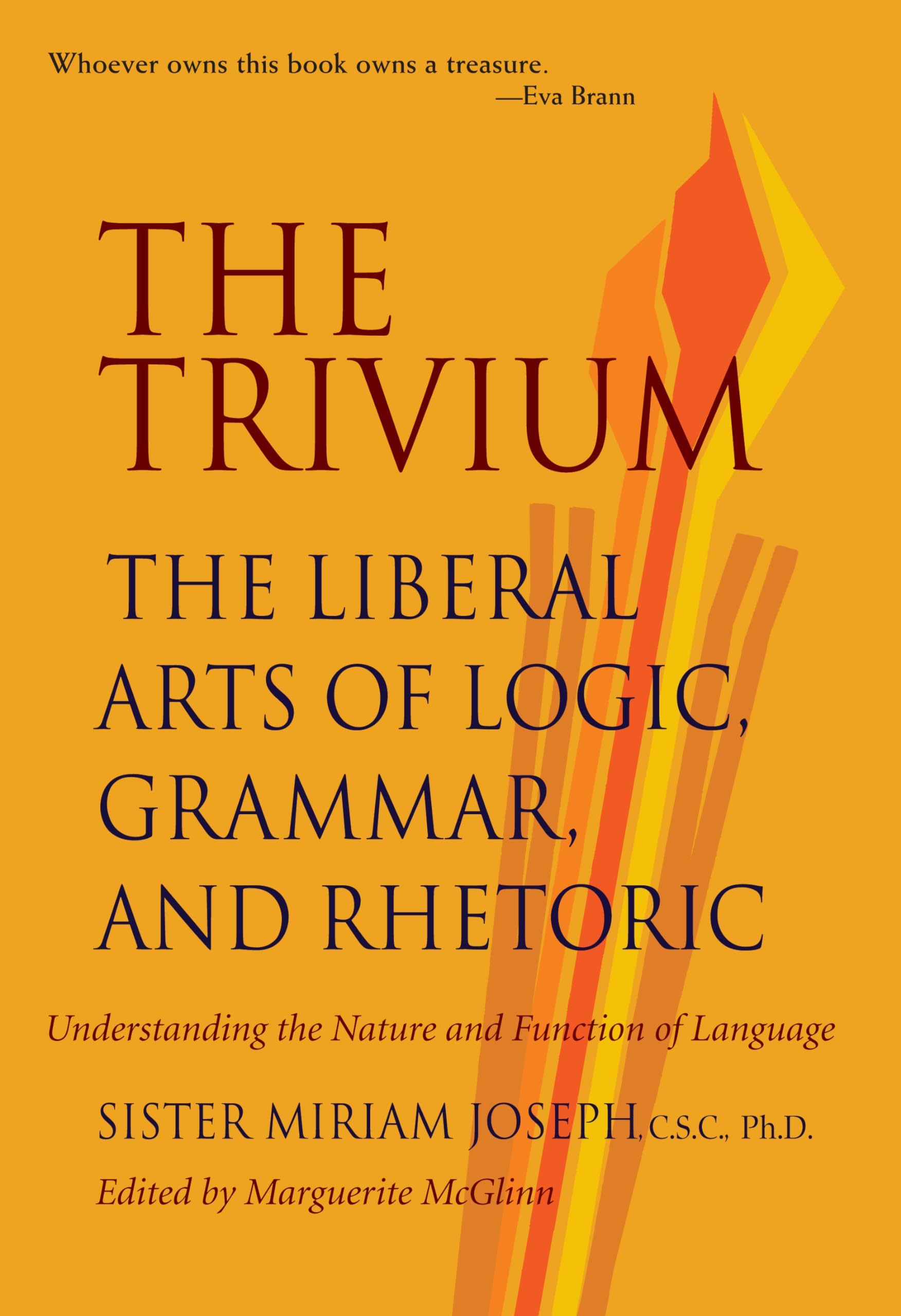

desertcart.com: The Trivium: The Liberal Arts of Logic, Grammar, and Rhetoric: 9780967967509: Joseph, Sister Miriam, McGlinn, Marguerite: Books Review: Tedious but rewarding - I ordered this book alongside Farnsworth's "Classical English Rhetoric," as it was the top recommendation from desertcart for that book and reviews were overwhelmingly positive. I approached the book as someone with a liberal arts degree and a tremendous interest in language, suspecting most topics covered in the book would be familiar. Its educational value far exceeded my expectations, and I wouldn't hesitate to say that mastering it gives one at least a year's worth of a modern liberal arts degree. To begin, this book is readily accessible and enormously valuable to students of any proficiency level. Those who, like me, already have some knowledge of the topics discussed are perhaps at a disadvantage to those approaching the book without prior knowledge since the book is somewhat antiquated in its terminology. Written in the 1930's, the book predates many movements that have swept into the universities, such as linguistics and modernist critical theory. So, for example, the book uses the term "phantasm" while I was more familiar with the linguistic term "prototype," though the two terms are identical. The book does not feel outdated, however; Marguerite McGlinn (the editor) has done a thorough job of noting instances where modern research is at odds with, or illuminates, Sister Joseph's words and provides context for the discrepancies. True to its nature, the book reads exactly like a textbook from the 1930's. Those familiar with more modern textbooks, in which the author assumes a playful, almost unserious tone to keep the student's interest, might find this book's tone unappealing. It is just the facts, ma'am, throughout. There are instances, particularly in chapter two, where Sister Joseph's aims become unclear and I was left questioning the value of what I was reading. This aimless sense continued for me through chapter 5 and then it all came together splendidly when the importance of general grammar in constructing syllogisms and deconstructing fallacies became apparent in the portion on logic. It was tempting for me to say, "Well, Sis, I already know what adverbs do so I'll see you in chapter 5!" and skip ahead a hundred pages. But there is a difference between general grammar (the relation of words of ideas) and special grammar (the relation of words in a specific language like English). Knowing the latter does not necessarily help you in understanding the former. Bearing this distinction in mind will help you slog through the first 5 chapters. The bulk of the book concerns logic and provides a very thorough education in it. There is so much here that I don't know where to begin, so I won't. But rest assured it covers all the biggies: validity, syllogisms, fallacies, mood, etc. And (finally!) Sister Joseph provides exercises for the reader to complete, and she uses examples and quotations from classic writers to illustrate her points. This makes the tedium of the grammar chapters far more tolerable. Sadly, the portion on rhetoric is the shortest. She discusses figures of speech (such as cliches), forms of writing (like short stories), and various aspects of poetic structure (like meter), all the while using these topics to discuss various rhetorical devices like parallelism and assonance. After an entire book of deep inquiry into each topic, the shallow, almost fleeting treatment of rhetoric is somewhat jolting. You still learn the particulars of various devices and they are illustrated with interesting examples, but the section does feel rushed and I wondered if there wasn't more to be uncovered. Happily, I have Farnsworth's book dedicated to the subject of rhetoric to read next! Overall, an excellent book that gives back in proportion to what the reader invests. Review: Great book, makes you think and rethink lots and lots - I will not lie - I still have mixed feelings about this book. The contents are great and kind of belittling at the same time. I like to think that I’m an amateur classicist and historian as I do know a great deal of Latin and classical Greek and history without being an academic, but this book has the rare distinction of making me feel cultivated and dumb at the same time. The book itself is an excellent resource to anyone who wants to learn about the three “civic” areas of classical learning, namely, grammar, rhetoric, and logic. The book, having been written several decades ago, preserves this unspoken aura of an olden-day work with its seriousness and belittling. I find it very emotionally confusing if anyone can understand what I’m saying. Having said all that, I cannot overstate how important and even essential it is to study rhetoric and logic in our very turbid days in order to try and discern what is real from what is “fake news” in this world where nothing is above a reasonable suspicion of having been “deep-faked”. One thing is certain: this book is extremely useful to anyone who wants to learn the (almost lost) arts of logical thinking.
| Best Sellers Rank | #28,761 in Books ( See Top 100 in Books ) #8 in Rhetoric (Books) #24 in Grammar Reference (Books) #33 in Writing Skill Reference (Books) |
| Customer Reviews | 4.6 4.6 out of 5 stars (543) |
| Dimensions | 6.2 x 0.9 x 9.3 inches |
| Edition | Reissue |
| ISBN-10 | 0967967503 |
| ISBN-13 | 978-0967967509 |
| Item Weight | 1.05 pounds |
| Language | English |
| Print length | 292 pages |
| Publication date | May 1, 2002 |
| Publisher | Paul Dry Books |
J**Y
Tedious but rewarding
I ordered this book alongside Farnsworth's "Classical English Rhetoric," as it was the top recommendation from Amazon for that book and reviews were overwhelmingly positive. I approached the book as someone with a liberal arts degree and a tremendous interest in language, suspecting most topics covered in the book would be familiar. Its educational value far exceeded my expectations, and I wouldn't hesitate to say that mastering it gives one at least a year's worth of a modern liberal arts degree. To begin, this book is readily accessible and enormously valuable to students of any proficiency level. Those who, like me, already have some knowledge of the topics discussed are perhaps at a disadvantage to those approaching the book without prior knowledge since the book is somewhat antiquated in its terminology. Written in the 1930's, the book predates many movements that have swept into the universities, such as linguistics and modernist critical theory. So, for example, the book uses the term "phantasm" while I was more familiar with the linguistic term "prototype," though the two terms are identical. The book does not feel outdated, however; Marguerite McGlinn (the editor) has done a thorough job of noting instances where modern research is at odds with, or illuminates, Sister Joseph's words and provides context for the discrepancies. True to its nature, the book reads exactly like a textbook from the 1930's. Those familiar with more modern textbooks, in which the author assumes a playful, almost unserious tone to keep the student's interest, might find this book's tone unappealing. It is just the facts, ma'am, throughout. There are instances, particularly in chapter two, where Sister Joseph's aims become unclear and I was left questioning the value of what I was reading. This aimless sense continued for me through chapter 5 and then it all came together splendidly when the importance of general grammar in constructing syllogisms and deconstructing fallacies became apparent in the portion on logic. It was tempting for me to say, "Well, Sis, I already know what adverbs do so I'll see you in chapter 5!" and skip ahead a hundred pages. But there is a difference between general grammar (the relation of words of ideas) and special grammar (the relation of words in a specific language like English). Knowing the latter does not necessarily help you in understanding the former. Bearing this distinction in mind will help you slog through the first 5 chapters. The bulk of the book concerns logic and provides a very thorough education in it. There is so much here that I don't know where to begin, so I won't. But rest assured it covers all the biggies: validity, syllogisms, fallacies, mood, etc. And (finally!) Sister Joseph provides exercises for the reader to complete, and she uses examples and quotations from classic writers to illustrate her points. This makes the tedium of the grammar chapters far more tolerable. Sadly, the portion on rhetoric is the shortest. She discusses figures of speech (such as cliches), forms of writing (like short stories), and various aspects of poetic structure (like meter), all the while using these topics to discuss various rhetorical devices like parallelism and assonance. After an entire book of deep inquiry into each topic, the shallow, almost fleeting treatment of rhetoric is somewhat jolting. You still learn the particulars of various devices and they are illustrated with interesting examples, but the section does feel rushed and I wondered if there wasn't more to be uncovered. Happily, I have Farnsworth's book dedicated to the subject of rhetoric to read next! Overall, an excellent book that gives back in proportion to what the reader invests.
R**L
Great book, makes you think and rethink lots and lots
I will not lie - I still have mixed feelings about this book. The contents are great and kind of belittling at the same time. I like to think that I’m an amateur classicist and historian as I do know a great deal of Latin and classical Greek and history without being an academic, but this book has the rare distinction of making me feel cultivated and dumb at the same time. The book itself is an excellent resource to anyone who wants to learn about the three “civic” areas of classical learning, namely, grammar, rhetoric, and logic. The book, having been written several decades ago, preserves this unspoken aura of an olden-day work with its seriousness and belittling. I find it very emotionally confusing if anyone can understand what I’m saying. Having said all that, I cannot overstate how important and even essential it is to study rhetoric and logic in our very turbid days in order to try and discern what is real from what is “fake news” in this world where nothing is above a reasonable suspicion of having been “deep-faked”. One thing is certain: this book is extremely useful to anyone who wants to learn the (almost lost) arts of logical thinking.
R**S
Essential Knowledge
This is a very serious book and requires diligent study. It’s a bit depressing to know this is what a college education once entailed before it was dumbed down.
T**N
Truly a Treasure!
On the front cover of my copy of this book occurs the following quote from Eva Brann of Saint John's College: "Whoever owns this book owns a treasure." I couldn't agree with her more. Between the covers of this excellent book the reader will find a wonderful introduction to Logic, Rhetoric, and Grammar. These three disciplines were known to Scholastics collectively as The Trivium. They formed the foundation for the Liberal Arts and stood as the first three of these Liberal Arts. Simply speaking, logic is about clarity of thought. Grammar is about clarity of writing. And Rhetoric is about clarity of expression, or communication. Excellence in each discipline is achieved through clarity. And clarity is one factor that is sorely missing in much of the discourse of our modern world. As a lifelong student, I highly recommend this wonderful little book. It is a treasure, to be sure. Yet, is also a joy to use this book as a guide to delve into the deep riches of understanding the nature and function of language. Although I understand that the book was intended to serve as material for a first year college course, I believe that students of any age can richly benefit from a serious, and joyful, study of this essential material. God bless.
L**O
Personalmente ero molto interessato all'argomento e sebbene fosse in inglese non mi sono lasciato intimidire. Ho fatto bene. Una bellissima lettura che prende in considerazione gli aspetti forse più accademici della retorica. SEMPLICEMENTE il testo di riferimento. Spedizione e qualità del prodotto come sempre perfette.
P**R
If you are coming from public education and you think you are well educated you are supposed to know what this is about. If you haven't heard of Trivium/Quadrivium you have quite a few topics to study. But the study of this arts brings you up into new levels. Not long ago one had to know those basic arts in order to be heard by the well respected society, most famous people of time were taught in order to be able to shine as they did.
D**L
This book is the record of something very interesting - an attempt, in the modern age, to create a general education on classical principles. And the book itself practices what it preaches; its prose is elegant, its exposition clear and for the intellectually curious it contains great rewards. It has quirks - it presents a medieval view of God's place in philosophy, and the presentation of the scientific method seems remote from anything a modern practitioner would recognise. But those topics are not what you read a book like this for. The real value comes from its presentation of the underlying principles of the classical philosophers, the medieval scholastics and the renaissance humanists. A deep, wise and challenging read.
B**S
In our modern days where education focuses on producing economic workers instead of shaping persons, this book is a breath of fresh air. The polished style of writing alone drew me in at page one.
W**I
A great book on the lost art of the trivium.
Trustpilot
1 week ago
3 weeks ago