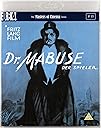
DR MABUSE DER SPIELER (Masters of Cinema) (BLU-RAY)
Product ID: 91408805
Details
- GenreWorld Cinema
- FormatBlu-ray
- ContributorFritz Lang
- LanguageGerman
- Runtime4 hours and 41
Desertcart purchases this item on your behalf and handles shipping, customs, and support to Senegal.
SYNOPSIS: One of the legendary epics of the silent cinema - and the first part of a trilogy that Fritz Lang developed up to the very end of his career - Dr. Mabuse, der Spieler. [Dr. Mabuse, the Gambler.] is a masterpiece of conspiracy that, even as it precedes the mind - blowing Spione from the close of Lang's silent cycle, constructs its own dark labyrinth from the base materials of human fear and paranoia. Rudolf Klein-Rogge plays Dr. Mabuse, the criminal mastermind whose nefarious machinations provide the cover for - or describe the result of - the economic upheaval and social bacchanalia at the heart of Weimar - era Berlin. Initiated with the arch - villain's diabolical manipulation of the stock - market, and passing through a series of dramatic events based around hypnotism, charlatanism, hallucinations, Chinese incantations, cold - blooded murder, opiate narcosis and cocaine anxiety, Lang's film maintains an unrelenting power all the way to the final act... which culminates in the terrifying question: ''WHERE IS MABUSE?'' A bridge between Feuillade's somnambulistic serial-films and modern media-narratives of elusive robber-barons, Lang s two-part classic set the template for the director s greatest works: social commentary as superpsychology, poised at the brink of combustion. The Masters of Cinema Series is proud to present Lang's early masterpiece in its fully restored version on Blu-ray in 1080p for the first time ever. SPECIAL FEATURES Review: Dark, gritty and unique! - Dr Mabuse The Gambler is a film that I purchased after watching Metropolis and Die Nibelungen. The fantastic creative style of these movies were truly unforgettable and I loved (nearly) every minute of each film. When I read about this film essentially being a crime thriller, I thought that the change in direction could be quite fascinating and it was. The premise of the expert gambler and hypnotist Dr Mabuse being hunted down by the police force is very well handled. I love the way the main character does his thing by switching between clever costumes and messing with the minds of his victims. There are some great effects moments, including a brutal shoot out at the end. Some of these scenes are a far cry from the previous Fritz Lang movies I have seen but did a great job of being visually spectacular. Much like the previously mentioned films, Dr Mabuse The Gambler is a lengthy two part movie that can seem a little tiresome in one sitting. With that said, the movie can easily be watched in two separate viewings and I do recommend that you do so. As much as I enjoyed the film, I would be hard pressed to watch it all in one go. I fully admit to being a little inexperienced with the silent movie genre of cinema, but I know what I like and this is definitely one of them. The film has a good story with numerous memorable characters, great music and just oozes with personality. I reckon if I can enjoy this then it is a must have for genuine movie enthusiasts. Review: Dr Mabuse - The Gambler: a true classic film - Fritz Lang's silent masterpiece is split into two parts and lasts about four hours. But, like a lot of Lang's films, it sets off at a whirlwind pace with an attack and robbery of a secret, commercial treaty on a moving express train. Dr. Mabuse, a man who amuses himself though gambling with human lives and destinies, uses the stolen information to corner the stock exchange. This is just the beginning of a epic struggle between moral individualism and the seemingly invincible powers of an evil mastermind. The print is crisp, the soundtrack is great,( a jazzy, Kurt Weil-sh, Mack the Knife-like piano score). The intertitles are in the original German with an English translation; and here there is a minor annoyance with some titles being an almost literal translation along the lines of, ' since two days I am waiting now." but that is a small irritation in an otherwise excellent package. Sometimes the image presented reminds us how long ago it is; the First World war had been over for less than five years. It seems other wordly in some aspects, (such as the policemen all carrying swords ): but very modern in others, (malevolent terrorism for no logical purpose). Dr Mabuse is the prototype of every James Bond villain you have ever seen. Well worth the purchase: an excellent introduction to silent films.

| Colour | Black & White |
| Contributor | Fritz Lang |
| Customer Reviews | 4.5 out of 5 stars 223 Reviews |
| Format | Blu-ray |
| Genre | World Cinema |
| Language | German |
| Manufacturer | Eureka Entertainment Limited |
| Number of discs | 1 |
| Runtime | 4 hours and 41 minutes |
S**E
Dark, gritty and unique!
Dr Mabuse The Gambler is a film that I purchased after watching Metropolis and Die Nibelungen. The fantastic creative style of these movies were truly unforgettable and I loved (nearly) every minute of each film. When I read about this film essentially being a crime thriller, I thought that the change in direction could be quite fascinating and it was. The premise of the expert gambler and hypnotist Dr Mabuse being hunted down by the police force is very well handled. I love the way the main character does his thing by switching between clever costumes and messing with the minds of his victims. There are some great effects moments, including a brutal shoot out at the end. Some of these scenes are a far cry from the previous Fritz Lang movies I have seen but did a great job of being visually spectacular. Much like the previously mentioned films, Dr Mabuse The Gambler is a lengthy two part movie that can seem a little tiresome in one sitting. With that said, the movie can easily be watched in two separate viewings and I do recommend that you do so. As much as I enjoyed the film, I would be hard pressed to watch it all in one go. I fully admit to being a little inexperienced with the silent movie genre of cinema, but I know what I like and this is definitely one of them. The film has a good story with numerous memorable characters, great music and just oozes with personality. I reckon if I can enjoy this then it is a must have for genuine movie enthusiasts.
P**6
Dr Mabuse - The Gambler: a true classic film
Fritz Lang's silent masterpiece is split into two parts and lasts about four hours. But, like a lot of Lang's films, it sets off at a whirlwind pace with an attack and robbery of a secret, commercial treaty on a moving express train. Dr. Mabuse, a man who amuses himself though gambling with human lives and destinies, uses the stolen information to corner the stock exchange. This is just the beginning of a epic struggle between moral individualism and the seemingly invincible powers of an evil mastermind. The print is crisp, the soundtrack is great,( a jazzy, Kurt Weil-sh, Mack the Knife-like piano score). The intertitles are in the original German with an English translation; and here there is a minor annoyance with some titles being an almost literal translation along the lines of, ' since two days I am waiting now." but that is a small irritation in an otherwise excellent package. Sometimes the image presented reminds us how long ago it is; the First World war had been over for less than five years. It seems other wordly in some aspects, (such as the policemen all carrying swords ): but very modern in others, (malevolent terrorism for no logical purpose). Dr Mabuse is the prototype of every James Bond villain you have ever seen. Well worth the purchase: an excellent introduction to silent films.
S**B
A silent era masterpiece.
I must honestly say i was very sceptic about a silent movie with a duration of 4,5 hours however this one knocked me off my feet. Fritz Lang is a master of the silent movie era together with the mighty F.W. Murnau. I saw the 2 parts of the entire movie over 2 days because i had to let it rest for a while before i was ready to undergo the second part. I have never seen the 2 follow up sequels made by Lang and after seeing the extra on this disc i might only be interested in the 2nd prequel because the 60ies and last part will not have the same atmosphere and impact on me i guess than this first part. Together with the sci fi silent classic Metropolis this is a true masterpiece. Seeing such a classic is a wonderful experience in a world of bigger, faster action movies which we now live in. I am a fan for slow movies or maybe i am just getting old, who knows, but i do know that i recommend everyone not to miss out on this Eureka! beauty. The packaging and booklet are again lovely as nearly always by The Masters Of Cinema.
N**N
Ghost of the Manipulator
An interesting film, historically both in terms of the development of films and the attitudes and politics of the twentieth century - as well as illustrating the enigma and the skill of Fritz Lang himself. Technically impressive, lively ... effective ... but rationally and logically preposterous: impact and effect have been given precedence over coherence and sense of plot ... supernatural events allow the cutting of rational corners! There are also ambiguities and discontinuities ... poorly matched disparate plot lines? ... which are carried through on the vigour of the action but also reflect Fritz Lang's own ambiguities of intent (political? anti-nazi or not?) and his dubious accounts of dealings with Doctor Goebbels and the regime. The accompanying "documentary essay" is as interesting as the film itself. .
R**E
Only for Fritz Lang fanatics.
I have to say that this movie which is in two parts, being in total over four and a half hour long is to my mind way too long. I suppose it could be viewed one part at a time, but in my opinion it would still be boring. Unless you are a Fritz Lang fanatic give it a miss.
R**T
Excellent upgrade of my old Kino DVD
Excellent upgrade of my old Kino DVD, Fritz Lang's seminal "Dr. Mabuse, der Spieler" is as spellbinding as ever. Essentially two films released about a month apart and running at 4.5 hours it is a two night event (for me anyway,) that never gets boring. Set in the uncertainty & unrest of Weimar era Germany, where getting rich quick and dire poverty went hand in hand--Mabuse is a psychoanalyst by day and criminal mastermind by night, that has minions all across Berlin. A city with a decadent night life that loves to party and gamble. It is a fabulous window into a troubling era. The image restoration by the Friedrich Wilhelm Murnau Foundation is incredible. Though one can see where takes from alternate prints were used, the results are mostly seamless. "Dr. Mabuse: der Spieler" also has a wonderful score composed by Aljoscha Zimmermann. As I always tell people "silent films" were not meant to be viewed silently. Essential viewing for anyone interested in film, especially the cinema of Weimar Germany.
A**E
excellent....stay the course and watch all of it if you dare!
just the ticket for a dark winter's night
T**Y
The Eureka Blu ray is the one to get - don't bother with any other versions!
This is one of those Blu Rays where you can finally see why a movie has been praised for decades. I could never get all the way through this 4.5 hour movie in the past due to its condition. This transfer from Eureka and The FW Murnau Foundation is stunning, and that makes all the difference. I can easily see the expressions on the actor's faces, and that makes all the difference in a silent film. And the sets are gorgeous! I'll let you read about "Dr Mabuse" elsewhere on the web; suffice to say, if you ever want to see this movie, this is the disc to buy. Great music, too!
G**E
Un chef-d'œuvre absolu
Docteur Mabuse le joueur est un chef-d'œuvre prophétique qui révèle les angoisses de la société allemande, dix ans avant l'arrivée au pouvoir du nazisme. Il a été réalisé par Fritz Lang, l'un des plus grands réalisateurs du cinéma mondial dont l'œuvre cinématographique toute entière est visionnaire (Métroplis, M le maudit). Ce film est le premier d'une trilogie sur son personnage central, l'incarnation du mal en personne, le Docteur Mabuse. En 1932 sortira Le testament du docteur Mabuse (qui sera interdit par le régime nazi) et en 1959 sortira Le diabolique Docteur Mabuse. Cette version a été restauré il y a dix ans par les archives fédérales de Berlin, le musée du film de Munich et une fondation allemande. Le spectateur peut ainsi profiter pleinement d'images d'une autre époque et s'imprégner d'une atmosphère aujourd'hui disparue. Le film étant très long, il a été coupé en deux parties par Fritz Lang lui-même. Ainsi deux DVD de 155 minutes pour l'un et 115 minutes pour l'autre (sans compter les compléments autour du film) constituent ce coffret. Grand film muet (comme presque tous les films de Fritz Lang au début de sa carrière), les sous-titres sont en anglais ou en français. A noter aussi que le film a été heureusement laissé en Noir et Blanc, laissant ainsi le charme totalement opéré.
J**4
Der zweiteilige Stummfilmklassiker auf BD
1920 schrieb der luxemburgische Autor mit deutscher Staatsangehörigkeit Norbert Jacques (1880-1954) seinen 348 Seiten langen Roman "Dr. Mabuse, der Spieler", der ein Spiegel seiner Zeit war und die Sehnsucht jeden Bürgers nach Wohlstand und Macht widerspiegelte. Denn die Realität in Deutschland (der Roman spielte in München) sah trostlos aus; der als schändlich empfundene Versailler Vertrag verpflichtete die neu gegründete Weimarer Republik nach dem verlorenen 1. Weltkrieg zu immensen Reparationszahlungen, woraus Armut und Hunger für den größten Teil des Volkes resultierten. Jacques "Dr. Mabuse" war eine Mischung zwischen Dr. Faust, Nietzsches Übermensch, dem bereits 1911 erfundenen Superverbrecher Fantomas und skrupellosen Kriegsgewinnlern, die im Luxus schwelgten. Thea von Harbou (1888-1954) adaptierte den Roman zu einem Drehbuch, das ihr Mann Fritz Lang (1890-1976) 1921/22 in zwei kurz aufeinander folgenden Kinofilmen mit einer Gesamtlaufzeit von 271 Minuten verfilmte. Die Stummfilme wurden ein riesiger Erfolg und machten die Kunstfigur "Dr. Mabuse" bis heute unsterblich. Auch für Fritz Lang war es sein erster richtig großer Erfolg, auf dem er seine weiteren oft finanziell ambitionierten Filme aufbauen konnte. Lang und Harbou verlegen die Handlung von München nach Berlin, setzten den Roman aber ansonsten ziemlich akkurat in bewegte Bilder um. Zwar stellen sie eine spätere Szene des Buchs an den Anfang des Films, halten sich davon abgesehen aber über weite Strecken fast sklavisch an Jacques Originalwerk. Nur gegen Ende hin entwickeln sie in den letzten 40 Minuten eigene Handlungen, die sich dann sehr von dem Buch unterscheiden. Ich persönlich finde den Film trotz seiner Länge von viereinhalb Stunden gelungener als das Buch selbst, das für mich auch einige Schwächen aufweist. Harbou wußte genau, wo es dem Film nützt, gewisse Kleinigkeiten zu ändern. Die Figur des Vaters Hull wurde weggelassen, die weltumspannende Organisation auf wenigere Helfer reduziert. Die Alkoholexzesse Mabuses werden nur angedeutet, seine Vergangenheit und lächerlichen Pläne des eigenen Staates Eitopomar ausgeblendet, der Showdown viel spannender gestaltet und die Erzählung mit einem neuen Ende (im Buch stirbt Mabuse am Ende, oder zumindest wird es dem Leser suggeriert) versehen. Ich denke, Lang war bereits klar, dass der Film ein riesiger Erfolg werden könnte und wollte sich durch diesen Kniff den Weg zu einer möglichen Fortsetzung offen halten. Diese folgte aber erst 1933 als Tonfilm. Die "Eureka!"-Veröffentlichung des Films auf zwei BDs von 2013 als Nummer 69 der "Masters of Cinema Series" ist wieder ziemlich gelungen, auch wenn das Bild der inzwischen über 100 Jahre alten Filme nicht perfekt sondern leicht grisselig ist. Dazu gibt es drei Featurettes, die ebenfalls Ausschnitte aus den Filmen enthalten, in denen das Bild etwas besser ist. Für das Alter der Filme ist die Bildqualität allerdings immer noch sehr gut. Leider kann ich die erste Disc nicht ohne englische Untertitel abspielen; bei der zweiten geht es. Die Featurettes beschäftigen sich mit Norbert Jacques und seiner Figur Mabuse (9:35 Minuten), Mabuses Motiven und wie die Figur entstehen konnte (29:55) und der neu komponierten Musik zum Film von Aljoscha Zimmermann (12:57), da anscheinend keine originale Filmmusik von Langs Hausmusiker Gottfried Huppertz (1887-1937) existierte. Dazu gibt es ein Booklet in Englisch, das auch mehrere Interviews mit Fritz Lang enthält.
B**A
Genial
Genial película en una edición estupenda; me parece estupendo que saquen este tipo de ediciones de cine clásico. Imprescindible para los cinéfilos.
O**R
Eureka's 2004 Two-Disc Special DVD Edition of Dr. Mabuse: Excellent Print, English-friendly Features
This review is for the 2004 Eureka 2-disc special DVD edition of Dr. Mabuse, The Gambler. The Amazon.ca ASIN for this product is B0001XQDVQ, and the UPC on the back of the slipcase is 5-060000-401998->. Note that this is *not* the Masters of Cinema (which is also Eureka, in a later incarnation) 2013 edition. For a comparison of these and other editions, see the article on Dr. Mabuse on DVDBeaver. This is a European set and so it is a Region 2 DVD set, which means that you must have either a Region 2 or an All-Region DVD player to watch it. It won't play on standard North American DVD or Blu-ray players, which are locked into Region 1 for DVDs. It is out of print, and mostly very expensive on the marketplace, but I got a New copy for a good price from Miss Hartley, a European merchant who advertises on Amazon.ca. It was delivered without problems and played perfectly. The film was originally shown in two parts, about a month apart, in Berlin, in April and May 1922. In this edition Part 1 (Dr. Mabuse: The Great Gambler) is on Disc 1 and Part 2 (Dr. Mabuse: Inferno) and the Special Features are on Disc 2. The total running time of Dr. Mabuse is 4.5 hours, not counting special features. The intertitles are in the original German; there are optional English and French subtitles. I used the English subtitles, which I found quite easy to read. (The translation, mind you, was clearly done by someone who does not know English as well as German, as it contains errors of grammar and word choice that indicate the translator is not a native English speaker. However, these errors do not obscure the meaning, so they are only a minor irritation.) I found the image to be wonderfully clear for a 1922 picture. Sometimes it looks pristine. It's never poor. The characters don't blur in motion (I read on the DVDBeaver site that the KINO edition of this film had some of that, which is due to an inferior, "non-progressive" transfer process.) The audio track is, of course, a music track, since this is a silent picture. It is done by a very small musical ensemble (violin, cello, piano, percussion, and possibly one or two other instruments), and is a new score done for the DVD (if any original music score was written back in 1922, it has been lost). It is an excellent score, capturing the moods of the film perfectly. There are a whole bunch of special features, some static (photos, biographies of personnel, data on the movie), and some with live people. The ones with live people are recorded in German, but with English subtitles, so non-German fans can enjoy them. (This is not always the case on special features from other countries, so it's a pleasant aspect of the edition.) The live features include a half-hour overview of themes from the movie, with clips to illustrate, a very good 12-minute feature with the composer, who explains his rationale for the musical choices he made, which is very educational if you know a bit about music, and a 9-minute feature on the author who created the character of Dr. Mabuse. All of these are welcome. (I understand from the DVDBeaver article that the newer Eureka (Masters of Cinema) version has all these live special features, plus a full-length commentary on the film by David Kalat. That might be worth having, but be warned: for that you need not just an all region DVD player, but an all-region Blu-ray player -- your North American Blu-ray player will not be able to read the discs.) The film itself is wonderful. It is a truly great silent film, with excellent photography, acting, subtitle dialogue -- every aspect of the film is nearly flawless. The story is dark and grim, which is necessary given that it is about the deeds of a monomaniacal master criminal, but it is compelling all the way through its 4.5-hour length. I think it flows better than Metropolis, and it's certainly less stiff and didactic. The villain, Dr. Mabuse, is almost supernatural in his presence and degree of evil, and the photography and sets help to bring this out. The actor playing Mabuse is astounding, giving one of the most gripping performances of silent cinema. The other actors are excellent as well. I'm very satisfied with the Eureka 2004 edition of Dr. Mabuse, and highly recommend it. However, at the time I bought it, I did not yet have an all-region Blu-ray player. Had I the right player, I might have opted for the Eureka/Masters of Cinema 2013 edition instead, which uses the same print and musical score, but has a full-length commentary and booklet. If you have the technology, you might do better to get the 2013 edition. But if you have all-region DVD capacity but not all-region Blu-ray capacity, you will not regret buying this edition -- an excellent edition of a classic film.
J**A
One of the great works of silent cinema
Dr. Mabuse the Gambler is a must-have for any film scholar. It is one of Lang's best works, and it's hard to understand why this film is so little-known while the flashy but leaden Metropolis is considered a classic. Sergei Eisenstein was an admirer of Dr. Mabuse the Gambler, and supposedly he obtained a copy and studied its construction. I can only assume that the picture had a influence on other filmmakers around the world; it has a much more modern feel than any film I've seen from the early 20s. The pace is quick (at least in the first part), the cross-cutting between scenes is sophisticated, there is great attention to detail in the sets, and it rarely has the "stagy" feel that many silent films suffer from. If one had to point to one element that puts it ahead of its time, it would be its overall construction--the way the various shots and scenes are put together to create the story. Dr. Mabuse the Gambler creates a sense of both time and space; many things happen simultaneously in the movie-world, and the locales we see are not two-dimensional stage sets but rather three-dimensional spaces where we peer around corners and follow the characters from one room to the next. The only silent filmmaker I can think of who lavished so much attention on creating a credible world is Erich von Stroheim, though one could argue that that filmmaker should have taken a lesson from the economy of Lang's storytelling. In addition to its status as a landmark film, Dr. Mabuse the Gambler is also truly entertaining, particularly the first part. There are car and train chases, riotous gambling dens, memorable bit characters, and some great special effects. The basic story of good versus evil is compelling. Dr. Mabuse is one of the screen's greatest villains, a shrewd megalomaniac who seems to be tormented and driven by his overpowering desires. Rudolf Klein-Rogge is truly fantastic in the part. Mabuse revels insanely at his conquests and explodes with fury when he is thwarted. However, though he is extreme, he is no cartoon supervillain or two-dimensional monster; he is a fallible character, not evil itself but rather human evil, and this is what makes him exciting. The quality of the DVD is good to fair. I was thrilled with the clarity and felt that Image had done a superb job, but those who expect every title on DVD to be as crystal-clear as a movie that was released last year will be disappointed. This is not a perfectly restored copy; there are little imperfections in the film, from scratches to missing frames. There are even some very minor shots missing--for example, the very first shot of the seance scene shows the circle of hands from above, and this is missing from the DVD version. However, this is the most extreme case that I noted. In all cases the missing scraps do not affect the film as a whole; it is just that there are moments where you might think that Lang had a poor sense of continuity (and this is not the case!). Another oddity about the copy is that at least one of the shots differs slightly from that on a copy I have on videotape. There is a scene on the DVD where von Wenk is speaking to Carozza in the prison, and the shot shows all of the two characters. On the videotape I have, the shot is a close-up from a slightly different angle. I have had the same experience with another film, The Last Laugh. On two different videotapes the same shot differs slightly. All this being said, I HIGHLY RECOMMEND this DVD. One must take into account that the film is from 1922 and is not very well-known. It is not a beloved classic that someone is going to lavish a small fortune into restoring to perfection. Note too that this is a movie that was not previously available on any format, period. There was one mail-order company that offered a home-made version on video, but the quality was poor at best and unwatchable at worst. It was like trying to watch the movie through a bowl of soup. Of particular note is that on the new DVD the film image has been shrunk so that it does not fill all of the available space of the television. This is because the aspect ratio of silent films was more square than the familiar 1:33 to 1 of the television set; sometimes leading to the tops of heads being cropped out when silents are transferred to video. This problem is solved on the DVD of Mabuse. And, of course, the DVD shows the movie at the correct speed. I totally disagree with the reviewer who said that it seemed speeded-up. Some of the chase scenes seem a little faster than normal speed, but I think that this was a device of Lang's rather than an imperfection of the DVD. There is also a commentary by a Mabuse scholar which, judging from the little I heard, is very well-informed. As a side note, Fritz Lang's sequel to Mabuse, 1933's The Testament of Dr. Mabuse (the original German version is available only on video), is also very entertaining, and it features Lohmann, the detective from M! However, The Thousand Eyes of Dr. Mabuse from the sixties (Lang's last film, I believe) is unfortunately quite forgettable and I cannot recommend it.
Trustpilot
2 weeks ago
1 day ago