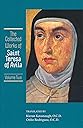
The Collected Works of St. Teresa of Avila, Vol. 2 (featuring The Way of Perfection and The Interior Castle)
Product ID: 8789360
Desertcart purchases this item on your behalf and handles shipping, customs, and support to Senegal.
This volume contains two of Teresa's most popular works: The Way of Perfection and The Interior Castle. Review: The inspiration for the quilt pattern Interior Castle and Castle Walls - This review is for non Catholics who maybe heard of the quilt pattern called Interior Castle or Castle Walls and wanted to learn about the originator of the term. This book is not easy reading and not created for quilters. This book is meant to be studied and acted upon. It is high level reading and just might hurt your feelings and change your perspective on life. I discovered Saint Teresa of Jesus also known as Saint Teresa of Avila by accident. I was studying a quilting pattern that referred to "Interior Castle." I was lead by various online biographical articles to the very interesting Saint Teresa of Avila. When I discovered that she wrote a book, I wanted to read what this woman living in the 1500s had to say. I am still studying this book because it is that intense. She writes to the other nuns calling them "sisters." African Americans sometimes call unrelated African American women "sista or sister" so I am reading the book differently than a Catholic, nun, or scholar. From my viewpoint as a Christian, she is writing to Christian women who have entered a convent. At that time, women were forced into convents which means that many of the nuns were not there because of a spiritual calling. She wrote "...my Sisters...God wants some to have an income, and in their case it's all right for them to worry about their income since that goes with their vocation; but for us to worry, Sisters, would be absurd.' 'Worry about the financial resources of others, it seems to me, would amount to thinking about what others are enjoying.' it seems that the Interior Castle is the soul of a person. The King of the Castle is one of the names of God in the pre-Christian era called -Adonai - who she called "Lord God." Keep in mind that not even nuns had the Bible as we know it today. Women were not typically educated to read and write at a scholarly level. For women to have a book they were authorized to read was an amazing achievement in the 1500s. The first Bible translated into Spanish was about the year 1501 according to http://clausenbooks.com/bible1600.htm. Teresa fought for respect of women who chose to enter religious service and for those women to change on the inside. To my surprise, the near ancestors of Saint Teresa of Avila was - Jewish. Her ancestors for forced to become Catholic or die. I see this book as the voice of a woman forced to slip in a little bit here and there of what she really wanted to say. On page 282 you get a glimpse of the reality she faced - her writings must conform with the Catholic Church or not get published. She wrote in 1577, " If I should say something that isn't in conformity with what the holy Roman Catholic Church holds, it will be through ignorance and not through malice." This is a dangerous book for a woman to read because a little bit of Teresa might leak from the edited pages and infect the mind. Imagine 10 million women focused on prayer for just one day. How would the women be changed? How would the world be changed? No wonder the men edited out what they did not women to know. I believe a little bit of Teresa passed inspection was was permitted to pass through to publication. Imagine learning to read just using this one book! I do not elevate a person - any person - of any religion. They are all just people. Blame that on my nursing background seeing the highest elevated person reduced to the ravages to cancer and death. Calling the person a saint does not elevate my opinion of a person. This book revealed that fact - Carmelite nuns should NOT be put on a pedestal. No religious person should be elevated above yourself. They are just human beings. I look at Teresa as a human being. I read several of her biography's. I could relate to her as a human being. People who have never heard of her are speaking the same spiritual truths that she wrote about in the 1500s. I wondered what made this woman a Saint. After reading more of her biography, I ordered this book. The book titled, The Collected Works of Saint Teresa of Avila Volume Two. Volume Two contains The Way of Perfection, Meditations on the Song of Songs, The Interior Castle. The softback is translated by Kieran Kavannaugh, O.C.D. and Otilio Rodriguez, O.C.D. The paperback book arrived in reasonable time and in perfect new condition. Yes, I would order it again. Teresa was sold out and souled out to her god who she called on page 124 "Emporor, supreme Power, supreme Goodness, Wisdom itself, without beginning, without end, without any limit to Your works." Some people are unable to touch anything related to the Roman Catholic Church which is a shame because closing one's mind in a such an almost racist way causes a self-imposed blindness. This woman fought the same battles that early Christians fought against the same constricting Roman Catholic Church - but she found the battle from within the church itself which seems to be to be a much harder battle. Teresa would not permit the Carmelites to become fodder for men's lusts. I wondered why someone would have to tell a nun not to be full of lust - then i realized the truth. In the 1500s women were thrown into convents for many reasons having nothing to do with spiritual service. Teresa's call to holiness resonated within me hundreds of years later. Many of the women in the convents found themselves prisoners within those convents. They may have been born rich like Teresa, but forced to give away everything to a gold-digging relative with political power. Once they were labeled as nuns, they could not marry. They were stuck. Many were illiterate. There were no careers for them. Teresa wanted a home for these nuns where they would not be under the control of lustful men and other lustful women. The wealthy women would go to the convents and gossip. The convents had become places of anything but spirituality. Teresa was changing the game back to its roots. At this point, I refer Christian woman back to the New Testament teaching about women in the church and will move on to the Interior Castle. This book has a wonderful section at the back which has references, notes, outlines of the prologe and each chapter, index, an appendix to the index which gives page references to the Castle, and a Bible book, chapter, verse biblical references section. For those who are quilters, the Appendix to the Index is where you will see the imagery of the Castle come to life then go read those specific pages. I hope you found this review helpful. I will be studying this book for some time applying the principals of prayer. This is a statement in the book that I do not agree with. I think the statement may have to do more with the fear of men that prayerful women cannot be controlled because the statement was out of character with the rest of the book. Be alert for those passages that may have been inserted to please men. Take with you from page 302: "if you should at times fall don't become discouraged and stop striving to advance. For even from this fall God will draw out good..." Quite frankly, in this book - St. Teresa of Avila sounds like a non catholic who had to insert the words Catholic in order to get published. She sounds non-denominational to me and Pentecostal. Pentecostals pray loud for all to hear in their own "spiritual language" that only themselves and their god understand. Occasionally someone claims to interpret the "spiritual language." Non Denominational Christians believe in "spiritual language" prayer but focus more on praying outloud and yelling during prayer. After decades visiting churches and fellowshipping with Christians, I have found that very few loud prayers are as righteous outside the church as they are when they are shouting their prayers. I like churches that permit shouters, but have an aversion to churches that insist on yelling prayers as if the God of Abraham, Isaac, and Jacob is hard of hearing. I believe there is a time for shouting as a personal release and a time of quietness for personal fellowship. In this book, Teresa accurately points out that why a person prayers is acutely important for the inner person. There are several times when reading the book that I laughed, because Teresa has a sense of humor. I think God has a sense of humor too. I laughed when Teresa wrote: "And it is good for us to consider that He taught this prayer to each of us and that He is showing it to us; the teacher is never so far from his pupil that he has to shout, but he is very close." I loved that statement. Teresa taught how to pray the Our Father prayer also called The Lord's Prayer. She said that praying the Our Father prayer "...involves reflection and that you neither can nor want to pray any other way but vocally..." Many non Roman Catholic churches teach reflective prayer of The Lord's Prayer having no knowledge of Teresa's writings. Many non Roman Catholic churches are taught that repeating The Lord's Prayer - the Catholics call the Our Father - is "vain repetion" mentioned in the Bible. This book is proof that while many Roman Catholics are clueless about the Our Father prayer, not all Roman Catholics fall into the category of vain repetitions. Teresa wrote that the vocal Our Father prayer was also a mental prayer. She wrote "But I tell you that surely I don't know how mental prayer can be separated from vocal prayer if the vocal prayer is to be recited well with an understanding of whom we are speaking to." Some time later, the focus in the Roman Catholic Church would change to praying to a woman named Mary - that Mary was the Father so people only need to pray to Mary to get the message to the Father. Teresa does not teach that false doctrine. Teresa taught that when you pray the Our Father, you are praying directly to the Father - not any other person or saint. That one point is the take-away that I received and wanted to share in this review. "Mental prayer consists of ... being aware and knowing that we are speaking, with whom we are speaking, and who we ourselves are who dare to speak so much with so great a Lord" Page 131. That one statement is the biggest division between Roman Catholics and non Catholic Christians. If you read this review and are not a Christian, this book is worth keeping in your personal library. Roman Catholics do not believe there is any other way to pray for prayers to be heard except through Mary - preferably their version of Mary. I could not understand how a statue of Our Lady of Guadalupe could be passed from house to house, prayed to fervently, fruit and flowers given as offerings to the statue, in these modern times, and the people not know that they are practicing idol worship. The same people wonder why they are having so many problems. Murderers have the pictures and statues of Our Lady of Guadalupe in their homes and tattooed on their bodies. I am convinced that if the same people would read this book and practice its teachings, their lives would be fundamentally changed. I am still looking in the book for where Teresa tells people to find a statue to pray. I thought sure I would be reading that I should find a statue of Mary and pray to Mary - but that is not what I found at all. No wonder this book is hidden from Roman Catholics particularly those who worship Our Lady of Guadalupe. Teresa was Spanish. Although people name their children Teresa, they do not know about this book. I thought to myself, "Wow." Disclaimer: I have lived in a convent for a few months as a child, a Catholic orphanage, and attended Catholic school named Our Lady of Guadalupe. I have much respect for Catholics, nuns, sisters, and the role of Our Lady of Guadalupe in the Mexican communities. The book titled The Collected Works of Saint Teresa of Avila is the missing link that I can now use to show Roman Catholics who believe they cannot have a personal prayer life with "The Father" that they can have a personal prayer life with "The Father" through the Our Father, mental, and reflective prayer. On page 445 she wrote "We have always seen that those who were the closest to Christ our Lord were those with the greatest trials." I apologize in advance if it seems that I have rewritten the book. I assure you that I have not. I have left out some page references due to distractions, but all quotes are from the book. This book is page by page worth reading and the back of the book with all of the extra helps is priceless. I ordered this book blindly not knowing what to expect because of my interest in the Interior Castle and Castle Walls quilt pattern. I wanted the next person to have a better idea of the book. I suspect that most people order this book for use in college or religious studies - hopefully women's studies. I did not write the review for them but if they find this review helpful - that's great. Some Castle Wall quilt design patterns are found at this webpage and quilt books with the patterns and completed blankets and wall art can be purchased on desertcart of course. http://www.earlywomenmasters.net/quilts/c/castle/index.html Now, back to quilting. Review: Enlightenment is awaiting YOU! - One of the Greatest Thinkers of Theology of all time! I had the Privilege of holding her Gold and bejeweled Relics in my own hands in the Church Dedicated to her! With the evils in the changing World, no such access is available today!
| Best Sellers Rank | #47,028 in Books ( See Top 100 in Books ) #4,720 in Christian Living (Books) |
| Customer Reviews | 4.9 out of 5 stars 246 Reviews |
L**G
The inspiration for the quilt pattern Interior Castle and Castle Walls
This review is for non Catholics who maybe heard of the quilt pattern called Interior Castle or Castle Walls and wanted to learn about the originator of the term. This book is not easy reading and not created for quilters. This book is meant to be studied and acted upon. It is high level reading and just might hurt your feelings and change your perspective on life. I discovered Saint Teresa of Jesus also known as Saint Teresa of Avila by accident. I was studying a quilting pattern that referred to "Interior Castle." I was lead by various online biographical articles to the very interesting Saint Teresa of Avila. When I discovered that she wrote a book, I wanted to read what this woman living in the 1500s had to say. I am still studying this book because it is that intense. She writes to the other nuns calling them "sisters." African Americans sometimes call unrelated African American women "sista or sister" so I am reading the book differently than a Catholic, nun, or scholar. From my viewpoint as a Christian, she is writing to Christian women who have entered a convent. At that time, women were forced into convents which means that many of the nuns were not there because of a spiritual calling. She wrote "...my Sisters...God wants some to have an income, and in their case it's all right for them to worry about their income since that goes with their vocation; but for us to worry, Sisters, would be absurd.' 'Worry about the financial resources of others, it seems to me, would amount to thinking about what others are enjoying.' it seems that the Interior Castle is the soul of a person. The King of the Castle is one of the names of God in the pre-Christian era called -Adonai - who she called "Lord God." Keep in mind that not even nuns had the Bible as we know it today. Women were not typically educated to read and write at a scholarly level. For women to have a book they were authorized to read was an amazing achievement in the 1500s. The first Bible translated into Spanish was about the year 1501 according to http://clausenbooks.com/bible1600.htm. Teresa fought for respect of women who chose to enter religious service and for those women to change on the inside. To my surprise, the near ancestors of Saint Teresa of Avila was - Jewish. Her ancestors for forced to become Catholic or die. I see this book as the voice of a woman forced to slip in a little bit here and there of what she really wanted to say. On page 282 you get a glimpse of the reality she faced - her writings must conform with the Catholic Church or not get published. She wrote in 1577, " If I should say something that isn't in conformity with what the holy Roman Catholic Church holds, it will be through ignorance and not through malice." This is a dangerous book for a woman to read because a little bit of Teresa might leak from the edited pages and infect the mind. Imagine 10 million women focused on prayer for just one day. How would the women be changed? How would the world be changed? No wonder the men edited out what they did not women to know. I believe a little bit of Teresa passed inspection was was permitted to pass through to publication. Imagine learning to read just using this one book! I do not elevate a person - any person - of any religion. They are all just people. Blame that on my nursing background seeing the highest elevated person reduced to the ravages to cancer and death. Calling the person a saint does not elevate my opinion of a person. This book revealed that fact - Carmelite nuns should NOT be put on a pedestal. No religious person should be elevated above yourself. They are just human beings. I look at Teresa as a human being. I read several of her biography's. I could relate to her as a human being. People who have never heard of her are speaking the same spiritual truths that she wrote about in the 1500s. I wondered what made this woman a Saint. After reading more of her biography, I ordered this book. The book titled, The Collected Works of Saint Teresa of Avila Volume Two. Volume Two contains The Way of Perfection, Meditations on the Song of Songs, The Interior Castle. The softback is translated by Kieran Kavannaugh, O.C.D. and Otilio Rodriguez, O.C.D. The paperback book arrived in reasonable time and in perfect new condition. Yes, I would order it again. Teresa was sold out and souled out to her god who she called on page 124 "Emporor, supreme Power, supreme Goodness, Wisdom itself, without beginning, without end, without any limit to Your works." Some people are unable to touch anything related to the Roman Catholic Church which is a shame because closing one's mind in a such an almost racist way causes a self-imposed blindness. This woman fought the same battles that early Christians fought against the same constricting Roman Catholic Church - but she found the battle from within the church itself which seems to be to be a much harder battle. Teresa would not permit the Carmelites to become fodder for men's lusts. I wondered why someone would have to tell a nun not to be full of lust - then i realized the truth. In the 1500s women were thrown into convents for many reasons having nothing to do with spiritual service. Teresa's call to holiness resonated within me hundreds of years later. Many of the women in the convents found themselves prisoners within those convents. They may have been born rich like Teresa, but forced to give away everything to a gold-digging relative with political power. Once they were labeled as nuns, they could not marry. They were stuck. Many were illiterate. There were no careers for them. Teresa wanted a home for these nuns where they would not be under the control of lustful men and other lustful women. The wealthy women would go to the convents and gossip. The convents had become places of anything but spirituality. Teresa was changing the game back to its roots. At this point, I refer Christian woman back to the New Testament teaching about women in the church and will move on to the Interior Castle. This book has a wonderful section at the back which has references, notes, outlines of the prologe and each chapter, index, an appendix to the index which gives page references to the Castle, and a Bible book, chapter, verse biblical references section. For those who are quilters, the Appendix to the Index is where you will see the imagery of the Castle come to life then go read those specific pages. I hope you found this review helpful. I will be studying this book for some time applying the principals of prayer. This is a statement in the book that I do not agree with. I think the statement may have to do more with the fear of men that prayerful women cannot be controlled because the statement was out of character with the rest of the book. Be alert for those passages that may have been inserted to please men. Take with you from page 302: "if you should at times fall don't become discouraged and stop striving to advance. For even from this fall God will draw out good..." Quite frankly, in this book - St. Teresa of Avila sounds like a non catholic who had to insert the words Catholic in order to get published. She sounds non-denominational to me and Pentecostal. Pentecostals pray loud for all to hear in their own "spiritual language" that only themselves and their god understand. Occasionally someone claims to interpret the "spiritual language." Non Denominational Christians believe in "spiritual language" prayer but focus more on praying outloud and yelling during prayer. After decades visiting churches and fellowshipping with Christians, I have found that very few loud prayers are as righteous outside the church as they are when they are shouting their prayers. I like churches that permit shouters, but have an aversion to churches that insist on yelling prayers as if the God of Abraham, Isaac, and Jacob is hard of hearing. I believe there is a time for shouting as a personal release and a time of quietness for personal fellowship. In this book, Teresa accurately points out that why a person prayers is acutely important for the inner person. There are several times when reading the book that I laughed, because Teresa has a sense of humor. I think God has a sense of humor too. I laughed when Teresa wrote: "And it is good for us to consider that He taught this prayer to each of us and that He is showing it to us; the teacher is never so far from his pupil that he has to shout, but he is very close." I loved that statement. Teresa taught how to pray the Our Father prayer also called The Lord's Prayer. She said that praying the Our Father prayer "...involves reflection and that you neither can nor want to pray any other way but vocally..." Many non Roman Catholic churches teach reflective prayer of The Lord's Prayer having no knowledge of Teresa's writings. Many non Roman Catholic churches are taught that repeating The Lord's Prayer - the Catholics call the Our Father - is "vain repetion" mentioned in the Bible. This book is proof that while many Roman Catholics are clueless about the Our Father prayer, not all Roman Catholics fall into the category of vain repetitions. Teresa wrote that the vocal Our Father prayer was also a mental prayer. She wrote "But I tell you that surely I don't know how mental prayer can be separated from vocal prayer if the vocal prayer is to be recited well with an understanding of whom we are speaking to." Some time later, the focus in the Roman Catholic Church would change to praying to a woman named Mary - that Mary was the Father so people only need to pray to Mary to get the message to the Father. Teresa does not teach that false doctrine. Teresa taught that when you pray the Our Father, you are praying directly to the Father - not any other person or saint. That one point is the take-away that I received and wanted to share in this review. "Mental prayer consists of ... being aware and knowing that we are speaking, with whom we are speaking, and who we ourselves are who dare to speak so much with so great a Lord" Page 131. That one statement is the biggest division between Roman Catholics and non Catholic Christians. If you read this review and are not a Christian, this book is worth keeping in your personal library. Roman Catholics do not believe there is any other way to pray for prayers to be heard except through Mary - preferably their version of Mary. I could not understand how a statue of Our Lady of Guadalupe could be passed from house to house, prayed to fervently, fruit and flowers given as offerings to the statue, in these modern times, and the people not know that they are practicing idol worship. The same people wonder why they are having so many problems. Murderers have the pictures and statues of Our Lady of Guadalupe in their homes and tattooed on their bodies. I am convinced that if the same people would read this book and practice its teachings, their lives would be fundamentally changed. I am still looking in the book for where Teresa tells people to find a statue to pray. I thought sure I would be reading that I should find a statue of Mary and pray to Mary - but that is not what I found at all. No wonder this book is hidden from Roman Catholics particularly those who worship Our Lady of Guadalupe. Teresa was Spanish. Although people name their children Teresa, they do not know about this book. I thought to myself, "Wow." Disclaimer: I have lived in a convent for a few months as a child, a Catholic orphanage, and attended Catholic school named Our Lady of Guadalupe. I have much respect for Catholics, nuns, sisters, and the role of Our Lady of Guadalupe in the Mexican communities. The book titled The Collected Works of Saint Teresa of Avila is the missing link that I can now use to show Roman Catholics who believe they cannot have a personal prayer life with "The Father" that they can have a personal prayer life with "The Father" through the Our Father, mental, and reflective prayer. On page 445 she wrote "We have always seen that those who were the closest to Christ our Lord were those with the greatest trials." I apologize in advance if it seems that I have rewritten the book. I assure you that I have not. I have left out some page references due to distractions, but all quotes are from the book. This book is page by page worth reading and the back of the book with all of the extra helps is priceless. I ordered this book blindly not knowing what to expect because of my interest in the Interior Castle and Castle Walls quilt pattern. I wanted the next person to have a better idea of the book. I suspect that most people order this book for use in college or religious studies - hopefully women's studies. I did not write the review for them but if they find this review helpful - that's great. Some Castle Wall quilt design patterns are found at this webpage and quilt books with the patterns and completed blankets and wall art can be purchased on Amazon of course. http://www.earlywomenmasters.net/quilts/c/castle/index.html Now, back to quilting.
K**N
Enlightenment is awaiting YOU!
One of the Greatest Thinkers of Theology of all time! I had the Privilege of holding her Gold and bejeweled Relics in my own hands in the Church Dedicated to her! With the evils in the changing World, no such access is available today!
M**Z
" I picked this book up when my spiritual advisor recommended that I read some of St
This book collects two main works: "The Way of Perfection," and "The Interior Castle." In addition, it contains "Meditation on the Song of Songs." I picked this book up when my spiritual advisor recommended that I read some of St. Teresa's writings. St. Teresa writes in a stream of thought type of way. She didn't plan out the chapters yet each one has an insight that was new to me or served as a useful reminder. This book can also serve as a good introduction to Carmelite spirituality.
R**S
A collection of St.Teresa of Avila's greatest works
Here in this collection are St. Teresa of Avila's greatest written books. The "Way of perfection and" the Interior castle" are classic mystical gems. Her meditation on the bible's "Song of songs" is a lesser known work, yet full of the relationship between the soul and its beloved. Anyone exploring mystical writings by St.Teresa of Avila, a Doctor of the church, needs to read this collection of spiritual writings.
C**O
Spiritual resource
Important original document
N**Z
St Teresa of Avila's writings are timeless truth
I have been reading St Teresa of Avila for over 35 years and find her insight, priorities, and guidance to be most helpful. I especially like how she wafts into conversational prayer with the Divine, while continuing to write. A must read for anyone called to the "practice of the presence of God", or to the inward journey of "prayer of the Heart" ( A form of Christian mysticism)
B**N
A wonderful classic for those who wish to grow closer to Jesus
This is a wonderful book. While the Saint’s books were written primarily for the nuns, it is a book that can help and instruct anyone who reads it with an open mind. As a Catholic woman who has studied Teresa of Avila extensively, I must object to “Living and learnings assessment/ remark, That Catholics “worship” Mary. This is a common misconception. There is a VAST difference between worship and veneration, which is actually what Catholics do. Mary gave birth to our Lord and Savior. We love her and venerate her. She is an intercessor for us in prayer, (not unlike asking a friend to pray for you,) however, she ALWAYS points to Jesus. There are many good books on Catholicism as well if she would like to learn more.
D**Y
I am familiar with the books in this volume and am anticipating the delights of the Carmelite printable worksheets as I enjoy th
Have just printed the work sheets for Fr. Kieran Kavanaugh's translation. I am familiar with the books in this volume and am anticipating the delights of the Carmelite printable worksheets as I enjoy the works of this wonderful saint one more time with yet more appreciation of her sharing capacity.
S**N
nice edition
All the volumes of ICS about St. Teresa are perfectly translated. Enjoyed specially The Interior Castle, an spiritual gem.
R**N
Great emphasis is placed on the value of the friendship ...
Here in Vol 2 we have The Way of Perfection (1569), Meditations on the Song of Songs and The Interior Castle (1577). The Way of Perfection is written for the sisters of her first foundation, the monastery of St Joseph in Avila, and so it sets out her vision of how the life of this newly-reformed experiment in Carmelite living should be conducted. Great emphasis is placed on the value of the friendship between the sisters (for this reason she insists that the number in each house should not exced 15. It is supposed to be a family). The other notable feature of this book is her extended treatment of the life of prayer (Chapters 20 - 40), based largely upon her understanding and practice of The Lord's Prayer. The Interior Castle, written at the age of 62 after five years' experience of what she considered to be the highest reaches of prayer, is the magnum opus of her maturity and is entirely based upon her own lived experience. This does not make it any easier to read, I have found! Some people will be helped perhaps by having read a more recent introduction to this great 'tour de force' before coming to the main dish. Select bibliographies are no doubt readily available and any Carmelite friend would be happy to help in selecting which might suit you. Sooner or later I suspect that we are all drawn into grappling directly with Teresa's own voice and her unique selection of imagery. It grows on most of us.
Trustpilot
3 days ago
2 months ago