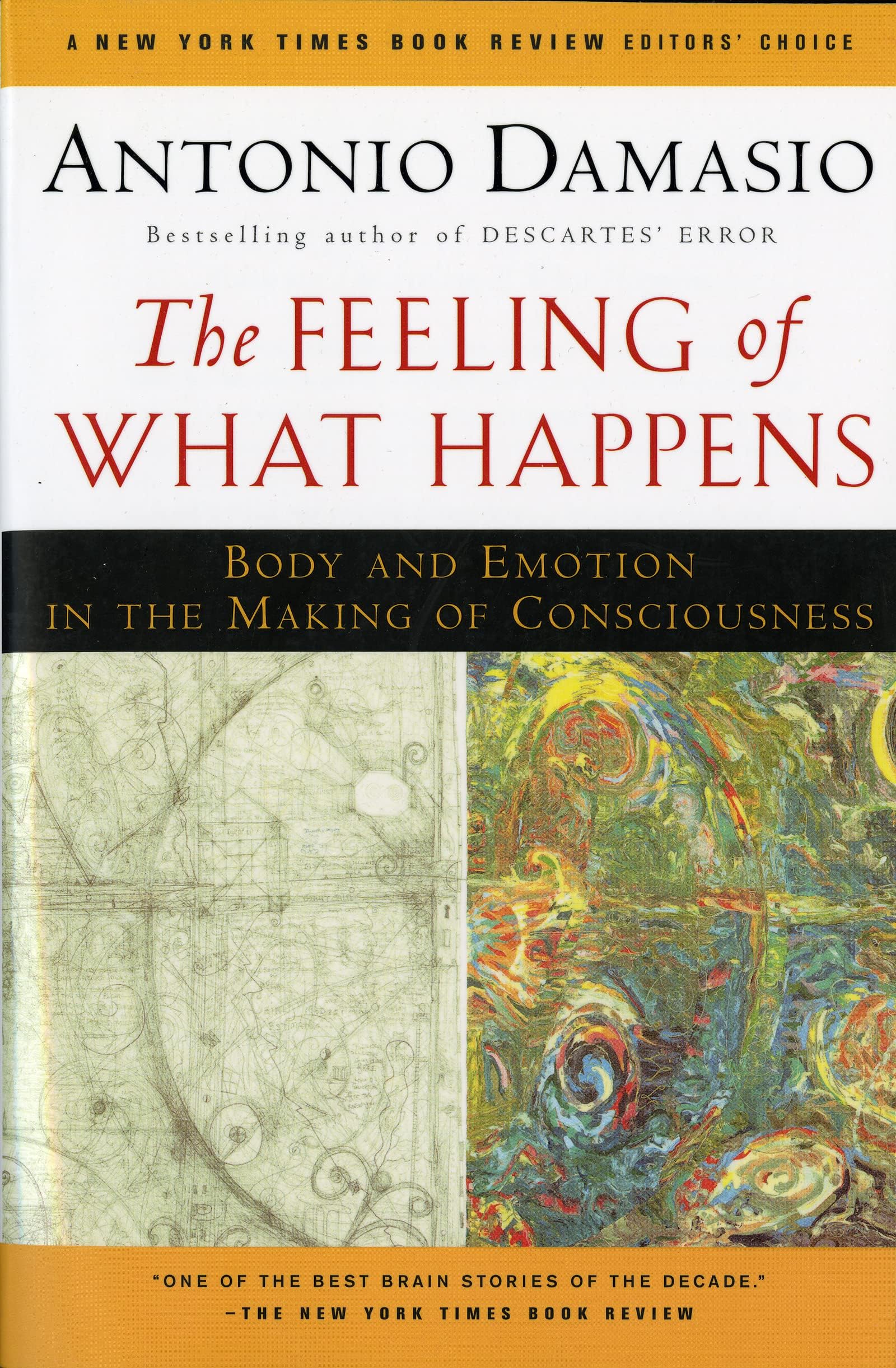
The Feeling Of What Happens: Body and Emotion in the Making of Consciousness ― A Groundbreaking Neuroscience Classic on the Nature of the Self
Product ID: 8718503
Desertcart purchases this item on your behalf and handles shipping, customs, and support to Senegal.
In The Feeling of What Happens: Body and Emotion in the Making of Consciousness, neuroscientist Antonio Damasio, director of UCLA's Brain and Creativity Institute, presents "the first truly compelling neurobiological account of the self...a remarkable work of intellectual daring" (Nature). A New York Times Book Review Editors' Choice Widley praised for his innovative scientific thinking and elegant writing, Antonio Damasio, the international bestselling author of Descartes' Error achieves an understanding of consciousness by asking and answering profound questions: How is it we know what we know? How is it that our conscious and private minds have a sense of self? In this groundbreaking book, Damasio — a renowned and revered scientist and clinician who spent decades following amnesiacs down hospital corridors, waiting for comatose patients to awaken, and devising ingenious research using PET scans to piece together the great puzzle of consciousness — explores the biological roots of sentient awareness and its role in survival. Consciousness is the feeling of what happens-our mind noticing the body's reaction to the world and responding to that experience. Without our bodies there can be no consciousness, which is at heart a mechanism for survival that engages body, emotion, and mind in the glorious spiral of human life. Linking body and emotion in an arresting and original study of what it is to be human, The Feeling of What Happens "will change your experience of yourself" (The New York Times). "Both Descartes Error and The Feeling of What Happens are essential reading. They are ground-breaking classics of psychology and neuroscience."—Journal of the Royal Society of Medicine
| Dimensions | 6 x 1.03 x 9 inches |
| Edition | Reprint |
| Isbn 10 | 0156010755 |
| Isbn 13 | 978-0156010757 |
| Item Weight | 1.2 pounds |
| Language | English |
| Print Length | 400 pages |
| Publication Date | October 10, 2000 |
| Publisher | Mariner Books |
User
An excellent introduction to the nature and importance of consciousness
Damasio's book provides a compelling and unorthodox account of the nature of consciousness, with a thorough background of current and past research into consciousness. Damasio frames his arguments with both the words of a philosopher and a clinician and thus provides his readers with a well-rounded view into the current state of consciousness research.He introduces his style of writing early in the book, namely one in which he will try to be as concise as possible but will have to resort to "asides and digressions" (page 12) to elaborate on his points. Damasio stays true to his word and has many of these asides and digressions in his attempt to explain this material to his readers. However, these asides and digressions do not detract from the book but rather add much needed context for the layperson to understand what is written. For example, Damasio has various case studies interspersed throughout his book to better explain what he writes. He will often describe patients who have certain interesting impairments and will describe how it affects their behavior. For instance, in part one, he talked about a man who had an "absence seizure followed by an absence automatism" to provide an example of someone who lost consciousness yet was still awake - to prove to readers that consciousness is not dependent on wakefulness. Not all his case studies are about neurological impairments though, but rather about abnormalities. In part two, he talked about Maria Pires, a pianist who was able to control her emotional states and literally change brain function just by thinking about it!One of the book's strong points is that it clearly indicates whether the information it is presenting is the author's opinion based on scientific evidence, or if it is the scientific evidence itself that is gained from peer-reviewed studies. This allows the reader to learn many fundamentals of neuroscience and realize how the problem of consciousness is currently being studied. This also allows readers to appreciate the author's commentary (as they understand where its coming from) that further elaborate upon studies, while also giving them an opportunity to form their own opinions.In part one, he introduces his approach to consciousness by defining certain terms he has coined, such as core consciousness and extended consciousness. He provides an evolutionary perspective on why consciousness exists. He introduces certain facts that he has gleaned from research studies that he holds as the background for the analysis of consciousness that will follow. Overall, this part provides a thorough explanation of terms he uses throughout the book and an excellent background that will aid the reader in understanding why Damasio proposes the ideas that he does in this book. I would encourage anyone who reads this book to read this part twice or to refer back to it (along with the appendix) to prevent any confusion when Damasio uses these new terms in later chapters of the book.In part II, Damasio goes into more detail on the terms he had introduced earlier in the book, such as core consciousness. He also introduces some basic neuroanatomy and definitions in this chapter, but in a way that the reader can learn rather than be frustrated and confused. Damasio introduces part II (as he does with the other parts) in a clear manner - by outlining his points before elaborating on it, a technique which is essential to allow the reader to know what Damasio expects them to learn from his writing. For instance, on page 37, Damasio writes, "In this book, I propose that, just like emotion, consciousness is aimed at the organism's survival, and that, just like emotion, consciousness is rooted in the representation of the body... For all these reasons, it is important to discuss the varied features of emotion before we begin addressing consciousness directly." This introduction, though seemingly lengthy, gives the reader a concise and accurate summary of the sections that follow, as well as letting the reader know why Damasio is discussing these concepts. Part II is the first time in the book that Damasio introduces a specific case for a lengthy section of the book. This is important to point out as in many non-fiction books, personal cases and studies can be discussed for many paragraphs and can subsequently cause the reader to lose interest as he/she will no longer be able to discern what the specific case has to do with the point the author is trying to make. Damasio, though, is able to provide a detailed explanation of a memory-impaired patient but remembers to devote the next few paragraphs to teaching the readers why the case is so important.In part three, Damasio goes in much more depth on his terms such as proto-self, core consciousness, extended consciousness and even terms that he has given new meaning to, such as "object." He writes more on how different brain regions may lend themselves to forming consciousness and devotes considerable attention to certain brain regions such as the reticular formation which play an immense role in consciousness.Part four provides more information and analysis on emotion itself and gives a general overview of consciousness and its role in life. As always, he ties in evolutionary theories and other arguments and facts he exposed in previous parts to make sure that the reader is getting a holistic view and does not remain tied down with the details. Oddly enough, the ending of this book provides a sort of non-fiction cliffhanger. The reader is left wondering where research into consciousness will lead next and just how many of Damasio's theories will be truly validated.Ultimately, this book is a groundbreaking piece of work that will enable its readers to understand where research into consciousness lies today and more importantly, why it matters. It will appeal to the philosopher, the clinician, the scientist and everyone in between!
User
Another Chance for the Affective Domain
"There would have been good reason to expect that, as the new century started the expanding brain sciences would make emotion part of their agenda.... But that...never came to pass. ...Twentieth Century science...moved emotion back into the brain, but relegated it to the lower neural strata associated with ancestors whom no one worshipped. In the end, not only was emotion not rational, even studying it was probably not rational." Damasio, 1999, p. 39With that statement, Damasio courageously took his own discipline's psychologists and neuroscientists to the woodshed for ignoring the importance of the affective domain, and that quotation perhaps explains the love-hate relationship that different reviewers express about this particular book.His observation is verifiable. One source is the history of citations on "emotion regulation" in the Handbook of Emotion Regulation by James J. Gross, editor. Another is the consignment of Benjamin Bloom's research team's second volume Taxonomy of Educational Objectives Book 2/Affective Domain to a collector's item in used book heaps. In all honesty, that 1964 volume was decades ahead of its time, well before Damasio's, and it is still a useful resource if you can get a copy. It is unfortunate how quickly its importance was dismissed, but Damasio's statement largely shows why Bloom's older volume 1 on the cognitive domain Taxonomy of Educational Objectives, Handbook 1: Cognitive Domain received a much warmer reception. John Dunlosky and Janet Metcalfe Metacognition noted that history reveals psychologists according metacognition with similar low status and held metacognition hostage for a time as an aspect of consciousness not worth the study.Damasio's work seems instrumental in accounting for the exponential upswing in research on affect. I found the book fascinating, not particularly difficult reading, and a useful resource to me as a college teacher and faculty developer. I've recommended it to many professors.
User
This book will help me teach my son that becoming "bionic" isn't a good idea!
We have the "transhuman" argument, he and I. It is becoming more popular among the kids. I guess Elon Musk putting chips into peoples' brains is a point for my son's side. But going full- on "human brain in a robot body" - no. I think it can't work, precisely because of what Dr. Damasio writes here. Your body is part of being conscious. How can you be you, and KNOW it, if you are plunked down into a robot? Excellent argument for my side!
User
well-written and inspiring work
By this time, there has been considerable praise already written for this book. I'll simply add my praise to the aggregate whole. I've also read Damasio's "self comes to mind" and the two books truly compliment each other. You might want to consider reading both books. He truly concentrates on the perceptive interpretation of emotions, which he calls a "feeling-percept". and this feeling-percept is just as important as the cognitive-percept for forming the state of consciousness. One cannot be excluded from the other. You can get the whole picture by shortening the book and reading pages 3-273. And then jump to his other book, "self comes to mind. It's easily 5 stars and I recommend to all. It is well written which is another plus for a neuro-scientist. Enjoy.
User
A great book, but the goal still seems a long way off
This is a fabulous book about the way that the brain interacts with the body, and with signals from the external world, to produce consciousness. That being said, there are long stretches of theorizing that could have been usefully broken up by more research -- laboratory or clinical; Pinker's How the Mind Words strikes a better combination. More seriously, I'm not convinced that Damasio achieves his objective: to explain consciousness. The closer he gets to that holy grail, the more he lapses into metaphors and appeals to poetry, a sure sign of trouble. Furthermore, to the extent that he sticks to the cognitive science lingo of mapping and images, I kept thinking that what he considers to be the essence of consciousness -- second-order images of the interaction of images of the world with images from the body -- could be replicated on a computer, without this producing consciousness in the sense that humans and (other) animals have it. While the book left me with a much-improved understanding of the biological supports of consciousness, an analysis of preconditions does not an explanation make.
User
Beautiful and philosophical
This is a beautiful and eloquent book, and very philosophical. I found it very thought provoking. If you're tired of all the pop culture psychology books and want a deeper perspective on consciousness I highly recommend reading this. It reminded me at times of Jordan Peterson's "Maps of Meaning" which I loved.
User
Insighful,profound .
This scholar deserves all the respect, such scholarship and insight are rare in this age omniscient pseudo science that over simplifies the complexity of a human brain.Its affects, emotions and feeling are now proven to be inextricably intersecting as we experience the vicissitudes of living this human life! This knowledge is priceless.Man is not a simple machine.
User
PAID FOR NEW BOOK, RECEIVED DAMAGED OR USED
Might be a great book, content looks promising. My 3 star response here is due to condition of the book. It is clearly damaged. Came on a standard bubble wrap mailer. The mailer was not damaged so it appears this from prior to shipping, or it is used. It obviously doesnt affect the ability to ‘use’ the book so I wont be returning it, but it should not have been shipped out as a ‘new’ item.
User
tough read
Well worth it. However it takes perseverance to make it through the very dense explanation, which is very necessary for what is being presented here - a different way of looking at being conscious
User
Fascinant
Un livre passionnant pour ceux qui veulent comprendre comment fonctionne l'être humain, quels sont les fondements physiologiques de nos sentiments, réactions et raisonnements. Une matière complexe racontée de façon simple et même souvent poétique par un grand spécialiste des neurosciences, qui a suivi de près des patients handicapés par des accidents dans le cerveau. Non seulement très instructif mais aussi un vrai plaisir.
User
Quite a ride!!
Very informative and super helpful
User
Paradigm-changing classic
Hardly an accessible read, though more so than Descartes' Error, yet worth persevering with - for me, a densely detailed yet revelatory model of the arising and maintenance of the felt sense of self, and the most persuasive such model yet, which has (unspoken) parallels with much early Buddhist thought. That being the case, it's surprising that Damasio was so resistant to considering the effect of meditation on self-states.
User
Great book
Amazing book, no further explanation needed. If you're interested in the science and theories of consciousness you're going to enjoy Damasio's theory.
Trustpilot
1 week ago
2 months ago