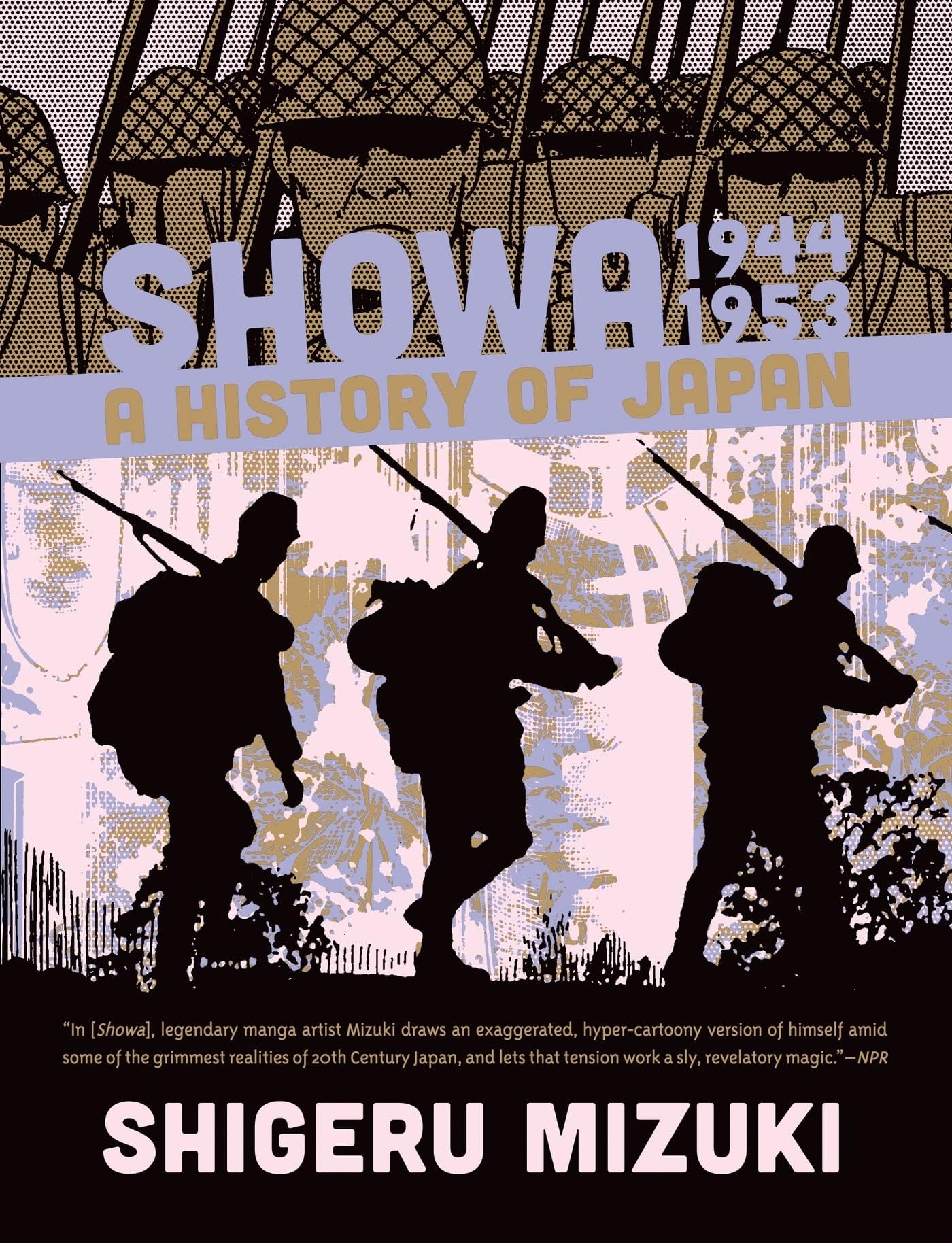
Showa 1944-1953: A History of Japan (Showa: A History of Japan, 3)
Product ID: 8717197
A sweeping yet intimate portrait of the legacy of World War II in Japan Showa 1944–1953: A History of Japan continues the award-winning author Shigeru Mizuki's autobiographical and historical account of the Showa period in Japan. This volume recounts the events of the final years of the Pacific War, and the consequences of the war's devastation for Mizuki and the Japanese populace at large. After the surprise attack at Pearl Harbor, Japan and the United States are officially at war. The two rival navies engage in a deadly game of feint and thrust, waging a series of microwars across the tiny Pacific islands. From Guadalcanal to Okinawa, Japan slowly loses ground. Finally, the United States unleashes the deathblow with a new and terrible weapon―the atomic bomb. The fallout from the bombs is beyond imagining. On another front, Showa 1944–1953 traces Mizuki's own life story across history's sweeping changes during this period, charting the impact of the war's end on his life choices. After losing his arm during the brutal fighting, Mizuki struggles to decide where to go: whether to remain on the island as an honored friend of the local Tolai people or return to the rubble of Japan and take up his dream of becoming a cartoonist. Showa 1944–1953 is a searing condemnation of the personal toll of war from one of Japan's most famous cartoonists. Review: An Epic Masterpiece! - I first learned about Shigeru Mizuki when I got a sample of this series on free comic book day. This is part of a series of four large graphic novels that give an excellent overview of Japanese history during the Showa period. The books combine the overview of Japanese history with autobiographical information from the author's perspective. There is an emphasis in the series on events surrounding World War II and the author's experience as a Japanese soldier during that time. Illustrations are a mix of highly realistic and cartoonish styles. This is the kind of story that teaches while drawing you in to one man's personal story. Lots of drama, humor, sadness, etc. This story really makes you think about what leads us to war and the effects of nationalism on real people. Review: The Empire of Japan falls and manga begins to rise in the third volume of Shigeru Mizuki's magnum opus... - The second volume of Shigeru Mizuki's amazing biographical historical magnum opus, "Showâ," ended on a mandible plummeting cliff hanger. The third volume picks up where that tense moment left off and continues the incredible tale of both Japan under the rule of the Emperor Hirohito and Mizkui's personal involvement in that era. The story shifts from omnisciently narrated history, led by the now very familiar Nezumi Otoko, to a singular microcosm of the age told through Mizuki himself. A flood of information fills the pages, especially for those unfamiliar with 20th century Japanese history, but the juxtaposition of history and biography works perfectly. Nezumi Otoko helps weave the two parallel but related stories into one harmonious union. The epic's entirety, encased in 4 enormous volumes, creates an unforgettable portrait of the twentieth century from a Japanese perspective. Much of this often horrifying story has faded into legend or even into oblivion for succeeding generations. World War II still stands as one of the bloodiest and most destructive wars the planet has ever seen. Japan played a large and ultimately tragic role in that massive conflict and "Showâ" presents a point of view not often seen in the West. Mizuki never glamorizes fascist Japan. He often rebukes to the point of disgust, confusion and aggravation. As many Mizuki fans know, it cost him an arm and almost took his life on multiple occasions. Only outstanding luck seemed to see him through. Volume three of "Showâ" covers the years from 1944 to 1953. These years span the end of the Second World War and the ensuing American Occupation of Japan under Douglas MacArthur. These represent probably the most turbulent and disturbing times for modern Japan. An empire fell and its people suffered horribly under its oppressive laws and ethos. Thankfully things started to take a turn for the better as the 1950s dawned. From this incomprehensible chaos the modern state of Japan emerged. The book opens with "The Tragedy of Imphal." Many consider the decisive Battle of Midway as the war's most pivotal turning point. "Showâ" argues that the failures at Imphal, a city in Burma, proved even more decisive and irreversible. Midway left the Japanese Empire badly maimed, but Imphal apparently stuck a near final blow. After Imphal, things became shockingly desperate. Nezumi Otoko even says "In pursuit of personal honor, Japan's commanders neglect supply lines and wantonly waste soldiers' and civilians' lives." Things will only get worse. Meanwhile, Mizuki finds himself literally hanging from a cliff to escape detection. Then he has to outmaneuver natives and escape into the jungle to avoid capture. He claims that a yokai kept him from falling over a cliff. Eventually he runs right into the navy and face angry questions about why he survived Baien. According to his "superiors," he should have faced a "noble death" and died fighting, no matter how hopelessly. This theme returns more ominously as Japan's costly war losses mount in the Pacific. The beatings, so frequent in Volume Two, continue unabated. Then malaria strikes, but the Japanese Army does not consider this an excuse for loafing. Rabaul, Truk Island, New Britain, the Marshall Islands, Palau, all witness humiliating defeats for Japan. Things just get worse for the soldiers, but Mizuki gets a surprise and much welcome service award for drawing his commander Hanafuda cards. War also continued with China, called the second Sino-Japanese war. Japan also starts losing to the Chinese Communist Army. The American B-29 then flies into service. General Tôjô initiates a policy of no retreat, no surrender. A-go and Saipan continue the losing streak. A bewildering and deeply disturbing massacre through mass suicide occurs in Saipan. America soon gains superiority in nearly every battle technology. Talk of "noble deaths" for soldiers escalates. Tôjô fumes "I'd rather see the death of the entire country than admit the smallest defeat." Things look pretty hopeless. The bombings begin and never let up. Okinawa, Taiwan and Yawate receive showers of bombs, some with napalm. MacArthur returns to Leyte as promised. Under increasing pressure, the infamous Kamikaze missions begin. Excessive rationing grips Japan and some people face starvation. Japan makes more missteps in Leyte Gulf. Allies appear everywhere. Mizuki narrowly escapes death as his squad takes massive fire while he fetches water, only to escape it again thanks to a commander who doesn't believe in dying a "noble death." The war in Europe closes as the Nazis fall and the Allied leaders meet in Yalta and plan to end the war in the Pacific. Iwo Jima sees fierce combat and Japan launches balloon bombs on California. Six people die. Back in the Pacific, a pathetically desperate plan to ram the battleship Yamato into the US fleet fails before it starts. The bombings continue over Japan. To prevent fires, houses, including Mizuki's parents' house, are leveled. At Marunga, Mizuki again succumbs to malaria. He loses his arm during an attack by Australian forces. It forms a gruesome infection, maggots and all. Commanders who allow their soldiers to live receive orders to commit suicide. Many continue to march out to "noble deaths." Nonetheless, Tôjô will not admit defeat to the Emperor, who makes another rare appearance. Mizuki, drained from malaria and infection, comes across the Tolai people. They take him in as one of their own, call him "Paul," and feed and nurse him. The allies, after meeting at Potsdam, begin a full-scale invasion of Japan, beginning at Kyûshu. Then the atomic bombs drop on Hiroshima and Nagasaki and Russia invades Japan from the north. Japanese leaders argue over what to do, but few want to surrender until the Emperor intervenes and calls for an end to the war and to "bear the unbearable." A phonograph recording of his formal classical Japanese speech pervades the airwaves, but apparently few can really understand it, though they comprehend the basic message. On the battleship Missouri, Japan finally surrenders on November 2, 1945. The American occupation begins under MacArthur and GHQ. A simple photo of him next to the Emperor, stripped of his divinity, lets everyone know where things now stand. Mizuki almost stays with "The People of the Forest," but after a wait he does return home to post-war Japan. The Emperor tours Japan to great adulation while the Class-A war criminals go on trial. Many hang, including Tôjô. Nezumi Otoko reflects that "the winning country gets to detemine what is and isn't a war crime." A new Constitution gets drafted. The Zaibatsu are dissolved. Ideas of democracy spread even though school books contain numerous redactions. Mizuki tries to make various livings through various means, but prices skyrocket. Two of Nezumi Ototko's friends, Baba and Jiji, help delineate the situation. A long sad string of US soldiers raping Japanese women begins. Prostitution, private not public, remains legal. Mizuki needs surgery on the remains of his lost arm. He finds himself with a ragtag group occupying abandoned buildings and guarding baskets. The world reforms following World War II. A cold war breaks out between the US and USSR. Korea breaks in two and the Korean War begins in 1950. Mizuki goes back to school after surprisingly cashing in on one of his business ventures. He ends up drawing Kamishibai, a precursor to manga. GHQ breaks unions and stops worker strikes. A number of suspicious incidents occur. On a constant quest to raise money, Mizuki follows a business partner with the goal of harvesting bird poop from Bourbon island. Mizuki earns the title "lice boy" along the way. Instead, he buys an inn and puts up Kamishibai artists. One proudly proclaims "took my first crap in ten days!" and then sets Mizuki up to see Katsumaru Suzuki, a Kamishibai master. He gives Mizuki the name the world now knows him by, Mizuki. He also asks Mizuki to put up Koji Kata the greatest Kamishibai artist in Japan. Nezumi Otoko muses "Shigeru Mizuki has a strange sense that his life has changed forever." Japan's global pride slowly revives thanks to Olympic swimmer Hironoshin Furuhashi and Nobel Laureate Hideki Yukawa. But storm clouds loom when loan shark Akitsugu Yamazaki commits suicide. Again, Nezumi Otoko: "Capitalism can be heartless and severe - a lesson Japan learns well." Following a shooting, Mizuki learns that he lived next to a gang. He moves to Nishinomiya as the heyday of Kamishibai fades. GHQ begins rooting out communists as the Korean war rages. US uses Japan as a base for military operations which causes an economic boom throughout Japan. MacArthur loses his command when his forces fail to take Seoul. Japan begins to modernize and Kamishibai's audiences have dwindled, but at the end of Volume three Mizuki's famous Kitaro and Sanpei the Kappa characters begin to make an impact. Kata tells Mizuki about the new comic book craze in Tokyo. So, still meandering, he boards a train for Tokyo. Volume Three reaches a climax with the end of World War II and the grim violence relaxes somewhat despite the turmoil of the occupation. The story turns more to Mizuki's aimless life and eventual destiny as one of Japan's most renowned manga artists. So far circumstance and luck have provided guidance. But his fortunes seem to improve along with his country's. As economic growth intensifies, Mizuki will find himself at the apex of the burgeoning comic book scene. Luck, along with some yokai, helped him survive the catastrophe of World War II. Luck, along with talent and wads of perseverance, will now likely provide him with more opportunities. The final volume covers the end of the Showâ era from 1953 up to the death of Hirohito. Those were also very interesting years for Japan.
| Best Sellers Rank | #2,777,773 in Books ( See Top 100 in Books ) #19 in Nonfiction Manga (Books) #32 in Drawn & Quarterly Comic & Graphic Novels |
| Customer Reviews | 4.8 out of 5 stars 198 Reviews |
P**L
An Epic Masterpiece!
I first learned about Shigeru Mizuki when I got a sample of this series on free comic book day. This is part of a series of four large graphic novels that give an excellent overview of Japanese history during the Showa period. The books combine the overview of Japanese history with autobiographical information from the author's perspective. There is an emphasis in the series on events surrounding World War II and the author's experience as a Japanese soldier during that time. Illustrations are a mix of highly realistic and cartoonish styles. This is the kind of story that teaches while drawing you in to one man's personal story. Lots of drama, humor, sadness, etc. This story really makes you think about what leads us to war and the effects of nationalism on real people.
E**K
The Empire of Japan falls and manga begins to rise in the third volume of Shigeru Mizuki's magnum opus...
The second volume of Shigeru Mizuki's amazing biographical historical magnum opus, "Showâ," ended on a mandible plummeting cliff hanger. The third volume picks up where that tense moment left off and continues the incredible tale of both Japan under the rule of the Emperor Hirohito and Mizkui's personal involvement in that era. The story shifts from omnisciently narrated history, led by the now very familiar Nezumi Otoko, to a singular microcosm of the age told through Mizuki himself. A flood of information fills the pages, especially for those unfamiliar with 20th century Japanese history, but the juxtaposition of history and biography works perfectly. Nezumi Otoko helps weave the two parallel but related stories into one harmonious union. The epic's entirety, encased in 4 enormous volumes, creates an unforgettable portrait of the twentieth century from a Japanese perspective. Much of this often horrifying story has faded into legend or even into oblivion for succeeding generations. World War II still stands as one of the bloodiest and most destructive wars the planet has ever seen. Japan played a large and ultimately tragic role in that massive conflict and "Showâ" presents a point of view not often seen in the West. Mizuki never glamorizes fascist Japan. He often rebukes to the point of disgust, confusion and aggravation. As many Mizuki fans know, it cost him an arm and almost took his life on multiple occasions. Only outstanding luck seemed to see him through. Volume three of "Showâ" covers the years from 1944 to 1953. These years span the end of the Second World War and the ensuing American Occupation of Japan under Douglas MacArthur. These represent probably the most turbulent and disturbing times for modern Japan. An empire fell and its people suffered horribly under its oppressive laws and ethos. Thankfully things started to take a turn for the better as the 1950s dawned. From this incomprehensible chaos the modern state of Japan emerged. The book opens with "The Tragedy of Imphal." Many consider the decisive Battle of Midway as the war's most pivotal turning point. "Showâ" argues that the failures at Imphal, a city in Burma, proved even more decisive and irreversible. Midway left the Japanese Empire badly maimed, but Imphal apparently stuck a near final blow. After Imphal, things became shockingly desperate. Nezumi Otoko even says "In pursuit of personal honor, Japan's commanders neglect supply lines and wantonly waste soldiers' and civilians' lives." Things will only get worse. Meanwhile, Mizuki finds himself literally hanging from a cliff to escape detection. Then he has to outmaneuver natives and escape into the jungle to avoid capture. He claims that a yokai kept him from falling over a cliff. Eventually he runs right into the navy and face angry questions about why he survived Baien. According to his "superiors," he should have faced a "noble death" and died fighting, no matter how hopelessly. This theme returns more ominously as Japan's costly war losses mount in the Pacific. The beatings, so frequent in Volume Two, continue unabated. Then malaria strikes, but the Japanese Army does not consider this an excuse for loafing. Rabaul, Truk Island, New Britain, the Marshall Islands, Palau, all witness humiliating defeats for Japan. Things just get worse for the soldiers, but Mizuki gets a surprise and much welcome service award for drawing his commander Hanafuda cards. War also continued with China, called the second Sino-Japanese war. Japan also starts losing to the Chinese Communist Army. The American B-29 then flies into service. General Tôjô initiates a policy of no retreat, no surrender. A-go and Saipan continue the losing streak. A bewildering and deeply disturbing massacre through mass suicide occurs in Saipan. America soon gains superiority in nearly every battle technology. Talk of "noble deaths" for soldiers escalates. Tôjô fumes "I'd rather see the death of the entire country than admit the smallest defeat." Things look pretty hopeless. The bombings begin and never let up. Okinawa, Taiwan and Yawate receive showers of bombs, some with napalm. MacArthur returns to Leyte as promised. Under increasing pressure, the infamous Kamikaze missions begin. Excessive rationing grips Japan and some people face starvation. Japan makes more missteps in Leyte Gulf. Allies appear everywhere. Mizuki narrowly escapes death as his squad takes massive fire while he fetches water, only to escape it again thanks to a commander who doesn't believe in dying a "noble death." The war in Europe closes as the Nazis fall and the Allied leaders meet in Yalta and plan to end the war in the Pacific. Iwo Jima sees fierce combat and Japan launches balloon bombs on California. Six people die. Back in the Pacific, a pathetically desperate plan to ram the battleship Yamato into the US fleet fails before it starts. The bombings continue over Japan. To prevent fires, houses, including Mizuki's parents' house, are leveled. At Marunga, Mizuki again succumbs to malaria. He loses his arm during an attack by Australian forces. It forms a gruesome infection, maggots and all. Commanders who allow their soldiers to live receive orders to commit suicide. Many continue to march out to "noble deaths." Nonetheless, Tôjô will not admit defeat to the Emperor, who makes another rare appearance. Mizuki, drained from malaria and infection, comes across the Tolai people. They take him in as one of their own, call him "Paul," and feed and nurse him. The allies, after meeting at Potsdam, begin a full-scale invasion of Japan, beginning at Kyûshu. Then the atomic bombs drop on Hiroshima and Nagasaki and Russia invades Japan from the north. Japanese leaders argue over what to do, but few want to surrender until the Emperor intervenes and calls for an end to the war and to "bear the unbearable." A phonograph recording of his formal classical Japanese speech pervades the airwaves, but apparently few can really understand it, though they comprehend the basic message. On the battleship Missouri, Japan finally surrenders on November 2, 1945. The American occupation begins under MacArthur and GHQ. A simple photo of him next to the Emperor, stripped of his divinity, lets everyone know where things now stand. Mizuki almost stays with "The People of the Forest," but after a wait he does return home to post-war Japan. The Emperor tours Japan to great adulation while the Class-A war criminals go on trial. Many hang, including Tôjô. Nezumi Otoko reflects that "the winning country gets to detemine what is and isn't a war crime." A new Constitution gets drafted. The Zaibatsu are dissolved. Ideas of democracy spread even though school books contain numerous redactions. Mizuki tries to make various livings through various means, but prices skyrocket. Two of Nezumi Ototko's friends, Baba and Jiji, help delineate the situation. A long sad string of US soldiers raping Japanese women begins. Prostitution, private not public, remains legal. Mizuki needs surgery on the remains of his lost arm. He finds himself with a ragtag group occupying abandoned buildings and guarding baskets. The world reforms following World War II. A cold war breaks out between the US and USSR. Korea breaks in two and the Korean War begins in 1950. Mizuki goes back to school after surprisingly cashing in on one of his business ventures. He ends up drawing Kamishibai, a precursor to manga. GHQ breaks unions and stops worker strikes. A number of suspicious incidents occur. On a constant quest to raise money, Mizuki follows a business partner with the goal of harvesting bird poop from Bourbon island. Mizuki earns the title "lice boy" along the way. Instead, he buys an inn and puts up Kamishibai artists. One proudly proclaims "took my first crap in ten days!" and then sets Mizuki up to see Katsumaru Suzuki, a Kamishibai master. He gives Mizuki the name the world now knows him by, Mizuki. He also asks Mizuki to put up Koji Kata the greatest Kamishibai artist in Japan. Nezumi Otoko muses "Shigeru Mizuki has a strange sense that his life has changed forever." Japan's global pride slowly revives thanks to Olympic swimmer Hironoshin Furuhashi and Nobel Laureate Hideki Yukawa. But storm clouds loom when loan shark Akitsugu Yamazaki commits suicide. Again, Nezumi Otoko: "Capitalism can be heartless and severe - a lesson Japan learns well." Following a shooting, Mizuki learns that he lived next to a gang. He moves to Nishinomiya as the heyday of Kamishibai fades. GHQ begins rooting out communists as the Korean war rages. US uses Japan as a base for military operations which causes an economic boom throughout Japan. MacArthur loses his command when his forces fail to take Seoul. Japan begins to modernize and Kamishibai's audiences have dwindled, but at the end of Volume three Mizuki's famous Kitaro and Sanpei the Kappa characters begin to make an impact. Kata tells Mizuki about the new comic book craze in Tokyo. So, still meandering, he boards a train for Tokyo. Volume Three reaches a climax with the end of World War II and the grim violence relaxes somewhat despite the turmoil of the occupation. The story turns more to Mizuki's aimless life and eventual destiny as one of Japan's most renowned manga artists. So far circumstance and luck have provided guidance. But his fortunes seem to improve along with his country's. As economic growth intensifies, Mizuki will find himself at the apex of the burgeoning comic book scene. Luck, along with some yokai, helped him survive the catastrophe of World War II. Luck, along with talent and wads of perseverance, will now likely provide him with more opportunities. The final volume covers the end of the Showâ era from 1953 up to the death of Hirohito. Those were also very interesting years for Japan.
P**F
A personal history worth telling
I devoured this manga, as I have with the other two preceding volumes. And while you could fault the somewhat one-damned-fact-after-another approach he takes to relaying the main events of the war, the artwork traced from photos somehow both dates and brings the book alive; it's like a scrapbook of key events, but only the ones he remembers as having much significance. But he really excels in telling his own remarkable story of survival against the evils of malaria, starvation and Japanese military discipline. That he emerged from the jungles with his humanity in tact is a remarkable feat and one worth celebrating. Read this.
P**D
Best of the first 3. More personal, more detailed
Bottom Line First: Showa: A history of Japan 1944-1953 is so far the best of this 4 book series by Shigeru Mizuki. There is a more complete picture of the politics and history of Japan from the closing days of WW II and the financial recovery from the war with the beginning of America’s involvement in the Korean War. Mizuki brings us much closer to his personal experiences as a soldier and citizen. He shares his suffering as a battlefield amputee and a malaria victim. He is honest about his struggle to survive in ruined Japan and to find for himself his future. He does not use any of this to portray himself as a victim. He is a proud Japanese and perhaps too unwilling to admit that Japan was the author of its destruction, or that occupied Japan was treated better than those it had invaded. Even so this is a view of this time period from one of its survivors and carries with it the honest that goes with his point of view. Recommended, and more highly than books 1 or 2. There is violence but Mizuki is cover war. There may be some colorful language but it is rare and appropriate to the speaker and the situation. Early in the book, Mizuki, the soldier makes friends with some local some tribal people. He does so mostly against the rules of the Army and much to his benefit. This would have been a good time to ask why Natives and Japanese troops had not formed many personal relationships. Mizuki may not have known, or he may not have wanted to speak to some of the worst aspects of local life under the Japanese’s Army. Certainly there were excess by some units in the allied army, but his book is only about Japanese’s history. Once repatriated to Japan, his presentation remains matter of fact. His brother guilt as a war criminal seems to be unfair, 70 plus years later, but Mizuki does not dwell upon it. We gt a taste of how the post war years were a trial and a scramble on everyone, but most he reports and makes little in the way of editorial. There is a steady repetition of major events by day and year; but very little in the way of context or analysis for anyone, especially a non-Japanese reader to understand why this or that event worthy. Part of this is because his intended reader was a Japanese person who may not have lived through this period by might know them from School. His goal was to make his own statement to his younger generation, about the history of 20th Century Japan not as told in the classroom. Having gotten used to Mizuki’s combination of hyper realism, involving a photograph to comic format he pioneered; interleaved with more traditional Manga cartoon style, I find this approach more reasonable and easy to follow. I will be reading Book four and with more anticipation than I felt at the end of either books 1 or 2.
D**N
Mizuki is an amazing author and illustrator
Mizuki is an amazing author and illustrator, and his story is both beautiful and terrifying. (It's amazing that this series exists at all.) I was never a manga fan, but this series is truly amazing in its scope and presentation. I have the middle two volumes in this series, and will probably buy the other two very soon.
W**R
Showa Is A Gift To Ages
Shigeru Mizuki is a gift from Japan to the world. A bane to Japan's racists, nationalists, and revisionists. The antidote to the Shinzo Abe administration. If ever you have been discouraged by the Japanese government's current policies viz-a-viz their continued patronage of Yazukuni Shrine and denials of the Nanjing Massacre and the comfort women system and their horrendous sanitizing of history in their official textbooks, Mizuki's Showa series will restore your faith in the truth of the Japanese people and the honor at the core of the Japanese nation. Mizuki-san lived through all of the troubled Showa era. A survivalist with a sense of humor and a talent to convey his times in a page-turning manga like no other. Domo Arigato Gozaimasu, Shigeru Mizuki. Truth Teller. Master of Manga.
E**.
It gives a great story with lots of historical information
I bought the series of these and went through them all in just a couple weeks. I didn't know much about Japan's history and found this to be an accessible and fascinating introduction. It gives a great story with lots of historical information. I found myself doing outside research because I wanted to know more about the items mentioned.
S**.
Great art, compelling narrative and edifying
Great art, compelling narrative and edifying. Anybody who likes to see how other nations tell their history will adore this volume of work.
P**L
Lohnt sich!
Wunderbare, lebendige, hintergründige und vor allem selbstkritische Geschichte Japans. Aber spätestens mit dem dem 3. Buch wiederholen sich einige Bilder. Ruhig die Lektüre etwas aufteilen.
G**B
Original book
Was exactly the edition needed to complete my series of four of the same author. Ultra prompt delivery. Tks.
S**S
A brilliantly informative and entertaining read!
After being introduced to Mizuki's Showa series due to an excerpt of Showa 1939-1944 being a required reading in my Japanese Studies history module, I was thoroughly impressed and bought all four. This one does not disappoint: it begins with Mizuki, as well as the Empire of Japan, at its lowest point, and both suffer terribly. And we then see chaos unfold as the war comes to a conclusion, and then the aftermath as the US begins its occupation of Japan, and Mizuki has to leave his newfound friends from the Tolai tribe. We see glimmers of hope and change as Mizuki, and the rest of Japan, try to survive the poverty-stricken early post-war period and deal with the aftershock of the war and the two enormous explosions that swiftly ended it. Nezumi Otoko, the half-human, half-rat Yo-kai narrates, guiding us through this tumultuous period in Japan's history, and you may recognise him from Mizuki's most famous work, Gegege no Kitaro (which I myself am eager to read now, I've just ordered Drawn and Quarterly's Kitaro). And Mizuki's style, contrasting realistic, gritty-looking imagery, in many cases drawings of photographs of events, with his cartoonish drawings (most hilariously contrasting the photograph-looking drawing of Churchill, Stalin and Roosevelt meeting at the Potsdam conference with his own caricatures). The narrative structure, weaving his own autobiographical story alongside the historical facts - so that we can better understand both - is wholly unique. My reccomendation is that you read the previous two volumes first - 1923-1939 and 1939-1944 - as then you can better understand the story of Mizuki and Showa-era Japan from start to finish.
M**O
Un manga per appassionati di storia
Shigeru Mizuki è uno dei più famosi mangaka giapponesi, specializzato nelle storie del folklore nipponico. In questo caso di focalizza sulla storia del Giappone dell'era Showa (1939-1944) e ci narra parte della sua vita. E' un manga molto interessante, pesante sotto alcuni aspetti, ma adatto soprattutto agli appassionati di storia o della cultura/storia del Giappone. Nel volume, Mizuki, utlizza tecniche artistiche differenti: da semplici disegni a schizzi molto realistici degli eventi di quegli anni. Nel terzo volume della quadrilogia ci narra la Seconda Guerra Mondiale in pieno svolgimento, la sconfitta del Giappone, il duro trattamento che dovette subire l'autore durante il servizio militare e la gravissima ferita subita in guerra, l'incontro con il "Popolo della Foresta" e il Giappone dopo il secondo conflitto mondiale. In questo volume si apprende l'inizio della carriera di Mizuki come mangaka.
9**9
Compelling and instructive account
It is an honor to be able to read an account of WWII and Mizuki. This volume is better than the first two volumes from the perspective of storytelling. I learned a lot from this. BTW, Mizuki seems to be the person who hallucinates with hunger. However, looking at his picture at the end, I find it rather surprising. Further, the man depicted as Mizuki looks so different from the real one. Well, it is the way he draws.
Trustpilot
1 month ago
3 weeks ago