

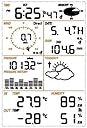

Ambient Weather WS-2080 Wireless Home Weather Station
Product ID: 8620192
Details
- BrandAmbient
- Power SourceBattery
- Special FeatureAlarm
- MaterialGlass Plastic
- Connectivity TechnologyUsb
- StyleCompact
💧Humidity
🌡️Temperature
🌬️Wind Speed
🌦️ Your Personal Weather Guru at Home!
The Ambient Weather WS-2080 is a compact and reliable wireless home weather station that measures essential weather parameters including wind speed, temperature, humidity, rainfall, and barometric pressure. It features a user-friendly LCD console, USB connectivity, and EasyWeather PC software for real-time monitoring and data logging, all at an affordable price.


| ASIN | B003OSJ08S |
| Additional Features | Alarm |
| Are batteries included? | No |
| Brand | Ambient Weather |
| Brand Name | Ambient Weather |
| Color | Silver |
| Connectivity Technology | USB |
| Customer Reviews | 3.8 out of 5 stars 582 Reviews |
| Display Type | LCD |
| Finish Type | Glossy |
| Global Trade Identification Number | 00857450002029 |
| Included Components | Receiver, Thermo-Hydro Transmitter, Wind Speed Sensor, Wind Direction Sensor, Rain Sensor |
| Manufacturer | Ambient Weather |
| Material | Glass, Plastic |
| Material Type | Glass, Plastic |
| Model | WS-2080 |
| Part Number | WS-2080 |
| Power Source | Battery Powered |
| Sensor Technology | Wireless |
| Shape | Rectangular |
| Special Feature | Alarm |
| Style | Compact |
| Style Name | Compact |
| UPC | 857450002029 |
| Upper Temperature Range | 149 Degrees Fahrenheit |
| Warranty Description | One year parts and labor. |
D**E
Best Valued Wireless Internet Home Weather Station
Ive never had weather station before like the reasonably priced ws-2080. easy to use and install. Love it. when used with weatherunderground, the station can be accessed anywhere. I have had the unit since November of 2013, and would choose this product again rather than the other brands out there. It's a great station for the money. It's a great way to dip your toes into the world of the home weather stations without a large investment. From a reviewer i found helpful From Paul... I'm a weather nerd. I've had several home weather stations over the years, some were better than others. Davis' stations are the best on the market, but they are expensive. You can have four complete WS-2080's for the price of the least-expensive Davis w/ the appropriate data-connect module. The Davis machines are definitely superior in accuracy & build quality and are (I believe) made in the US. All great things, and if you're very serious about home weather then Davis is the way to go. But if you're looking for a decent home weather station that has PC/Mac + Internet capabilities for a low price, the WS-2080 is an excellent choice. I've had mine up and running for over a year now, with no problems. I've had no problems with the sensor range; my base is sitting about 75' away from the outside sensor, through 1 exterior (with a few windows) and 3 interior (no windows) walls. No connection problems at all. Unlike some of the other low-cost home weather stations, I've not had any problems with erroneous data. It's clean. With a previous station I'd get frequent erroneous 57mph wind gusts when it rained, despite my best efforts of sealing & ferrite-choking the cables. A few caveats: 1) Use good lithium batteries in the outside sensor unit. It takes two AA's. Yes, lithium's are 2-3 times as expensive as alkalines. But lithium batteries will last much longer than standard alkalines, and they are much better in the cold. I live in the midwest, and I'm still on the first pair of AA lithiums from over a year ago, and they went through a brutally cold winter without any complaints. Alkalines are fine for the base. My station's connected to a PC, so it is powered via the USB connection anyway. 2) Build quality of the sensors is very low. The sensors work well and are decently accurate, but it's all made with the cheapest plastic. Don't drop any of the parts, they will break. Be *very* careful of the wind cups. I recently moved, and in moving I managed to accidentally tap the wind vane on my garage ceiling. Barely grazed it. One of the struts that supports the cups immediately snapped. The cup itself had the integrity of an egg shell; easily crushed by thumb & forefinger. Very brittle. I'm not sure if this is how it was when new, or the result of a year's worth of exposure to the elements. Luckily AmbientWeather sells replacement parts, so I'm just out a few bucks. 3) Buy the better radiation shield that Ambient Weather recommends. The station comes with a small shield, but it's woefully insufficient. Using the included one, my station would get temps 15+ degrees (F) above ambient in direct sunlight. Using AmbientWeather's suggested shield, temperatures are now unaffected by direct sunlight, just as it should be. If you are placing the thermometer/hygrometer sensor somewhere always shaded, then you'd be fine with the included shield. But if the sensor ever receives direct sunlight (not just during the day, but any day of the year too...), buy the better shield. 4) The wind & rain sensors must level to work properly. You absolutely must pay special attention to level the rain sensor. Must. The rain gauge in this (and most other) station works like a see-saw. As water pours through it, two little buckets tip back and forth inside the housing. As they rock, the sensor records that motion as amounts of water. If the housing isn't level, the buckets won't rock properly and the gauge won't work. Take the time to make sure it's level when you install the station. If the price were higher, I'd knock off a star for the build quality. But as it is, it's a decent station for the money. It's a great way to dip your toes into the world of the home weather stations without a large investment.
T**R
Perfect Home Weather Station
To be clear, I rate this a 4.5/5. It's been an entire year since I purchased this station which allows me to make a complete review. First of all, reading other reviews I feel lucky that mine hasn't failed. The installation was very straight forward and I had it mounted in no time. Installed the software and configured my station as needed. Because I planned on uploading my data to Wunderground, I installed the free software Cumulus and data was online in minutes following the instructions. My station is mounted about 20ft off the ground and around 100ft from the receiver (through 2 walls) and the signal is rarely lost even in a blizzard. From the actual data perspective, I couldn't be more pleased. Yes, this is a somewhat cheap model compared to many other stations out there, but it stands toe to toe. I live in the Midwest area and you can bet our weather is anything but ordinary. This station in its first year has been through temps of 100ºF down to -20ºF (-50ºF wind chill) and has worked flawlessly. You MUST purchase a set of very good batteries to maintain your station working (I recommend Energizer Advanced Lithium). If you want to avoid spikes in temperature reading due to direct sunlight, place the sensor in a shady area (facing north) or purchase the larger solar shield. To obtain accurate wind speeds, make sure you place the station away from very tall objects (trees, homes, etc.) or place them higher up. The rain gauge is OK. For light to moderate rain, the sensor works perfectly and is off by less than 5% when compared to a physical rain gauge. When experiencing torrential rainfall the error can be up to 50% due to the rain drops bouncing off the plastic from the gauge and not landing inside. However it's still very good in collecting data. This station has few problems that should be noted. As many people have probably already said, the receiver sometimes loses connection to the computer when connected via USB. This happens around once a month or so. The station itself is still sending out data and the receiver is collecting it and showing it fine, however it doesn't get sent to computer. The only fix is to disconnect USB from computer and take out the batteries of receiver and reinsert (calibrate as necessary). While this takes seconds to do, it can become annoying when your station is stuck sending same data for hours on Wunderground if not caught in time. Another thing is the update interval of 48 seconds. While this isn't an issue for most of the sensors, I've found that my wind speeds are lower than what they actually are. Sometimes if there's a very strong gust between intervals it isn't recorded and it's like it never happened. This is the most annoying part for me as wind speed is one of the top things I wanted to work. Through one of the coldest/snowiest winters our area has seen in decades, I'm glad I had this weather station to record data. It was well worth the cost and it can't be beat for the price. However, this station is no longer being produced (although it can come back if there's a strong demand).
T**K
Ambient Weather WS-2080: Great station for a great price
So I replaced an Oregon Scientific weather station whose rain gauge transmitter stopped working after 1 week with the Ambient Weather station WS-2080, and couldn't be happier. Since there are a lot of reviews already on this product, I'm going to focus on some of the pros and cons that I've run across. Pros: - One of the first things I noticed was how easy it was to set up. Attaching each of the arms to the included mounting pole just requires a screwdriver and an adjustable wrench, and each seperate component slips on one of the arms and a single screw secures it. So it took me about a half an hour to completely set it up on my roof, and that included getting everything up on the roof. - Since everything plugs directly into the transmitter unit (with phone cables, so they just plug in), you only have to worry about a single transmitter. This has a couple of advantages over the Oregon Scientific I replaced: 1) You don't have to worry about multiple transmitters and having multiple points of failure 2) You don't have to sync each component with the base station. - Since there is only one transmitter that everything is plugged into, you only have to supply one set of batteries. The previous weather station I had required batteries in each component, which was a lot of batteries. - The screen layout on the base unit and the screens in the included software are well organized and easy to read. i.e. The data is well organized, so you don't have to search around to find the information you want. The Oregon Scientific unit I had may have had a lot of data available, but it was basically a jumble of clutter and was way to busy. I found myself always searching around for even the most basic of information. - The software that comes with the unit is very easy to use, and allows for a lot of customization for settings, alarms etc. Cons: - The only con I have is the kit doesn't come with mounting brackets for the pole that everything is attached to. Since the odds are high that the pole is going to be mounted against a wall, having a mounting bracket would have been a nice addition. Note: If you don't want to go out and buy a bracket, you can do what I did. I took the mounting bracket off of the transmitter unit and use 1/2 of the bracket to mount the transmitter under the eaves so it was out of the sun, and used the other half of the mounting bracket to attach the pole to the side of the roof. Worked great and is nice and secure. So overall I'm very happy with the weather station, and would definitely recommend it.
S**O
Avoid. Period.
Update: The unit is currently reporting an indoor temperature of 140F and an outdoor of 123F. Other measurements still appear to be ok. Software that communicates with it has started hanging. This is after a couple months of reliable operation, with about a 1% data loss rate. Bottom line: this product is complete TRASH. I should have returned it when I had the chance. My current plan is to build my own weather station, using a few of the working parts from this one, and responsibly dispose of the rest of it. Read on for my previous review, written when I still had some hope of getting useful data our of this thing: --- I've changed my review on this thing several times. I can't recommend this device, but if you are lucky and patient you MIGHT get a solution you can live with, for cheap. If that's appealing, read on. The original shipment simply didn't work. Radio contact between the sensors and display unit was very unreliable, the display had a number of dead LCD elements, and the "atomic clock" didn't work. After some fussing, I sent the display unit back for replacement. (I didn't pay shipping either way.) The new unit had working LCD elements, and wasn't as unreliable about receiving data, but it still lost quite a bit, and I finally wrote software to measure how often it really failed to provide data. It turned out to be working about 68% of the time, over a third of the radio's stated range, through a single pane of glass. Really bad. Since then I've re-positioned the sensor transmitter and put Lithium AA batteries in it. I'm still losing some data, but I'm up to 96% reliable instead of 68%. I still consider this kind of crappy, since there's less than 100' of open space (and one sheet of glass) between the transmitter and receive. The atomic clock feature has never worked, but I never expected it to. Other than the lossy data transmission and dysfunctional clock, the display unit (which has the barometer sensor in it) is unreliable about the air pressure - unplug it and plug it right back in, and the pressure reading changes by as much as 0.5 inches. That's poor accuracy. The outdoor sensor array is fragile and I suspect they won't last more than a couple years outside. The solar shield that protects the thermometer from direct sun is known to be less than functional. Basically, this is cheap stuff, and you may have to be persistent to get usable results. Lithium batteries appear to be absolutely necessary in the sensor, even if the weather is not all that cold. Careful positioning of the transmitter, and a willingness to experiment and crucial. Unless you live near WWV, just forget the clock. Software people who have written interfaces to this gear, and Fine Offset gear in general, universally complain about the quality of the unit - inaccurate, intermittent and prone to wild measurement spikes, like the calm night it reported 120mph winds for hours straight. Basically, "low expectations" are the key takeaway here. I'm still debating returning it.
T**R
Skeptical at first, but so far, very pleased.
I think I read too much into some of the reviews, but after talking to one of the most favorable reviewers, I decided to take the plunge and get this unit. Assembly is relatively easy as long as you have good reading comprehension skills. What I mean is that some things are assumed and laid out in terms that make you feel like a child. I read one review that stated that it didn't tell you the exact screw sizes that were needed but actually it does.... it uses terms like "the SHORT screw; the LONG bolt.. etc..." So, reading comprehension is a must if you don't want stress... :) For me, the programming of the indoor unit was the hardest. No matter what I did, my settings would change once the "radio clock" locked in on the outside unit. I actually emailed AW and they said that I wasn't doing it correctly and I followed their method and it did work; for just a few hours. For some reason, it keeps turning off DST, which means your unit is an hour slow during DST. So, I knew that I was doing it correct from the get go and instead of continuing a mute email trite with the company, I just change the "adjustment" for my local from a -5 to a -4, and I will just have to put it back to -5 when DST ends this fall. Just a small SNAFU that I can live with. The software that comes with this unit is ok for most but if you want to make your WS public with many of the weather sites available (weather underground, weather bug, to name just two), you will need another program. Cumulus is free and what I'm using to put my station live on Weather underground dot com. It's really neat when people at work pull up their weather apps and tell you what the weather is at such and such a place and then you bring up "your homes" EXACT weather conditions and blow them away in awe. ;) For this price, I know this in not something that is going to last for "years", or so I'm thinking but time will tell... I started out with this low priced entry level to see how I would like it and I'm hooked! When/if this unit fails, I will invest in a higher quality system but so far, this one is working like a charm and I've been comparing my reports with "professional" reports in my area and we are all close enough be well within the margin of error expected. My biggest reason for getting this is so I could keep tabs of my home's weather while away. I live in NC and this has been one of the wettest summers that I can remember. Just last Saturday, we had over nine inches of rain in just a few hours. Flooding was rampant. I hope all this makes sense and you are definitely getting what you pay for. One really important thing to remember is "location, location, location"! Ok, that's three... ;) Use common sense when locating your unit as everything will affect it's measurements. There's a formula (in the instructions) that tells you how high/far it needs to be compared to the height of local things like trees/buildings. I always add at least 10 percent to both the distance and height to be safe. There are some that will tell you that you are not high enough or far away from, but remember, you are measuring "local conditions", not the jet stream for a regional forecast/conditions. :) If your a weather nut, like I am, you will not be disappointed with this system as an entry level station to get your feet wet to see if you really want to do this, and maybe later down the road, invest into a more accurate/reliable system.
E**Y
Decent USB capable station for the price
I've had my WS-2080 up & running for 5 months, and for the most part, I'm satisfied with it. It's no Davis (or other pro-level) station, but for the price, and features, it's a good deal for starting out. Assembly of the sensor array was quite easy, however the plastic used feels rather light & flimsy - I'll just have to wait and see how it survives my Northern winters. Installation on the mast was not too difficult, the only challenging part was in getting the wind vane oriented to North while up on a ladder. The included solar radiation shield for the thermometer/hygrometer (which is actually the outdoor transmitter module) is not at all adequate if you plan on installing the array anywhere with direct sun exposure...the temps will not be accurate. You can buy a 'proper' shield from Ambient, build your own (Google is your friend), or try to mount the transmitter away from direct sun. The other sensors, including the rain gauge are pretty accurate, provided that you properly plumb the mast. The indoor station is easy to read, good contrast on the LCD, but the smallish buttons and menu system are a bit tedious to get things configured...much easier to use the software to set it up. I would have preferred an actual base stand to support the station vertically, as with the flip-out back stand it sits on an angle, taking up more desk space (and reduces the viewing angle of the screen). Once configured and connected to the computer, it's relatively easy to monitor & track your weather data, and upload to the various weather sites such as Weather Underground. Cumulus pc software works quite well. I was tired of needing to keep the pc running at all times to upload my 'live' data, so I have made the switch to a Linux based software package called pywws. It runs on my USB router 24/7, and does not rely on a pc being active to upload/log data. If you have an open source router, and a bit of Linux knowledge, and want to avoid the pc route for uploading/logging, I highly recommend pywws. The code & group can be found on Google. I've been having some random loss of signal from the outdoor sensors since the beginning, despite having fresh lithium batteries and being pretty much 40' line of sight between the sensors and the base unit. Not sure if it's a positional problem, or a hardware issue, but it's not software related - as the loss of data is being stored in the base unit's memory itself (and reading the data with 3 different apps all show the same error). Ambient's support was poor - I emailed them about the issue, they responded with a "guess", and they never responded to my messages after that point. I could live with the occasional hiccup, but it would have been nice to know if this could be a hardware defect or not.
J**N
Save Your Money!
the temperature indoors is accurate, outdoors is another story. as mentioned in some previous reviews, has inaccuracies caused by the poor quality of the cover of the narrow meter. people recommend forking out an extra $40 on an "upgraded" cover...Why? Shouldn't this better functioning piece that is pivotal to the basic function of this weather station be the Standard piece of which the station is shipped with?! Because without it, you basically only have accurate temperatures when the temp/humidity device is not being cuddled with sunlight. A fatal flaw in design quality that impedes its function of the very basic thing you buy a system like this for. If you can manage to find a way to overlook the worse disaster in home meteorological history that is the failure to obtain an accurate reading of the temperature outside, then you might be happy with the other functions it happens to do well (one of which is NOT measuring outside temperature during 8am-7pm generally). We found wind speed to be accurate and helpful, as well as direction. Rain gauge is spot on (though gets put out of commission during winter where it's regularly freezing and getting good amount of snow. the range has never been a problem, and one thing i DO like is its durability gainst the elements. In the 3 years this has been in use, it has never malfunctioned (except for not giving accurate readings of outside temperature during sunlight hours) and small parts have withstood the tests of time in a mountainous region with high wind gusts, harsh winters, and hot, wet summers. Final Thoughts: The Ambient Weather WS-2080 is sturdy, reliable (for everything but outside temperatures during sunlight hours, due to design/shade flaw), and has a solid foundation for something that would be perfect for any home to own, if not for having to fork out an extra $40 for something that any person with basic reasoning skills would determine that the current uv radiation shield should be recalled and trashed, and the upgraded version be included in its place at no extra charge, just good business practice. As-is, no, i do Not recommend anyone who plans on putting this in an area outside that gets any sunlight at all, get thiss weather station. There are other better-made ones on the market that dont try to play customers for fools. Why 2 stars and not 1? Every other part of this weather station is well built and durable, and will surely last many years to come. I have an analog dial thermometer that tells the temperature very very well that cost $1.00 at a garage sale, right outside the kitchen table.
G**J
Terrific weather station
I've been using this station for over 6 months as a replacement for a previous station and it has been everything I needed it to be. I am a weather fan, but not fanatic, so this model fits my needs since it isn't basic but not so super advanced that I feel like I need a meteorology degree to figure it out. The Easy Weather software that comes with it lives up to its name, easy to install and easy to use. The station is accurate when compared to the weather reports for my area. The display is easy to read. The outside components seem durable. Hard to say much else when it works as described and works well. The few drawbacks are the short stand on the back of the display unit and the mounting options for the exterior components. The display unit can be wall mounted, but if you want to leave it on a desk, it is almost horizontal because the attached stand is short. This wasn't a big problem for me, since I was able to prop it up on a small book on the same shelf. The exterior units are made to attach to the enclosed pole and they work fine if you will be using that pole. Since I already had a tall, sturdy metal pipe I had used with a previous weather station and wanted to reuse that pole, I found I needed to do a few modifications to the mounting arms. My suggestion to the company would be to use some type of adjustable bracket on the arms to give customers some choices for the external unit other than a wall mount or attached to the included pole. I do suggest either wall mounting the temperature gauge in deep shade or purchase the large solar shield. As with all exterior weather stations, the temperature will be a little off if the unit is in the sun. At least with this one, the shield is an option.
ケ**ん
メンテナンスが大事
購入し運用して約5年になります。メンテナンスをしながら現在も活躍してます。畑の中に1.5メーターのポールを立ててそのポールに観測装置を取り付けています。最初は家の中では電波状態が悪くちゃんとデーターが拾えないことが多かったので受信機をばらし本体の中にあるビニール線アンテナをちゃんとしたロッドアンテナに取り換えたところ格段に受信感度が上がりました。また、雨量計は長い間使っていると観測装置の中のシーソーマスの中に土がたまり動かなくなるので定期的に取り出して掃除をする必要があります。一度だけ風向センサーに蜘蛛の巣がはられ動かなくなったことがありました。やはりちゃんとメンテナンスが大事です。
地**8
異常気象の時期です。活躍しています。
この商品については、まずまず満足しています。組立と設置はマニュアルに頼らずできましたがコンソールとデーターの作成ではやはりマニュアルが必要となり、付属の英語版マニュアルを和訳して対応、これについては出展者にも連絡させていただきましたが、その後のなんの連絡も入ってきていません。安価な商品であってもうまく使いこなせてこそ機器の商品価値があるものとも考えます。やはり、最低限の日本語解説の必要性を感じています。
A**ー
WS2080A使用に関して
WS2080A 日本語の取扱説明書が必要でです 温度の華氏と摂氏の切り替えができない?
A**ー
日本語に対応していません
マニュアルも、WEBページ閲覧でも、日本語に対応しておらず、意味不明。 その様な商品であることを記載すべきです。返金して欲しい
Trustpilot
2 weeks ago
3 weeks ago