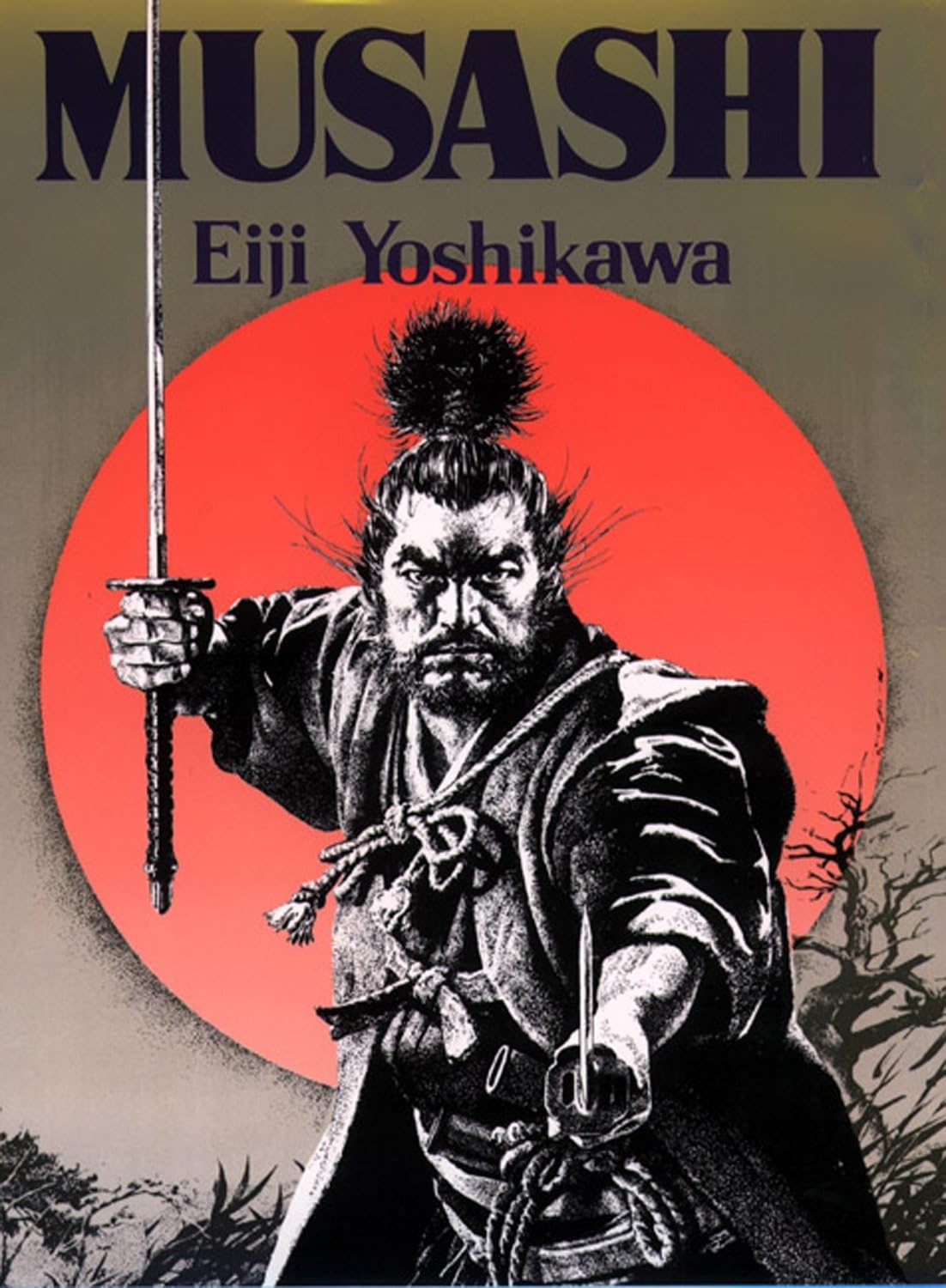
Musashi: An Epic Novel of the Samurai Era
Product ID: 85878595
The classic samurai novel about the real exploits of the most famous swordsman. Miyamoto Musashi was the child of an era when Japan was emerging from decades of civil strife. Lured to the great Battle of Sekigahara in 1600 by the hope of becoming a samurai—without really knowing what it meant—he regains consciousness after the battle to find himself lying defeated, dazed and wounded among thousands of the dead and dying. On his way home, he commits a rash act, becomes a fugitive and brings life in his own village to a standstill—until he is captured by a weaponless Zen monk. The lovely Otsu, seeing in Musashi her ideal of manliness, frees him from his tortuous punishment, but he is recaptured and imprisoned. During three years of solitary confinement, he delves into the classics of Japan and China. When he is set free again, he rejects the position of samurai and for the next several years pursues his goal relentlessly, looking neither to left nor to right. Ever so slowly it dawns on him that following the Way of the Sword is not simply a matter of finding a target for his brute strength. Continually striving to perfect his technique, which leads him to a unique style of fighting with two swords simultaneously, he travels far and wide, challenging fighters of many disciplines, taking nature to be his ultimate and severest teacher and undergoing the rigorous training of those who follow the Way. He is supremely successful in his encounters, but in the Art of War he perceives the way of peaceful and prosperous governance and disciplines himself to be a real human being He becomes a reluctant hero to a host of people whose lives he has touched and been touched by. And, inevitably, he has to pit his skill against the naked blade of his greatest rival. Musashi is a novel in the best tradition of Japanese story telling. It is a living story, subtle and imaginative, teeming with memorable characters, many of them historical. Interweaving themes of unrequited love, misguided revenge, filial piety and absolute dedication to the Way of the Samurai, it depicts vividly a world Westerners know only vaguely. Full of gusto and humor, it has an epic quality and universal appeal. The novel was made into a three-part movie by Director Hiroshi Inagai. For more information, visit the Shopping area Review: Rich story telling - There is history and there is story telling, mix the two and you get an epic novel. Eiji Yoshikawa does this to perfection. He creates some fictional characters but preserves the real culture and daily life of the period. His detailed knowledge of place, and understanding of samurai traditions gives the reader a stunning view of Japan in the period between 1600 and 1612. Review: 10/10. This is a book I will read time and time again. - Jocko podcast led me to this book. This is a phenomenal read front to back. Don’t worry about the thin paper, it fits the atmosphere of the book. The book is full of triumph, loss, lessons, and blood. If you are at all interested in reading about The Way, get this book. I will now be buying everything I can from this author.
| Best Sellers Rank | #52,064 in Kindle Store ( See Top 100 in Kindle Store ) #11 in History of Japan #13 in Japanese Literature #19 in Historical Japanese Fiction |
R**B
Rich story telling
There is history and there is story telling, mix the two and you get an epic novel. Eiji Yoshikawa does this to perfection. He creates some fictional characters but preserves the real culture and daily life of the period. His detailed knowledge of place, and understanding of samurai traditions gives the reader a stunning view of Japan in the period between 1600 and 1612.
M**H
10/10. This is a book I will read time and time again.
Jocko podcast led me to this book. This is a phenomenal read front to back. Don’t worry about the thin paper, it fits the atmosphere of the book. The book is full of triumph, loss, lessons, and blood. If you are at all interested in reading about The Way, get this book. I will now be buying everything I can from this author.
M**X
Brilliant
True masterpiece, unique in its kind, and superbly written. This is one of the few books which I've read in a long time that I didn't want the story to end. Despite seeming a dauntingly long and hefty novel, the story flows at a neckbreaking pace, full of surprises and clever plots at every turn. The book I would most compare it to is James Clavell's epic "Shogun", but besides the fact that both stories take place more or less in the same time period in Japan (beginning of Edo period), the comparison ends there. Whereas "Shogun" describes Japan from the eyes of a foreigner, and deals with high-court intrigues, Musashi's fictional story (albeit loosely based on events in his life including all his ill-fated duels) deals with the common day-to-day life in Japan, the peasantry, the samurai, the secret lives of Geishas and pleasure quarters, Buddhist priests and itinerant monks, of families torn by the everlasting conflicts that was raging between North and South daimyo factions at that time (Osaka vs Edo courts), the tribulations of ronin who were left masterless after the battle of Sekigahara and who were roaming the country incessantly in search of odd jobs or who would become evil doers. Such a man was Musashi, who being on the losing side of the Sekigahara battle, started a life long wandering journey throughout Japan, perfecting his sword techniques and becoming, slowly, the most prestigious swordsman of all time. Although the book only recounts 12 years of this journey, these were without doubt his formative years, and the characters he meets, loves or fights with along the way all edge him, little by little, towards achieving his goal, the Way of the Sword. Every encounter Musashi goes through is a lesson of life and death, something that even we, as readers, can apply in our daily lives centuries later. It's timeless advice. The second thing I thoroughly enjoyed about the book was the translation. The way the story flows, the vocabulary used as well as the dialogues are very well rendered to the point where I was actually believing the text to be written originally in English. There's also quite a lot of light-hearted, downright comical dialogues, which give the story a lighter tone despite the somber aspect and seriousness of the background story. I actually wonder if this is the work of the translator (by the mere fact that eastern languages are not always easy to transpose into western ones) or if Eiji Yoshikawa himself inserted those funny passages. In any case, this novel was a hidden gem that I would highly recommend to anyone looking for brilliant historical fiction or simply who wants to learn more about Japanese culture during the Edo period.
N**W
The Samurai Religion: The Original Samurai Epic
An intimidating book to say the least. Picking it up and flipping through the pages will make you question if it's worth starting. At times I questioned whether it was worth finishing, but by the end I was incredibly happy I did. Shogun by James Clavell left me wanting more. It was an excellent book about a time in Japan where samurai were revered and the Way of the Sword was equivalent to a religious pursuit. Looking for something similar, searches kept coming up recommending Musashi. 1000 pages wasn't too intimidating considering Shogun was no short story. Inevitably, comparisons will be made between Shogun and Musashi although the latter proceeded and should be given credit as the muse for Clavell. Both center around the samurai culture but where they differ is in Shoguns plot focusing more on evolution of a man through his love story where Musashi follows the evolution of a man through a spiritual pursuit. Shogun draws you into the story with it's plot, Musashi draws you in with it's detailed look at The Way of the Sword. From a rebellious youth, anxious to prove himself, to a famous swordsman still renowned in Japanese folklore, Musashi follows the journey of Miyamoto Musashi as he strives to become the greatest swordsman in all of Japan. The book has numerous plotlines and even more characters that is confusing at times. Because all the characters have Japanese names that English speakers don't hear too often, it's easy to find yourself lost when characters come in and out of the story. Usually context jumps in to help jog the memory. Throughout I never felt much of an attachment to any of the characters, even Musashi, until the end. Approaching the final act, it dawned on me that I cared what happened to Musashi. Whether that means the book is good or bad I'll leave to you. If you're looking for a fast read that has you gripped from start to finish, turn to Shogun, but if you're looking for a more authentic and deeper look at samurai and Japanese culture, Musashi is a great read.
A**R
Great reading
My favorite novel. My first encounter with the novel was a silver paperback I found in a convenience store at the Honolulu Airport in the early 90's. It was separated into five paperbacks back then. Eventually I purchased the set online. A few years later I bought a hard copy from a Borders in San Diego. I read this novel seven times before 2006. I introduced the novel to several friends. We'd have fun comparing people we knew to the characters in the novel. We gave people nicknames from the characters in the novel. It's a motivational, historical fiction, romance, samurai novel. I'm glad an edition is still available.
K**R
Must Read!
Absolutely incredible—I couldn’t put this book down. The author brings the world to life with vivid detail and creates characters that are truly memorable. It’s not only beautifully written but also grounded in impressive historical accuracy. I was completely hooked from beginning to end.
A**E
Masterpiece!
Musashi by Eiji Yoshikawa is a MASTERPIECE! When i bought the book I didn't know if was ever going to finish it. It was an intimidating book to the eye. Once I started the book I didn't really know what was going to happen. Would I start it, and then get tired of it, and move on to another book, because it was so long book? I never took on such a huge book. I made it a goal to finish the book. I wanted to hurry, read through it and just finish the book. Page after page of reading I was hooked. It became a huge part of my life. I read it morning, midday, and night. The story of Musashi was so well written in this book, it was hard to put down. When I came to the end of the book, I was happy I completed one of the greatest novels ever written. Days later I was sad the journey was over. I wanted to finish the book so bad, when I did, I was sad the amazing story was over. I will be reading this book over and over, throughout my life. I didn't give detail on the story, so I wont take away anything form the book until you read it. I HIGHLY RECOMMEND this book to your collection. I believe everyone should add this book to their collection. A MUST READ for everyone!
C**R
Timeless. Epic. Beautiful. Stands Tall Along With the Best Historical Fiction has to Offer.
Gary Jennings has been my high bar for well-researched yet totally compelling historical fiction for decades. Not once in all the time since have I felt that anyone came close to his level. Eiji Yoshikawa is just as good. The writing is clear, descriptive, and betrays no hint that the story was published in the 50s. The setting is obsessively detailed. And there's no hint of the social norms or history of the time being discarded in favor of making it more accessible or shoehorning a love story as Clavell's Shogun did. Also unlike Shogun is the doing away of thinly disguised historical figures of the time. The figures portrayed are named and they're wholly believable. The only complaint I have rests in the translation which substitutes more widely known English words like "governor" in place of "daimyo" instead of simply explaining the word to the reader... But these are just nitpicks. The only other possible downside I see for the average reader is the length. Yoshikawa wants you to linger with him on the sights and sounds and muse about the nature of things. And he takes his time to do it. But not once did I feel the story dragging or losing interest. If you love historical fiction and you have even a passing interest in Japan... look no further. I've already ordered every other translated Yoshikawa book I could find. But I don't relish thr search I'll be on after I'm done to find anyone else who can stand up with Mr. Jennings and Yoshikawa san.
M**H
Epic
I have read the manga based on this book and it was amazing. The book is slightly different and operates on a much larger scope. I enjoyed every bit and page of this amazing novel
K**O
Sensacional!
Estória sensacional. A leitura é uma imersão pelo Japão do século 17. Clássico que deve ser lido por todos.
T**Q
Book quality
Haven’t finished reading but the books quality itself came in great
A**O
Epic novel is an accurate description
No more pleasurable reading than this novel, part fiction, part history on the life of Miyamoto Musashi. Would love to get my hands on the complete version that spans several volumes (approximately 4000 pages total), but this nice near 1000 page book is well written, and very hard to put down. The novel spans very specific periods of Musashi's life and skips other parts, but this might in most cases be due to the fact that they slimmed down a 4000 page book to this manageable almost 1000 book. For those reading on the historical part of the story, it ends as the complete volumes do with his fight against Kojiro. The balance of his life is not covered in this book, or even for that matter in the whole 4000 pages of the complete work. Even for those just interested in reading about samurai and feudal Japan, it makes for an excellent read. Those of us old enough to remember Shogun, this is a million times better than Clavell's fiction (although some parts of Yoshikawa's book seems to have inspired Clavell). And for the marital artists, there is so much to be discovered in this book, from points touching upon Musashi's own writings, his artistic endeavour and his martial skill and philosophy. And even though there is still a lot of mystery surrounding the life and times of Miyamoto Musashi, Yoshikawa fills in the story with well thought fiction that reads as historically accurate for the period in which Musashi lived. I recommend this book for all the reasons mentioned above, but most of all pick it up for the sheer pleasure of reading a magnificently written text on a legendary historical individual.
A**A
Bought as a gift
Bought this as a gift to my cousin overseas. Arrived well and she liked it.
Trustpilot
2 weeks ago
1 month ago