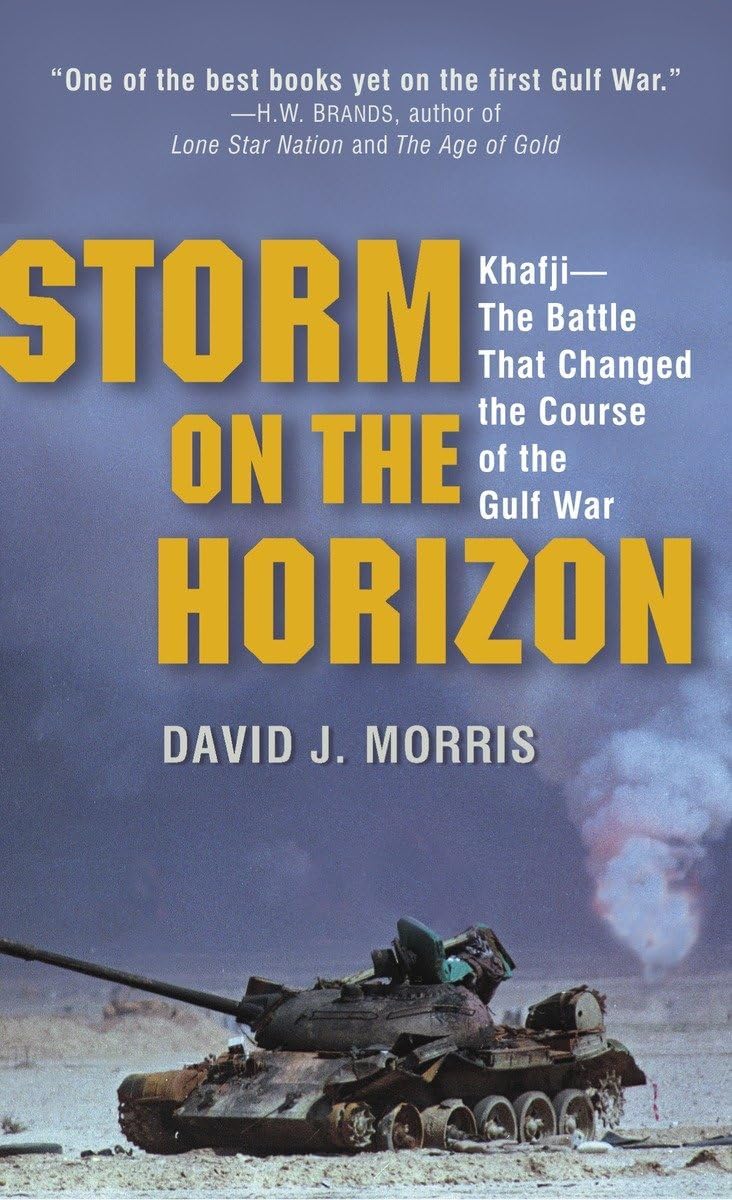
Storm on the Horizon: Khafji--The Battle That Changed the Course of the Gulf War
Product ID: 8500460
On January 29, 1991, Saddam Hussein hurled three crack armored divisions into Saudi Arabia, determined to stop the American attempt to liberate Kuwait before it began. Caught without warning in the path of the Iraqi juggernaut were small groups of U.S. Marines and Special Forces soldiers, their weapons no match for the Iraqi tanks bearing down on them. Based on scores of firsthand reports and newly declassified documents, Storm on the Horizon is a riveting account of how these elite fighting men not only escaped the Iraqi onslaught but fought their way to victory with true American grit. From the ferocious desert attacks to the desperate street fighting in Khafji, Marine David Morris captures the ordeal through the eyes of men who fought it, giving readers a front-row seat to the bloodiest battle of the Gulf War. Review: Those awesome Marines.... - This is a breakout book for a Marine officer with an amazing ability to write - This is a story about a battle virtually no one ever heard about, yet author Dave Morris does an excellent job capturing the terror of fighting an overwhelming armored force. And as seems to happen all too often, there were more Marine casualties from our Air Force A-10 pilots ( who have an ability to kill Marines with a heartbreaking regularity - see "Charlie Battery; A Marine Artillery Battery in Iraq" about yet another Air Force FUBAR at An-Nasiriyah ). Interesting to note the army's ability to have their convoys get lost in Iraq, and their women soldiers captured ( see Jessica Lynch ! ) The author has written one of the better books about the Marines in Desert Storm - he puts you up in the front lines, and makes you care about the Marines as they fight. Well done !! Review: good read - This book is written well and a good read. I especially appreciate the clarity in the descriptions of what battle confusion looks and feels like. I reject the idea that one cannot understand without experiencing it. One can't experience it personally from a book, but a good writer can indeed enable you to understand. Read it twice, as I have many other books about this engagement.
| Best Sellers Rank | #2,882,493 in Books ( See Top 100 in Books ) #64 in Operation Desert Storm Military History #15,200 in Military Leader Biographies #59,303 in World History (Books) |
| Customer Reviews | 4.6 out of 5 stars 54 Reviews |
A**N
Those awesome Marines....
This is a breakout book for a Marine officer with an amazing ability to write - This is a story about a battle virtually no one ever heard about, yet author Dave Morris does an excellent job capturing the terror of fighting an overwhelming armored force. And as seems to happen all too often, there were more Marine casualties from our Air Force A-10 pilots ( who have an ability to kill Marines with a heartbreaking regularity - see "Charlie Battery; A Marine Artillery Battery in Iraq" about yet another Air Force FUBAR at An-Nasiriyah ). Interesting to note the army's ability to have their convoys get lost in Iraq, and their women soldiers captured ( see Jessica Lynch ! ) The author has written one of the better books about the Marines in Desert Storm - he puts you up in the front lines, and makes you care about the Marines as they fight. Well done !!
K**H
good read
This book is written well and a good read. I especially appreciate the clarity in the descriptions of what battle confusion looks and feels like. I reject the idea that one cannot understand without experiencing it. One can't experience it personally from a book, but a good writer can indeed enable you to understand. Read it twice, as I have many other books about this engagement.
D**Y
Storm on the horizon
I think this is great book but only the hard cover like this one because my friends and I are on the cover, that was a great pic the day after the battle
J**D
Engaging
Raw but not crass. Unglorifying. Seemed balanced and without agenda. Interesting history and insight into how friendly-fire incidents can happen.
M**L
OP 4 Veteran
As a veteran of the fight for OP 4 on Jan 29 1991, I can honestly say that this book got it right. I literally trembled as I read it. It put me right back to that cold night. I highly recommend this book.
S**Y
Great book on an overlooked battle
I loved the inside look at small marine units and as a retired marine officer I found myself laughing and smiling when the author caused me too remember my training and past platoons. Brings to life a battle I had little knowledge about and one I didnt here about from my buddies that were over there. A quick read.
A**R
Interesting description of historic event---Why never ever to ioin the Marines!
This is an interesting description of an historic event!The title is misleading;how could it change the course of the war,when it's importance was not recognized until long afterwards? What makes me sick is the time and again appearing Marine's arrogance und hubris! First:Take away their technical goodies and the Marines are pretty helpless!As shown here.(This is an opinion,that is shared by most armies in the world) Second:If the Seals and the Green Berets haul ass,they probably know a little bit more and have a sound reason to do so!To stay further on is no bravery but utmost stupid!(Quote Navy Seals:"We do not make frontal assaults on maschinegun-bunkers;that's what the Marines are for!) Yes they were mostly extreme brave,but certainly they were not that terribly efficient!A reasonably good book,but not one you could'nt live without
S**N
The Best book on the Gulf War
If you buy one book on the first Gulf War(1991) you must buy this book. This amazing treatment of the Gulf War and its importance does not focus on the ground offensive that retook Kuwait, instead it focuses on the battle of Khafji, in which three Iraqi divisions invaded Saudi Arabia and were destroyed by the combined arms tactics and technology that would prove so efficient days later when the Coalition launched their own offensive. What makes this book so amazing and its focus on this event unique is that the author argues this event, more then the later campaign, was the turning point in the war. It was at Khafji that the American army, which had not won a large battle since Inchon, faced the `ten foot tall' giants of Iraq and watched as the Iraqi army was destroyed. Previously the `speed bumps' of American soldiers along the Iraqi border felt that they could easily be brushed aside, but this battle taught them that regardless of the Iraqi armies veteran status and its triumph over Iran and Kuwait it was no match for the new technologies arrayed against it. Probably the unspoken but obviously poignant statement of this book is that it illuminates the truth about the Gulf War. Many have argued that America and the coalition did not give the `sanctions' time to create a `peaceful solution'. This book shows the Iraq was going for the prize, namely the southern oil fields of Saudi, just beyond the abandoned coastal city of Khafji. Had American troops and technology not been in place, the Iraqi army would have destroyed Saudi and Americas oil lifeline. Those who argue that Saddam wanted a `peaceful solution' are proved wrong in this epic account. The writing is superb, the action is intense and there is no history of the Gulf War that compares in any way to this masterful account. Seth J. Frantzman
S**.
Récit très américanocentré de la bataille de Khafji
L'intérêt de David J. Morris pour la bataille de Khafji remonte à sa période en tant qu'élève officier à Quantico en 1992. Il se trouve qu'un des sergents instructeurs d'une section présente à ce moment-là était un vétéran de Khafji. Pour Morris, cette bataille rangée, la première pour l'armée américaine depuis la fin de la guerre du Viêtnam, préfigurerait les engagements en Afghanistan, par exemple, où de petites équipes américaines très mobiles guident et encadrent des forces alliées contre un adversaire du tiers-monde -tout en subissant aussi, parfois, les aléas de la puissance de feu de leur propre camp... Morris souligne que rien n'était joué d'avance contre l'Irak en 1990-1991. La prise de Khafji par les Irakiens, le 29 janvier 1991, donne l'occasion à certains Américains de venger l'affront du Viêtnam, selon lui. L'auteur base son récit, essentiellement, sur l'interview de plus d'une centaine de vétérans américains qui ont participé à la bataille de Khafji. Le mouvement des Irakiens sur Khafji prend par surprise deux sections de reconnaissance profonde des Marines et un groupe de Special Forces stationnés sur la frontière saoudienne avec l'Irak, comme "sonnettes", pour collecter du renseignement et protéger un énorme dépôt de carburant des Marines situé non loin des premières lignes. Par conséquent, la plupart de ces petits groupes situés bien en avant du reste des forces est contraint de se replier dans la ville de Khafji devant l'assaut des blindés irakiens. Avec leurs moyens de communication, les Marines vont guider des frappes aériennes sur les chars et les véhicules blindés irakiens tout en restant dissimulés dans des bâtiments, à la merci d'être découverts et éliminés par les assaillants. L'assaut de Saddam Hussein comprend en fait trois secteurs d'attaque. Khafji est le point faible parce que la ville est défendue par la Garde Nationale saoudienne et des unités du Qatar. Les forces de reconnaissance des Marines ne peuvent compter que sur des mitrailleuses lourdes et des missiles antichars, et le soutien de LAV. Ils sont hors de portée de leur artillerie et doivent s'appuyer sur leurs alliés arabes pour espérer repousser les Irakiens. Les Marines guident les frappes via une équipe ANGLICO (Air-Naval Gunfire Liaison Company) qui suit les unités arabes qui montent en ligne sur Khafji. Cette équipe comprend à la fois des pilotes et des artilleurs. Pour Morris, la bataille a tout simplement été oubliée parce qu'elle n'a pas impliqué au moins une grande unité américaine, mais seulement des Saoudiens, des Qataris et une poignée d'Américains. Pourtant, la bataille de Khafji montre à l'évidence les forces mais aussi les grandes faiblesses de l'armée irakienne, en dépit de huit années de guerre contre l'Iran : de quoi dégonfler la baudruche créée depuis le mois d'août 1990 où la contre-attaque est présentée comme devant finir dans un bain de sang face à la quatrième armée du monde (!). Le plan irakien était audacieux, mais les généraux irakiens n'ont pas réussi à complètement le mener à bien. L'USAF tue, selon les statistiques, 2 000 Irakiens pendant les frappes ; 75 véhicules irakiens et 48 soldats sont tués à Khafji et 400 faits prisonniers. Côté américain, les Marines sont surtout victimes de tirs "Blue on Blue" : un LAV-TOW détruit un de ses homologues notamment parce que les TOW n'ont qu'une vision thermique, et que la silhouette de chaleur des véhicules est parfois difficile à distinguer, notamment de nuit en plein milieu d'une bataille. L'aviation américaine, de même, n'est pas exempte de "friendly fire" pendant les combats. Morris passe beaucoup de temps sur cette partie de la bataille, l'attaque ouest des Irakiens contre le groupe de reconnaissance des Marines stationné sur une digue de sable, appuyé par une compagnie de LAV-25, et qui protège une route menant au coeur de l'Arabie Saoudite ; un peu moins sur l'attaque à l'est contre la ville de Khafji elle-même, où deux équipes ANGLICO des Marines se retrouvent prises au pigèe. L'originalité du livre est qu'il se place du point de vue du combattant, ce qui tranche dans une littérature qui s'intéresse souvent, à propos de la guerre du Golfe, aux décisions stratégiques, etc. Mais le livre est aussi écrit par un ancien officier des Marines et cela se ressent, à plusieurs titres. D'abord, comme souvent dans ces récits américanocentrés, les Irakiens et les alliés arabes de la coalition pilotée par les Etats-Unis sont certes braves, mais mal entraînés et donc ridicules ou inutiles sur le plan militaire. Ensuite, l'US Army n'est pas non plus présentée sous les meilleurs auspices : les Special Forces abandonnent soi-disant les Marines à leur sort, l'USAF ne fait que bombarder tout ce qui est en-dessous d'elle... mais elle aurait suffisamment affaibli les Irakiens pour que la grande offensive terrestre ne soit finalement qu'une "promenade de santé" pour l'US Army. Si l'on ajoute à cela l'utilisation par l'auteur d'un vocabulaire pas forcément expliqué dans le lexique pourtant présent, on comprendra que l'intérêt du livre en soit singulièrement diminué.
J**N
Five Stars
Good book. Deliverd on time. Thank you.
E**S
Thoroughly researched and written with clarity
I think the author hit the perfect point in time to bring light upon this battle, with the survivors still alive and young enough to have precise memories of what happened but also distanced enough to speak clearly without fear of disciplinary, or other kinds, of retribution. This precise timing is rightly exploited with an exhaustive research of books, articles, oral histories and the numerous interviews conducted by the author with the survivors. The result is a very detailed account of the battle that despite the amount of information that it presents is an easy read. One quick note on the level of detail of his research, it includes Amazon reviews that some of the survivors made on previous books written on the the subject. Another plus for this book is that it reflects poor leadership or other mistakes, as the Saudis multiple blunders or American blue on blue accidents, instead of just being another Fox News toned hagiography of American servicemen. If anything one could complain about the book being written too much from the point of view of junior officers, the author was one in the Marine Corps at a different time, but all writers have a point of view that they can never escape completely.
A**R
Interesting description of historic event---Why never ever to ioin the Marines!
This is an interesting desccription of an historic event!The title is misleading;how could it change the course of the war,when it's importance was not recognized until long afterwards? What makes me sick is the time and again appearing Marine's arrogance und hubris! First:Take away their technical goodies and the Marines are pretty helpless!As shown here.(This is an opinion,that is shared by most armies in the world) Second:If the Seals and the Green Berets haul ass,they probably know a little bit more and have a sound reason to do so!To stay further on is no bravery but utmost stupid!(Quote Navy Seals:"We do not make frontal assaults on maschinegun-bunkers;that's what the Marines are for!) Yes they were mostly extreme brave,but certainly they were not that terribly efficient!A reasonably good book,but not one you could'nt live without
Trustpilot
3 weeks ago
5 days ago