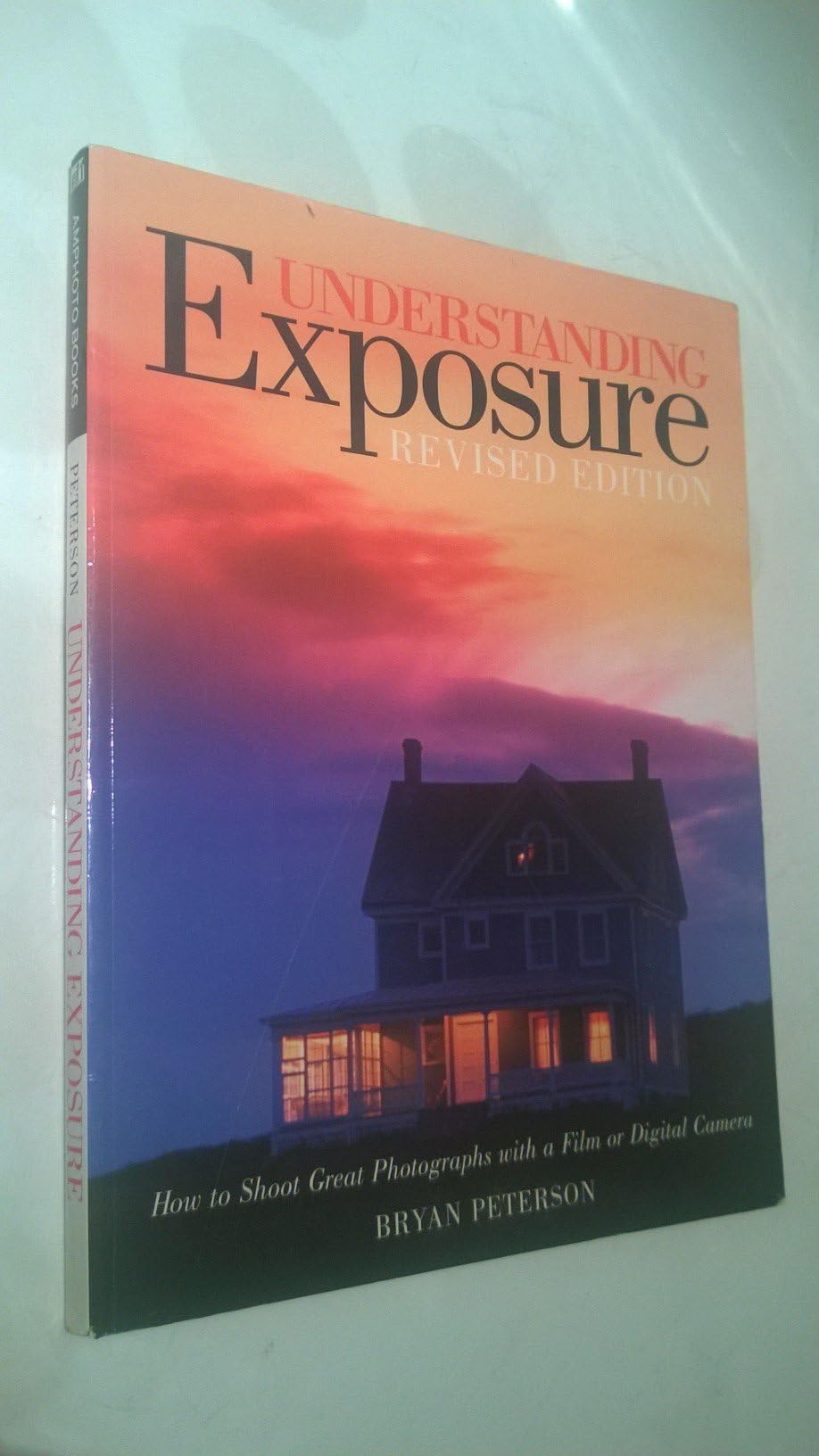
Understanding Exposure: How to Shoot Great Photographs with a Film or Digital Camera (Updated Edition)
Product ID: 83583386
📊Clear aperture, shutter, ISO interplay
📸150+ vivid color images
⚙️Detailed exposure elements
Desertcart purchases this item on your behalf and handles shipping, customs, and support to Senegal.
📷 Elevate your photography game—don’t just shoot, create iconic images!
Understanding Exposure is a definitive guide by Bryan Peterson that demystifies the core principles of photographic exposure—aperture, shutter speed, and ISO—through over 150 vivid color images and clear explanations. Perfect for amateurs ready to move beyond auto modes, this updated edition bridges film and digital photography, empowering readers to master manual settings and creative techniques for consistently striking photos.
| Best Sellers Rank | #311,498 in Books ( See Top 100 in Books ) #152 in Photography Equipment (Books) #171 in Photo Essays (Books) #248 in Photography Reference (Books) |
| Customer Reviews | 4.6 out of 5 stars 1,062 Reviews |
R**N
Avoid the school of hard knocks and take the express
I ordered this book after a couple of years of being a serious amateur photographer. I can say that many of the lessons regarding exposure that I have learned the hard way over the last couple of years would've come much easier if I had read this book back then. To the book review -- The book focuses on three concepts and their inter-relationship of the concepts to come together and form an exposure: 1) Aperture 2) Shutter Speed 3) ISO The author is clearly extremely knowledgeable and has mastery of photography to where he can explain all of these concepts in very easy to understand terms. The book also has a very sincere and down to earth "feel" to it. It's almost like I can hear the author is sitting next to me and explaining the concepts. The book also helps the reader understand what he calls the "creatively correct" exposure. That is to say, the right combination of ISO, Shutter and Aperture to get the "best" picture. There are tons of full color examples in the book that illustrate what the author is trying to convey complete with shutter speeds, aperture, lens, film type etc --- very helpful. Back to me for a bit and how the book helped me after 2 years...In the last few years, I've progressed from using shooting in full automatic to shooting in Aperture Priority and in Shutter Priority. That is to say, semi-manual as I like to call it and I thought that's all I needed. Through it all, I stayed away from full manual mode. After reading this book, I'm shooting most of my shots in full Manual mode and am considering getting a light meter. It wasn't so much that I didn't know, its that the book reinforced the concepts I've learned along the way to where I've made the leap to full Manual mode. I still use full auto, aperture priority, and shutter priority but I find myself in full manual more of the time. So even after a few years of shooting -- (1 hour total shooting time by the author's measure), this book was still helpful to me......but I would've gotten here two years sooner if I had read this book back then. Mind you, I have no formal training in photography. I just got into it several years ago for a variety of reasons including avoiding royalty fees for pictures I needed for business presentations. I must say I didn't read the book cover to cover but used it as a reference -- skipping around until I had gotten it all. This is what I recommend: 1) If you're a novice photographer and want to learn how to shoot good exposures, this book will help. 2) If you're a semi serious amateur and haven't made the leap to full manual, this book will help you make the leap. 3) If you already know all of this but don't shoot very often, get this book and use it as a reference. It's the easiest to understand book on exposure I have read to date mainly because it has enough full color examples combined with solid writing to help you learn.
J**N
A "Must Read" for Learning Photography
Kudos to Bryan Peterson on the release of this long-awaited update to his 1990 classic, Understanding Exposure: How to Shoot Great Photographs. I've been recommending the original edition of this book to my DIGITAL photography students and on-line forum buddies for several years now, even though the original edition pre-dates the "digital photography" revolution. This new edition includes all the essential information from the earlier edition and brings it completely up-to-date with the inclusion of how this information is relevant to digital photography. Who should buy this book? This is a book for those interested in photography who want to take their photography to the next level. This book is for the hobbyist who is mostly using the camera's automatic settings, but is interested in using more of the camera's manual and semi-automatic modes to get better results. The author does a superb job of teaching the fundamentals of exposure in a simple and very easy to understand manner. This is usually an intimidating topic, but Mr. Peterson teaches it using every day language and examples. In no time, the reader will understand how aperture, shutter speed, and ISO are manipulated to get the right exposure and the desired photographic results. Beyond this, the author teaches the reader how to "approach" almost every conceivable photographic opportunity using the camera's semi-automatic modes (mostly aperture-priority). So not only does he teach the fundamentals of HOW exposure works, but he teaches WHEN to use one approach over another to achieve desired results. This alone is worth the price of the book! This book is beautifully written and generously illustrated with over 150 original color images from the author. The images really bring the concepts to life and are a source of inspiration for the reader. Who should not buy this book? If you are a seasoned photographer who has mastered the subject of exposure and is well versed in the use of aperture-priority, manipulation of depth of field, and metering, this book will be too basic for your learning needs. Again, kudos to Bryan Peterson on the release of this fine book. I am among the thousands of photographers who are very appreciative to Bryan for changing the way we approach a given photo opportunity and have taken our photography to the "next level." Sincerely, jim henderson (the sandman on the forums)
A**E
Inspiring, non-techical
This book is an enjoyable, quick read. It contains many color plates, accompanied by text, that clearly demonstrate photographic choices such as (esp) depth-of-field, and shutter-speed. The book frequently presents sets of photographs of identical scenes, taken with automatic and manual camera settings, which are used to explicate the shortcomings of generic one-size-fits-all point-and-shoot (P&S) camera automation that can frustrate artistic intent or expectations. More usefully, the book describes rules-of-thumb approaches using commonly available camera features that can compensate. Among the book's strengths is motivating why and when to depart from P&S automation. As such, it may be especially useful to folks (like me) who are transitioning from a digital P&S to a more capable camera. The book content avoids technical details, and offers good tips for an intermediate photographer, most accompanied by useful broad-brush techniques and memorable analogies that I have found helpful in my subsequent picture-taking. The book's focus is on taking "correct-by-design" pictures, with a bias against subsequent manipulation (digital or film), but does skim over such possibilities. On a negative note, I was somewhat disappointed that the technical specifications on several interesting pictures lacked complete EXIF-type information (usu: lens, ISO, lens/focal length, camera). Among other omissions, this lack makes it difficult to tell when a given photographc was taken with a true full-frame 35mm camera (APS) vs the common digital APS-C format, or something else, entirely. As an additional nit, the book suffers from its generality: I'd like to have seen more specifics on working through the flaws of a specific, less-capable (digital) camera+lens, as opposed to the approach taken which broadly distinguishes between film vs. digital but avoids details (presumably to avoid offending camera manufacturers). Finally, as a digital photographer, I definitely would appreciate more information on histogram/values interpretation, better guidelines on what is/isn't recoverable by post-processing, and in general, a slightly less purist approach to the world of fixing up pictures up after the fact. For folks new to the world of photography, I'd highly recommend this book. For folks with more experience, I'd suggest looking elsewhere (and let me know where!). For Amazon, how about a slightly more sophisticated system that allows reviewers to better express a newbie/intermediate/expert rating?
M**Y
Go a little deeper in Exposure....and enjoy the author's evident Love for image making.
So, you know you use a larger aperture for a shorter depth of field. And you know large apertures have small numbers. But would you like to know why that is? Do you already know? If, indeed, you know these basic principles but not 'why' they exist, then you remind me of me, and I think you'll like this book. The photos are great, the book dimensions show them off well, and the descriptions are fantastic. It's not a dry, dull technical book...not does it overdo the, um, humor (ahem, Scott Kelby....). But it makes exposure make sense of a deeper level. Of course, if you don't an know aperture from a hand grenade, you'll probably like this, too. But, you don't have to be 'that clueless' to get something from this book. For me, it's reinforcing things I already know and helping me understand them a little more...and inviting me to really use my knowledge. The author evidently loves to shoot, and that enthusiasm is infectious. Don't worry that's it's too easy or too hard for you; just read it. I think it's been around forever...and books that stay in print that long tend to do so for a reason. (Recommended for film and digital, I will add that I am reading the revised edition, 2004, and am delighted that there is more information on digital than I expected. I do remain curious about the upcoming August 2010 edition, though.)
F**Z
Great book on exposure
I love the way Bryan Peterson writes his books. They are so down to earth in their explanations. He has also included so much information without cluttering the writing. So many photo books talk way above the normal--just learning-- person. That will cause the person to get discouraged instead of being encouraged in the photography field. I can speak from that first hand. I have purchased books to try to be a better photographer only to find the more I read the more confused I became. The way that "Understanding Exposure" is written, it does not do that. It is written all the way to the end with the basic photographer in mind. It is not to say that more advanced photographers can not gain extra knowledge from this book, by all means they can== with all the hints it is a wealth of information. I love the photo examples along with the settings that were used on the camera. The photos are beautiful.It has sections for shutter speed, aperture,light as well as special techniques and filters. It even has a chapter on film vs. digital. The opening chapter is just that, an introduction to exposure. So many times it is the exposure settings we can not get right and this book will definitely do the job. I have a much better understanding of what the basic terms are and how they are applied. I keep this book handy as there are times I second guess myself and this is a great go back to reference as well. I think if you are a beginning photographer or a seasoned veteran you can still pick up some great ideas from this book
D**A
Helps You Understand How Shutter, Aperture and ISO Work Together
I just bought a DSLR in order to learn more about how aperture, shutter speed and ISO interact with each other, and this book really helped me understand how they work together and create different depths of field. He uses simple analogies to explain various topics like ISO, and through lots of pictures, he shows the effect of the different settings. He gives you exercises to try that help you better understand how each setting affects the outcome - this was a great way for me to actually see how aperture and shutter affect your images. He breaks up the book into separate areas (one on Aperture, one on Shutter, etc.) which helps you keep the information presented in an organized manner. Plus, once you master one section, you move on to the next building block. The other great thing for a beginner like me was to look at the photographs and learn how different focal lengths are used to achieve the various results - now I want to get a telephoto lens! He also has side boxes that describe various features that your camera may or may not have (Depth-Of-Field Preview, fixed lens, etc.) which, when applicable to my camera, helped me understand what these features were and how they should be used. The book has really spurred my interest in photography - I feel that in a very short time, I've learned to take some very creative pictures! To a beginner like me, this book was like taking a class in photography with exercises that actually further your understanding of exposure. UPDATE: I finished the book, and he gives you a lot of great tips on how to use ND filters, various types of lighting, exposures against the sky and green areas and tips on how to use gray cards to help with exposure. There's a lot of information presented which helps gives us beginners a direction to work with.
C**N
Not bad, but a little disappointing
On the upside, I learned a few useful practical techniques from this book. Peterson's advice about how to get good exposures in a variety of circumstances is generally good and straightforward. There are also some nice pictures, though in only a few cases does he provide comparisons between the same scene shot well and shot not-so-well. On the downside, I get the strong impression that Peterson is good at practical advice because he really isn't that good at theory. He explains several basic theoretical concepts, but often in very simplified and occasionally potentially misleading terms. On page 37, he writes that smaller apertures give better sharpness, but fails to mention that too small an aperture will actually lose sharpness due to diffraction. In fact, he never mentions diffraction at all throughout the book. One cannot help but wonder if he even knows about it. His idea that f/8 is a "don't care about depth of field" aperture, while f/4 is "shallow DOF" and f/11 is "deep DOF", isn't completely wrong by any means, but it is badly oversimplified. At very wide angles such as 20mm, for example, f/8 at a distance of 10 feet provides all the DOF you are likely to need, while at 250mm, f/8 at a distance of 20 feet will blur a distant background fairly well. Oversimplifications such as these -- giving advice that may be reasonable for a 50mm lens and common subject distances, but that is incorrect even for some of the photos printed in the book -- do not serve the reader well. There are also some factual mistakes in the book that seem very strange coming from a professional photographer and instructor. For example, on page 36, he writes that the aperture of a lens is formed by "six overlapping blades." He reinforces this elsewhere by saying that when a lens is stopped down, the out-of-focus highlights (he never uses the common term "bokeh") are "hexagonal." It seems impossible that he could have experience with more than a few different lenses, since while some lenses have six aperture blades and therefore give hexagonal bokeh, many others have five, seven, eight, or nine blades, yielding pentagonal, heptagonal, octagonal, or nonagonal bokeh. Some even have curved aperture blades to more closely approximate a circle. How can he not know this after all his years of working and teaching? In sum, this isn't a bad book, but it really isn't all that great either. It's an okay choice for the beginner who wants to get some good practical advice without drowning in theory, but anyone who really wants to understand the subject and isn't afraid of a more complex view of what is inherently a rather complex subject should look elsewhere.
S**K
A great guide for someone new to photography (like me).
I recently came upon a digital camera that had full manual controls and didn't really understand what any of the functions did. I was pointed to this book as a beginners guide to photography. The book seems to make two assumptions : That 1) You don't know a lot about photography but 2) You know how to use your camera. With Camera Manual and book in hand I went through the book and began to understand how exposure works on a camera and roles ISO, Aperture, and Shutter Speed play. Some of the fanciest pictures became a lot simpler as he broke down how to produce such images. If you're new to photography this book is a good place to start. The topics range from the very basics of what your camera does to capture an image to how to use your camera, to more situational photography (landscapes at sunset, large landscapes, nature scenes, etc). I'm not even a competent photographer yet but my pictures are starting to get better. I still find myself coming back to the book often to take a look and reference what is in it. For those who have picked up a DSLR and don't have any idea how to use it - the contents of this book do apply to you as well. It's not 30 pages of how to load and select film, it really is mostly about how to correct expose a picture. It touches on composition mildly, but isn't a book about that. If you already know the roles of ISO, Aperture, and Shutterspeed and are looking for a guidebook about how to take more situational shots, this probably is not for you. The book construction itself is solid. It's not flimsy paper but not stiff either. Glossy pages like you might see in a photography art book. You might also get a chuckle out of the several somewhat shameless references to his 'beautiful' wife the author intersperses at various times throughout the book.
M**L
Quality of pictures...
Quality of pictures, imagination, variety of studied subjects... one of the best books I've learnt about photographic exposure.
A**O
This book deserves its reputation
So many people recommended this book that in the end I had to get it. And it's basically just as good as everyone says. As you'd expect, it runs through the main things you need to know about exposure: using aperture for depth of field, fast shutter speeds for movement and all that stuff that you already know. Except he seems to add things that you didn't know, or hadn't thought of. Remember, this is just about exposure, so it's not telling you how to frame shots, or what to take photos of, just how to get the exposure right. He uses a lot of easily remembered terms, like 'story telling' or 'who cares?' apertures. Some of them seem a bit silly, but there's no doubt you know what he's talking about. Later on, it gets even sillier, when he talks about 'Brother Blue Sky' and Mr Green Jeans' for exposure of skies and green areas. And you think, hang on, I'm not twelve. But I can see the point. If he was very technical about it, you'd never remember, but this way, you're out with your camera, and you think, I'll use Brother Reflecting Sky. Just don't say it out loud. So Peterson has a knack of putting things over in an easy to comprehend way that's actually useful when you're out taking shots. I tried a few of his techniques straightaway, and they work. The book is nicely illustrated of course, with good examples to show how the techniques work. It's well written, and genuinely useful if you pretty much understand how to use manual exposure but want to go a step further.
L**S
Great read and very informative
Great for beginners having difficulty wrapping their head around exposure and other aspect of DSLR's and digital photography. It's in English.
J**.
Great book, great information!
I'm just getting into reading it. But, so far, it has great information for me, a beginner photographer. Will be happy to try this knowledge out.
A**N
Get This Now
I didn't given any thought to photography since high school, where I took it as one of my bird courses. I remember I had a lot of fun exploring the world through the viewfinder. So 20 years later, I finally picked up a dslr to remind myself just how much fun it was. It didn't take long for me to realize that I was lost at trying to figure out the exposure settings with the light I had let alone the complexity of exposure settings that make the shot interesting. The internet is a good resource, but there's nothing like having a tangible book in hand. Since you're reading this, you already know that this book has great ratings. Actually, it's invaluable for beginners and intermediate photographers. I found this book at a large chain book store in Toronto, only to discover that it was half the price on Amazon. Thanks Amazon.
Trustpilot
2 weeks ago
2 weeks ago