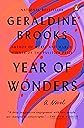
Year of Wonders: A Novel of the Plague
Product ID: 8283774
⏳Set in 1666, historical authenticity
📚Pulitzer Prize-winning author
🔥Top 400 in Contemporary Literature
Desertcart purchases this item on your behalf and handles shipping, customs, and support to Senegal.
📖 Dive into history’s most gripping year of wonders!
Year of Wonders is a critically acclaimed historical novel set in 1666 England, following a village’s self-quarantine during the plague. Written by a Pulitzer Prize-winning author, it features a compelling heroine and richly detailed storytelling that explores community, resilience, and human spirit amid catastrophe. A bestseller with over 13,000 reviews and a 4.4-star rating, it’s a must-read for lovers of historical fiction and powerful narratives.

| Best Sellers Rank | #17,436 in Books ( See Top 100 in Books ) #336 in Contemporary Literature & Fiction #811 in Politics & Government (Books) #1,200 in Family Life Fiction (Books) |
| Customer Reviews | 4.4 out of 5 stars 13,369 Reviews |
K**T
Excellent novel based on true events of a village fighting the bubonic plague
Year of Wonders is a novel inspired by a real village in 17th century england that was hit with one of the last waves of bubonic plague on English soil. In real life, Eyam England, a village of about 800 souls, agreed to self isolate when the plague hit in 1665 so as to prevent the spread to the rest of england. for a year they were cut off from the rest of england, struggling with the disease, and in the end half the town dying off. That, friends, is the plot of the book. The characters in the book are fictional, but many are based on real persons of the time. We see these events unfold through the eyes of Anna, a lowly servant woman and young widow. as one after another, high born and low, good and bad, fall ill we see anna struggle with the gruesome disease, and the loss of her friends, neighbors, and her own children. We see her grow in strength and wisdom, discovering a talent for healing and medicine. she rises from 'oh, that servant peasant' to one of the key pillars of the town. Through her we see people react in ways that are historically documented: some become zealots, others give into lusts and live for the day. some run from responsibility, others grow with strength and wisdom they didn't know they had. in the end the town is devastated but survives, and Anna has a new path open up to her in a twist i didn't see coming. The characters are well fleshed out, engaging, and realistic. the plot keeps moving and doesn't bog down - it was a page turner for me. the author paints the period and details of daily living (obviously well researched) so vividly that you really can feel part of the events of the time. The book is festooned with relatively archaic words for long past items and tools, accurate for the time but probably unfamiliar to most readers. All in all, an excellent book. highly recommend.
L**N
Hypocrisy, Ignorance, Religion, and the challenges of Nature
[some spoilers included] Villages in mid-17th c. England were often enclaves unto themselves, except for traveling merchants and the wealthy who could afford to venture distantly. The town’s tight enclosure intensifies the relationships between the inhabitants, and when the bubonic plague strikes because an outsider brings in flea-invested cloth, the claustrophobic feeling is exponentially increased. This is multiplied again when the rector Michael Mompellion urges the village to self-isolate rather than spread the disease to nearby areas. The book is rich in authentic detail and thoroughly researched. There is an overall darkness and almost claustrophobic mood rendered in the novel…the sense of being imprisoned by the boundaries of the town, the darkness of ignorance that pervades the inhabitants; the oppression of religious dogma, the degradation of women and the cruelty against those who were believed to practice witchcraft, the unjust class system as exemplified by the wealthy, selfish Bradford family, and the physical darkness of a world without much light. A world of dirt, hunger, impoverishment, plague-infested fleas, and death. The writing is brilliant. So many poetic and richly observed lines such in the first paragraph: “The wood stacked by the door, the tang of its sap still speaking of forest. The hay made, all golden in the last of the afternoon light. The rumble of the apples tumbling into the cellar bins.” Here, as throughout, Brooks evokes our senses: visual, aural, smells, which is the hallmark of a great writer because these descriptions set the reader firmly into place. “We live all aslant here, on this steep flank of the great White Peak. We are always tilting forward to toil uphill or bracing backward on our heels to slow a swift descent.” A brilliant observation! Or Anna’s cottage: “It was a tiny place, just one room propped upon another, so ill-built that the hatch sat rakishly atop the whole like a cap pulled crooked across a brow. The cottage was set hard into the side of the hill, crouching before the winter winds that roared across the moors.” I greatly appreciated the skill with which Geraldine Brooks created this world. There were, however, some scenes I found very uncomfortable. While I can read a gory murder mystery without issue, the scene in which Anna Frith must deliver a baby made me extremely squeamish. This account was too extended and graphic, although it was a horrifically accurate portrayal. The sermons delivered by Michael Mompellion were also unsettling to read. As a secular person (as is the author), I found these overbearing, pompous, and egotistical—as if he alone possessed superior wisdom. Even so, Brooks portrays Mompellion as a white hat until, suddenly, his hat turns black when his cruelty toward his kind and lovely wife, Elinor, is revealed. We learn that he refused to sleep with Elinor because, as a naïve teenager, she had been tricked into having sex with a man who promised marriage and then, when she was pregnant, left her, forcing her to abort the child. The fact that the rector deems her sinful and that she must be punished for her sins by never having sex with him…well, what about Charles, who seduced the young Elinor when he was older and more experienced? He didn’t seem to be a target of the priest’s vilification, nor does Mompellion seem disturbed by having illegitimate sex with Anna—okay for him but not for the woman? But then we have these lines uttered by Mompellion to Anna: “What could she [Elinor] give in atonement for the life that, because of her actions, never could be lived? Because lust caused the sin, I deemed that she should atone by living some part of her life with her lust unrequited. The more I could make her love me, the more her penance might weigh in the balance to equal her sin.” And: “I had to be assured she was cleansed or else risk the loss of her for eternity.” In other words, once she was dead, they could have sex together in heaven? When Anna asks, “And you?” Mompellion laughs and replies, “Do you know why women are the dregs of the Devil’s dunghill? When they [men] want a woman, they school themselves to turn their thoughts to all the vile omissions of her body.” And: “I, the husband, am the image of God in the kingdom of the home…and now it seems that there is no God, and I was wrong.” Poor self-involved fool! I can think of no other novel except perhaps Hawaii by James Michener, which depicts another rapid minister, that so delineates the horrors perpetrated by men of the cloth. I wish Mompellion had been punished by the author rather than his wife, Elinor. My suggestion? Toss the guy in one of the local lead mines and let Anna and Elinor find a life together. If the author wanted an optimistic ending, this one would serve better the one in which Anna travels to Oran and is smoothly assimilated into the house of Ahmed Bey, learns medicine, and seems to suffer no difficulty with language or culture. This conclusion struck me as forced and tacked on…a quick fix to make a happy ending. Even so, this is a masterful recreation of a dark, frightening period in English history.
E**Y
Wow
An extraordinary writer. Visceral, brutal, touching, insightful and a number of times profound. Plus it was a really good tale and fun read.
J**G
A wonderful story, expertly written
This is a brilliant and well crafted story of a terrible time. The author's depiction of this village and the inhabitants is striking and vivid. It all comes to life. I felt like I knew these people and could touch their emotions. In the end it's uplifting and satisfying and excellent. This is a wonderful story, indeed.
A**E
A lot more than I ever wanted to know about the Plague!
I heard an interview with Geraldine Brooks, the author of the book, in which she discussed her motivations and perspectives in writing this book. It sounded interesting, so... Actually, it's fascinating and very well written. It's told from the perspective of Anna Frith, a young servant to the town minister and his wife, who, as we learn in the first chapter, is a recent widow who has also lost her children. The book is written "in media res," (remember your 11th grade English?) in that it begins in early 1666, in the full grip of the Great Plague, and then goes back to the early part of 1665 and begins at the beginning. Briefly, and not to give too much away, it is about a small village in the lead-mining district of England that is exposed to the Plague by means of a flea-infested bolt of cloth that is brought into the village by a tailor who boards with the narrator, Anna. He is the first to die, followed fairly swiftly by about half the population of the village in one year. The village minister suggests that the village quarantine itself, so as to protect its neighbors from the Plague, and the villagers agree. Thus begins a year of horrors... and wonders. The Plague leaps quixotically from house to house, picking off some residents and sparing others, with no apparent rhyme or reason. Led by the minister and his wife. the village tries to unearth God's will and purpose in besetting them with this affliction, but nothing they come up with seems to work, and the body count keeps climbing. The Plague finally looses its grip after a year and some very unexpected revelations. The book is very well written. You can clearly hear the voice of the young narrator, a 20-year-old widow who has lost everything but her common sense. As she moves from crisis to crisis, you watch her grow from a fairly 2-dimensional character to a fully realized one, until she takes her destiny into her own hands in an action that would be unusual today, let alone 350 years ago. The book uses the vocabulary of the time, which includes many words that are no longer in our vocabulary, and are therefore unknown to us. The book offers no glossary, so you are on your own to figure out their meaning. This has a 2-fold effect: on the one hand, it slows down the reading somewhat, and makes for a certain degree of frustration because you don't really know what these terms mean. On the other, it certainly lends authenticity to the narration, and if you stop and think about it, you can probably figure it out. (The most exciting aspect of the book is that, after many, many years of crossword-puzzling that called for "adit" as the obsolete term for a mine entrance, this is the FIRST time I've ever actually seen the word used - puzzlers rejoice!) Partly because of the use of contemporaneous vocabulary, you get a real sense of what it must have been like to live in a small, poor village in the mid-17th century. Life was difficult at best, and this book brings that every-day-ness to life better than any other I can think of. It exposes the daily life of common people, under extreme duress, certainly, but still quite authentically. What makes it really interesting is that while presented as fiction, the book is based on fact; the village of Eyem quarantined itself, at the suggestion of its minister, during the Great Plague of 1666. The character of the minister in this book, Mr. Mompellion, is based on the real minister. I recommend this book. It's a fairly fast read and will leave you thinking about it at the end. I went back and reread some passages several times, just to make sure I had understood them properly - if you read the book, you will too, and will know which passages I'm referring to. Enjoy!
A**Y
Wonderful story with a very disappointing end
I LOVED reading about the small village being ravaged by the plague and the difficult decision to close their gates and quarantine themselves from the rest of Derbyshire. The story is based on a real village Eyam and how they handled the Bubonic Plague in 1665-1666. I really felt for these villagers as the plague was just unrelenting in how it terrorized these people. The relationships in here were interesting as some were born out of the stress of their situation and others were more organic and enduring. But oh how I hated the ending. The last 50 pages or so made me mad because they ruined an otherwise beautiful book. I’m settling on 3 stars for a rating only because the majority of the story was so great. Minette Walters’ Black Death duology is a much better plague story, in my opinion. Ms Walters also wrote of a village that shut their gates to in/out traveling, but instead of doing it to protect the surrounding areas, they did it to protect themselves.
L**C
Witness to a time of crisis
Geraldine Brooks is a skilled journalist and she brings her talent of keen observation and attention to detail to this, her first novel, based on the true story of the English village of Eyam, Derbyshire. In 1666, when plague was running rampant, these people voluntarily chose to quarantine themselves and tend to the sick and dying rather than take to the road and try to run from this awful disease. Ms. Brooks does an outstanding job of getting into the heart and soul of what this experience must have been like and has created some full-blown and very human characters to tell her story Through the eyes of Anna Firth, a young widow who is a servant to the minister and his wife, the happenings of that fateful year are recounted in excruciating detail, using the rhythms and language of that long-ago time. As her children and neighbors suffer and die, she is witness to the extremes to which people will go in a time of crisis. I winced at the some of the supposed cures as well as some of the barbaric customs and punishments. I watched her friendship with the minister's wife flourish. I felt the torments of the flawed human beings who struggle with dark inner turmoil. And understood the role of religion in their lives. These are deeply complex characters and unexpected secrets surfaced as I got more and more into the story. I felt I was riding the wave of the book, unable to put it down and feeling I was walking right beside Anna in that small sad village with its shrinking population where fields lay fallow and apples rotted on the trees because everyone was either dying or tending to the sick. And then, just at the tide was turning and I felt the story was coming to a satisfactory conclusion, the author took me on yet another roller coaster ride as the last fifty pages changed directions, unearthing even more secrets and taking a turn that thrust Anna into a whole new adventure. I recommend this book highly even though I understand it is not for everyone. It is indeed upsetting. But it also shows the resiliency of the human spirit and adds perspective to what is going on in the world today.
A**R
Lite Historic Reading
This story follows the tale of an English handmaiden named Anna Firth during the year of the plague, 1666. The plague seed arrives to her secluded village via bolts of cloth sent from London. As the residents begin to fall ill and die, one after the other, those that remain alive make the vow to remain in the village, because to flee would only spread the disease further. This is a historical novel but it's not a dry, boring read. It's based on the true account of an English village that did impose a self-inflicted quarantine, but much has been invented to make for a more readable story. Undeniably, Anna is made into a heroine as she goes to the rescue of her fellow villagers, delivering babies, tending to the sick, helping those that cannot help themselves. But Anna is also made human by a few rare emotional choices she makes. After losing her husband in an accident and losing the prospect of new love with another man, quiet Anna feels a sudden surge of jealousy at the love between the village rector and his wife. That they should have each other and she should be alone is too unfair; so she smashes every single dish she had close at hand. That was in 1666, but by today's standards, I would imagine this to be akin to pushing a car off a cliff just to watch it be destroyed. Her loss of control was a small passage in the book, merely a paragraph, but it brings Anna down from the saintly, iconic picture that she has been painted into throughout the whole story. I've heard people say that they didn't enjoy the ending of this book. They thought the ending was too abrupt or a `cop out'. Yes, the book wrapped up quickly, but it wasn't "...and then she woke up. The End." This book was following Anna and it went where she went. It could have continued on, covering the aftermath of the plague and all that entails, but then the book would have been 10 volumes long. I call this book "Lite Historic Reading". If you want something more substantial, pick up Umberto Eco's The Name of the Rose or Iain Pears' An Instance of the Fingerpost. Both are extremely long, erudite, satisfying works of fiction that one could write their Master's thesis on. The Year of Wonders is a good book to read during a rainy weekend.
M**M
A book for the times
I have had this book on my TBR list for a couple of years. I have read several of Geraldine Brooks’s other books and had not realised that this was her first novel. Her writing is fantastic and she is a great storyteller. I was inspired to read this book now, as someone at work has started an “iso” book group, and this was the chosen book. For anyone who reads this review in the future, this is because we are in the midst of the COVID 19 pandemic and have all been socially isolated and working from home. This book is appropriate then as it deals with the plague epidemic of 1665-6 in the UK, and specifically the plague village of Eyam in Derbyshire. This village was stricken by bubonic plague, and took the unusual step of cutting itself off from the rest of the world to stop the spread of the disease. The villagers themselves suffered greatly, and many died. We now know a great deal about this disease and how it is spread, but that was not the case in the 17th century. The story is told by Anna, who is a survivor- not only of the plague, but of other tragedies in her life. Her husband Sam is killed in an accident in his lead mine, a common occurrence in those days. She becomes great friends with the minister’s wife, Elinor, who teaches her to read. Anna has a very hard life but ends up happy and fulfilled, albeit far away from Derbyshire. This is a story of love and loss and triumph over the odds. It is also historically interesting, being based on a true story. I found that much of it resonated strongly with our own situation in the current pandemic and it almost could have been written last week, not in 2011. Highly recommended, especially for lovers of Geraldine Brooks’s work.
H**K
小説として面白く、ペストの実情も知ることができた
17世紀後半のイギリスの小村。無学で貧しい父と継母に育てられたアンは、夫を事故で失い、村の牧師夫妻の召使として二人の子供と暮らしていたが、そこにペストが流行する。次々と村人が死んでいく事態に、牧師は外部に病気が広がらないように村を閉鎖する。死の恐怖に直面した人々は魔女として無実の女性を殺すなど、迷信に走ったり酒びたりになったりする。アンも子供を失うが、その中で自分のとるべき行動を見出していく。たまたま同じようにペストを背景に展開し、ストーリー性が面白かったKen Follett のWorld Without Endを直前に読んでいたが、こちらは牧師の妻のエリノアにも助けられて内面成長をしていくアンが丁寧に描かれていて、終わりまで一気に読んだ。ペストの話は史実に基づいているそうだが、終わりがやや強引で、作者が自分の経験を無理やりに入れ込んだ印象があったので星を一つ下げた。
M**B
Magnificent novel with the memory of the Black Death
The Year or Wonders, what Dryden called Annus Mirabilis though in the backdrop of the traumatic civil war, here Brooks beautifully captures the year, the 1665 - the year when nearly 5000 people were dying in a week - the year of the Black Death. The Plague and the Great Fire of London erased one third of London's population in two successive years. Brooks in her novel portrays the role of women, and the ways to survive amidst the pandemic. This is a magnificent novel. However, I got a book with yellowed pages with pencil markings, which I do not like anyhow. Keep reading. Keep engage in getting the orgasmes of the pleasures of reading a text.
S**S
Keep a box of tissues handy for this brillant read!
One of my top 10. I love history and the time of the plague fascinates me. Thanks to this book I learned about plague holes where people from surrounding plague infected villages would leave supplies for victims to keep them alive, but their illness contained to avoid spread. The fictional story had my emotions spinning in circles, what an ending to a fabulous book!
T**A
Astounding
It’s not just the eloquence of the language. It’s the surprising turns as life finds a way amidst the decay of death. One of the best reads in a long time.
Trustpilot
1 month ago
1 month ago