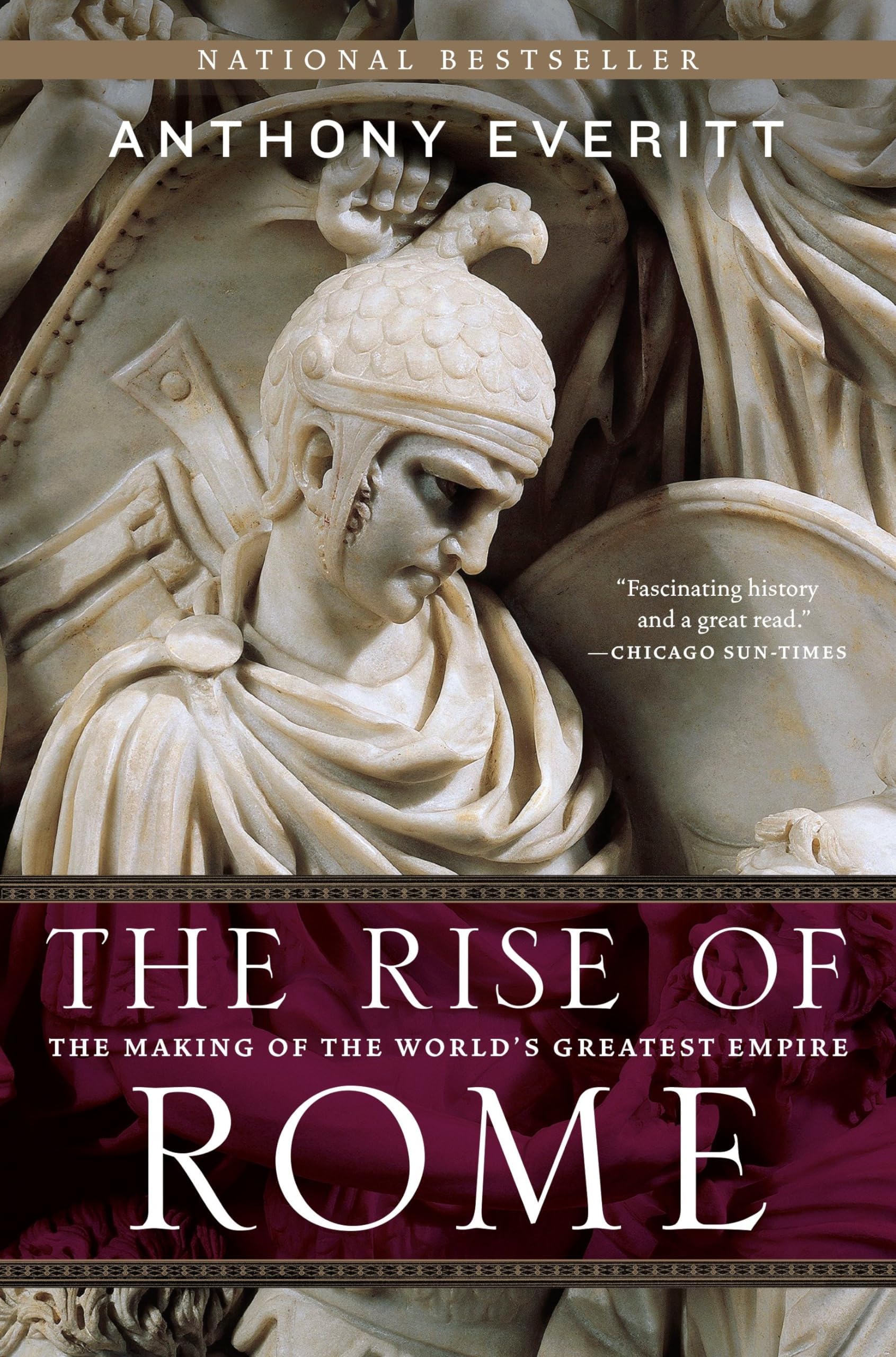
The Rise of Rome: The Making of the World's Greatest Empire
Product ID: 8246068
Desertcart purchases this item on your behalf and handles shipping, customs, and support to Senegal.
NAMED ONE OF THE BEST BOOKS OF THE YEAR BY THE KANSAS CITY STAR From Anthony Everitt, the bestselling author of acclaimed biographies of Cicero, Augustus, and Hadrian , comes a riveting, magisterial account of Rome and its remarkable ascent from an obscure agrarian backwater to the greatest empire the world has ever known. Emerging as a market town from a cluster of hill villages in the eighth and seventh centuries B.C., Rome grew to become the ancient world’s preeminent power. Everitt fashions the story of Rome’s rise to glory into an erudite page-turner filled with lasting lessons for our time. He chronicles the clash between patricians and plebeians that defined the politics of the Republic. He shows how Rome’s shrewd strategy of offering citizenship to her defeated subjects was instrumental in expanding the reach of her burgeoning empire. And he outlines the corrosion of constitutional norms that accompanied Rome’s imperial expansion, as old habits of political compromise gave way, leading to violence and civil war. In the end, unimaginable wealth and power corrupted the traditional virtues of the Republic, and Rome was left triumphant everywhere except within its own borders. Everitt paints indelible portraits of the great Romans—and non-Romans—who left their mark on the world out of which the mighty empire grew: Cincinnatus, Rome’s George Washington, the very model of the patrician warrior/aristocrat; the brilliant general Scipio Africanus, who turned back a challenge from the Carthaginian legend Hannibal; and Alexander the Great, the invincible Macedonian conqueror who became a role model for generations of would-be Roman rulers. Here also are the intellectual and philosophical leaders whose observations on the art of government and “the good life” have inspired every Western power from antiquity to the present: Cato the Elder, the famously incorruptible statesman who spoke out against the decadence of his times, and Cicero, the consummate orator whose championing of republican institutions put him on a collision course with Julius Caesar and whose writings on justice and liberty continue to inform our political discourse today. Rome’s decline and fall have long fascinated historians, but the story of how the empire was won is every bit as compelling. With The Rise of Rome , one of our most revered chroniclers of the ancient world tells that tale in a way that will galvanize, inform, and enlighten modern readers. Praise for The Rise of Rome “Fascinating history and a great read.” — Chicago Sun-Times “An engrossing history of a relentlessly pugnacious city’s 500-year rise to empire.” —Kirkus Reviews “Rome’s history abounds with remarkable figures. . . . Everitt writes for the informed and the uninformed general reader alike, in a brisk, conversational style, with a modern attitude of skepticism and realism.” — The Dallas Morning News “[A] lively and readable account . . . Roman history has an uncanny ability to resonate with contemporary events.” — Maclean’s “Elegant, swift and faultless as an introduction to his subject.” —The Spectator “[An] engaging work that will captivate and inform from beginning to end.” —Booklist Review: Rome - a wonderful day tour of the great city - Rome's rise is substantial: the length of time it took, the vast reach, the permeation of Roman culture into other cultures, the effort involved to get there and even how long it lasted - all point to a resilient, dedicated people. The legacy is still with us, or how else could Everitt find readers for this compelling story? It is an excellent telling, but a partial one. How could a single volume not be? The book covers approximately the first 700 years. Beginning with murky myths and legends and the first settlers who trade salt along the eastern banks of the Tiber River to ending with Octavian, Julius Caesar's sole heir, who rules supreme after the republic is a long gone form of government, Rome struggled, changed, developed. The empire would not reach its furthest boundaries until over 100 years after Octavian, but the roots of decline are already in place. Rome was not always such an absolute, dominant force. It may fight in Sicily, but still does not control Italy's boot. It was sacked by Celts/Gauls in 390 B.C.E. Later Hannibal entered Italy over the Alps and stayed for 15 years. As the Roman trader/farmer/soldier settlement grew, so did the opponents it took on and took in. Rome was constantly at war with surrounding tribes. It might be asked about Rome what was asked about Napoleon, 'Can one be a neighbor?' Rome did not just make war, it built. It built roads, aqueducts, a navy from scratch and incredible buildings. Rome developed adaptive and long lasting forms of government and religious institutions. Like a wonderful day tour of Rome, this book presents people and sights (some horrific) of the great city that will call you to more depth and investigation elsewhere. Review: Kindle Edition - I will leave it to others to review the material in-depth. As a graduate level history student, I found it both informative and readable. A great chronological survey of ancient Rome from its mythical roots in the aftermath of the Trojan War to the collapse of the Republic during the civil war between Caesar and Pompey (with mention of Augustus). The Kindle edition contains a few errors, but nothing that really detracts from a smooth reading experience. It also includes a table of contents, and extensive endnotes (covering approximately 35-40% of the text). Everitt is a great author, though not a professional historian. His expertise is in the visual arts, I believe, but he knows his subject very well along with the associated scholarship. His works on Cicero, Augustus, and Hadrian also come highly recommended for the general reader or history student.



| Best Sellers Rank | #85,605 in Books ( See Top 100 in Books ) #83 in Ancient Roman History (Books) #486 in Political Ideologies & Doctrines (Books) |
| Customer Reviews | 4.4 out of 5 stars 641 Reviews |
D**B
Rome - a wonderful day tour of the great city
Rome's rise is substantial: the length of time it took, the vast reach, the permeation of Roman culture into other cultures, the effort involved to get there and even how long it lasted - all point to a resilient, dedicated people. The legacy is still with us, or how else could Everitt find readers for this compelling story? It is an excellent telling, but a partial one. How could a single volume not be? The book covers approximately the first 700 years. Beginning with murky myths and legends and the first settlers who trade salt along the eastern banks of the Tiber River to ending with Octavian, Julius Caesar's sole heir, who rules supreme after the republic is a long gone form of government, Rome struggled, changed, developed. The empire would not reach its furthest boundaries until over 100 years after Octavian, but the roots of decline are already in place. Rome was not always such an absolute, dominant force. It may fight in Sicily, but still does not control Italy's boot. It was sacked by Celts/Gauls in 390 B.C.E. Later Hannibal entered Italy over the Alps and stayed for 15 years. As the Roman trader/farmer/soldier settlement grew, so did the opponents it took on and took in. Rome was constantly at war with surrounding tribes. It might be asked about Rome what was asked about Napoleon, 'Can one be a neighbor?' Rome did not just make war, it built. It built roads, aqueducts, a navy from scratch and incredible buildings. Rome developed adaptive and long lasting forms of government and religious institutions. Like a wonderful day tour of Rome, this book presents people and sights (some horrific) of the great city that will call you to more depth and investigation elsewhere.
A**W
Kindle Edition
I will leave it to others to review the material in-depth. As a graduate level history student, I found it both informative and readable. A great chronological survey of ancient Rome from its mythical roots in the aftermath of the Trojan War to the collapse of the Republic during the civil war between Caesar and Pompey (with mention of Augustus). The Kindle edition contains a few errors, but nothing that really detracts from a smooth reading experience. It also includes a table of contents, and extensive endnotes (covering approximately 35-40% of the text). Everitt is a great author, though not a professional historian. His expertise is in the visual arts, I believe, but he knows his subject very well along with the associated scholarship. His works on Cicero, Augustus, and Hadrian also come highly recommended for the general reader or history student.
D**N
A Good Background for Understanding our Current Democracy
Well written work. Reads almost like a novel. Would have helped to keep characters straight and time periods in order if there was a brief listing of both at the beginning of the book. There is one at the end but it is too late and too detailed. This needs to be condensed. One major criticism: the author tends to blend current language and words into the history telling which sometimes confuses the tale. It also would have helped if it was more clearly stated what was mythical and what was real and when the real history started. You do get a good foundation in understanding the basic underlying reasons why the empire succeded and hints of the causes for its eventual fall.
D**N
The Rise of the Republic
If I were to mention the Roman Empire in any sort of word association context, many people might respond with some variation of "decline and fall of". It seems that every historian or history buff who is at all familiar with the history of the Roman Empire thinks largely in terms of its decline and fall and they all seem to have their favorite theories why the Empire fell; moral decay, economic collapse, climate change, etc. The impression seems to be that Rome was somehow doomed to fail and that the only lessons to learn from Roman history is what great powers ought not to do in order to avoid their own decline and fall. Yet, Rome was an enormously successful state. For almost six hundred years, 146 BC to AD 410, Rome was uncontested ruler of the lands surrounding the Mediterranean, a feat unmatched by any of the many great powers since, and even after the "fall" of the Empire in 476, the eastern half of the Roman Empire, the so-called Byzantine Empire manager to last for another thousand years. No other, more recent, great power has managed such longevity. Perhaps the question we need to ask about the Roman Empire is not how it fell, but how a small, Italian city-state rose to rule the known world, and how they managed to rule for so long. This is the question which Anthony Everett seeks to answer in "The Rise of Rome". In his book, Everett traces the history of Rome from its legendary, even mythical, beginnings to the generation before the rise of Caesar. Everett recounts the legends of Rome's founder, Romulus, and its kings, the overthrow of Tarquin and the establishment of the Republic, and the wars in which the city fought for its life against its neighbors. Everett then considers what truth, if any, may be behind these legends based on the findings of archeology, while noting that the true events are less important than the fact that the Romans themselves believed the legends to be true and were influenced by them. The Republic slowly came to dominate Italy, in part because of Rome's military prowess, Rome was an aggressive, militaristic state, but also because the Romans repeatedly demonstrated a statesmanlike common sense in their relations with defeated enemies and in their own internal politics. Here we begin to have somewhat more reliable historical accounts and we can begin to understand what the Romans were doing right. The Romans did not seek to destroy their enemies once they were defeated, but to have their former enemies join them. Italians could become allies in league with Rome and perhaps even gain Roman citizenship. Rome suffered from the same sort of class conflicts as the Greek city-states, but while the Greek factions usually tried to destroy each other, the Roman ruling class generally managed to find some compromise which kept the city together. More than any thing else, it was the Roman refusal to accept defeat and determination to continue fighting, even when their cause seemed lost, that led to the many Roman victories, as such warlords as Pyrrhus and Hannibal discovered. The Punic Wars were a turning point in Roman history. For the first time, Rome acquired territories outside of Italy, and by the end of the Third Punic War in 146 BC, Rome had come to dominate the Mediterranean. Rome had become a wealthy superpower. This success was not altogether favorable to the development of the character of the Romans. The Republican customs and institutions which suited an Italian city-state did not scale all that well to a mighty empire and the traditional good sense and willingness to compromise that had been displayed by Rome's ruling class began to falter in the newly affluent society. Everett ends his account of the rise of Rome with the rebellion of Rome's Italian allies, who, perhaps uniquely in history, did not seek to overthrow Roman leadership, but to be allow to become Roman citizens themselves, and rise and fall of the Roman generals and statesmen, Marius and Sulla, who set the precedents for Caesar's dictatorship and the end of the Roman Republic. I can highly recommend "The Rise of Rome" for anyone interested in the history of the Roman Republic, particularly the early centuries that do not get nearly so much attention time of Caesar and the early emperors. Maybe we could learn some lessons in how to manage an empire.
F**H
A book for a serious reader
This book contains a wealth of interesting tidbits of history. The author weaves together a number of factors that influence the development of the Roman Empire. However, it is very difficult at times to follow the meaning and impact of each factor. It will take more than one reading to develop and understanding of what the author is trying to convey. This book is probably written for someone who has some previous knowledge of about the subject. Still, I enjoy reading about history and enjoy the enthusiasm the author projects in his writing. I feel it is a scholarly written book that serious readers will find worthwhile reading.
P**I
Reads like a high school textbook
Is anyone else put off by the pedestrian prose? I had high hopes for this book because the subject matter is so rich and I know so little of it. However, I find it difficult to read because of its flat sentences. Not that it's plodding, but the overall tone is superficial (I believe another reviewer said the same thing) and therefore less than fully captivating. but I'll keep at it because I want to see how it comes out... Do the Romans win or lose in the end?
T**I
I am biased as I'm in love with Ancient Rome
Disclaimer: I am biased as I'm in love with Ancient Rome. That being said, Anthony Everitt as an uncanny knack for intertwining historical lore with storytelling that leaves you pouring over the pages wondering what will happen next and what the consequences will be. His foreshadowing is great, his tie-ins are on point, and he's never off topic. Not to mention his sources, it's outstanding the amount of research this guy puts into his work. Well done! Enough about the writer, though, what about the book? The Rise of Rome follows the known history ancient Rome (noting when it's factual and when it is disputed) from the supposed roots of the Fall of Troy all the way up to when the Republic was replaced by the its first emperor, Augustus. Along the way, Anthony draws a careful line detailing not only how Rome could rise to the great power it did, but also noting which points and at what times the civilization sets dangerous precedents and will eventually lead to its demise. I've said it before and I'll say it again, I feel as though the USA is some modern day reincarnation of Ancient Rome. From the mix of honor and devotion to country along with wicked dealings and terrible contemptible treatment of supposed allies, the USA will cease to be a power if or when the government ceases to coexist with itself. Ancient Rome tumbled because the politicians became Generals and they could no longer tolerate their political enemies. In the USA today, Democrats and Republicans rip each other down in words only, and so long as it stays that way and after every election the losers go home to follow along, we will not follow in Rome's footsteps. And oh yeah, side note, I can not WAIT to visit Rome next month!
I**R
Ancient history with important lessons for our current times.
How does a reviewer give a 4.5? I finally settled on a 4, expecting that the glowing reviews by others more knowledgeable than I will lead anyone even vaguely interested in this fascinating subject to read this book. It is both a fun and easy read, and a fount of knowledge about a fascinating society, the various governments by which it was ruled, the factors that led to its success, and to its ultimate failure. A failure occurring after many more years than our own country has been around. But a failure which offers many lessons for us. A thoroughly enjoyable book. the only reservation which led to my taking .5 off the rating is that in the Kindle version I didn't find any maps (perhaps my fault) which made it difficult to understand much of the discussion of military encounters. But that information isn't really necessary to understand the big picture, and learn the important lessons..
D**I
Great read
If you are at all interested in ancient Roman history and culture this is a must have book. The author has meticulously researched this book and has written it as a page turner mystery and adventure novel. It details the history of the Roman civilization from it's early history to it's end. The book not only has many interesting facts and outlines the major players but it also gives an historical account as to the path taken by Rome in becoming the ruler of the ancient world. If you enjoy a well written historical novel, do not hesitate in buying this book.
M**T
Like Rome look no further great intro
Great historical book real easy read would recommend
C**E
libro
me gustò y la facilidad de poder obtenerlo a travès de ustedes
J**M
but it is an excellent book to understand the beginning of Rome
I am still reading it, but it is an excellent book to understand the beginning of Rome.
T**Y
Really interesting.
Bought for a change to my usual read. Like how it's written. Informative, interesting, definitely worth a read.
Trustpilot
2 months ago
1 month ago