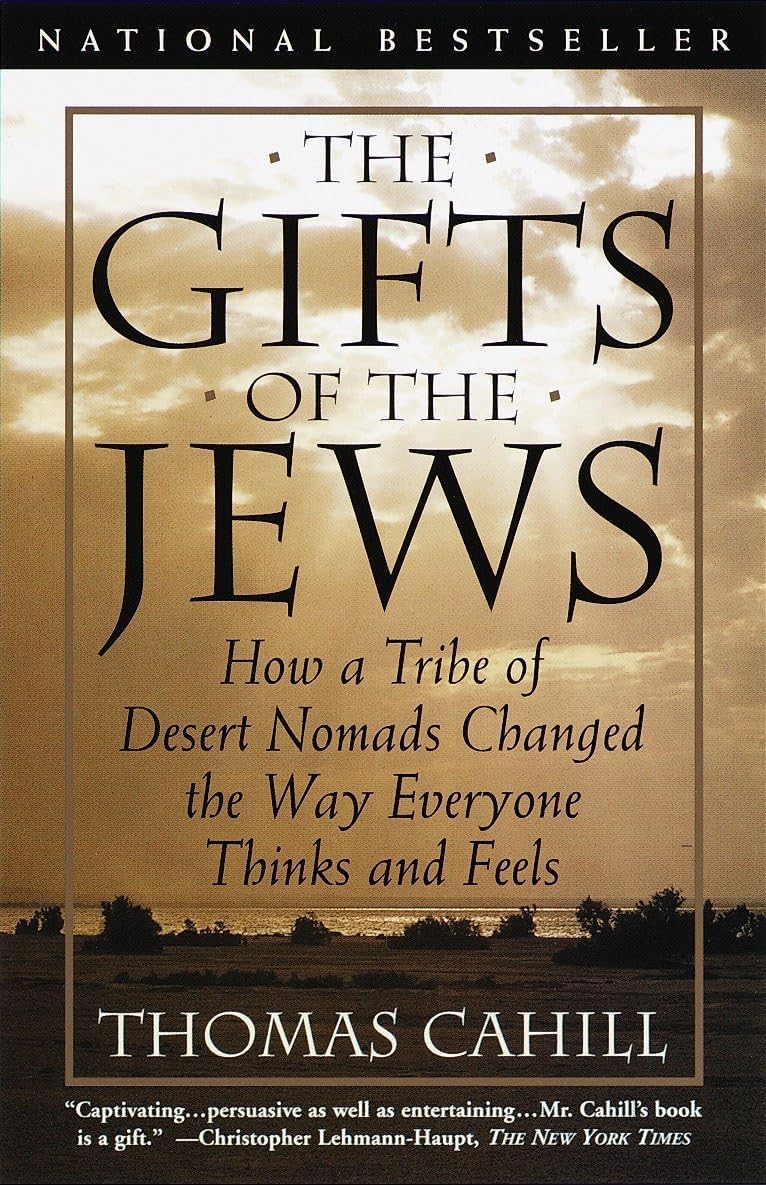
The Gifts of the Jews: How a Tribe of Desert Nomads Changed the Way Everyone Thinks and Feels (The Hinges of History)
Product ID: 8183216
⏳Revolutionary concept of time
📚Bestselling historical narrative
🕊️Foundational cultural insights
Desertcart purchases this item on your behalf and handles shipping, customs, and support to Senegal.
⏳ Unlock the ancient secrets that rewrote history and your worldview!
The Gifts of the Jews by Thomas Cahill is a nationally bestselling historical exploration revealing how ancient Jewish ideas about time and individuality revolutionized Western civilization. Blending compelling storytelling with scholarly insight, this book challenges conventional views and highlights the enduring impact of biblical figures and their culture on modern thought.


| Best Sellers Rank | #137,849 in Books ( See Top 100 in Books ) #57 in History of Judaism #167 in History of Civilization & Culture #220 in Jewish History (Books) |
| Customer Reviews | 4.5 out of 5 stars 750 Reviews |
B**E
excellent book
Presented ideas, relationships, and interpretations of the Old Testament that I found compellingly. Provided a structure by which to keep track of characters and times.
H**R
I am officially a Thomas Cahill fan!
This is the second Cahill book I have read. He brilliantly executes the narrative by setting the stage for the ancient worldview of the Sumerians and their contemporaries, and then contrasts it with the rise of a people out of Ur (Sumerians) with a completely perspective on how to view deity, time, eternity, life, and more. He challenges the understanding that Abraham, Isaac, Jacob, Joseph, and Moses were Hebrew speakers even though there is no proof that this Semitic language existed prior to the 11th Century B.C., as these leaders were the products of Sumerian, Canaanite, and Egyptian civilizations. He also defends the integrity and the historicity of the oral culture of these people. This book will challenge what you think you know. Epic!
A**Y
The Finger of God in Human Affairs
Following "How the Irish Saved Civilization", I read volume 2 of Thomas Cahill's Hinges of History series: The Gifts of the Jews. In this bestselling book, Cahill sets out to show that the world we live in and everything we do and think, is purportedly a result of the Jewish "revolution" in history. The concepts expounded in the Bible were a dramatic break from the ancient religions and philosophies, that viewed the world as an endless cycle of birth and death in which human beings had no control over their lives. The Jews broke this way of thinking by defining time as continuous, as moving towards a better future through the decisions of men and women living here and now, in the present. Were it not for the Jews, argues Cahill, the world as we know it would not have come to be; we would have been unable to grasp concepts such as history, future, freedom, faith, hope, individual, justice and pretty much everything else. What a wonderful theory and, as a Jew, I'm obviously all for it. But unfortunately Cahill devotes most of the book not to providing evidence to support this theory, but rather to a recounting of the major stories of the Bible from his perspective. The few profound points he makes about the contribution of the Jews to the world are lost in the endless quotes from the Bible and in Cahill's somewhat simplistic theories about what really happened. For example, do we really need to know that he believes the Red Sea was a marsh and not a sea, or that the Manna the Israelites ate in the desert was most likely some white plant secretion? Such details are numerous and do not contribute to the main idea offered by the author. Cahill does not come through as a particularly believing person and he certainly does not view the Bible as the word of God. Therefore, it is interesting that he uses the following definition for the existence of God: "...the Jews developed a whole new way of experiencing reality, the only alternative to all ancient worldviews and all ancient religions. If one is ever to find the finger of God in human affairs, one must find it here." (p. 246) I wonder if Cahill was aware that this very definition was given by Benjamin Disraeli, Prime Minister of Britain. When asked by Queen Victoria if he can provide proof that God exists, Disraeli (born Jewish himself) thought for a moment and replied: "The Jews, your Majesty". As a believing Jew I particularly liked the way Cahill defines how each and every one of us hears the Voice of God: "Each reader must decide if the Voice that spoke to the patriarchs and prophets speaks to him, too. If it does, there is no question of needing proof, any more than we require proof of anyone we believe in... one does not believe that God exists, as one believes that Timbuktu or the constellation Andromeda exists. One believes in God, as one believes in a friend - or one believes nothing." (p.250)
J**E
Abraham was pulled out of a child-sacrificing culture to be the spiritual father of those who seek mercy not sacrifice!
Okay, parts are slow slow slow. But the one thing I got out of this and really needed to (and so do many who shake their fists at God and don't understand the whole Abraham/Isaac scene) is that the God of Abraham was a forgiving merciful God who didn't force religious prostitution/rape and child sacrifice on His Children (no matter what anyone says). In fact, Abraham was pulled OUT OF THAT pervasive culture and shown a God of mercy who has laws that prevent people from such crimes, when in the Spirit of the Law (Jesus later taught), and shows them how to be (lo and behold) good to each other....well, as much as humans can be compared to Jesus. But if people want to keep thinking "what a meany" for making Abe climb up that mountain and putting him on the spot like that: know from this book and archeology and history that this God, Abraham's God, provides a sacrificial lamb in each "sons" place. Other gods, not so much (not then anyway). That first son is you, my friend. Praise Him for giving us an avenue of escape from our "selves," through the Jews, who showed us Him.
I**A
Buena lectura
Buen libro
M**.
Five Stars
Have original autographed copy. This order is for a friend. Cahill is a brilliant Catholic professor at Fordham University in NYC. Introducing his book at a local Temple meeting some years ago, he said "Anyone who hates Jews hates God." (because in the Judaeo-Christian bible it says God came to the Hebrews during the Exodus from Egypt). Unforgettable, as are all his other well-written books! Have lent it to many friends and clergy. What more can I say?
C**N
A Book That Could Have Been Great...
Going into this book, I had a lot of hope. Cahill's introduction showed promise. He briefly notes how ancient peoples thought in cycles. In other words, time isn't linear but cyclical. What has been, will be again. He then goes on to declare that "the Jews were the first people to...find a new way of thinking and experiencing, a new way of understanding and feeling the world, so much so that it may be said with some justice that theirs is the only new idea that human beings have ever had" (p.5). The first chapter sees Cahill expand on this idea by recounting how ancient peoples thought. He uses The Epic of Gilgamesh and other ancient near eastern writings to describe the worldview and religion of humanity's ancestors. And in so doing, he sets the background for Israel's contrasting worldview. According to Cahill, Israel was the first culture to view time in more linear fashion. Israel saw existence as including a beginning, middle, and end. This becomes especially apparent when we compare Israel's sacred writings with the myths and writings of other cultures. Genesis begins with the word 'in the beginning.' On the other hand, the stories of other ancient cultures often "begin in the middle and end in the middle." Though it might not seem like much, this was a huge accomplishment. This idea that time moves in a direction rather than cyclically helped people develop an adventurous, entrepreneurial spirit. Without this fundamental idea, the history of Western society would have been utterly altered. But this isn't the only gift of the Jews. Cahill also notes how the descendants of Abraham developed a sense of individuality. Whereas the writings of most other cultures lacked references to 'I', the Bible - especially the Psalms - is filled with personal reflection. Scripture also differed from the writings of other people by focusing on normal people. Think of Ruth or Job or even Abraham. These men and women weren't anything special. They weren't heroes or kings. They were just people. So, according to Cahill, the Jews helped humanity see itself as a collection of individuals rather than just a mass. All of these insights are worth considering - especially as a Christian. Unfortunately, the longer the book goes on, the weaker it gets. Cahill spends a lot of time in the early chapters describing these ideas and principles which Judaism bequeathed to Western society. But about halfway through, he exhausts the 'gifts' and ends up simply recounting the history of Israel from scripture. If you've ever read the Bible through, or you know the story of Israel fairly well, the latter half of the book will leave you wanting more. This isn't to say that Cahill does a poor job. He doesn't. I think he tells Israel's story well - hitting all of the high points. I just wish he would have been able to continue presenting different 'gifts of the Jews' in the latter chapters. For those wondering, I should also note that Cahill isn't exactly conservative (though he isn't exactly liberal either). He believes Abraham and Moses were real individuals. He even thinks that scripture communicates the general outline of their stories. Though he argues that scripture is also filled with errors and absurdities. Over all, I moderately enjoyed the book. Though I felt like it could have either been shorter or more fleshed out. My biggest takeaway was the reminder that the Bible and its people are unique in history. If not for Abraham and his descendants, the world - especially the Western world - would be a very different place.
D**N
A Religious History
America is immersed in Judeo-Christian values. Our legal system derives from this heritage. Our moral structure, for which America is revered worldwide, comes from this heritage. This small book traces the development of these ideas back to the earliest times. It gives on a good basis for understanding how God has sculpted our culture. This is not extremely well written. In fact, the beginning of the book is a bit tawdry. But, stick with it to the end, and you will appreciate the material presented more than you could believe. I recommend it to anyone interested in the roots of morality and civilization in religion.
D**R
Strongly recommend to read.
Very good well written history book..
J**N
OUTSTANDING!!! A Must Read !!!
OUTSTANDING!!! A Must Read !!!
A**I
Absolut lesenswert
Eine gut lesbare, nicht zu theoretische Auseinandersetzung mit den jüdischen Ursprüngen der westlichen Zivilisation. Dieses Buch ist absolut zu empfehlen.
J**H
a good, thought-provoking read
A very interesting presentation of the stories of the patriarchs, and a helpful drawing out of the essence of the ideas that developed and continue to have influence today.
洋**友
旧約聖書を物語風になぞっている・・・
アマゾン・アメリカでのレヴューの数が多いので、読んでみると、信者(それもコアの)向けに旧約聖書物語を語っているだけ。決して歴史主義に立って旧約聖書の成立だの、ユダヤ民族の起源を実証的に解き明かしたものでは全くないので、それを期待すると大外れ(がっかりしたー)。アメリカの素朴で熱心な信者向けのよくあるスピリチュアル物ですね。この著者ならではの特別なところが分からないので星3つ減!!
Trustpilot
1 week ago
1 week ago