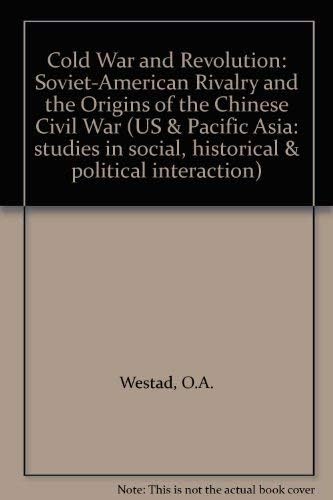
Cold war and revolution: Soviet-American rivalry and the origins of the Chinese Civil War, 1944-1946
Product ID: 807043653
Desertcart purchases this item on your behalf and handles shipping, customs, and support to Senegal.
Review: Good Study in General, But Some Oversimplifications of Issues, Actors - Odd Arne Westad's Cold War & Revolution: Soviet-American Rivalry and the Origins of the Chinese Civil War, examines the roles that the United States and the Soviet Union played in helping to create the conditions for China's civil war. The book covers the period from roughly mid-1944 until early 1946. Westad began by examining the American and Soviet positions toward China at Yalta, and the positions of the Chinese Guomindand government under Jiang Jieshi (Chiang Kai-shek), and the Chinese Communists under Mao Zedong. Westad noted that both the United States and the Soviet Union both sought stability in Asia and to ensure that China would not be able to challenge each of them in any meaningful way after the war. Additionally, Jiang was happy to have both powers back his government in a formal treaty. “A driving force in this process was Jiang Jieshi's attempts to compensate for his military weakness by achieving foreign support for his regime (30).” Jiang was firmly in command of Chinese policy at this time, Westad wrote. Jiang had to balance many factors to keep his government in power, and it was Jiang alone who decided upon the deals he struck at Yalta, which would theoretically maintain Chinese stability- not his advisors. Westad noted that Jiang's agreements with Stalin must be seen in a similar light as the Molotov-Ribbontrop Pact of six years earlier. In part both agreements, Wested argues, were meant to keep revolutionary factions marginalized with their respective regimes. To counter what appeared to be the growing political strength of the Guomindand, Mao reached out to other groups both within China and without, notably to the United States. When these overtures only met with partial success, by Mao's standard, the Communists began to prepare for civil war. In Washington, President Harry Truman still hoped for a diplomatic decision in China, and dispatched the former Chief of the General Staff George C. Marshall to Asia. This mission, however, faltered as both sides in China increasingly prepared for war. It was here, Westad wrote, that Jiang distanced himself from the Soviets because of domestic hostility to the USSR's occupation of Manchuria, and believed he could win a war against Mao's forces with US backing. Su-Ya Chang wrote in The Journal of Asian Studies that “Westad makes an admirable attempt to present a multifocused interpretation of relations among the nations,” though believed the work suffered from contradictory statements, such as those on the readiness of the Communists for war. Shu Guang Zhang wrote in The American Historical Review that “There can be little doubt... that this is an excellent study on the origins of the Chinese civli war...” Zhang did criticize Westad's treatment of all leaders as more or less “equally rational.” Westad makes many fine points in this book, though some of his observations don't quite work. The comparison between the Molotov-Ribbentrop Pact and the Guomindand-Soviet agreements at Yalta don't really appear to be appropriate. The Nazi-Soviet Pact was built upon military expediency for Hitler, not upon his fear of internal communist revolution. Zhang is correct as well in the criticism that all actors are more or less treated as cooly logical decision makers, each pursuing their nation's agenda's rationally. Westad doesn't appear to offer much of a sense of immediacy for the pressures these men acted under, beyond the general contours of the political problems. Still, Westad offers a wonderful multi-faceted approach to the subject, drawing upon a wealth of Chinese and American sources. Rather than simply offering a third world country as a sideshow in the bi-polar struggle between the Untied States and Soviet Russia, Westad highlight's China's internal politics and problems, and how the two great powers' manipulations factored into China's civil war. Review: Solid Study - In Cold War and Revolution: Soviet-American Rivalry and the Origins of the Chinese Civil War, 1944-1946, Norwegian historian Odd Arne Westad--professor of international history, London School of Economics and Political Science--analyzes US-Russian-Chinese relations in the early postwar period. The study is a modified version of the author's doctoral dissertation, and is heavily supported by extensive archival research conducted in the United States, Norway, and China. Each of the seven chapters in the book analyzes a different major development leading up to the Chinese Civil War from the unique perspectives of the Chinese Communist Party (CCP), Guomindang (GMD), United States, and Soviet Union. This multi-focused approach is beneficial to the reader, as it examines the motives and reasoning behind several important complex decisions each party made during the period. The author's primary focus is to develop a better understanding of how the postwar US-Soviet rivalry impacted the struggle for political power in China. The study begins during the buildup to the Yalta Conference, which was heavily influenced by events in China. The Soviets had returned to an active policy on East Asia in the fall of 1944 for the first time since 1941. The reasoning behind this shift was a desire by Stalin to increase Soviet postwar influence. As a result, he determined Soviet military intervention in Japan in 1945 would secure a say in any postwar decisions regarding East Asia. The political situation in China would play a significant role in Soviet planning. Ideally, Moscow wanted the GMD to open the government to CCP participation; however, they feared that Washington would adversely view their ideological connection to the CCP. Meanwhile, Jiang Jieshi had been fighting two battles for over seven years: one against Japan and another against separatist and Communist challenges to the GMD. Jieshi knew that he needed US aid to outlast the Japanese, and distrusted the Soviets for having supported the CCP in the past. Although strong ideological animosity existed between the GMD and the Soviets, the United States attempted to improve relations between their two allies. As a result, GMD anti-Soviet propaganda subsided in mid-1944, and Jieshi began to engage in meetings with the Russians. This initiative was not uniformly accepted by the GMD, and an intense debate ensued between those who favored consultations with the Soviets and those who would not consider any dialog with Moscow. Westad goes into great detail describing these differences and subsequent Soviet-GMD negotiations. Initially, FDR wanted the CCP to join a coalition government with the GMD, as he was convinced the former was not heavily influenced by Moscow. However, with the Chinese military crisis in late 1944, the president worried that the potential fall of the Jieshi regime could result in a dangerous political vacuum. He therefore sought a general agreement with the Soviets over which kind of government China should have. This became a major objective at Yalta, as FDR attempted to bring the two Great Powers together on several international issues. Following FDR's death, the GMD expected the vocally anti-Communist Truman to take a tougher stance against the Soviets and CCP. As a result, Jieshi was less willing to negotiate with the Communists. Yet the Soviets were interested in a treaty with the GMD, and talks between the two governments ensued. Westad provides details of these negotiations, including Stalin's assurances that the Soviets would not support the CCP. By mid-1945, Jieshi had determined that the best path for his government was to avoid an alliance with either of the Great Powers, and instead turn their differences to his advantage. US-Soviet tensions increased following Stalin's choice to attack Japan, a decision which was not coordinated with Washington. As Westad notes, this event largely set the stage for the ensuing Cold War. Following the signing of the Soviet-Sino treaty in August, Truman began to perceive the agreement as a threat to US interests, prompting the president to inform the GMD that the Soviets could not be trusted. However, Stalin had never planned on the treaty damaging relations with the United States, as only a year earlier FDR had been pushing for greater Soviet-GMD coordination. Meanwhile, the CCP under Mao was attempting to seek cooperation with the United States. Mao's "China-centered" approach had resulted in numerous disagreements with the Soviets, who provided insignificant support to the CCP during their struggle against the GMD. For example, "Moscow did not allow Chinese Communist guerrillas to retreat into the Soviet Union, nor did they allow the party to organize among Chinese living on the Soviet side of the border" (p. 62). In early 1945, Mao believed that cooperation with the United States was vital, as the nation was sure to have a major influence on postwar Chinese politics. However, he became discouraged after a series of anti-Communist statements from Washington in April following FDR's death. Uncertain of how geopolitical developments would unfold following the defeat of Japan, the CCP began to prepare for a Chinese civil war. Japanese surrender in September resulted in chaos throughout China. The United States backed the GMD, ordering all Japanese commanders outside Manchuria to lay down their arms only to the representatives of the National Army. Although the CCP was attempting to take advantage of the situation and seize new territory, the Soviet-GMD treaty--coupled with US support for the GMD--dampened their efforts. Although CCP forces aligned with the Red Army, the brutal behavior of Soviet troops toward Chinese civilians presented a major problem for the party's propaganda efforts in the Northeast. By mid-November, Jieshi had decided to launch a major military offensive against the CCP. The United States was faced with a decision on how to proceed in postwar China. In addition to providing the GMD with military aid, the Americans also established a permanent military mission to China. These decisions were influenced by the Soviet continuation of its Manchurian offensive after Japan declared itself willing to surrender, arousing suspicion in Washington regarding Soviet intentions. Internal discussions within the CCP and United States regarding courses of action during this period are discussed in great detail by Westad. The Chinese Civil War (1946-49) originated with the emergence of the Cold War, and set the terms for US and Soviet intervention in global domestic conflicts over the next four decades. Westad does a fantastic job outlining the origins of this approach in China, and presents the history of the period through the lenses of all parties involved. The author's multi-focused approach provides the reader with a solid understanding of the numerous external factors and internal dynamics that influenced each party's decisions throughout the conflict, and is a vital contribution to the understanding of the origins of both the Chinese Civil War and the Cold War.
| Best Sellers Rank | #193,461 in Politics & Government (Books) |
| Customer Reviews | 3.3 out of 5 stars 2 Reviews |
C**N
Good Study in General, But Some Oversimplifications of Issues, Actors
Odd Arne Westad's Cold War & Revolution: Soviet-American Rivalry and the Origins of the Chinese Civil War, examines the roles that the United States and the Soviet Union played in helping to create the conditions for China's civil war. The book covers the period from roughly mid-1944 until early 1946. Westad began by examining the American and Soviet positions toward China at Yalta, and the positions of the Chinese Guomindand government under Jiang Jieshi (Chiang Kai-shek), and the Chinese Communists under Mao Zedong. Westad noted that both the United States and the Soviet Union both sought stability in Asia and to ensure that China would not be able to challenge each of them in any meaningful way after the war. Additionally, Jiang was happy to have both powers back his government in a formal treaty. “A driving force in this process was Jiang Jieshi's attempts to compensate for his military weakness by achieving foreign support for his regime (30).” Jiang was firmly in command of Chinese policy at this time, Westad wrote. Jiang had to balance many factors to keep his government in power, and it was Jiang alone who decided upon the deals he struck at Yalta, which would theoretically maintain Chinese stability- not his advisors. Westad noted that Jiang's agreements with Stalin must be seen in a similar light as the Molotov-Ribbontrop Pact of six years earlier. In part both agreements, Wested argues, were meant to keep revolutionary factions marginalized with their respective regimes. To counter what appeared to be the growing political strength of the Guomindand, Mao reached out to other groups both within China and without, notably to the United States. When these overtures only met with partial success, by Mao's standard, the Communists began to prepare for civil war. In Washington, President Harry Truman still hoped for a diplomatic decision in China, and dispatched the former Chief of the General Staff George C. Marshall to Asia. This mission, however, faltered as both sides in China increasingly prepared for war. It was here, Westad wrote, that Jiang distanced himself from the Soviets because of domestic hostility to the USSR's occupation of Manchuria, and believed he could win a war against Mao's forces with US backing. Su-Ya Chang wrote in The Journal of Asian Studies that “Westad makes an admirable attempt to present a multifocused interpretation of relations among the nations,” though believed the work suffered from contradictory statements, such as those on the readiness of the Communists for war. Shu Guang Zhang wrote in The American Historical Review that “There can be little doubt... that this is an excellent study on the origins of the Chinese civli war...” Zhang did criticize Westad's treatment of all leaders as more or less “equally rational.” Westad makes many fine points in this book, though some of his observations don't quite work. The comparison between the Molotov-Ribbentrop Pact and the Guomindand-Soviet agreements at Yalta don't really appear to be appropriate. The Nazi-Soviet Pact was built upon military expediency for Hitler, not upon his fear of internal communist revolution. Zhang is correct as well in the criticism that all actors are more or less treated as cooly logical decision makers, each pursuing their nation's agenda's rationally. Westad doesn't appear to offer much of a sense of immediacy for the pressures these men acted under, beyond the general contours of the political problems. Still, Westad offers a wonderful multi-faceted approach to the subject, drawing upon a wealth of Chinese and American sources. Rather than simply offering a third world country as a sideshow in the bi-polar struggle between the Untied States and Soviet Russia, Westad highlight's China's internal politics and problems, and how the two great powers' manipulations factored into China's civil war.
D**M
Solid Study
In Cold War and Revolution: Soviet-American Rivalry and the Origins of the Chinese Civil War, 1944-1946, Norwegian historian Odd Arne Westad--professor of international history, London School of Economics and Political Science--analyzes US-Russian-Chinese relations in the early postwar period. The study is a modified version of the author's doctoral dissertation, and is heavily supported by extensive archival research conducted in the United States, Norway, and China. Each of the seven chapters in the book analyzes a different major development leading up to the Chinese Civil War from the unique perspectives of the Chinese Communist Party (CCP), Guomindang (GMD), United States, and Soviet Union. This multi-focused approach is beneficial to the reader, as it examines the motives and reasoning behind several important complex decisions each party made during the period. The author's primary focus is to develop a better understanding of how the postwar US-Soviet rivalry impacted the struggle for political power in China. The study begins during the buildup to the Yalta Conference, which was heavily influenced by events in China. The Soviets had returned to an active policy on East Asia in the fall of 1944 for the first time since 1941. The reasoning behind this shift was a desire by Stalin to increase Soviet postwar influence. As a result, he determined Soviet military intervention in Japan in 1945 would secure a say in any postwar decisions regarding East Asia. The political situation in China would play a significant role in Soviet planning. Ideally, Moscow wanted the GMD to open the government to CCP participation; however, they feared that Washington would adversely view their ideological connection to the CCP. Meanwhile, Jiang Jieshi had been fighting two battles for over seven years: one against Japan and another against separatist and Communist challenges to the GMD. Jieshi knew that he needed US aid to outlast the Japanese, and distrusted the Soviets for having supported the CCP in the past. Although strong ideological animosity existed between the GMD and the Soviets, the United States attempted to improve relations between their two allies. As a result, GMD anti-Soviet propaganda subsided in mid-1944, and Jieshi began to engage in meetings with the Russians. This initiative was not uniformly accepted by the GMD, and an intense debate ensued between those who favored consultations with the Soviets and those who would not consider any dialog with Moscow. Westad goes into great detail describing these differences and subsequent Soviet-GMD negotiations. Initially, FDR wanted the CCP to join a coalition government with the GMD, as he was convinced the former was not heavily influenced by Moscow. However, with the Chinese military crisis in late 1944, the president worried that the potential fall of the Jieshi regime could result in a dangerous political vacuum. He therefore sought a general agreement with the Soviets over which kind of government China should have. This became a major objective at Yalta, as FDR attempted to bring the two Great Powers together on several international issues. Following FDR's death, the GMD expected the vocally anti-Communist Truman to take a tougher stance against the Soviets and CCP. As a result, Jieshi was less willing to negotiate with the Communists. Yet the Soviets were interested in a treaty with the GMD, and talks between the two governments ensued. Westad provides details of these negotiations, including Stalin's assurances that the Soviets would not support the CCP. By mid-1945, Jieshi had determined that the best path for his government was to avoid an alliance with either of the Great Powers, and instead turn their differences to his advantage. US-Soviet tensions increased following Stalin's choice to attack Japan, a decision which was not coordinated with Washington. As Westad notes, this event largely set the stage for the ensuing Cold War. Following the signing of the Soviet-Sino treaty in August, Truman began to perceive the agreement as a threat to US interests, prompting the president to inform the GMD that the Soviets could not be trusted. However, Stalin had never planned on the treaty damaging relations with the United States, as only a year earlier FDR had been pushing for greater Soviet-GMD coordination. Meanwhile, the CCP under Mao was attempting to seek cooperation with the United States. Mao's "China-centered" approach had resulted in numerous disagreements with the Soviets, who provided insignificant support to the CCP during their struggle against the GMD. For example, "Moscow did not allow Chinese Communist guerrillas to retreat into the Soviet Union, nor did they allow the party to organize among Chinese living on the Soviet side of the border" (p. 62). In early 1945, Mao believed that cooperation with the United States was vital, as the nation was sure to have a major influence on postwar Chinese politics. However, he became discouraged after a series of anti-Communist statements from Washington in April following FDR's death. Uncertain of how geopolitical developments would unfold following the defeat of Japan, the CCP began to prepare for a Chinese civil war. Japanese surrender in September resulted in chaos throughout China. The United States backed the GMD, ordering all Japanese commanders outside Manchuria to lay down their arms only to the representatives of the National Army. Although the CCP was attempting to take advantage of the situation and seize new territory, the Soviet-GMD treaty--coupled with US support for the GMD--dampened their efforts. Although CCP forces aligned with the Red Army, the brutal behavior of Soviet troops toward Chinese civilians presented a major problem for the party's propaganda efforts in the Northeast. By mid-November, Jieshi had decided to launch a major military offensive against the CCP. The United States was faced with a decision on how to proceed in postwar China. In addition to providing the GMD with military aid, the Americans also established a permanent military mission to China. These decisions were influenced by the Soviet continuation of its Manchurian offensive after Japan declared itself willing to surrender, arousing suspicion in Washington regarding Soviet intentions. Internal discussions within the CCP and United States regarding courses of action during this period are discussed in great detail by Westad. The Chinese Civil War (1946-49) originated with the emergence of the Cold War, and set the terms for US and Soviet intervention in global domestic conflicts over the next four decades. Westad does a fantastic job outlining the origins of this approach in China, and presents the history of the period through the lenses of all parties involved. The author's multi-focused approach provides the reader with a solid understanding of the numerous external factors and internal dynamics that influenced each party's decisions throughout the conflict, and is a vital contribution to the understanding of the origins of both the Chinese Civil War and the Cold War.
Trustpilot
5 days ago
1 month ago