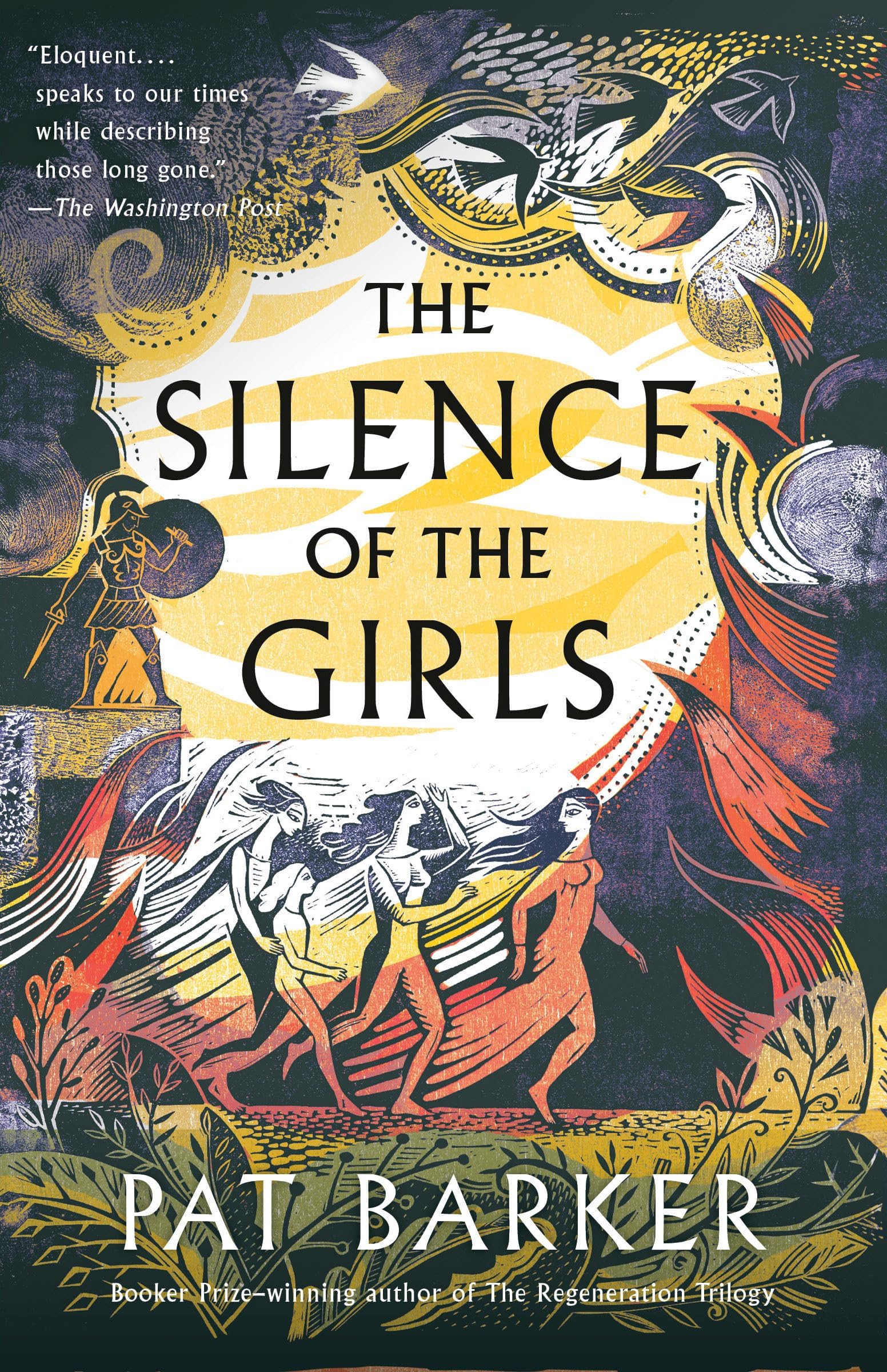

Desertcart purchases this item on your behalf and handles shipping, customs, and support to Senegal.
🏛️ Silence speaks louder: The Trojan War retold through the eyes that history forgot.
The Silence of the Girls is a Booker Prize-winning author Pat Barker’s feminist retelling of the Trojan War, focusing on Briseis, a queen turned slave. Shortlisted for the Women's Prize for Fiction and the Costa Novel Award, this critically acclaimed novel offers a gripping, immersive perspective on ancient myth, war, and female resilience, ranking high in Ancient & Classical History Fiction with over 15,000 positive reviews.


| Best Sellers Rank | 5,344 in Books ( See Top 100 in Books ) 21 in Ancient & Classical History Fiction 80 in Myths & Fairy Tales 121 in Myths & Legends |
| Customer Reviews | 4.3 out of 5 stars 15,730 Reviews |
K**R
Not man-xplaining
Silence of the girls One of the reasons I really enjoyed Pat Barker's Regeneration Trilogy is her understanding of the workings of the minds of men - especially men in conflicts. This book is another example of that, this time set in the Trojan War. Now I guess that would exasperate Pat herself, (or at least confirm her worst fears); as she has written a book mainly dealing with the woeful way women are treated (in war) and all I take from it is how brilliantly she describes the behaviour of men in conflicts. What can I say Pat, I’m a man, guilty as charged; however please keep trying because some of your good sense may eventually penetrate my thick carapace. Another thing I enjoy is a book that takes a well known story or event (in this case the Iliad and the Trojan War) and tells the tale from another perspective (a captured female slave in the Greek Camp besieging the city of Troy). The taking of the slaves (all women of course); their degradation; the life in the camp; are all described succinctly and so well that you can practically smell the stench, feel the fear, and hear the noise. The book takes up a whole range of topics: war as a means of pursuing national or personal gain; sex and violence; the master / slave relation; rape as a weapon of war; men's relationship with their mother; male friendship; pride; old age; and gives good insights on these without ever interfering with a terrifically told tale. Barker is particularly good at describing the conditions experienced by the women involved; they are mistreated, degraded; reduced to silent chattels; live in constant fear and yet, they manage to survive and sometimes laugh; showing great resilience. The women live in a 'rape camp' and under the constant threat of violence which the author details without the sex and violence ever being equated. While the sex and the violence may be occurring at the same time there is never any suggestion that one heightens the other - apart from in the heads of the violators. None of the men in the story (heroes in the myths - Achilles, Agamemnon, Patroclus, Hector, Odysseus, etc.) come out of the book in a good light; the best of them is only a little less obnoxious, inconsiderate or pathetic than the rest; put-upon Patroclus; the fool Alcimas; old and jaded Priam. It is enjoyable to see these heroes of the Iliad and the Odyssey painted with all their flaws with Achilles for example shown as a mother obsessed, proud, baby-man. The Trojan War itself sort of goes on in the background and the personalised account of Briseis fills the story so well that the actual fall of Troy and the deaths of the heroes are almost an anti-climax and secondary concerns. I was tempted not to review this book at all due to the black hole of 'man-xplaining' something I know nothing about. This review is not meant to put men off reading this terrific book. It is an excellent read as a reworking of a well known tale seen from the perspective of those who always end up collateral damage in the pursuits of men.
M**N
One of the best, profound, but not perfect
I would love to praise this Iliad version to the skies but cannot quite do so. The wordcraft is simply divine, catching the breath on almost every page with skilful imagery. Characters and plot are close to cannon (Homer, Euripides) to be satisfying for those of us who know them, without bleaching the book into a mere retelling or scholarly exercise. No this is vibrantly alive, human drama. I have rarely been so gripped by historical fiction and I am not a reviewer given to high praise. I do not personally agree with the portrait of female helplessness given. The women of the Mykenaean Age held considerable power - and did not live in veiled seclusion like their later descendants. Nor are slaves - of any period- usually as helpless as those seen here. Slaves (and modern worer slaves) find ways to subvert ab=nd hit back at their masters in sabotage and disruptive inefficency if nothing else, But this is not my key plaint which holds back a five star review. The feminism is in only one place, crude: a statement by Helen. This is a consequence of how the author ignores the deities too much and therefore the conflict between Helen and Aphrodite, which is central to the Iliad plot. This is forgivable as the author's choice of perspective. I find it harder to overlook the total censorship of the economics of the Trojan War. Briseis as a queen would have been well aware of the trade conflicts between the Mykenaean states and Troy, rather like the EU and USA today. It is not fruitful to fuss about whether the war was caused by the gods, by Helen's *infidelity, or by economics. Far better to say that the Iliad adventure was bred by all three. I would have liked less attention on Achilles as this does not accord with the female narrative. It should be possible to make one, two or three of the women so powerful and complex that they equal or surpass him. But for all my whingeing this is a genuinely mature book, enthralling, sensitive, more accurate than most, and I have no hesitation in urging you to read it for your greatest pleasure of mind, heart and spirit.
D**W
Compelling read
Really compelling, and I am not normally a huge fan of classical history. Well written lives up to the hype.
C**L
Overloaded with micro detail
This is a mildly interesting feminist book, for its reframing of historical legends (Trojan war, Achilles, Agamemnon, Odysseus, Ajax all play a role). Their stories are retold from the perspective of the women in their lives, who have previously been airbrushed out of historical records and texts. The book makes some startling observations e.g. that it’s unlikely that Helen of Troy was ever consulted about the massive 10-year war that was fought over her. But the pace of the story is very slow, and the male characters are flat and unconvincing. The characterisation is too flat to sustain the slow pace of the story, especially in the final parts which plods along with too few concessions to the reader. Disappointing.
J**R
excellent retelling of the end of the Trojan war
This is the first in the author’s trilogy retelling the events of the Greeks and Trojans in Homer’s epics The Iliad and The Odyssey from the point of view of the women involved and in particular of Briseis, wife of the king of a minor Trojan city, Lyrnessus. The story begins with the sack of her city by the Greeks and the massacre of all the men, including her husband and four brothers (all old men and non-fighting boys are also all hunted down and killed). Briseis and other females are carried off to the Greek camp, where she becomes the “prize” of Achilles, (in)famous leader of the Myrmidons. The story conveys in stark simplicity the horrors of the war, the sexual violence, and the complete lack of agency on the part of the female captives who are now concubines and slaves to their new individual Greek masters. But over time, Briseis has perforce to learn to adapt despite herself to her new situation, and try to bring about a new accommodation with Achilles. In the same way, others among the captive women adapt to their new situations and even come to love their captor “husbands”. Despite the brutal realism of this world, it is one where the liminal still exists: Achilles goes for morning swims to meet his mother the sea nymph Thetis; Priam miraculously enters the Greek camp without protection to plead for the return of his son Hector’s body; the spirit of the slain Patroclus, Achilles’s companion and lover, returns to guide, comfort and try to restrain his actions. Patroclus is probably the most admirable man in in this story - he was one man that Briseis herself also misses, due to the moderating effects of his influence on Achilles, who frequently acts like a man-child, especially during his spat with Agamemnon. One disadvantage of historical novels told from a female point of view is that battles and sieges generally cannot be shown in first person narration. So here the fall of Troy, the death of Achilles and the capture of the Trojan women all take place in a few short paragraphs in hindsight. And no mention of a wooden horse! (This said, the first person narration is not consistently applied elsewhere in the narrative). At the end of the story, then, after Troy has been conquered, the Greeks prepare to return home, under the leadership of Agamemnon. Briseis reflects, perhaps a little too knowingly, about how all these events will be viewed by future generations: “What will they make of us, the people of those unimaginably distant times? One thing I do know: they won’t want the brutal reality of conquest and slavery. They won’t want to be told about the massacres of men and boys, the enslavement of women and girls. They won’t want to know we were living in a rape camp. No, they’ll go for something altogether softer. A love story, perhaps? I just hope they manage to work out who the lovers were. His story. His, not mine. It ends at his grave”. A great read and I will look forward to reading the rest of the trilogy before too long.
A**A
Unimaginably distant times
In this retelling of the aftermath of the fateful argument between Achilles and Agamemnon during the Trojan Wars, Pat Barker takes the viewpoint of Briseis, the high-born woman taken captive as part of the booty from the city of Lyrnessus. Having witnessed Achilles actively involved in the brutal killing of her husband and brothers, she suffers the further trauma of being accepted as his “sex slave”. She is scornful of the women who fawn on the men who possess them to wheedle favours, but knows there is a fine line between this and annoying Achilles so that he hands her over to the common soldiers to share, in what she describes as "a rape camp". When Patroclus, the friend of Achilles with whom Briseis forms an unlikely friendship offers to persuade Achilles to marry her, she observes how it must appear shocking that she can contemplate such a course of action, yet when reduced to slavery one is prepared to consider almost any way of improving one’s lot. No doubt hardened by her string of First and Second World War novels, Pat Barker does not flinch from describing scenes of great brutality in battle, alternating with the somewhat contradictory and ludicrous rituals to both desecrate and honour and the person one has killed. Yet her main interest is clearly the role of women in the Trojan wars, the stoical acceptance of their lot as they prepare food, wash clothes and care for the sick to keep the camp going. The tone is often deliberately modern, colloquial, foul-mouthed, I assume in an attempt to draw parallels between people past and present, enabling us to identify better with the former as "real". I agree with readers who find the attempt to punctuate an ancient legend with modern anachronisms jarring and who are irritated by the sudden switch part-way to the point of view of Achilles, which tends to undermine a distinct focus on the lives of the forgotten and undervalued women. This is not a feminist novel in the sense that women do not rise up in rebellion against their treatment, nor seriously question the constraints under which they have to live. Descriptions of roles in the camp are often quite dull, for that is what they were. I found myself curiously unengaged by the book, perhaps because too many incidents rely on magic. So we see the capricious gods punishing the camp with a plague of rats since Agamemnon refuses to release his "bed woman" to her priestly father. Achilles is able to shout so loudly from the camp that his war-cry can be heard in Troy, causing strong men quake. Since he is in need of a suit of protective armour, his mother the goddess Thetis rises from the waves to supply him with a perfectly fitting and flexible one. Having slain Hector, he drags the body behind a chariot daily to dishonour it, only to find that the gods have “defied” him by restoring the corpse to its original state. Although it is very readable and quite imaginative in reworking the “facts” of the Iliad, I am more impressed by Pat Barker’s books on C20 wars, which seem to provide greater scope for creative writing with character development and plot twists. As it is, Achilles seems merely moody and brutish, fated to die shortly as the price of becoming a legendary super killing machine; Patroclus is portrayed as implausibly empathetic and kind, since he massacres the enemy alongside Achilles without any evident qualms, and the nature of the relationship between the two remains blurred. Briseis is parcelled up like a commodity for a decent enough new husband who will protect her, so her feminism is limited to a C21 awareness of brutality and exploitation which she is unlikely to possess. The final chapter is disappointing: a rushed information dump of bloodthirsty violence to round off the tale.
C**L
A wonderful book showing the ancient Greeks in all their savagery
Before I start I’d better get a couple of “Pseud’s Corner” disclaimers out of the way! I was recommended this book at a dinner party by someone I hadn’t met before who said they were reading an amazing book and how much they were enjoying it. Enquiry revealed it was this work; I said I’d read Pat Barker’s “The Ghost Road” years ago and admired it very much, but couldn’t remember reading anything else by her. So when I got home I ordered it up on Kindle after a brief look at what it was about. Next pseudish point – I’m probably of the last generation who were routinely taught about the Greek/Roman myths while at school. I don’t think it is necessary in order to enjoy this book, but it probably helps. The problem was there were lots of books, illustrated by the high Victorians (think Alma Tadema, Waterhouse, Leighton et al) which showed people draped elegantly in chitons reclining near white marble pillars. There were also a lot of bowdlerised children’s versions of Classic Myth and Legend which rather airbrushed out the fact that, especially around the time of the Trojan Wars, this was an extremely savage and warlike bronze-age society with a strong penchant for human sacrifice. The bloodthirstiness of the myths somehow got lost in the telling, and the weirdness of the metamorphoses and the vengeance of the gods when the humans committed the deep sin of hubris, was fluffed over. The knowledge helped with the then required reading of Chaucer, Spenser, Shakespeare, Milton, Keats, Shelley et al, all of which were liberally laced with complex classic references as it was expected that any readers would be familiar with them. I can’t remember whether it was Kipps or Mr Polly who lamented his lack of classical education and not being taught “who dragged who three times round the walls of where!” So given that I’d spent a lot of my childhood absorbed in classic myth and legend (always preferred the Greek for some reason rather than the copycat Romans) and listing the equivalent names of the major deities was definitely a school task, I immediately recognised the name of Briseis. The woman who caused the most trouble in the entire Iliad after Helen herself (the face that launched a thousand ships and burned the topless towers of Ilium, etc). It was a real eye opener when I read Robert Graves’ “The Anger of Achilles” in my early 20’s – it really brought home the violence and unpleasantness, in contrast to the elegant waftings. So this form of retelling the Trojan War is not new, and when I started reading “The Silence of the Girls” – got there at last! I thought – “oh, but I’ve just read something similar”. I’d not all that long ago read and loved Colm Toibin’s “House of Names” which again is a series of first person POV tellings of the fall of the House of Agamemnon, dealing with Agamemnon’s return to Mycenae, his murder and the Oresteia. Again, it aims to reflect the brutality and savagery of the period, but branches away from the classical renditions with imagined episodes and is an extremely poetic work. The Silence of the Girls is mainly told from the POV of Briseis, taken as a spoil of war, and given to Achilles, although herself wife of a “King” of a city allied to Troy. Again, the great classical translations make much play of the Kings and Rulers who all thronged to defend Menelaus’ honour and besiege Troy in order to rescue Helen. In reality, many of these ancient Greek city states were very small and their rulers little more than hereditary Lord Mayors. What is interesting about Barker’s presentation is that (a) she sticks very closely to the Iliad and (b) she never ascribes modern thinking or attitudes to Briseis. She utterly accepts her fate, but here’s the bit I thought clever, she often uses modern language and phrases. This deliberate anachronism was very effective, and a wonderful contrast to (largely historical novels) which go to great lengths to describe the period, buildings, dress, etc and people it with lightly disguised modern characters. This seems particularly prevalent with the female characters, who are often ascribed thoughts and actions that would have been inconceivable and impossible in the era they were supposedly inhabiting. The character of Achilles is displayed in all its unpleasantness – is there a single more unlikeable figure in the whole of classical mythology? All that sulking and stropping and the lives lost as a result of his amour propre being wounded when Agamemnon demanded he acquire Briseis to compensate for giving up Chriseis (getting complicated here.) Agamemnon runs him a close second for sheer unpleasantness of course, what with the little matter of sacrificing his own daughter Iphigenia for a fair wind. So, if you grew up with the Iliad, then you will probably love this, and it is a great book even if you didn’t. The characters are clearly drawn, and I really felt the labour of the conquered women with their incessant weaving (Troy was particularly famous for its textiles) and their basic pharmaceutical skills with herbs and honey. I did not however, read it as a feminist tract – my education was clearly too heavy on the classics and entirely lacking in female studies!
F**S
Silence speaks louder than words
I did enjoy this book, particularly the voice of Briesis, which felt very authentic. It was a very interesting, as well as timely, idea to write a story about the Trojan War from the perspective of one of the women who was enslaved by the Greeks. I appreciated the fact that the author didn't attempt to to sugar coat the brutal reality of what happened to women like Briesis by turning this into a love story between her and Achilles. I wasn't that sold on the voice of Achilles in the sections that were told from his perspective; these didn't feel as authentic as the others and at times almost 'wooden' in their depiction of emotion. But perhaps that was deliberate? Achilles was both petulant and arrogant - a far cry from how he is portrayed in Homer's epic poem. This was a culture in which skilled warriors were lionised and glorified, when in reality they were chauvinistic, bloodthirsty, violent men who killed without mercy or remorse, enslaved and raped women and murdered their male children, stole everything from the people they crushed and never once questioned the 'rule' that "might is right". They had been raised, trained and taught to do nothing else. They were cold, greedy, ruthless and violent. In a world run by other men where women were seen as "things" to awarded, taken, thrown away, sacrificed and abused. Their thoughts, feelings and needs were unimportant. This book is about what was really going on underneath that cloak of silence they had to wrap around themselves in order to survive in a world where answering back or speaking up would end in their death, or a fate worse than that, or simply being laughed at or totally ignored. The only Greek warrior who I had any sympathy for was Patroclus, who probably wouldn't have been there if he hadn't had to come as Achilles' companion. He at least showed kindness and humanity and decency, having learnt the hard way the true consequences of violence. In this version of events, I cannot understand why he loved Achilles at all. Achilles seemed to treat him just as arrogantly and thoughtlessly as he did everyone else. That relationship, a very important one in the story, wasn't really portrayed in a way that made sense to me. The quite different relationship established between Patroclus and Briesis made more sense to me and I am not sure whether that was the intention. There is a lot that is great about this book and some things that just didn't work for me.
S**N
My last read of 2018 - will go on my top reads of the year list.
I am a sucker for anything having to do with Greek mythology and I am also a fan of this author’s novels, so I was really looking forward to reading this book. I was not disappointed. I’ve read the Iliad and the Odyssey and have read many stories and seen many movies that retell those stories. When I was young I thought the Odyssey was the more interesting of the two with the many tales of monsters and evil sorceresses. It was only when I was older did I really appreciate the Iliad and how deeply the story resonates still in modern times. What this book does - which is remarkable both in its execution and in its originality - is have us view the story of the the Trojan War from the viewpoint of the women involved. Most of the time the story is narrated from the point of view of Briseis, the princess given as a war prize to Achilles. (Occasionally we get a few short chapters from Achilles point-of -view.) When we read the story from Briseis and witness what we do from her eyes, this story will be changed for you forever. At least it was for me. This is not the retelling of a classic book with a modern feminist viewpoint coming in as an anachronism; that makes me a little crazy. Instead we see what life was like in that time not just for the men, but for the women too. As awful as it was for the men, the horrors for the women was even worse. Forced to witness the slaughter of their husbands and children then given to the victors as either war brides (if they’re lucky) or else given to the soldiers, the women suffer unimaginable atrocities. You are always aware of this when you read books and stories - that the women suffer - but you’re so used to getting lost in the heroic and adventurous tales such as those of Achilles and Hector that you can forget about what’s happening just out of view. This book makes us look. For me, one of the signs of a good book is whether or not I want to pick it up again. This absolutely passed that test. I loved this book and when I read the last page I experienced that “reader’s high” that you get when you’ve really read something that has moved you. Highly recommended.
A**E
Grausame Story, spannend erzählt
Eine Geschichte über einen Krieg kann wohl nur grausam sein. Insoweit hätte mein Geschichtslehrer gesagt: "Nur für starke Nerven!" Lesenswert ist, wie die Autorin herausarbeitet, welche eigentlich sehr lächerlichen Gründe hinter dem ganzen Gemetzel stehen: Kindsköpfe, die wie kleine Jungs handeln, die sich im Sandkasten das Spielzeug wegnehmen wollen. Gerade heute ein sehr wichtiges Buch. Beim aktuellen Krieg in Europa dürfte es im Grunde kaum anders sein.
V**D
Great story
Very original rewriting of the Iliad! Achilles' myth is deconstructed to erect a new narrative, the one of Briseis, the slave.
G**A
A one must read
10/10 writing & well described emotions
M**S
Wonderful
Gripping, wonderful, well written Love it
Trustpilot
5 days ago
1 month ago