Buy anything from 5,000+ international stores. One checkout price. No surprise fees. Join 2M+ shoppers on Desertcart.
Desertcart purchases this item on your behalf and handles shipping, customs, and support to Senegal.
🎶 Elevate Your Acoustic Game with the Aura Spectrum!
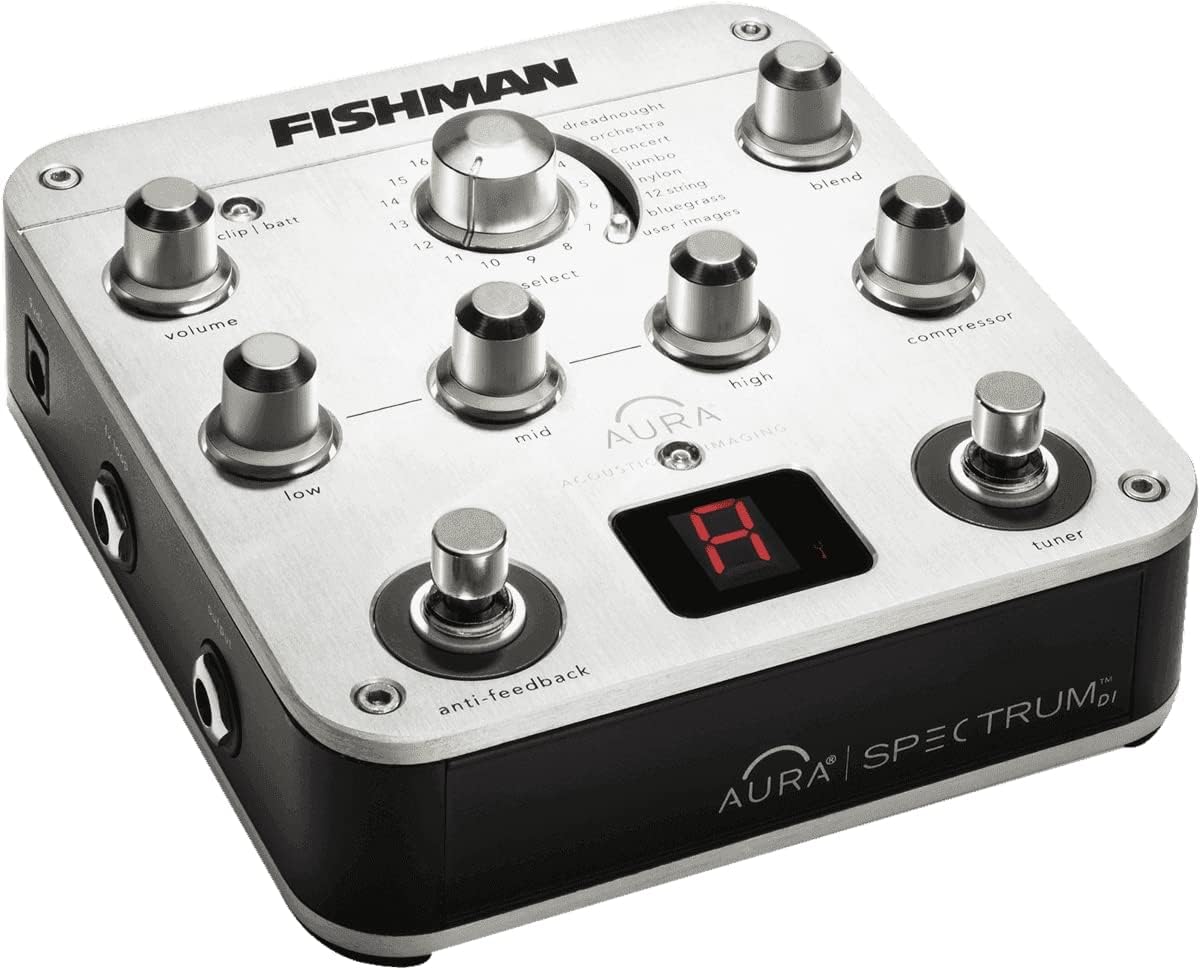
The Fishman Aura Spectrum DI Imaging Pedal is a cutting-edge acoustic imaging pedal that features 128 customizable imaging presets, professional-quality direct output, and built-in tools like a compressor, tuner, and EQ, making it an essential tool for any serious acoustic musician.

| ASIN | B002KWG4QA |
| Amperage | 50 Milliamps |
| Audio Output Effects | Compression, EQ |
| Best Sellers Rank | #44,917 in Musical Instruments ( See Top 100 in Musical Instruments ) #31 in Acoustic Guitar Effects #12,130 in Guitar & Bass Accessories |
| Brand | Fishman |
| Brand Name | Fishman |
| Color | Silver |
| Connector Type | 1/4 inch (6.35mm) audio jack, USB |
| Controls Type | Knob |
| Customer Reviews | 4.1 out of 5 stars 164 Reviews |
| Global Trade Identification Number | 00605609106797 |
| Hardware Interface | USB |
| Included Components | Aura Image Gallery software, USB cable |
| Item Dimensions | 2 x 3 x 6 inches |
| Item Dimensions L x W x H | 6.6"L x 6.1"W x 2.75"H |
| Item Weight | 454 Grams |
| Manufacturer | Fishman Transducers Inc. |
| Manufacturer Part Number | PRO-AUR-SPC |
| Model Name | {FEEDTITLE} |
| Model Number | PROAURSPC |
| Power Source | Battery Powered,Corded Electric |
| Product Dimensions | 6.6"L x 6.1"W x 2.75"H |
| Signal Format | Analog |
| Style | Aura Spectrum DI Pedal |
| UPC | 605609106797 |
| Voltage | 9 Volts |
| Warranty Description | 1 year limited manufacturer warranty. |
J**B
Magic Quack-B-Gone box
I love the sound of a good acoustic guitar, but the sound of an acoustic guitar amplified with an undersaddle piezo pickup sounds terrible to me. Terrible. I've walked out on shows because of the buzzing, quacking piezo tone that sounds nothing like an acoustic guitar. A piezo pickup doesn't have a linear response. Of course it doesn't sound right, you are introducing distortion at the front end of your signal chain. Ick. Tragically, there are generations of young guitarists who seem to think that's what an acoustic guitar sounds like. Quaaaack. Some folks think this is an acoustic guitar modeler. It isn't. It will not make your Ovation sound like a Martin. It will not make your six string sound like a 12 string. There are boxes that will do such things (the Roland GR55, for example). What this box does is convert the undersaddle piezo output of an acoustic guitar to a mic'd sound of the same guitar using signal processing. The wizards in the secret Fishman laboratories hook up a guitar with its piezo pickup, and simultaneously mic the acoustic sound of the guitar. When they play the guitar, they electronically compare the mic'd signal to the piezo signal, and store the differences in an image file. When you play your piezo into the Fishman Aura Spectrum DI, it processes the piezo signal with the image to reproduce the mic'd signal. Pretty slick, huh? Science, man. Don't worry, you can still play religious music through it. I bought the Fishman Aura Spectrum DI hoping to tame the duck. It does! But it takes some time to match the image to the guitar. This can be particularly hard if an image is not available for your specific guitar. But there are enough images out there that you should be able to come close. For example, there is no image for my Luna AMD100, but after experimenting I found the Gibson Songwriter Deluxe Cutaway image sounds great on it. Even better, the different microphone models for this image have distinct personalities -- all good. The problems come when the image is mismatched with your guitar. The results can be all over the place. Some will nail the high end, but produce some strange resonances. Others will capture the low end, but produce a plinky high end. Some come tantalizingly close. In this, you can use it as an effect box if that floats your boat. For me, none of the mismatched images sound good. You sure can tell when you hit a well matched image. Boom! Magic! If all else fails, you can ship your guitar to Fishman and ask the wizards to make an image for your guitar. You can even select which microphones they will use. But it will cost you. The manual says to mix the image sound with the piezo. For me, the less piezo the better. I used to play out with a fairly high end acoustic through a magnetic pickup, and was never happy with the sound. I now play out with an inexpensive Chinese made guitar that costs about the same as the Fishman Aura Spectrum DI that is processing it. But I get a better sound than I ever did before. I've seen some folks complain about how much the unit costs. But if you can get great live sound with a modestly priced guitar through the Fishman, why expose your vintage Martin to the drooling, beer flinging hoards? This is a great technology, well integrated into a rugged, handsome, and convenient package. For me, it falls into the category of expensive, but worth it. And nothing else comes close.
B**T
Be patient! It can take time to find the right image!
It's easy to understand how this thing could get a bad review by someone who is impatient or doesn't fully understand what it is and what it isn't. To be honest, when it first arrived I'd have to admit I didn't fully understand what it was supposed to do to my guitar sound or how - I only knew what I was *hoping* it would do. Oh I had read the reviews and the online manual and seen a bunch of videos, but even then I didn't truly know how good I could get my guitar to sound or how I could make the Spectrum do it. It's an expensive piece of gear and if it didn't immediately make your guitar sound like angels singing right out of the box its easy to imagine a less patient person looking for the receipt and packing material 15 minutes in. What I've discovered after downloading all the public images from Fishman (a MUST) and trying several dozen images and settings for maybe 3 hours is that a pristine, miked acoustic guitar sound is possible, but getting there requires a lot of experimentation. Consider the variables: Each image is going to shape the sound source according to the microphone and guitar used to create it. Some of the combinations of guitar and microphone have a *dramatically* different effect on the source sound. An important point here is, either find your exact guitar make and model OR use the image wizard tool in the software to get a list of "similar" guitars. If you find an exact match you have an advantage because you just eliminated one of the variables. If not (as in my case - I have a 1984 Alvarez Yairi dred) you must resign yourself to loading several different combinations of guitar/mic images into the Spectrum and doing a lot of A/B comparisons. Other suggestions that may help find that one "sweet spot" image: 1. Eliminate everything else in the signal path. Plug directly into the amp if possible. 2. Keep everything flat, and no effects! Very important - you want to judge the subtle nuances between images on completely uncolored sound. 3. When you find a list of candidate images with the wizard, look up the guitars online and choose the ones that match the wood species of your guitar for back, sides AND top. 4. Understand that if you're playing through an image that doesn't match your exact make & model, your guitar is another variable in the equation that will inevitably color the sound. For example, it you're playing through a Taylor image and your guitar has more depth in the lower notes than a Taylor, the resulting sound might be a bit muddy or boomy, regardless of which mic is used. The trick is to try to match the make/model of the image as closely as possible in woods and acoustics to leave the microphone as the only remaining variable affecting the sound. I've been working with a few dozen images and I'm only now beginning to zero in on some that sound really nice with my guitar. And when I say really nice I mean REALLY nice. Be patient - this is not an effects pedal or a modeler. It will take some time to get the Spectrum tweaked just right to get that beautiful, natural sound you're looking for, especially if you can't find an exact match to your guitar.
P**E
A pretty good solution for live sound
For reference, I have a Martin DCPA4 Rosewood, and a Cordoba GK Studio Negra, both have on-board Fishman transducers, the Cordoba also has a mic you can blend (which I bypass for the Spectrum). My amp is a Fishman Loudbox Mini. My music style is wide ranging, into blues, jazz, rock, folk/finger style, and classical. NOTE: This is what I'll call my initial review. I've been using the Spectrum now for 2 weeks and have not had a chance to work with it for recording. This review relates to playing live with my rig and my initial findings with the unit so far. Having read other reviews in researching this product, I expected the preset and fixed patches (like on the Dreadknot section) to be inferior and the on-line downloadable patches from the Aura library to be superior. So right away, I downloaded patches for my guitars, 12 for the Martin, 4 for the Nylon String. My initial plug and play result was disappointing--more on why in a moment. This ain't my first rodeo with gear and I used to do the electric thing with a full rock band, have been a house band and played out a lot so as to support my gear habit. :) So I knew it can take time to dial something in. Sure enough, I discovered that my reverb on the amp was too high, and later realized that sweeping my mids on the amp was a bad idea for the Aura. I reset the amp settings to defaults (12 o'clock for bass, mids, treble, this kind of thing, cut reverb completely out (and found I don't really need reverb most the time, just a smidge at the most for some rooms). What was surprising to me, is that so far, while I find many very usable patches, one of my favorites for my Martin is one of the Dreadknot defaults (#10). I have yet to find any that really sound more alive and real than that particular patch--it comes closest to a miked sound with the full harmonic content and detail of what that really is. Now, the D45 images work well on my Martin, and even a few Taylor Dreadknot images work well, especially if I want that more trebly sound, like to cut through a mix. Many of the Dreadknot and Jumbo images work well with my Martin DCPA4RW. All the patches help eliminate the piezo quack. Which is funny, because that piezo quack is getting more and more commonplace in modern acoustic guitar recordings, I hear it all the time now on one of my favorite XM radio stations (31, Coffee House). I get why some people today completely miss the need for an Aura--musicians today are popularizing the piezo sound! But while they make it work and make it musical (with help from sound engineers who mix the albums), a piezo has its limitations. The F1 Analog on my Martin is probably the best piezo sound I've used... But for my ear, while there's a time and place for everything under the sun, what I love and enjoy most out of the Aura is how it FEELS. In other words, the response to my own playing, hearing it come back amplified but preserving more of the dynamic harmonic content of the actual acoustic guitar sound, as it sounds out in front of the guitar, improves my playing feel (and playing energy as a result). I think at least any intermediate semi-seasoned player will understand. It's not perfect, as it is mimicking, simulating the sound (and does an amazing job), but it's not the real thing and so there are limitations, thus the 4 stars instead of 5. Is it an improvement? For me, a tone slave, YES! The onboard anti-feedback is pretty amazing, actually. Took me a while to figure out how to use it, and I still don't have every aspect down, because at times I seem to be stuck with the last settings and takes me a minute to figure out how to clear the old and rerun for the current session/room. But when it kicks in, it really finds and limits the offending frequencies in a musical way. You can actually then toggle it off/on if you like, but it is bizarre how it does affect your tone. With it off, my tone seemed to also suffer for some reason. I don't feel it suffers when the AF is active. The compressor is awesome. Very simple, very musical. I keep mine at about 2 o'clock, as it also adds playability and clarity and keeps everything nice and night sounding. Would likely turn down to 12 o'clock when amplifying at higher volumes. The blend level? I'm usually at 40-60% at relatively low volume levels. Even at 100% it's pretty good, but yes, artifacts do become more common, and this is worse with increase in volume (amplification). Again, haven't tried to record yet, but look forward to it. Just got to get my recording gear back from a friend. I set the amp to defaults and use the bass, mids and treble on the Aura. NYLON I am not pleased much with the nylon string side yet. I admittedly haven't spent near the time, but I don't find much usable there yet, and I'm dialing the mic out of the equation. Even tried it with the mic just in case. Nothing too impressive there yet. I have to go through the library and try to find something better, haven't found anything there yet that sizzles like for the Martin. The onboard piezo/mic blend capability of my Cordoba GK Negra actually work very well, but I was hoping this would have some more sonic options. So far, nothing significantly better than the onboard system sounds without the Spectrum. Sorry to report. But remember, again, I'm not too deep into the library options yet, there's much more work to do. I hope to find some images that sing as much as it does on the steel string side. Overall, it's a great tool for live sound and getting past the piezo limitations--and also giving you a great playable feel. I think it sings more with finger-picking and such, not as amazing for strumming yet, but still early in the game. I suspect it's trickier when processing 5-6 string chords, and while it's not bad with strumming, it just doesn't shine to me like it does with say 1-4 notes a time, as with fingerstyle work. I do not regret the purchase, in fact I'm very stoked!
J**N
Dissatisfied
It's the worst pedal I have ever use. Would not recommend!!!
M**Y
Fishman Aura Spectrum D.I.
I bought this on the reccommendation of reviews on line, here and elsewhere. And the reviews were right, this little box does everything I need. I was looking for a DI that would provide: a tuner, E.Q., feedback suppressor, and a pre-amp. I play a variety of acoustic instruments and needed a way to change instruments onstage without the noise associated with unplugging a guitar cable from a DI. The Fishman automatically mutes the signal when the tuner is engaged, cool! Now I can change from my guitar to mandolin or dobro without having to go to the PA to mute the channel. I wanted something that had all these abilities in one unit, having too many little boxes on-stage is a drag during and after the performance. Now for the images the unit provides. I don't have any of the guitars imaged, my stage acoustic is a strange cheap Korean guitar that I hotrodded,(tired of dragging expensive guitars to bars), so I just choose the image of the "Concert Guitar" and found a mic image that sounded the best. They all sounded pretty much the same, which all are actually very usable sounds. I knew and expected I wasn't going to make my guitar sound like a vintage Martin, or my cheap but very cool(vintage) Harmony electric mando sound like a Gibson, but my instruments sounded great and were pre-amped just right, all with just one box!!! CUSTOMER support, I had a problem with the first unit the vendor sent, it quit working a week after I bought it, just before a gig I was planning and needed it for. I went to the Fishman website and wrote a letter describing my problem and need (the gig was in one week), they understood my panic, sent me a new unit without requiring me to send the old one in first (Trust and belief in customers is a new experience for me), THIS was WAY cool and the new one came a day before the gig. In using the Aura Spectrum on the gig, I was pleased to find the feedback suppressor worked miracles, the sound man had me way loud in the monitor, with a loud low frequency making everyone nervous, I just stepped on the feedback button, and POOF!, it was gone. I could tune up various instruments and get levels very easily, all without leaving my chair (I have to sit down to play dobro). This was a new day for me, life was good, I am a happy customer!!
R**.
Wanted to like it
I have a Taylor 314c with the ES2 pickup system. Great guitar, terrible electronics. I tried this pedal out in the hopes of improving that for stage but the pedal did not have my guitar (or one that sounded good). I tried loading more in but the software did not work well and my newish macbook pro would not find the pedal on USB. Returned.
K**S
Lots of features but too expensive!
This has lots of features. It has a line level XLR which is great. It's probably way more than I really need. The main thing I wanted was a way to make my Fishman Matrix Infinity pickup sound more "real". This does okay, but I still haven't found a sound I am totally happy with. I have tried downloading the files from the website, but I guess I am still looking for something more realistic. That being said, the people in the clubs all say it sounds really good - I am not so convinced... If this unit cost about $200 (and still had the XLR out) I would give it a higher rating.
C**B
Amazing tool! Take your time to use it correctly
I got this pedal on the recommendation of a very smart FOH friend who recommended it for my piezo-equipped guitars. On both the acoustics and the PRS HB II I use, this thing is a godsend for recording and playing live. If you use an acoustic, this will restore the tone/get rid of (or at least reduce) the quack you're hearing all the time. Used on a cheaper guitar (an ovation around the office) it'll make it sound significantly better than it would be even mic'ed. Used on an expensive guitar (Martin HD28 and Taylor 710 tested) it'll restore that nice cleaner non-quacky sound you're used to with a good condenser mic. The most unreal thing (and to be honest the real reason I love this pedal) is when you use it on a very high-quality piezo equipped electric. In my case, a SC HB II from PRS. It took me a few hours of going through images, but when you find the right image to match the output of the pickup your ears will not believe it. For reference- I used the taylor 710/Neumann M147 image or the 814 cutaway/KM84. It almost freaked me out a little. It literally sounds like an acoustic guitar through the protools rig. I've recorded it and a/b'ed it vs actual acoustics, and it sounds better than some of them (had people in studio wondering what the heck voodoo magic I'd done with plugins- none applied!). It won't beat an actual HD28 mic'ed in a room, but you can't lug that on stage and play electric at the same time. All in all, an insanely handy live tool. Other notes: The thing's a bit large, but you'd expect that for an EQ/DI/Comp/simulator all in one. Take the time to fully understand the trim/EQ/compression parts of the pedal and for the love take your time with the images. Some will sound awful with your guitar, and some will sound brilliant- try to pick images that closely match the body type and pickup output of your guitar, and the results will be miles better! If you're expecting it to turn your ovation into a D35, you're going to be disappointed. If you use it as intended (match guitar to image) you'll get a massive improvement in your direct tone.
Trustpilot
2 days ago
3 weeks ago