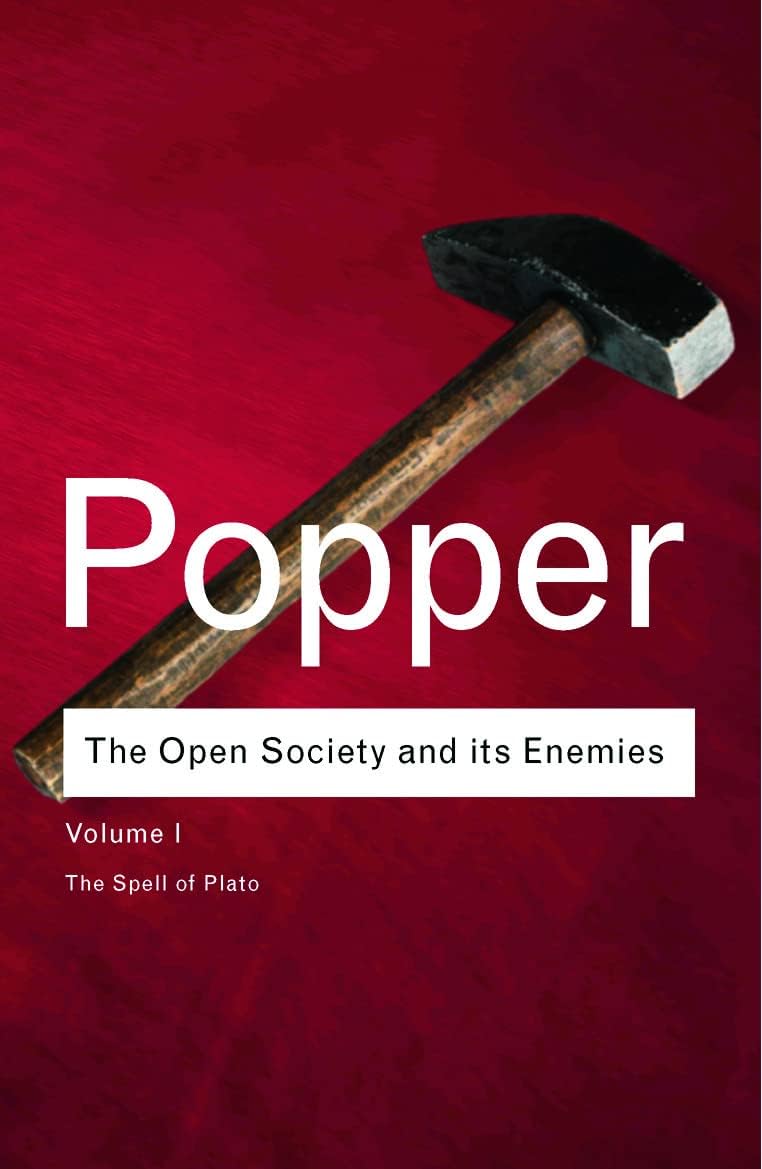
The Open Society and its Enemies: The Spell of Plato (Routledge Classics)
Product ID: 78046092
Desertcart purchases this item on your behalf and handles shipping, customs, and support to Senegal.
Written in political exile during the Second World War and first published in 1945, Karl Popper's The Open Society and Its Enemies is one of the most influential books of the twentieth century. Hailed by Bertrand Russell as a 'vigorous and profound defence of democracy', its now legendary attack on the philosophies of Plato, Hegel and Marx exposed the dangers inherent in centrally planned political systems. Popper's highly accessible style, his erudite and lucid explanations of the thought of great philosophers and the recent resurgence of totalitarian regimes around the world are just three of the reasons for the enduring popularity ofThe Open Society and Its Enemies, and for why it demands to be read both today and in years to come.This is the first of two volumes of The Open Society and Its Enemies. Review: Three Stars - Had issues with an already opened packet! Review: Immer noch zu lesenden. - Popper ist klug. Popper ist klar. Popper heutzutage noch haben auszulesenden von jedem aufgeklärten Subjekt als ein Gegenmittel gegen die totalitäre Ideologie. Aber all dies schließt nicht aus die Suche und der Fund beide Wahrheit und Inspiration in Plato dass er kritisiert für die angeblichen Folgen seine Theorien hatte in der 20 Jahrhundertgeschichte. Aber Popper hat seine schreckliche Mängel besitzen: seine Erkenntnistheorie lächerlich und Begrenzung [woher er sich versuchte zu sein eine Art von "totalitärer Tyrann" im Reich von Wissenschaften begrenzt ist]. Und ich bin mir nicht sicher wer im langen Lauf betrachtet wird Philosoph der wahre Genie durch die Nachwelt. Ob das Popper selbst sein würde, oder diese origineller Denker, zu wessen Arbeiten die ganze europäische Philosophie ist nur ein endloser Kommentar, und denen Popper wagt zu so rau kritisieren zwei und halbes tausend nachher er war gegangen.
| Best Sellers Rank | #100,072 in Books ( See Top 100 in Books ) #598 in Philosophy (Books) #702 in Political Science (Books) #2,382 in Politics |
| Customer Reviews | 4.6 out of 5 stars 83 Reviews |
A**A
Three Stars
Had issues with an already opened packet!
P**V
Immer noch zu lesenden.
Popper ist klug. Popper ist klar. Popper heutzutage noch haben auszulesenden von jedem aufgeklärten Subjekt als ein Gegenmittel gegen die totalitäre Ideologie. Aber all dies schließt nicht aus die Suche und der Fund beide Wahrheit und Inspiration in Plato dass er kritisiert für die angeblichen Folgen seine Theorien hatte in der 20 Jahrhundertgeschichte. Aber Popper hat seine schreckliche Mängel besitzen: seine Erkenntnistheorie lächerlich und Begrenzung [woher er sich versuchte zu sein eine Art von "totalitärer Tyrann" im Reich von Wissenschaften begrenzt ist]. Und ich bin mir nicht sicher wer im langen Lauf betrachtet wird Philosoph der wahre Genie durch die Nachwelt. Ob das Popper selbst sein würde, oder diese origineller Denker, zu wessen Arbeiten die ganze europäische Philosophie ist nur ein endloser Kommentar, und denen Popper wagt zu so rau kritisieren zwei und halbes tausend nachher er war gegangen.
L**K
So far part 1
I read part 1 although couldnt say now how critical he was of Plato. Second time I read the Republuc I thought it ironic but looked at it again and wasnt sure. Hope to read on Marx one day.
J**R
One of the Great Works on Classical Liberalism
This book, written as a sustained critique of the social philosophy of Plato, is one of the best statements of classical liberalism I have encountered. The basic message of Popper's book is that an open (free) society is characterized by the presence of criticism, discussion, and participatory reform. Popper finds occassion to contrast this view of society with the philosophy of Plato, one of the great minds of the western intellectual tradition. And it is interesting to note that in the preface Popper writes that he chose to attack Plato only because he is so revered. Plato, it must be remembered, lived in Athens at a time when democracy was being introduced. Plato witnessed the displacement of many of his friends from political positions of power, and was shocked by the social turmoil that these changes engendered. Plato saw these changes as extremely bad, and concluded that all change is necessarily destructive and degenerating because he conceived the origin of society as consisting of pure forms of absolute objects such as good, beauty, perfection, etc. The task before him was to find a way of preventing (or arresting) change, so that degeneration and social decline could be avoided. He believed it was necessary to divide society into three classes: the rulers, the warriors, and the workers. In order to arrest change, there must never be disunion in the ruler class. To accomplish this, it was proposed that property be abolished in this class, and the family destroyed, since famililal loyalties often lead to political conflict. No mixing between the classes should be tolerated, and Plato argued that special methods of breeding should be employed among the different classes to ensure "racial purity." For Plato, then, the chief aim of the "philosopher king" was to arrest change by preserving harmonious union among the ruling class. This could be achieved only by dividing society into classes the purpose of which was to specify in advance the activities that could be performed by each. The concluding chapters are more positive, and attempt to introduce alterntative political arrangements that would do a great deal in promoting an "open society." This would include the existence of democracy, critical discussion, change, "piecemeal" reform, and so on. Popper sees utopian programs like Plato's as exemplary of tyranny. They preserve taboos, dogmas, rigid social inequities, power, etc. Only until alternative views are permitted can we hope to bring into existence a free and open society. A wonderfully insightful book, and especially useful against those who see Plato as the founder of humanitarianism based on the principle of The Philosopher King.
B**E
Some flaws, some misunderstandings, but on the whole correct.
This was the Volume I of Karl Popper magnum opus. I'm still trying to find Volume II. I ordered it on Amazon, but the seller sent me Volume I, instead. The seller refunded my money, but I still don't have Volume II. Anyway, this is a non-fiction history of the early Greek push for a stable (he calls it "open") society, free from tyranny. Karl has a problem dealing with the spiritual side of persons. He apparently wasn't a very spiritual person, so he dismisses the ethical and moral implications of modern spirituality as "taboos". I guess he didn't read far enough into the Judeo-Christian scriptures to reach the Two Great Commandments. Those commandments are not "the 65 MPH Speed Limit" for people's behavior. They are "Newton's Laws of Motion" for people's behavior. Unless a person has a chemical imbalance or a physical defect in their brain, they cannot break the Two Great Commandments. Mr. Popper never read that part of Judeo-Christian theology. So, he incorrectly believed that Judeo-Christian theology still revolved around "taboos", and "thou shalt not ...". He is correct in thinking that the Old Testament view of "thou shalt not" is like trying to push a length of chain so that it is straight. Try it; it can't be done. You can push and shove that length of chain until your heart breaks. It will never come out straight. Enter a construction worker from Nazareth. HE says, "Grab the chain by either end and pull it; the chain is immediately straight." Yeah, HE said, "Regardless of whether you want to or not, you will follow that thing you have called your god with your whole heart and soul and mind and strength and will. And whether you want to or not, you cannot treat another person fundamentally better than you treat yourself; you will condemn them for things you feel guilty for doing yourself, and you will praise them for the behaviors you like best about yourself." HE didn't say it in those exact words, but that's what it comes out meaning. Sans the understanding of the Two Great Commandments, Mr. Popper incorrectly believed that the Judeo-Christian ethic was stuck in Deuteronomy. So why the 5-Star rating, if he messed up his analysis? Well, he correctly describes the evil that wants to destroy civilization. He correctly describes how evil people will exploit the tendency for people to want to shirk their responsibilities in order to turn civilization backwards. It is hard work being civilized. It is hard work taking responsibility for your own mistakes. It is hard work having to be mindful, thoughtful, and deliberate in your actions. As Rudyard Kipling observed, "If you don't fight it, the jungle will run in." He is correct in that.
T**T
Good service
As promised, the book arrived on time and in good condition
Trustpilot
2 weeks ago
1 month ago