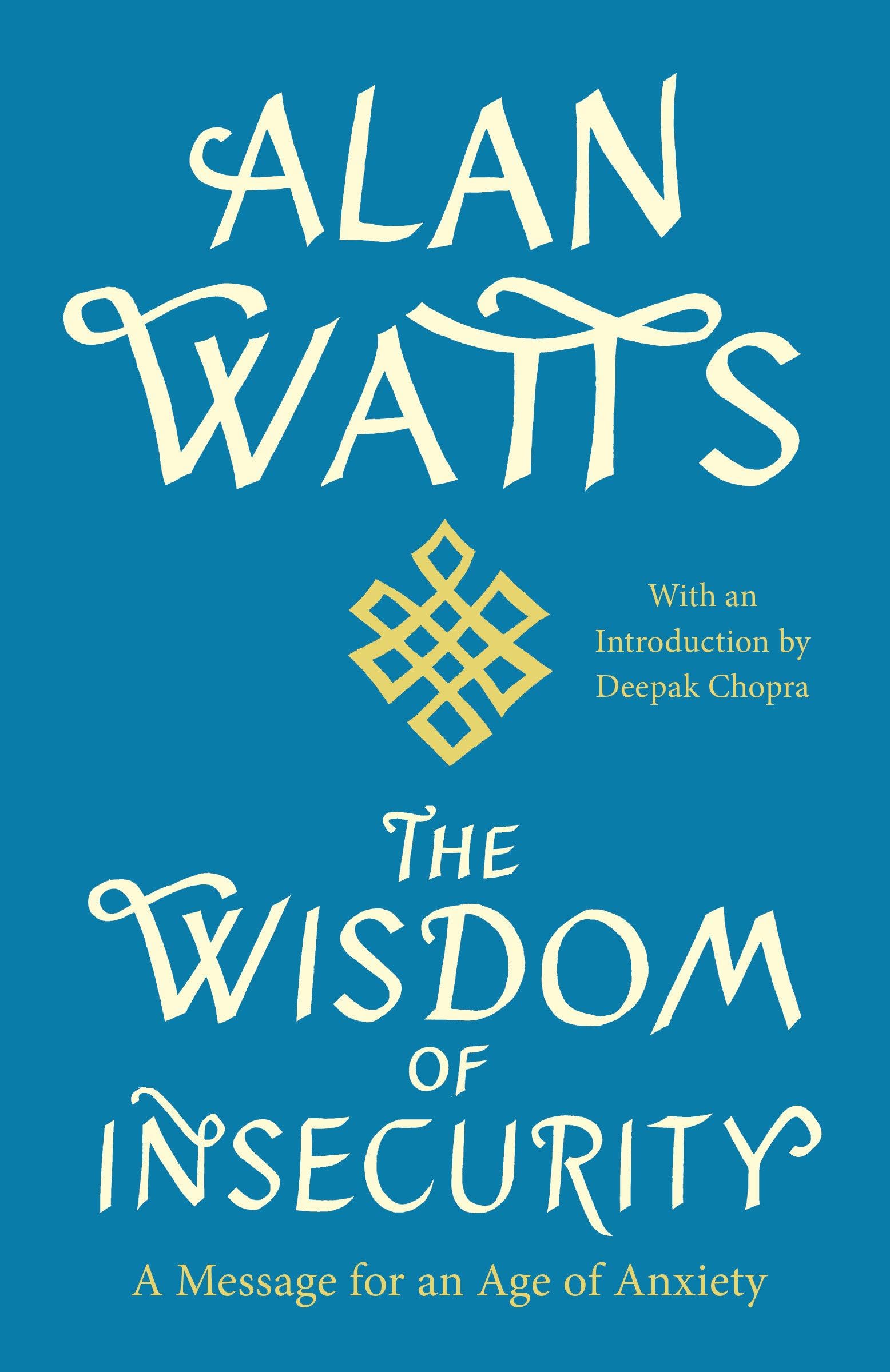
The Wisdom of Insecurity: A Message for an Age of Anxiety
Product ID: 771032608
⏳Focus on present moment
📘Timeless 70+ years classic
🧠Deep philosophical insights
Desertcart purchases this item on your behalf and handles shipping, customs, and support to Senegal.
📚 Unlock timeless clarity: Let go, live now, and thrive in uncertainty!
Alan Watts' 'The Wisdom of Insecurity' is a seminal 1951 work that challenges modern anxieties by encouraging readers to embrace the present moment. Combining Eastern philosophy with Western thought, it offers profound insights into overcoming spiritual emptiness and skepticism in a materialistic age. With over 6,600 reviews averaging 4.5 stars, this enduring classic continues to inspire a new generation seeking peace amid uncertainty.


| Customer Reviews | 4.5 out of 5 stars 6,621 Reviews |
S**I
Great book
Brilliant book for understanding how to experience life.
S**Y
Fresh thinking for modern life.
Alan Watts was one of the great popularisers of 'eastern' thinking in the west. This 1951 classic is probably an excellent starting point for anyone wanting an introduction to Watts' writing. Even though this book is well over 60 years old, it remains an extremely timely read, and it is surprisingly fresh in both its approach and thinking. Watts' starting point is the predicament of western man in the mid twentieth century; the book is definitely a product of 'you've never had it so good' 1950's materialism. Watts was one of the first people to detect the spiritual emptiness that many people feel in modern society (in spite of rising living standards and longevity) and in this book he proposes, if not a cure for this feeling of emptiness, then at least a new way of looking at things. Watts also shows how scientific scepticism has undermined the belief in God. Watts sums up this stance perfectly: 'If, the scientists would say, you believe in God, you must do so on purely emotional grounds, without basis in logic or fact.' Needless to say such scepticism has grown inordinately since Watts wrote these words and it has perhaps reached its zenith in recent years with the 'New Atheist' movement. This scientific viewpoint has made the belief in the Christian God untenable for many western people, and it is to such an audience that Watts aims his writing. There are so many pithy statements in this book; every page seems to contain a phrase or sentence that just leaps out at you and I love Watts' distinction between faith and belief: 'belief clings while faith lets go.' You could certainly see similarities between Watts' writing in this book and the work of J. Krishnamurti in such books as 'The First and Last Freedom.' (1954) Watts and Krishnamurti also share similiar preoccupations with 'the thought and the thinker,' the burden of selfhood and the nature of time and its role in creating psychology insecurity. In spite of these similarities, however, Watts' fascinating blend of eastern and western thinking and his own distinctive turn of phrase give him a memorable voice all of his own. In summary an excellent and influential book. Many modern writers have taken many of the ideas that Watts first set out in English all those years ago and taken them mainstream but, for me, Watts is the original and the best.
A**L
Are you so future focused that your life is slipping past?
We fail to live because we are always preparing to live - sometime in the future. We base what we want on our experiences in the past because, after all, that's the best prediction of what we will like in the future. Watts feels many religions are equally obsessed with the future (eternal life in Heaven) and the past (dogma handed down over the generations). However, he writes: 'there is no reality than present reality, so that, even if one were to live for endless ages, to live for the future would be to miss the point everlastingly.' However, the problem is more deep seated. We are anxious not only because we are not living in the eternal now but because we think there is a separate I. We are not certain where this I lives: in our heads, our bodies but we are certain there is a I and everybody else is you. But Watts believes there is just one of us and this one includes the flowers, plants, animals and everything. I've comes across this idea before but Watts has a new spin: we 'reach a point where what is unknown is not a mere blank space in a web of words but a window in the mind, a window whose name is not ignorance but wonder.' Unfortunately. most of us are too timid to open the window, we close ourselves down with repetition. distraction and addiction. But once we open up to wonder, see the connections between everything, we will no longer be the anxious I desperately trying to feel OK. At least this is what I think is Watts case, I certainly buy the beauty of the eternal now. This book filled me with wonder. I guess I am just too trapped in I (but love the few moments when the division has melted away).
M**S
Prophetic Genius
Everyone should read Alan Watts - humanity would be saved.
A**R
Words literally cannot describe the mental breakthroughs I've had from ...
Words literally cannot describe the mental breakthroughs I've had from reading Alan Watts over the last year. This book put the cherry on top of the MOUNTAIN of wisdom this man has shared with me. I am not religious or spiritually engaging person, but this book has reignited my awareness of my spirit and brought upon a calm attitude to my thought process, that one can only compare to the innocence of being a children again. Alan takes you on a journey, his own journey but also at the same time guides you towards your own and maybe untold journey. This is not purely based on spiritual or religious point of view, but a some what philosophical story telling experience about mankind's illusions or themselves in the world whilst inevitably compare yourself to these realities. How he mastered to make so many millions of people relate to his words individually is true genius. The laws of anxiety in my mind I thought to be real, started to fade away whilst reading this book. He allows the reader to see past the words and into their own spirit at the same time. You should read this book with a open mind, not with a closed and self obsessed mind. If you cannot let in the possibility that everything you think you know about the self the "I" is not true, then you MUST read this book. If you know anyone who shows deep discontent with the normal routines of day to day life, encourage them TO READ THIS BOOK. If you yourself seem to have a constant dissatisfaction or even distraction with the daily deeds of life it self then please again READ THIS BOOK... no one should find any negatives from facing themselves with the guidance of Alan. Zen Mind & Singularity is key x
M**D
Wisdom of insecurity
Recommend
G**N
Crystal clear insight, cutting through all the nonsense with humour and intelligence.
Clear insightful questions and suggestions. It may scare or offend people who have already made up their minds to believe something that may be questioned here, but who really knows anything beyond their own experience? Alan Watts never declares anything that requires an imaginative leap or blind faith. He simply intelligently examines what we are and why we feel how we do, offering amazing insight, humour, and in many ways a sense of how to see things for what they are and let go! It’s a pity Deepak Chopra had to start the book with a monumentally condescending paragraph, being one of those self declared spiritual folk in the know. This is only my opinion. I don’t claim to have any special insight or knowledge.
V**T
Really interesting book and really well written. Whether you ...
Really interesting book and really well written. Whether you agree with him or not, it's really thought-provoking and helps you to view the world in a different manner. So far my only issue is when he talks about primitive women giving birth without pain, it's clearly a man speaking. Slightly delusional. It's well worth a read though.
R**O
Mesmerised
A book that everyone should read.
E**S
Another masterpiece of Alan Watts
Alan Watts managed to express complicated philosophical issues in an accessible way. Our western way of thinking is governed by dualism (body-mind, matter-form, good-evil, cause-effect), eschatology (salvation in pre-modern times, technological perfection in modernity) and the illusion of an immutable ego (soul, person). To this dualism Alan Watts opposes the non-dualism of eastern tradition and - being well acquainted with western philosophy and Christianity - dares the difficult task of trans-lating terminology from a different culture. As the title implies Alan Watts does not propose a recipe or a dogma but describes living your a life of letting things happen by being part and not an adversary of the stream of life. To all those who wonder why we are thrown into existence, why we are subject to pain and death, why we are just a glimpse of existence between two eternal phases of non-existence, and who cannot subscribe to metaphysics of life after death, Alan Watts gives a new perspective of not looking at life but living life. Emmanouil Pajatakis
F**S
Absolutely Perfect!
Everything was good and I've received the item in perfect conditions. Customer service has been very kind and really useful.
J**E
One of the best books I've ever read
I love the work of Allan Watts. I feel that he explains The Ego, Religion, and the present moment so well compared to many other authors out there. I'm not discrediting anyone else's work but Allan Watts has an amazing way of explaining his beliefs through his unique way of writing. I recommend this book to anyone who struggles with a racing mind and to anyone who deals with insecurity (which is all of us to a certain degree). He really drives his point well about way we are always looking for certainty. I do recommend.
A**R
what can you say it's Alan Watts
one of the greatest 20th century philosophers
Trustpilot
2 months ago
1 month ago