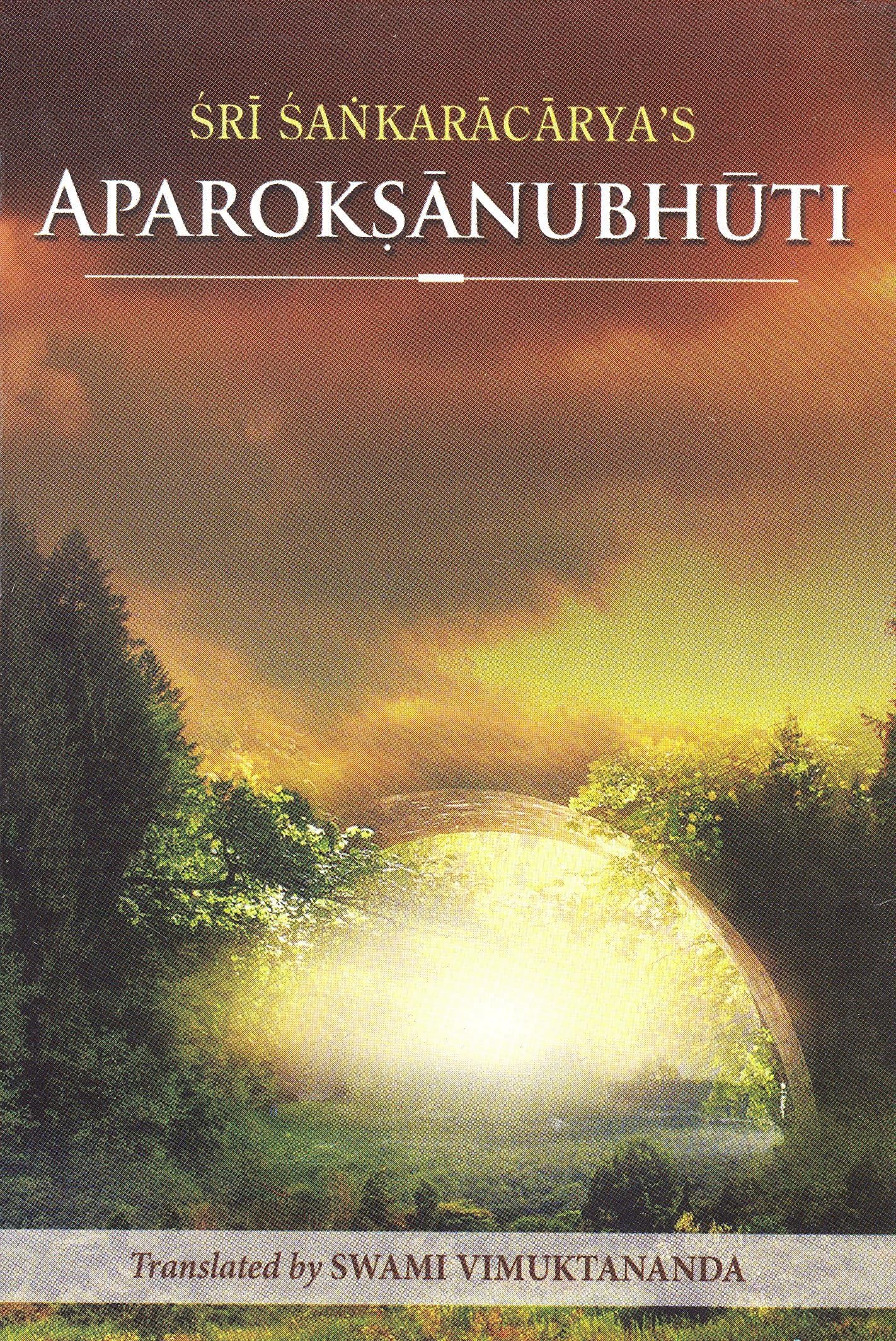
Aparokshanubhuti: Or Self-Realization of Sri Sankaracharya
Product ID: 7677216
Desertcart purchases this item on your behalf and handles shipping, customs, and support to Senegal.
A major work of Shankara on Advaita philosophy. The central theme of the book is the identity of the Individual self with the Universal Self. In other words, we as individuals are the Universal Self. The goal of life is to realize this truth. Review: Timeless Short Read to be read over and again - This little book opened an important door for me, even though I’m quite familiar with the subject therein, in a more than intellectual way. I do believe Adi ShankarAcharya himself wrote it, as it is in his writing style. Furthermore, it contradicts some of the more modern teachings of the complete absorption in Atman, which correlates with the direct experience of the Self that was espoused in that golden age. I especially like being able to read the English-translated original Sanskrit first, seeing how it was presented in the verb-last way of Sanskrit expression. Then the transliteration by Swami Vemuktananda was clear as glass. Highly recommended, especially if you are already quite familiar with Advaita Vedanta. If you’re beginning, it may be well to buy and let it rest on a bookshelf awhile, then dive in a bit later as guidance directs. But buy it now, lest you forget and miss the chance. Namaste Review: 🙏🙏🙏 - Divine knowledge for those who are ready. Aham Brahmasmi! Aham Brahmasmi! Aham Brahmasmi! Never give up your daily spiritual sadhana!
| Customer Reviews | 4.6 out of 5 stars 443 Reviews |
L**E
Timeless Short Read to be read over and again
This little book opened an important door for me, even though I’m quite familiar with the subject therein, in a more than intellectual way. I do believe Adi ShankarAcharya himself wrote it, as it is in his writing style. Furthermore, it contradicts some of the more modern teachings of the complete absorption in Atman, which correlates with the direct experience of the Self that was espoused in that golden age. I especially like being able to read the English-translated original Sanskrit first, seeing how it was presented in the verb-last way of Sanskrit expression. Then the transliteration by Swami Vemuktananda was clear as glass. Highly recommended, especially if you are already quite familiar with Advaita Vedanta. If you’re beginning, it may be well to buy and let it rest on a bookshelf awhile, then dive in a bit later as guidance directs. But buy it now, lest you forget and miss the chance. Namaste
J**U
🙏🙏🙏
Divine knowledge for those who are ready. Aham Brahmasmi! Aham Brahmasmi! Aham Brahmasmi! Never give up your daily spiritual sadhana!
S**Y
Direct knowing
Found it straight to the point. The essential non dual teaching. Makes arguments to support our non dual reality as fact.
D**A
Theory and Practice of Brahman Realization.
The steps at the end embody the theoretical ideas of Atman/Brahman in the earlier part. This work must be studied several times for full comprehension.
A**O
Mind blowing! A treasure of a book.
If one is interested in Advaita Vedanta, in the study of the non-dual path, then it is recommended to meditate and contemplate the pearls of wisdom written in the Aparokshanubhuti written by Sankaracharya Sri
F**I
A must read for spiritual seeks!
The book is a classic for the spiritual seeker. For a deeper understanding, it should be coupled with the lectures of Swami Sarvapriyananda on the Aparokshanubhuti which are available on YouTube.
M**A
Good translation, advanced / philosophy / vedanta text
My review is for informational purpose only. I am not qualified to talk or comment on Adi Shankaracharya's work in any shape or manner. I came across this "yat sakshat aparokshat brahma" vakya (sentence) while listening to Sri Samaveda Shanmukha Sarma's discourse on Dakshina-murthy Stotram. In that discourse while explaining slokas, Sri Sarma makes this statement that is given in Bhridaranya upanishad. Meaning of this "yat sakshat aparokshat brahma" is what that is 'aparoksha" everyday is bramha. There are three Sanskrit words / terms (that are loaded) here: pratyaksha, paroksha and aparoksha ,with my Kannada language knowledge it was fairly easy to understand, but it is hard for a non-Indian language person to understand head or tail to this sentence. 1. That which is not "pratyksha" (pratyksha -that can be seen with naked eye), is paroksha. 2. That which is not pratyksha is "aparoksha". So remember no pratyksha means it is "aparoksha" (for this topic at least) 3. Shankara did not use the word - Paroksha (meaning that which is not seen). 4. That knowledge that you get by understanding vedanta philosophy is "Paroksha" Jnana / Vidwat or you become Vidhwamsa. But this is not "anubhuti", this is just expertise in a subject. Like a professor of corporate strategy -only talk and case studies, NO actual experience running a company. So this text deals with "aparoksha" -which is always there call it brahman, chit, pure consciousness (truth is sat, or asti in sanskrit) And how to realize that "aparoksha" - anubhuti is to experience that "aparoskha" using various means that is not perceived by indriyas (senses). Watch Professor Brian Cox's Wonders of universe. You need a special equipment to see the origin of universe (light waves and radio waves, special telescope and special equipment to record radio waves at different end of spectrum). He is explaining science. Read Shankara's advaitha tatwa. They closely match - at the highest level, all matter and energy in universe is one and same, but due to density ripples, same thing is seen differently (as stars, planets, life etc). This universe's primordial sound is captured using special equipment by scientists. So in a similar manner, if we are to experience that "self" in us, then we need special equipment (call it samadhi phase). So Shankara always talks metaphysics and adwaitha (another indirect word -there are no two things, why not say, there is only one thing?) Finally note: The more science advances , advaitha siddhanta of Vedas (and clarified by Adi shankaracharya in his works) will be proven again and again. (statement by Swami Vivekananda). Think about this profound statement - No other religion or country can make this statement except Hindu philosophy (sanatana dharma). That is because the entire brahmanda (universe) starting from any (atom) is made of same material. This is what science tells us (2004, 2001 Big Bang theory, proof that all matter in us, animals, trees, banana, rocks, space and stars has same origin) Anubhuti: Is feeling the actual "aparoksha" , getting that experience. Reading a book is understanding its "artha" formation of sentences, meaning, etc. But "feeling" is different and that is what Sri shankara is referring to. Dristantha versus Siddhanta (seeing and forming opinion versus logic, experience based realization) -Most world religions (except hindu philosophy) is based on a story -Drishtanta (there is hell or heaven, you do this, you get hell or heaven, do not do this, convert non-believers to its own religion, other people are useless, no karma, if you do bad, you can go to some person and confess, and somehow things go away - all this based on human logic). Whereas - Hindu philosophy is based on Siddhanta and experience (darshana - people / rishis , Ramakrishna, Ramana Maharishi recently). Logically Shankara shows that there is something out there beyond your senses that can be experienced. That something out there is the "truth" and to experience that you need special equipment.
N**T
Phenomenal work by Shankara on the way to self-realization
Phenomenal work by Shankara. Watch Swami Sarvapriyananda’s YouTube playlist along with this book. He explained each verses in great depth.
T**O
Very good
Very good
K**R
Profound Book
This book is very useful for people practicing spirituality.....It contains profound knowledge given by Adi Shankaracharya....
R**I
Stupendo
Un'opera immancabile nelle biblioteche di ogni studente del Vedanta. Viene descritta anche una pratica meditativa in 15 punti al fine di realizzare e stabilizzare la vera natura del Sé. Consigliato!
J**I
Great
Great
T**R
A Wonderful Book
An excellent introductory Vedantic Text with a powerful Vedantic Meditation Technique described elaborately at the end
Trustpilot
2 months ago
2 months ago