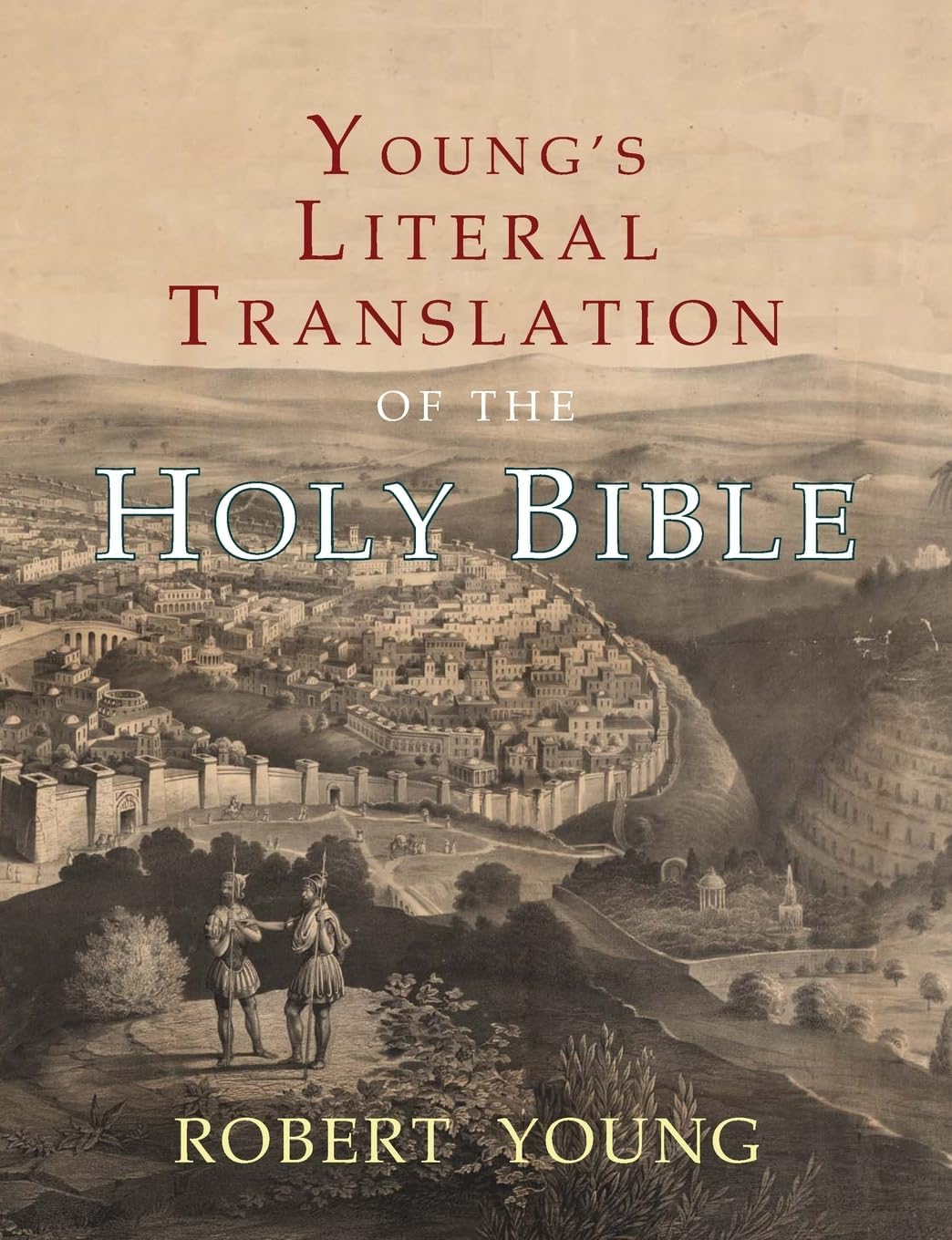
Young's Literal Translation of the Holy Bible: With Prefaces to 1st, Revised, & 3rd Editions
Product ID: 76277967
📏7.44 x 9.69 in Crown 4vo size
📚Perfect bound with gloss lamination
🕰️Faithful 2017 reprint of 1898 edition
Desertcart purchases this item on your behalf and handles shipping, customs, and support to Senegal.
📖 Unlock the Bible’s original voice with unmatched literal clarity!
Young's Literal Translation is a meticulously literal English Bible translation based on the Textus Receptus and Majority Text, first published in 1862. This 2017 edition is a high-quality facsimile reprint of the 1898 Revised Edition, featuring a large, easy-to-read 7.44 x 9.69 inch format, perfect binding, and gloss lamination. It offers scholars and serious readers a rare opportunity to engage with a Bible translation that prioritizes original tense and word accuracy, making it a definitive resource for studying the boundary between translation and interpretation.
| Best Sellers Rank | #522,005 in Books ( See Top 100 in Books ) #3,369 in Christian Bibles (Books) |
| Customer Reviews | 4.5 4.5 out of 5 stars (390) |
| Dimensions | 7.44 x 1.57 x 9.69 inches |
| ISBN-10 | 1684221803 |
| ISBN-13 | 978-1684221806 |
| Item Weight | 3.04 pounds |
| Language | English |
| Print length | 788 pages |
| Publication date | December 15, 2017 |
| Publisher | Martino Fine Books |
R**I
Excellent reproduction of 1898 print
Clearly printed text
P**R
Five Stars
excellent, just as I expected
K**S
An eye-opener
I don't know how I managed up till now without this . It should be in the bookshelf of every serious student of the Bible,especially if he aspires to preach. It would not be easy or necessary to preach from, because a translation usually involves a measure of paraphrase. Even them, there are ambiguities in the original languages where the translator, even Dr Young, has to make a choice, possibly with doctrinal significance. For example, in John 15: 2, Young has "every branch in me not bearing fruit, He doth take it away..." Th e Greek source is airei, which can mean "he taketh away" or "he lifteth it up." The idea of lifting up a branch in order to bring it into the sun in order to bear fruit is vastly different. A fruitless branch can either be taken away, he has lost his salvation, or restored, a very different concept. In Hebrews 9:15-17, YLT is the only translation , apart from the NASB, which makes sense. The Greek diatheke can mean covenant or it can mean testament, or will. If the latter, it means Christ made a will, died, and executed His own will. Even the KJV errs in this. I had been using the excellent Bible Hub comparative site, another indispensible source, but on the strength of this I bought my own YLT. A Bible is only as good as its source documents. Young uses the Textus Receptus. In his preface he does not presume to arbitrate between versions, because he doesn't believe many people are qualified as translators and textual critics. So this is a translation of the Textus Receptus. What I find vital is that this translator believes in the inerrancy of Scripture, and in verbal inspiration of the original manuscripts, ie every word is inspired by God and appears as God intended. He accepts that the inerrancy extends only to the original texts. However , even the best translation is likely to be coloured by the beliefs of the translator. Young believes in inerrancy, and does not admit the possibility of error in the pens of the authors. he relies on the promise given by the Holy Spirit keeping Christ's promise to guide them into all truth. They are written by men, not robots, but men who were guided into all truth.He clearly regards the Bible as a work of the Holy Spirit, using human channels, Who overaw the work in order ot make it inerrant. To Young, tenses and articles matter- the tense must be correctly translated, and definite articles included where they were found in the source documents. He has written scholarly prefaces to all editions. His translation is not intended to compete with the Common Version, by which I think he means the KJV, but to supplement it. Sorry to ramble, but this book is an eye-opener, especially to one like me, whose Greek is extremely limited. It is translated into 19th century English, with King James style verb-endings. This has the advantage, lost in all modern translations, of distinguishing between the second person singular and plural, eg Luke 22:32. He also translates John 13:2 as "supper being come", which is correct. On practical considerations, the book has a hard cover, and will stay open at any page. It is on nice firm paper, which doesn't concertina like so many Bibles. the typeface is small, but easily legible. It is not cluttered up with glossaries, maps or abridged concordances, but still weighs in at about 1.5kg! He also found time to write Young's Analytical Concordance, another vast work of scholarship! This I have found indispensable.
D**R
Fantastic 19th Century Scholarship
A very good example of 19th century biblical linguistic scholarship. It is an impressive translation and somewhat ahead of it's time, at the time. Young also made a great concordance in English with Hebrew and Greek. It does not have the advantage of the past 150 years of archaeology (think Dead Sea Scrolls) and linguistics. It may be dated in some assertions now, but is still quite good. The book was typeset and printed by printing press in the late 1800s, so yes, the text is a bit fuzzier than modern printing but is as legible as any other old library book. It's my favorite older literal translation and I recommend.
B**A
awesome scripture
im really excited and happy when i receive my order
B**B
Great. for study
This is a great bible for study. The translation is perfectly literal as far as I have checked. I do not recommend this bible for people who are not into serious bible study. Also, I would not recommend this as a main bible. I would suggest that all people who want to buy this translation have another translation as their main translation, consulting the YLT only when you want to understand the original Greek or Hebrew better but you do not speak the language. This translation does not interpret or have any doctrinal biases. This means that, for example, the Hebrew word "ha'adam", which refers to mankind or humanity many times, is always translated as "the man", which can be misinterpreted at face value. Another example is Romans 2:11, where the Greek word for partiality is literally translated as "acceptance of faces." Unlike a KJV or ESV or something else, which you can read and understand without much knowledge of ancient Jewish culture or biblical language due to the nature of the translation, in order to read this you must be familiar with the ancient Jewish philosophies and Hebrew and Greek linguistic features. Keep in mind, the book is very thick and heavy. This is not a bible to transport, but one to keep on a shelf or desk in a study until needed. Who should buy this: *Pastors, preachers, and serious bible students who do not speak Koine Greek or Biblical Hebrew. *People who speak Greek and Hebrew, but who want a translation to quote to non-Greek and Hebrew students which is as accurate to the original languages as possible. Who should not buy this (or would gain little from it): *People not familiar with English (the grammar is strange and can be hard to read if you do not speak English fluently). *New Christians and people not already familiar with the basics of the bible. *People who fluently speak Greek and Hebrew and who can easily translate those languages into English for other people.
Trustpilot
2 months ago
2 months ago