
Desertcart purchases this item on your behalf and handles shipping, customs, and support to Senegal.
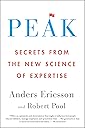
“This book is a breakthrough, a lyrical, powerful, science-based narrative that actually shows us how to get better (much better) at the things we care about.”—Seth Godin, author of Linchpin “Anyone who wants to get better at anything should read [Peak]. Rest assured that the book is not mere theory. Ericsson’s research focuses on the real world, and he explains in detail, with examples, how all of us can apply the principles of great performance in our work or in any other part of our lives.”—Fortune Anders Ericsson has made a career studying chess champions, violin virtuosos, star athletes, and memory mavens. Peak distills three decades of myth-shattering research into a powerful learning strategy that is fundamentally different from the way people traditionally think about acquiring new abilities. Whether you want to stand out at work, improve your athletic or musical performance, or help your child achieve academic goals, Ericsson’s revolutionary methods will show you how to improve at almost any skill that matters to you. “The science of excellence can be divided into two eras: before Ericsson and after Ericsson. His groundbreaking work, captured in this brilliantly useful book, provides us with a blueprint for achieving the most important and life-changing work possible: to become a little bit better each day.”—Dan Coyle, author of The Talent Code “Ericsson’s research has revolutionized how we think about human achievement. If everyone would take the lessons of this book to heart, it could truly change the world.”—Joshua Foer, author of Moonwalking with Einstein Review: The definitive guide to becoming an expert - Many books have been based on Dr. Ericsson’s lifetime of research on expertise (like Malcolm Gladwell’s Outliers), but these books have missed the key nuances or highlight only some parts of his research. So it’s great to have a comprehensive and an accessible book from Dr. Ericsson and Pool (If you want to dive into his research read “The Cambridge Handbook of Expertise and Expert Performance”) Dr. Ericsson deconstructs the actions that need to be taken to go from average to a legend (like Mozart, Michael Jordon). He starts by asserting that we all have the same “gift” – the adaptability of the human brain and body. What separates the expert from the average Joe is that the expert takes advantage of this adaptability through deliberate practice. The first part of the book describes what deliberate practice is, and how experts apply it to produce their extraordinary abilities. He provides several insights in this section – effective practice increases your ability (as opposed to - you are born with certain abilities and that they are static), developing your ability makes things that was not possible – possible, you cannot train to acquire general skills – you have to train to develop highly specific skills, and that the quality and quantity of mental representation of a skill differentiates an expert. The second part of the book describes how you can apply deliberate practice to get better in your area of interest. While practicing a skill keep in mind the 3 Fs: Focus, feedback, and fix it. The purpose of practice is to identify your weaknesses by pushing yourself well outside your comfort zone, which leads to your focus areas. Then you break it down to manageable well specified skills and work on it one by one (in the right sequence) and use feedback to monitor your progress. While working on your focus area you are likely to hit a plateau – the key to overcoming this is to experiment with different methods to improve until you find something that works. Dr. Ericsson describes the four stages in the development of expertise in children. Stage 1 (nurturing interest): parents can nurture interest in a specific skill by providing time, attention, and encouragement. Stage 2 (become serious): help them develop routines, provide support, and encourage and praise them for their improvements. Stage 3 (commitment): provide opportunity to learn from the best, while continuing to provide support. Stage 4 (break new ground): make unique creative contribution to the field Dr. Ericsson ends the book by answering the question – “What is the role of innate characteristics like IQ?” – it does provide an advantage when first learning a skill, but experts beat this advantage by the quality and amount of their practice. Chase your dreams to make them a reality through deliberate practice. Review: Good - Nice book, on deliberate practice, and how to work on itself
| Best Sellers Rank | #25,142 in Books ( See Top 100 in Books ) #15 in Sports Psychology (Books) #16 in Children's & Youth Sports Coaching #16 in Rugby Coaching |
| Customer Reviews | 4.6 out of 5 stars 3,479 Reviews |
A**R
The definitive guide to becoming an expert
Many books have been based on Dr. Ericsson’s lifetime of research on expertise (like Malcolm Gladwell’s Outliers), but these books have missed the key nuances or highlight only some parts of his research. So it’s great to have a comprehensive and an accessible book from Dr. Ericsson and Pool (If you want to dive into his research read “The Cambridge Handbook of Expertise and Expert Performance”) Dr. Ericsson deconstructs the actions that need to be taken to go from average to a legend (like Mozart, Michael Jordon). He starts by asserting that we all have the same “gift” – the adaptability of the human brain and body. What separates the expert from the average Joe is that the expert takes advantage of this adaptability through deliberate practice. The first part of the book describes what deliberate practice is, and how experts apply it to produce their extraordinary abilities. He provides several insights in this section – effective practice increases your ability (as opposed to - you are born with certain abilities and that they are static), developing your ability makes things that was not possible – possible, you cannot train to acquire general skills – you have to train to develop highly specific skills, and that the quality and quantity of mental representation of a skill differentiates an expert. The second part of the book describes how you can apply deliberate practice to get better in your area of interest. While practicing a skill keep in mind the 3 Fs: Focus, feedback, and fix it. The purpose of practice is to identify your weaknesses by pushing yourself well outside your comfort zone, which leads to your focus areas. Then you break it down to manageable well specified skills and work on it one by one (in the right sequence) and use feedback to monitor your progress. While working on your focus area you are likely to hit a plateau – the key to overcoming this is to experiment with different methods to improve until you find something that works. Dr. Ericsson describes the four stages in the development of expertise in children. Stage 1 (nurturing interest): parents can nurture interest in a specific skill by providing time, attention, and encouragement. Stage 2 (become serious): help them develop routines, provide support, and encourage and praise them for their improvements. Stage 3 (commitment): provide opportunity to learn from the best, while continuing to provide support. Stage 4 (break new ground): make unique creative contribution to the field Dr. Ericsson ends the book by answering the question – “What is the role of innate characteristics like IQ?” – it does provide an advantage when first learning a skill, but experts beat this advantage by the quality and amount of their practice. Chase your dreams to make them a reality through deliberate practice.
S**W
Good
Nice book, on deliberate practice, and how to work on itself
S**D
Mastery at its best.
Best book for expertise in anything or any field. But for curious people like me who are not expert in anything there's hope. Recent studies, books like Range and prediction for the Future of Work favors Generalists over Specialists.
V**V
Great Book! Surprised how an imported edge have always ...
Great Book! Surprised how an imported edge have always been missing from whatever i was spending time on! Must Read for all who tend to grow and grow fast!
H**R
Pretty informative book
Nothing
S**Y
good one - Deliberate practice
good one - Deliberate practice. The original author of 10k hours, tell you about the value of deliberate practice and to align it with your best time of the day, generally the moment you wake up. He tells you that even the most talented people, who simply seems to be endowed with a lot of skill actually have worked harder than their peers. The secret to greatness is hard work and zero distraction.
D**A
Four Stars
Eye opener book to expand knowledge
R**A
How to stay in the Peak
The book highlighted the importance of purposeful practice or deliberate practice to master in any pursuit. Our belief creates a mental representation of the situation or task which we can pursue through deliberate practice to become an expert in the chosen field.Motivation and persistence are required to make deliberate practice incessantly. The author established the fact that "a genius is not born but it is nurtured". With a planned strategy to train a child in any pursuit can make him/her master or expert in that pursuit within a reasonable time. The key point is to start practicing from the early childhood which is the potential period to create genuine interest in any pursuit. A useful book for the parents and guardians to make use of the principles elaborated throughout the book to get a first-hand result by themselves.
A**S
Bastante obvio.. pero muy bueno para recordar y profundizar.
Existe la falsa creencia generalizada de que los que llegan a dominar una materia, o llegan a ser grandes expertos en algo tienen un don para ese algo. Gran error pensar asi. Esa manera de pensar invita a uno/a a autodescartarse para perseguir el sueño de ser muy bueno en algo que a uno le apasiona. Vemos Everests inalcanzables, donde si son alcanzables. El profesor Anders Ericson, después de muchos estudios y analisis, explica, con muy buenos ejemplos, algo que para mi es obico, pero que me ha ido bien recordar, profundizar y entener mejor: que a la maestría en cualquier disciplina se llega, no solo después de muchas horas de práctica, sino de un entrenamiento enfocado a resultados. Entre otras cosas mas que no puedo resumir aqui... Super interesante, esperanzador y motivador. En definitiva.. y esto ya es cosecha mia propia: En youtube hay tutoriales gratis para aprender casi de todo. ¿ En que queremos ser expertos?.. Solo es cuestión de tener esto claro y, luego, de una manera inteligente, ponerle muchas horas de pasión y dedicación a la matería. RECOMENDABLE. MOTIVA A PERSEGUIR TUS SUEÑOS.
T**M
Great!
this really explains so much about learning an mastery!
M**S
A game changer
This is probably the second-best book I have ever read in this genre (the best is, and probably always will be, 'Getting Things Done' by David Allen). Why did I love it? Because I read a LOT of books of this kind (self-help, psychology, business, etc.) and while lots of others provide good ideas or insights, this book provides a completely new way of looking at the world. That's why it's a game changer for me. From the way I am learning to dance to the way I work at my desk, the principles highlighted in this book are relevant and applicable. They say there are two tests for a good book: 1. Will I remember it in a month? and 2. Does it change the way I think about the world? This book is a resounding yes.
J**A
Muy bueno
Se exponen casos de éxito desde distintos escenarios y queda muy clara la recomendación de lo necesario para convertirse en experto
P**Z
PeaKED
Uma jóia. Cheio de de informações bem fundamentadas em pesquisas. E o mais legal, aplicável !
Trustpilot
3 weeks ago
1 week ago