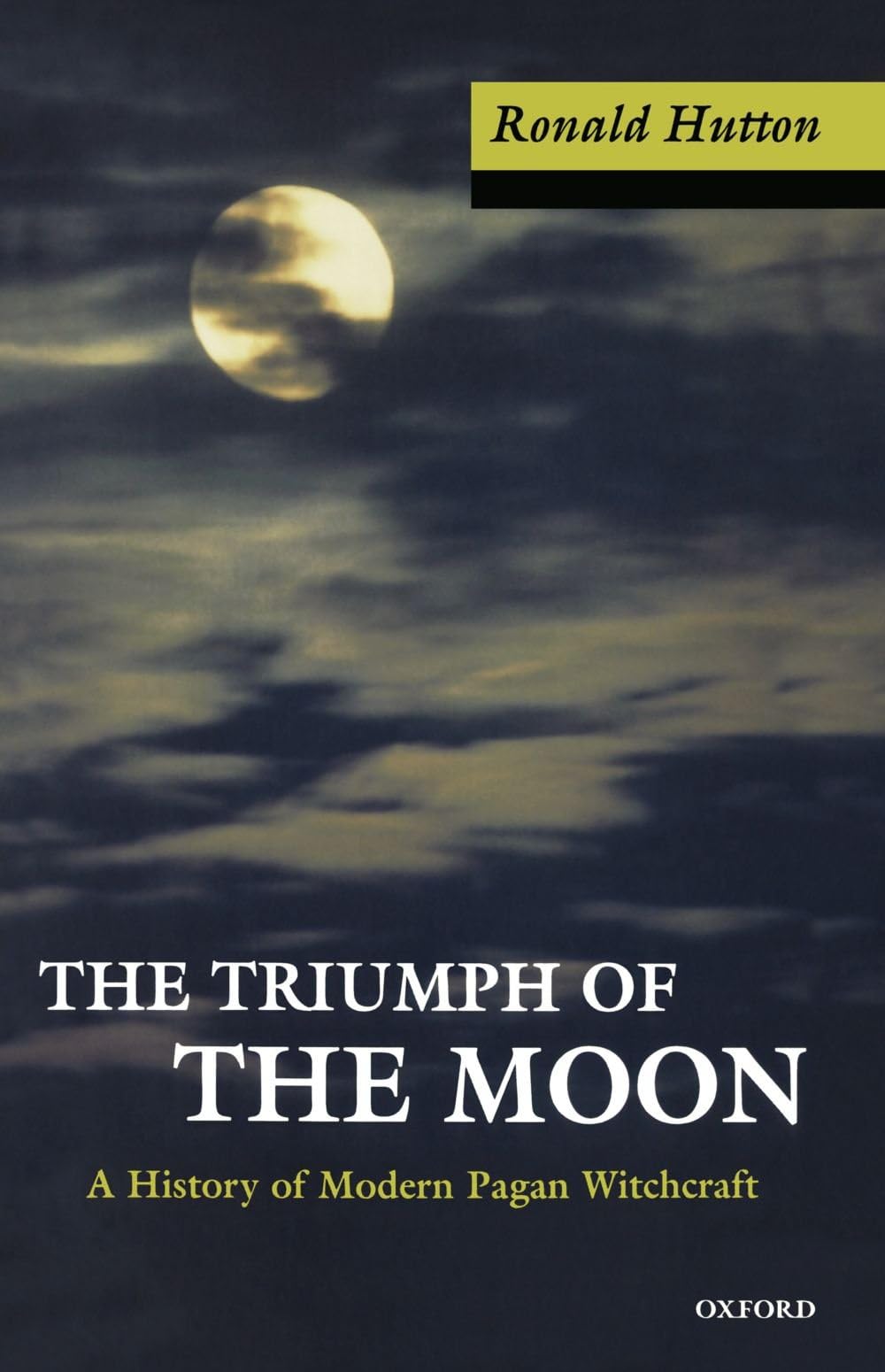
The Triumph of the Moon: A History of Modern Pagan Witchcraft
Product ID: 6943063
Desertcart purchases this item on your behalf and handles shipping, customs, and support to Senegal.
Here is a book that brings witchcraft out of the shadows. The Triumph of the Moon is the first full-scale study of the only religion England has ever given the world--modern pagan witchcraft, otherwise known as wicca. Meticulously researched, it provides a thorough account of an ancient religion that has spread from English shores across four continents. For centuries, pagan witchcraft has been linked with chilling images of blood rituals, ghostlike druids, and even human sacrifices. But while Robert Hutton explores this dark side of witchery, he stresses the positive, reminding us that devotion to art, the natural world, femininity, and the classical deities are also central to the practice of wicca. Indeed, the author shows how leading figures in English literature--W.B. Yeats, D.H. Lawrence, and Robert Graves, just to name a few--celebrated these positive aspects of the religion in their work, thereby softening the public perception of witchcraft in Victorian England. From cunning village folk to freemasons and from high magic to the black arts, Hutton chronicles the fascinating process by which actual wiccan practices evolved into what is now a viable modern religion. He also presents compelling biographies of wicca's principal figures, such as Gerald Gardner, who was inducted into a witch coven at the age of 53, and recorded many clandestine rituals and beliefs. Ronald Hutton is known for his colorful, provocative, and always thoroughly researched studies on original subjects. This work is no exception. It will appeal to anyone interested in witchcraft, paganism and alternative religions. Review: A history of modern Witchcraft based on fact, not fantasy... - Finally, a historian has written a book that details the origins of modern Witchcraft and Wicca. And said historian actually did a great deal of research and backs up his thesis with factual, primary source material, as opposed to the usual fantastical wish-fulfillment claptrap that many Neo-Pagan authors use to support thier pet theories regarding the history of Witchcraft. Some people will be disappointed in this book, no doubt, for nowhere does Hutton mention an unbroken lineage of Witches that stretches beyond the burning times far into the dim reaches of matriarchal prehistory where all the women were strong, the men were beautiful, and the children were peaceful and never hit each other over the head with rocks whilst playing oppressive, competitive male-oriented team sports. What this book does detail is a plausible explaination as to -why- modern Witchcraft would arise at all, and how it fits into post industrial society. I cannot praise the fact that Hutton doesn't only delve into the history of Witchcraft, but he shows us why it is important in the first place, and what it has to say about society as a whole, and Neo-Pagans in specific. The book is well-written, if densely packed with information. It is not an easy read; if one skims, one is apt to miss essential details and lose sight of the myriad threads that Hutton traces in his search for the warp and weft of Witchcraft today. I took my time reading this book, savoring it with rhapsodic glee: it was good to find that there was an academic who had actually taken the time to prove some of my own pet theories about Witchcraft in England during the modern period. At any rate, this book belongs on the shelf of every literate and educated Witch, Wiccan and Neo-Pagan in the world. If we Witches ever got around to opening up schools, I believe this should be a standard history text for any class that includes the study of our religious beliefs. It is always important to know where one comes from, in order to better decide where one would like to go. Review: Witchcraft and Wicca--not quite the same thing - Ronald Hutton is professor of history at University of Bristol, and quite possibly the foremost academic authority on Wicca--modern pagan witchcraft. His hypothesis is relatively straightforward: Wicca is the only religion England has ever given the world; it is not the same thing as witchcraft, but a modern synthesis of a great many historical events and intellectual currents. Throughout recorded history, one finds evidence of witchcraft and occult practices. But Wicca, properly so called, is the brainchild of Gerald Gardner. Gardner was an Englishman who spent much of his life as the owner of tea and rubber plantations in Ceylon (Sri Lanka), North Borneo, and Malaya, and who later worked as an inspector in the Malay customs service. In 1936, at age 52, Gardner retired to England. After a series of encounters with other occultists (including the notorious Aleister Crowley and the Ordo Templi Orientis, and someone whom Gardner calls "Old Dorothy"), and his own research and inquiries, Gardner published in 1949 a novel entitled "High Magic's Aid," which he claimed contains beliefs and rituals of the alleged witches with whom he worked. In 1951, England repealed the Witchcraft and Vagrancy Act, allowing witches to practice more openly. And in 1954, Gardner brought out his second book, "Witchcraft Today," in which he posed as a disinterested anthropologist lucky enough to have discovered surviving covens practicing a secret initiatory system of pagan religion, a religion that Gardner claimed stretched back into antiquity over millenia. But Professor Hutton demonstrates, to my satisfaction at least, that this isn't really what occurred. Instead, Hutton claims, Gerald Gardner drew on a wide disparity of sources and subject matters, and on his own and others' misinterpretations and misunderstandings of history, to synthesize his own version of what he believed witchcraft ought to be, a normative rather than empirical phenomenon. Gardnerian Wicca is therefore the product of Gerald Gardner's creative genius. Hutton also clarifies the relationships among the various descendants and step-children of Gardnerian Wicca. Professor Hutton tells this story with supreme craftsmanship and elan. A lesser analytical talent might be overwhelmed with the vast amount of source material; such an inferior author might also confuse the various strands, or fail to trace properly the various twists of the tale. Red herrings indeed abound in this story, but Professor Hutton does not fall for them, nor allow them to divert him from the book's main task. He skilfully weaves all the various threads together. At book's end, the careful reader has been enlightened, confusion dispelled, not increased. This reader, who has paid properly close attention to what Professor Hutton has to say, will find her understanding of Wicca and its origins greatly enhanced, and will not be so credulous when confronting Wiccan claims of its immense antiquity. Professor Hutton succeeds in the task he sets for himself. By taking us along in the journey, we have not only been vastly entertained, but enlightened. Bravo!
| Best Sellers Rank | #865,039 in Books ( See Top 100 in Books ) #160 in Religious History (Books) #262 in History of New Age & Mythology #744 in Wicca |
| Customer Reviews | 4.5 out of 5 stars 325 Reviews |
B**R
A history of modern Witchcraft based on fact, not fantasy...
Finally, a historian has written a book that details the origins of modern Witchcraft and Wicca. And said historian actually did a great deal of research and backs up his thesis with factual, primary source material, as opposed to the usual fantastical wish-fulfillment claptrap that many Neo-Pagan authors use to support thier pet theories regarding the history of Witchcraft. Some people will be disappointed in this book, no doubt, for nowhere does Hutton mention an unbroken lineage of Witches that stretches beyond the burning times far into the dim reaches of matriarchal prehistory where all the women were strong, the men were beautiful, and the children were peaceful and never hit each other over the head with rocks whilst playing oppressive, competitive male-oriented team sports. What this book does detail is a plausible explaination as to -why- modern Witchcraft would arise at all, and how it fits into post industrial society. I cannot praise the fact that Hutton doesn't only delve into the history of Witchcraft, but he shows us why it is important in the first place, and what it has to say about society as a whole, and Neo-Pagans in specific. The book is well-written, if densely packed with information. It is not an easy read; if one skims, one is apt to miss essential details and lose sight of the myriad threads that Hutton traces in his search for the warp and weft of Witchcraft today. I took my time reading this book, savoring it with rhapsodic glee: it was good to find that there was an academic who had actually taken the time to prove some of my own pet theories about Witchcraft in England during the modern period. At any rate, this book belongs on the shelf of every literate and educated Witch, Wiccan and Neo-Pagan in the world. If we Witches ever got around to opening up schools, I believe this should be a standard history text for any class that includes the study of our religious beliefs. It is always important to know where one comes from, in order to better decide where one would like to go.
A**R
Witchcraft and Wicca--not quite the same thing
Ronald Hutton is professor of history at University of Bristol, and quite possibly the foremost academic authority on Wicca--modern pagan witchcraft. His hypothesis is relatively straightforward: Wicca is the only religion England has ever given the world; it is not the same thing as witchcraft, but a modern synthesis of a great many historical events and intellectual currents. Throughout recorded history, one finds evidence of witchcraft and occult practices. But Wicca, properly so called, is the brainchild of Gerald Gardner. Gardner was an Englishman who spent much of his life as the owner of tea and rubber plantations in Ceylon (Sri Lanka), North Borneo, and Malaya, and who later worked as an inspector in the Malay customs service. In 1936, at age 52, Gardner retired to England. After a series of encounters with other occultists (including the notorious Aleister Crowley and the Ordo Templi Orientis, and someone whom Gardner calls "Old Dorothy"), and his own research and inquiries, Gardner published in 1949 a novel entitled "High Magic's Aid," which he claimed contains beliefs and rituals of the alleged witches with whom he worked. In 1951, England repealed the Witchcraft and Vagrancy Act, allowing witches to practice more openly. And in 1954, Gardner brought out his second book, "Witchcraft Today," in which he posed as a disinterested anthropologist lucky enough to have discovered surviving covens practicing a secret initiatory system of pagan religion, a religion that Gardner claimed stretched back into antiquity over millenia. But Professor Hutton demonstrates, to my satisfaction at least, that this isn't really what occurred. Instead, Hutton claims, Gerald Gardner drew on a wide disparity of sources and subject matters, and on his own and others' misinterpretations and misunderstandings of history, to synthesize his own version of what he believed witchcraft ought to be, a normative rather than empirical phenomenon. Gardnerian Wicca is therefore the product of Gerald Gardner's creative genius. Hutton also clarifies the relationships among the various descendants and step-children of Gardnerian Wicca. Professor Hutton tells this story with supreme craftsmanship and elan. A lesser analytical talent might be overwhelmed with the vast amount of source material; such an inferior author might also confuse the various strands, or fail to trace properly the various twists of the tale. Red herrings indeed abound in this story, but Professor Hutton does not fall for them, nor allow them to divert him from the book's main task. He skilfully weaves all the various threads together. At book's end, the careful reader has been enlightened, confusion dispelled, not increased. This reader, who has paid properly close attention to what Professor Hutton has to say, will find her understanding of Wicca and its origins greatly enhanced, and will not be so credulous when confronting Wiccan claims of its immense antiquity. Professor Hutton succeeds in the task he sets for himself. By taking us along in the journey, we have not only been vastly entertained, but enlightened. Bravo!
T**R
Good interesting book, but not the last word.
The Triumph of the Moon, by Hutton, Hutton is a British historian who has spent 10 years or so researching pagan history. He recent book deals with the social and cultural forces that led to the emergence of Wicca in the middle of the 20th century. He then chronicles the major trends in Wicca in the last half of the 20th century. In one chapter he discusses the Starhawk/Budapest feminist California liberal misandrist turn that paganism took in the 1980s. Hutton describes how their badly misandrist and overly emotional writing lacked any scholarly credibility, but nevertheless had a major impact of Wicca and paganism in general for two decades. With publication of Hutton's book and others we are finally beginning to see some signs of returning to a more balanced pagan literature. His history is incomplete however, and he makes some of the same mistakes and assertions that he criticizes others for making. For example in the first half of the book Hutton extensively details literary references to witches and claims about historic roots. Many pages are each devoted to Margaret Murray and others. Then toward the end he waives off all of that in a page or two by simply asserting that it has been disproved. He provides nothing close to supporting data to demonstrate that claim. A few years ago I attended a workshop by Dolores Ashcroft-Nowikci (21 books and other publications listed on Amazon) where she described in detail her study of an actual pagan village that kept itself hidden since the Norman invasion, and which had written records of village life since that time. According to Nowicki the village was finally over run by urban sprawl in 1990 but most of the residents have relocated to a new hidden village that still follows pre-christian pagan traditions. Nowicki says that her mother was born in the pagan village. Either Nowicki was lying to everyone who has attended her workshops describing the pagan village, or Hutton's scholarship that "disproved" the survival of actual pagan villages is sadly lacking. I have also researched or become aware of several other pieces of information that leads me to believe 1) that some of the historical witch trials and hangings were in fact people whom modern pagans would recognize as pagan witches, and 2) that some family tradition witches were actually surviving pagan witches. Hutton asserts that all claims to any pagan survival have been disproved, and in fact are not possible, but he offers no proof and provides no data. A widely published author, Initiate Wiccan HPS, and leader of a Ceremonial Magick society in the UK such as Ashcroft-Nowicki cannot be waived off by assertion without some evidence that her claims are false. My own family admitted to being witches at the Salem trials, but their stories have been deleted from current histories rather than researched and discounted. You won't find their names on lists of witch trial victims published in the last half century. Today's historians would rather claim that all the witch trial victims were really Christians. That's not scholorship, that's just avoiding the disagreable facts. On the positive side Hutton does provide a lot of information about Gardner and subsequent Wiccan history. His observations about the state of Wicca today are interesting. I was especially fascinated by the discussion trying to fit Wicca into anyone's scholarly classification system for religions and religious branches. Wicca, it seems, doesn't fit any classification system and religious scholars don't know what even to call it. I would recommend the book to all Wiccans and interested parties, but keep in mind that it's not the last word on a lack of pagan roots.
E**R
There is absolutely *no* better researched book on the history of Wicca
There is absolutely *no* better researched book on the history of Wicca. This really is a masterpiece work from Hutton that explores the unique origins of Britain's only original religion. The section on Wicca in America contains some early history that is often missed by American historians on the subject, but really falls off as one would expect around the era where Drawing Down the Moon picks up the historical narrative. It is solidly researched, extremely convincing, and Hutton maintains an open mind and respectful voice while discussing the faith of Wiccans while maintaining a scholar's objective and rational approach to the evidence. Major historiographical debates are openly acknowledged, with Hutton honestly admitting when he doesn't know the answers, but willing to provide his absolute best interpretation of events. I've made this required reading in for a class on witchcraft and witch hunts in America, despite its focus on Britain because it simply an excellent book for students to examine and read.
B**E
Excellent rigorous attention to the history of where Modern Pagan Witchcraft has come from
Well, I wrote quite a long winded and spoiler-ish review here: [...] So in lieu of copy-pasting I'll just say I loved this book - not as much as Stations of the Sun (which I just about revere) but it's so excellent at giving an extremely rigorous account of how current WooWiccans got to where they are. It also respectfully gives plenty of space for people trying to practice Paganism realistically without the Woo. Which I found rather wonderful of him. Gave much more credence to everything he said, because he was always respectful and considerate, even tearing down possibly dearly held beliefs. Was glad to see that there are a lot of modern witches who completely understand the real and actual history and still practice and believe. No harm in it at all. Also vastly relieved to see so many people in the reviews here to reject all the woocrap that's been passed around since those damn Romantic poets ;)
A**Y
A long, entertaining read, that gets no one anywhere.
While reading through this book, I was assured that I'd be giving it 5 stars on Amazon, but by the time I finished reading the last page I changed my mind. I decided on three stars because I enjoyed reading the book. Ronald takes you on many twists and turns and writes in an entertaining way. So as an interesting and entertaining book, I'd give it 5 stars... but the bigger issue here is that, although Ronald Hutton writes a lot about British history, he doesn't write nearly enough about witchcraft's and Wicca's history, as others in these reviews have noted. Ronald Hutton seems to have molded his view of Wicca from a very British, patriotic perspective. Although he fails to define a strong thesis, the one I intuited was "Wicca was invented by Britain, and is the only religion given to the world by Britain. I'm proud of this, as I am British, and therefore any pieces of evidence that the religion existed prior to Gerald Gardner will be ignored or painted over." I went into the book believing I was about to have all my suspicions about an "ancient origin" of Wicca destroyed. That is why I bought the book; I thought it would be able to debunk the "myths" I'd read previously about Wicca, but instead of addressing the claims made by the many authors he cites, he just brushes them off. When he does address claims, they're always ones he can prove wrong, giving the impression that the author Hutton is addressing is, in the whole, wrong. I'll give Doreen Valiente as an example. I remember him using maybe one page to address her contributions to Wicca's history (she supposedly believed in the Witch-Cult til her death), yet he doesn't address any of her claims on that short entry, leaving me wondering further: "So are her claims indeed wrong? You have obviously read her books, as you mention them, so why deliberately skip over the evidence she proposes that go against your own claims? Are we just supposed to trust your word on it? "Trust me, Doreen was wrong, just cuz." Okay. I'll wrap this up. In summary, I went into this book believing Gerald Gardner (and his buddies) invented Wicca, and came out wondering, perhaps, that maybe Ronald Hutton's viewpoint, shared by almost all historians, is simply a very narrow, comfortable view, that is afraid to address a broader, and less mysterious, truth. By the time I finished the last page of this book, I pretty much just said, "That's it? What exactly was his point?" He doesn't prove or disprove anything, yet somehow, by the end, concludes that Gerald Gardner and his buddies invented Wicca. That's fine, and I'll accept that, but please prove it! This book is an amalgamation of old poetry, assumptions about the origins of many ancient concepts (triple goddess anyone?), and open-ended unaddressed questions, not a history. If I met Ronald Hutton on the street I would praise him as being a brilliant historian, but if he asked if I liked this book I'd say, "open your mind and try again." I'm glad that this book wasn't an instant "case closed" for everyone interested in Wicca for its potentially older-than-Gerald history, as Ben Whitmore has written a book making a case for just that, an "ancient" origin, I hope that "Trials of the Moon: Reopening the Case for Historical Witchcraft" will pay due respect to the many pieces of evidence to support ancient witches, which Ronald Hutton has painted over.
J**K
An 'Insider' Scholar of Neo Paganism who found this book EXCELLENT! Not a boring textbook!
I am a working on my second Masters in Religious Studies with the goal of moving into the PhD program next fall. My area of interest is New Religious Movements and especially Neo Paganism. That being said, I am also interested in the topic on a personal level as well. My supervisor recommended this book for the history it provides. I have been assigned many textbooks in my college career and non of them were as easy to read or take notes with that this book. Critiques that people have made seem to forget that Ronald Hutton is a Historian of Religion and his job is to systematically pic apart history and examine it with a fine tooth. I think he (at the time 1999) did a great job at this. As a scholar of Religion we are told we must not 'go native' and that we must examine our topics from an outsider lens. Hutton does the very well. His book is not all criticism or negative comments as some practitioners here have mentioned. When further research needs to be done, or he is stating his own speculation, he is VERY CLEAR about letting the reader know this. And unlike another reviewers suggestion that his negative review sparked a mad rush of Hutton friends and such to post reviews, I have never met the man, have not read any of his other work (though for my degrees I shall now consider him a source for history), and have not been paid or prompted by anyone else to write this other than as a scholar of Religion.
J**B
This book changed my life.
This book was a game changer for me. I had been an initiated Wiccan for many years when I first read it. This book helped me come to a much deeper understanding of the history of Wicca and helped me examine what I truly believe. I am still a follower of the "Old Ways" but with a greater understanding of the origins of the religion. After reading Triumph of the Moon I went on to collect many of Professor Hutton's other books and have copies of Triumph in Hardback (my original copy, read so many times the binding is giving up) paper back and now Kindle. I can not recommend this book enough! If you are a Wiccan and read this book you will come to a new understanding of your religion…hopefully for the better. If you are not, then you will understand Wiccans better for having read it.
L**M
Came bent
The backcover and some pages were bent. Very sad
E**A
molto interessante
Di facile lettura nonostante la lingua inglese, da una visione della nascita e sviluppo della wicca/ stregoneria su cuoi riflettere. Un testo fondamentale per chiunque voglia esplorare l'argomento al di la dei soliti scrittori neo-pagani
S**E
scholarly and very valuable book - for me a "must read"
Ronald Hutton is Professor of History and presents us with a splendid scholarly analysis of the origin of the Pagan Movement in Britain. The book's focal point is the Wiccan tradition, 'the only religion Britain has given birth to'. It is well researched and Mr. Hutton remains objective and respectful to the Pagan Movement. The comprehensively structured book is divided into two halves: 'Macrocosmos' analyses the different cultural concepts leading to the emergence of Wicca. 'Microcosmos' follows the specific development of Wicca. In 'Finding a Language' we look at the general attitudes towards Paganism during the 18th century. It was the German Romanticism and veneration of old classical Pagan Deities which became the herald of the modern Pagan Movement. The next Chapter 'Finding a Goddess' shows how the image of the Goddess developed from real polytheism to the 'highly atypical' image of Apuleius' Isis as embodiment of all Goddesses and finally being structured by Robert Graves into the threefold Goddess. 'Finding a God' traces the development of the God image from Jupiter to Pan and how the latter became the Horned God of Witches in the 20th century. In 'Finding a structure', Mr. Hutton shows the development of the secret societies, from the Freemasons. Though I already read the book; it amazed anew how much the Wiccan ritual owes to the Freemasons. 'Finding High Magic' looks at the development of learned magic and shows the key role of Eliphas Levi, his synthetisations and change of the aim of the Magician towards mystical union and higher spiritual maturity. I read this with a certain contention: As a trained ritual magician I'm sometimes fed up with the arrogant way some Pagans talk down on 'those ceremonial magicians' and then you find out they are Wiccans. The other personal importance is that it clearly showed me why I'm doing both: Ritual magic and ADF. In 'Finding Low Magic' the impact of the latter on the modern Pagan Movement is analyzed. It is quite ironic, how many modern witches feel allied with the cunning craft and how little influence it actually really had on Wicca in sharp contrast to the High Magic many sniff at. As many Pagans believe that folk customs are remains of Pagan practices the chapter about 'Finding Folklore' is very important. It is stressed, that many ideas rested upon some truth, but the interpretations went overboard. Personally I really enjoy brining folk lore into rituals, they seem to fit better into Pagan thought than into Christian. The next chapter 'Finding witchcraft' traces the development and changes towards witchcraft of the last three centuries and how the idea came into being that the victims of the witch trials were Pagan (priestesses). In 'Matrix', the elements from the previous chapter were combined in literature and the Woodcraft movement. Some like W. B. Yeats and Georg Russel foresaw the revival of Pagan (Irish) deities. In 'God (and Goddess) parents' the 'main initiators' of the modern Pagan Movement are presented: Aleister Crowley (influencing Wiccan Rituals), Dion Fortune (sexual polarity), Robert Graves (triple Goddess), Margaret Murray (ancient lineage and structure), which later was modeled further by Gerald Gardner. Microcosmos opens with 'Gerald Gardner'. He obviously did not want to stand on the sidelines, sitting fast in council seats (Folklore Society, ADO). Personally I like Mr. Hutton's interpretation of a divine force growing stronger during the last 200 years who finally worked through Gardner, but can accept as well his more scientific thesis of cultural forces. After presenting Gardner's biography and creation of the Book of Shadows 'Gerald's People', traces the establishment of Wicca, the immense contributions of Doreen Valiente and the creation of the eight High days, in my opinion his largest legacy. The following chapters 'The wider context: Hostility' and 'The Wider Context: Reinforcement' deal with the reactions. Hostility was not such a surprise to me as the movement is very counter-cultural and the figure of the witch in mainstream not really positively identified. In 'Old Craft, New Craft' the claims of other Covens spread by the time of 1960 descended from other lines is analyzed. Most people claiming to be Hereditary witches seem to have inherited not a complete system, but some charms and spells. The next chapter 'The Man in Black' deals specifically with the particular line of Robert Cochrane, a propagated inherited tradition. Many questions stay open here. In 'Royalty form the North' Alex Sanders and his struggle to become Wicca and the formation of the 'Alexandrian' tradition is unfolded. The reception of Wicca in the United States, which from the 1970s on became the centre of modern paganism, is the focus of 'Uncle Sam and the Goddess'. The biggest contributions are with the pagan feminist movement and the chants and songs. 'Coming of Age' tells how Paganism came into a greater popular knowledge. What I really like about this chapter is how it shows that Paganism has matured, though we still have some way to go. While in 'Grandchildren of the Shadows', Mr. Hutton summarizes what he sees as features of modern Pagan witchcraft, which I agree mostly with. It would be interesting though if someone would make a research unfolding the cultural differences and their influence on how Wicca is lived in the respective countries. I love this book. It is filled with much rich information. I've found the first part of greater importance, as many 'Myths' about Wicca are uncovered. This should be a 'must read' for every Pagan and especially Wiccans. Personally, I enjoyed the scholarly style, but this certainly is a drawback for the greater masses which should know the contents of the book.
G**Y
Why this is an important book
Have just finished The Triumph Of The Moon and am extremely impressed by the sheer amount of research that has gone into it. I first encountered Ronald Hutton when he appeared as a consultant on the British t.v. show Time Team and noted at that time his incredible attention to detail.Kudos to you Ronald and keep up the outstanding work!
T**2
A masterful magic(k)al study of a modern mystery religion
Ronald Hutton deserves to be canonized -- if that's not a contradiction in pagan terms -- for his service to the entire modern pagan movement. The Triumph of the Moon is his fourth book so far looking at the folklore and pagan religions of the British Isles, from Pagan Religions of the Ancient British Isles, through The Making of Merry England, and Stations of the Sun, to this wonderful and exhaustive study of the origins of the modern pagan movement. Hutton, himself a pagan brings a scholar's eye for detail to his work. He quietly, effectively and decisevely demolishes all the foundation myths that were built into modern witchcraft by its founders -- Gerald Gardner et al. He quite clearly sets the modern movement as growing out of the mythical and occult stirrings of the last quarter of the nineteenth century -- exposing any claims to 'continuity' with a mythic golden pagan age, where we all danced round the stone circle and marked Beltane and Samhain with bonfires etc -- as nonsense. Many wiccans have anticipated all this increased historical honesty of the Craft, and now describe themselves as 'traditional/herediatary' rather than Gardnerian or Alexandrian. They cite a tradition handed down by cunning men or wise women, who would dispense herbal remedies and folk wisdom. While these village herbalists/curers did exist, Professor Hutton says they have had little real significance on the modern movement. Sorry folks. And for anybody who still believes in Margaret Murray's books, such as The Witch-Cult in Western Europe and The God of the Witches, or Charles Leland's Aradia as reliable historical texts (and on a personal note I have met some who still do - incredibly) then he has some similarly bad news. They are more poetry and wishful thinking, rather than serious works. Interesting for whatr they reveal about contemporary beliefs -- but not to be cited as historical evidence. Nevertheless, Professor Hutton makes it quite clear that despite modern paganism's decidedly modern beginnings (can anybody really establish evidence of covens operating before Mr Gardner's famous New Forest encounter?) this does not undermine the validity of wicca as a religion. Indeed he quite clearly points out that it is a British triumph in one sense -- a modern religion that Britain (largely) has given to the rest of the world. To sum up: The book is wonderful -- if you area pagan you should read it -- and if you're not -- well read it anyway -- it's Ronald Hutton at his best.
Trustpilot
3 days ago
1 month ago