Description
- Trusted by Industry Professionals and Installers: With a proud legacy of 36 years in the industry, now our LiFePO4 batteries have earned widespread adoption across various industries, endorsed by professionals and installers alike. Selling over a million batteries and over 80 Megawatt-hours of energy every year and growing, our track record speaks volumes about our product's reliability and performance.
- Unmatched Cell Technology: Our LiFePO4 batteries are crafted using state-of-the-art cells, setting a new standard in battery design. Our cells recently ranked #3 globally in shipping by volume. Held to the highest standards and quality checks, our cells make our batteries outshine the rest. Our LiFePO4 batteries provide 4000 to 7000 cycles & a 10-years expected lifetime compared to others in the industry.
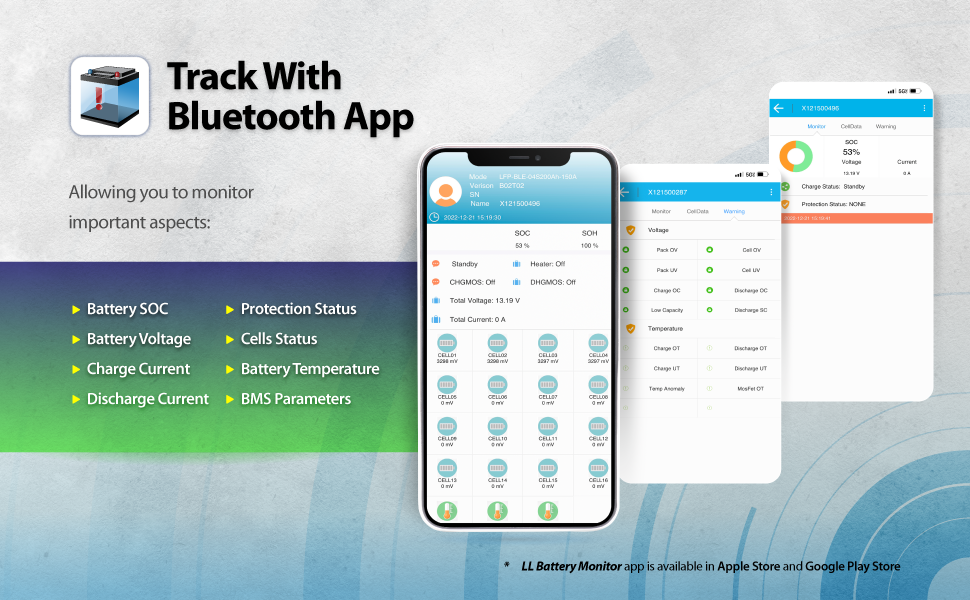
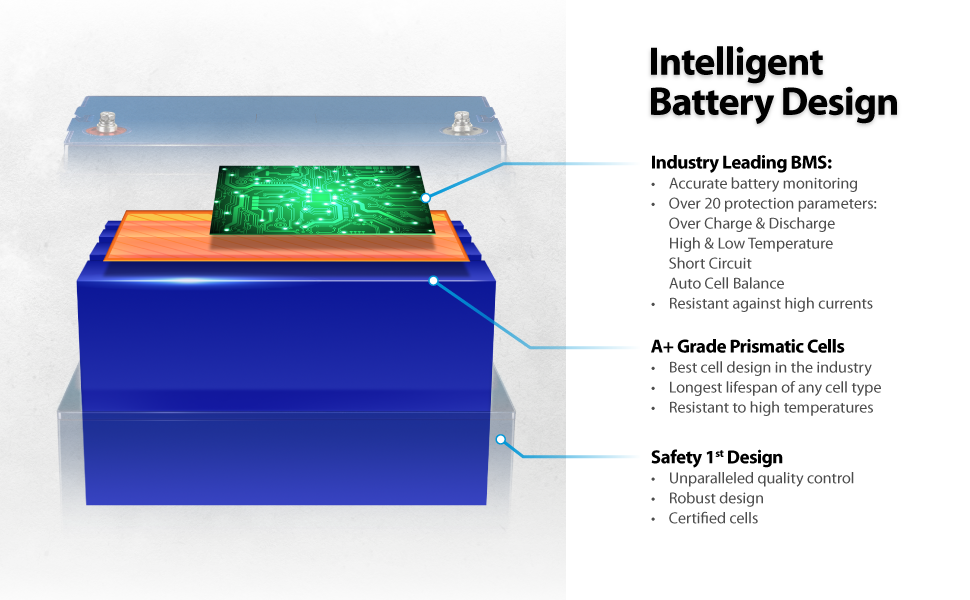
- Cutting-Edge BMS for Superior Battery Performance: With our proprietary Battery Management System (BMS), precisely optimized to complement our specific cells, you can expect maximum useful life and unparalleled battery protection, ensuring years of uninterrupted enjoyment. Our industry leading built-in Battery Management System (BMS) protects the battery cells from overcharge, deep discharge, overloading, overheating, low-temperatures and short circuits.
- Unparalleled Resilience through Rigorous Testing: Our prismatic cells undergo rigorous testing across a multitude of conditions: from puncturing, to fire, short circuit, and even high impact damage, our cells are tested against all types of damage, providing outstanding resilience and the peace of mind you deserve.
- The Expert Promise: Experience Hassle-Free Purchasing with Our Unwavering Warranty and World-Class Tech Support: When you choose our LiFePO4 batteries, rest assured of a seamless and reassuring buying process, backed by our exceptional warranty and dedicated technical support.
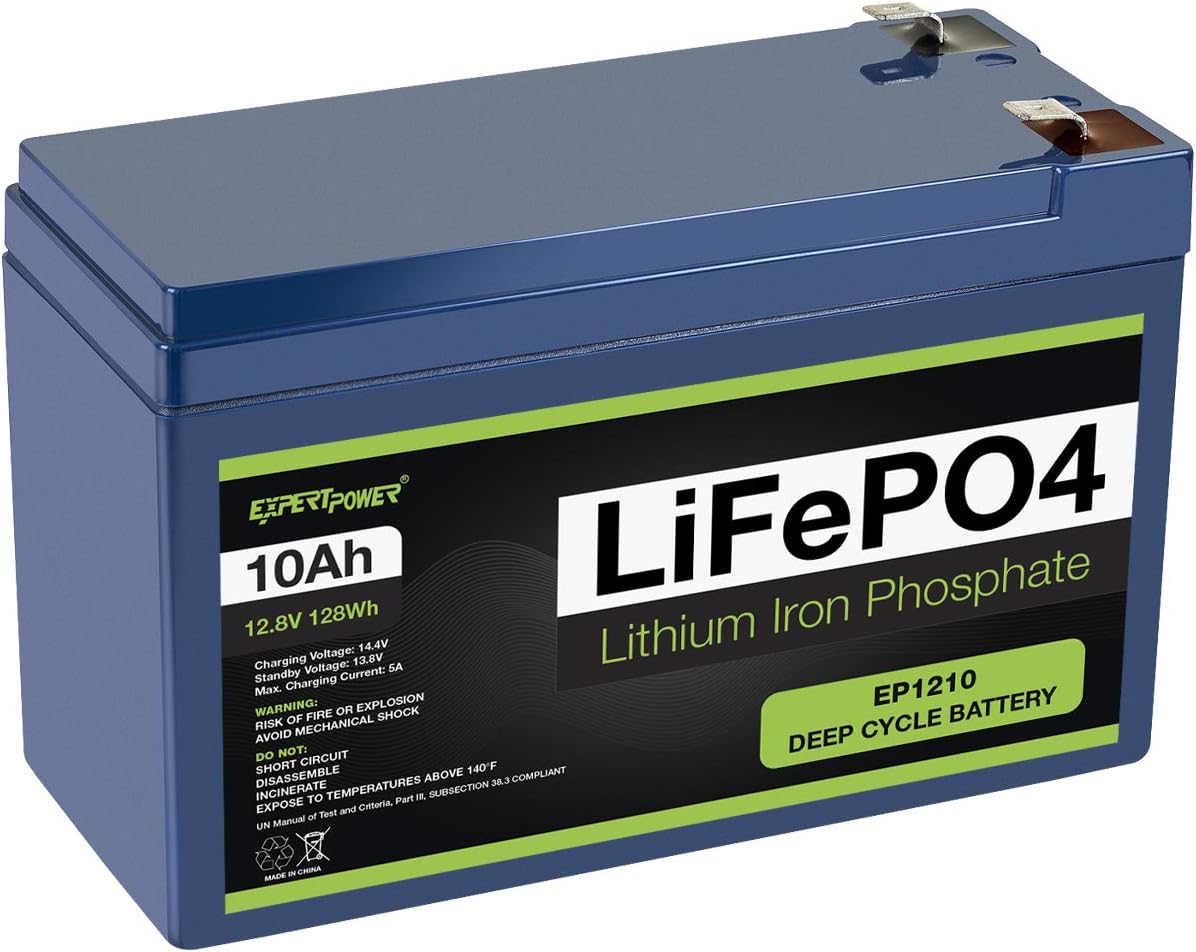
The battery's proprietary lithium-iron phosphate chemistry takes the hassle out of maintaining and utilizing the power you need. Batteries are meant to be used when you need them and if you need them all the time then lead acid becomes too unreliable and exhausting to keep track of. The lithium chemistry of the battery cuts the weight of the traditional lead acid battery to less than half while providing a massive boost to performance and capacity so you won't miss a single second of runtime. Designed for more than just storing power easily, they're here for you to provide long-lasting peace of mind with their immense durability making it easy to use them in your home, at your job, or for your outdoor needs where trust, safety, and the environment matter most. ExpertPower's lithium battery is the next step to a cleaner, stronger, and safer power solution.Nominal Voltage: 12.8vCharging Voltage: 14.4±0.2vRated Capacity : 10Ah (0.2C, 25°C)Terminal Type: F2Dimensions (L x W x H): 6 x 2.6 x 3.7 (H + Terminal: 3.9) InchWeight: 2.7lbsMax. Continue Discharge Current: 10AMax. Permanent Discharge Current: 15A 10Sec.Max. Continue Charge Current: 5ALife Cycles: 2500 with 100% DOD; 3600 with 80% DOD; 7000 with 50% DODOperating Temperature:Discharging: -4°F to 140°FCharging: 32°F to 140°FStorage Duration:12 months at 77°F1 Year Hassle-Free Warranty
Review: Saves weight, saves space, longer life, what's not to like? - Update 4/29/2021 The battery is performing well. We made a trip to Florida to visit my parents which included one night without hookups. The DC to DC charger works great and the battery is not having any issues with performance. I was thinking of adding another but the reply I got was not to do so if the age is greater than 6 months. I guess I need to save for the 200AH model. Update: 6/22/2020 We still have only had short opportunities to use this battery since our trip to Alaska has been pushed back to next year. That was one of the main reasons for purchasing and installing this battery. However, I am still very happy with it. I did have to make some changes though. First, I realized that the tow vehicle could not charge the battery when I noticed that it was lower after towing than before. Two days of towing took it down to about 70%. This prompted me to purchase a Renogy 20A DC to DC charger and to install a battery isolator relay in the Frontier we use along with a dedicated circuit to power it. Now I can be confident of properly charging the battery while towing. Please be aware of this if you purchase one of these or a similar LiFePO4 battery as the 12V circuit running through the trailer connector cable is not suited for proper charging. It would probably be okay for short hauls, but not multi-day trips, especially of one is planning on off-grid camping. I also purchased a 100W Renogy solar suitcase to use if we are off-grid. Between the generator, the tow vehicle, and solar, we have three ways to charge the battery so I think we will be okay for off-grid camping. Original review: I purchased this battery to take the place of two 6V GC2 batteries I have used since December, 2015 in our camping trailer. By specifications, the GC2 batteries have more power, but since they are Lead-Acid, the best practice is to only discharge them no lower than 50% state of charge. The 215AH becomes only 107.5AH. To get that, it meant carrying about 120 lbs on the tongue of the trailer. Comparing specifications, the ExpertPower 100AH LiFePO4 battery can be discharged much deeper without damage, which means that the 100AH is almost completely usable. Also, the LiFePO4 batteries do not build up explosive hydrogen gas which means I could relocate it to inside. The compact size and the fact that the battery weighs only 29.7 lbs means that my useful cargo carrying capacity is now greater than with the Lead-Acid batteries since I save about 90 lbs with the LiFePO4 battery. I had previously built a compartment inside in a place where wires were that was otherwise wasted. This looked to be the ideal spot to put the battery. It had easy access, both to install the battery and to run the wires needed. I also opted to install a battery cut-off switch (relocated from the old battery case) and a battery monitor that will act similar to a fuel gauge in that it monitors amperage in and amperage out and calculates the state of charge. This is needed because a simple voltmeter won't work. The way LiFePO4 batteries discharge is that they have a rather flat discharge profile until they get low. Then voltage drops off rapidly. Beside the battery monitor, I needed to change the converter in my trailer since a lead-acid battery charger requires a different method of charging. We have a WFCO 8955 power center. WFCO makes a replacement converter that has the correct charging profile for LiFEPO4 batteries, WF-8950L2 MBA. One could get by with getting a stand-alone charger and not connecting it to the converter if that suits the installation better, but for us, this was the better option. I also probably could have gotten by with 6 gauge wire, but opted for 4 gauge because of the length of the run from the converter to the battery location. It will keep the voltage from dropping too much through resistance and be that much safer. The specification state that I can expect >2,500 discharge/charge cycles at +20C 0.2C (which I take to be temps between 20C and .2C or 68F and 32.4F) if discharged 100%. If only discharged to 50%, the expected number of cycles increases to around 7,000. Even the lower figure far exceeds the expected life of lead-acid batteries. ExpertPower states an expected 10 year life. Things to watch out for: Operating temperatures for discharge are -4 to 140F and charge 32-140F. Storage is between 32 and 86F. That is another reason for moving the battery inside. I can control the temperatures better when it is inside. Because LiFePO4 batteries have a very low self-discharge rate (approx 3%/month), one can charge the battery, disconnect it, and store it for a year at 77F and not damage the battery. The bult-in Battery Management System serves to protect the battery if conditions go outside safe specifications. I have not had an opportunity to really put this to the test yet as it is winter and we won't be using it much until later this year. However, this seemed the best time to purchase and install it. I will update later after we gain experience with it and I can better report on how it performs.
Review: A heads up for UPS users, not disparaging either this battery or the UPS, but... - This battery installed OK into a CyberPower 1500VA PCS Sinewave UPS. But when a small power blip occurred; all my lead acid UPS systems had no problem but the CyberPower 1500 shut off. I think this was because the UPS thought the battery was charged and even indicated with a 300W load that it had 32 minutes run time. But it was wrong. The load was shut off and the UPS shut itself off. I'm not disparaging either this battery or this UPS. Just, they don't work together most likely because an SLA charger will not charge this battery. See the answer to the first question for more detail.