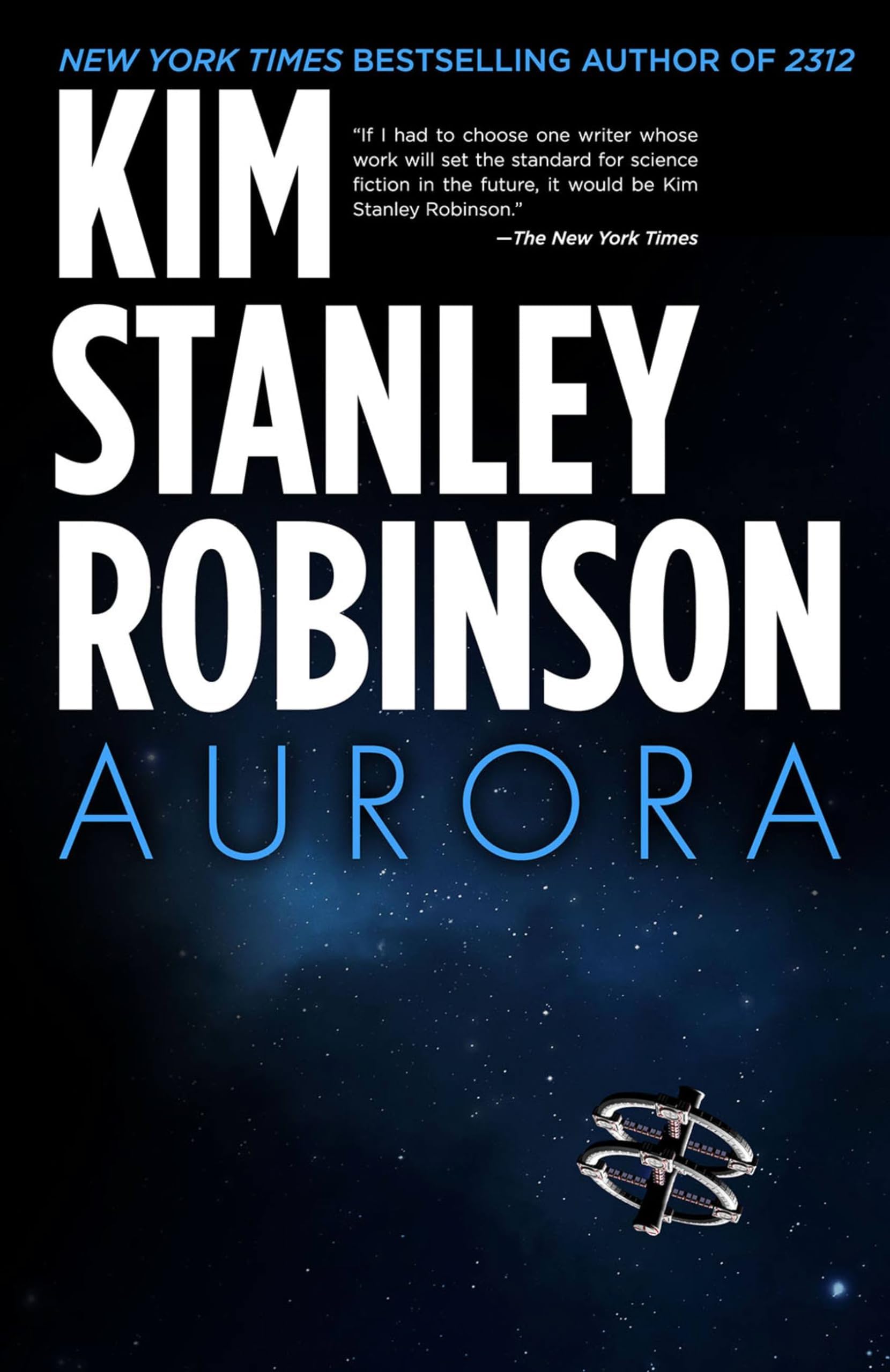
Aurora
Product ID: 65515191
A major new novel from one of science fiction's most powerful voices, Aurora tells the incredible story of our first voyage beyond the solar system. Brilliantly imagined and beautifully told, it is the work of a writer at the height of his powers. Our voyage from Earth began generations ago. Now, we approach our new home. AURORA. Review: but it's like none I've read before - Mankind has a fascination with travelling to the stars and settling other planets. The desire to do this is a natural extension of historical explorers and settlers: the "discovery" and exploration of America, the settling of the old west, the manned expeditions to the moon and the unmanned exploration of Mars and the outer solar system. But we seem to have reached out limit. The laws of physics tell us we can't travel faster than light, so exploration of other solar systems is out of reach. Of course, science fiction writers have found ways of travelling to other stars and distant galaxies for decades now. Most of those methods are either impossible (faster than light travel) or beyond our knowledge (wormholes, for example). One way that writers have gotten humanity to the stars is via the generational starship; put a bunch of travelers on a starship designed to last a very long time, let them have families and live their lives as normally as they can until they get to their destination, then settle the planet and voila, humanity has expanded into the galaxy. There are any number of novels that have variations on this story, but in the end, humanity gets there and survives. Kim Stanley Robinson's latest novel AURORA is a generational starship novel, but it's different from any other I've read. AURORA starts out with the ship just a few years away from its destination, Tau Ceti. The ship is showing signs of wear, and it will have some trouble making it there according to the ship's chief engineer Devi. As planetfall gets near, we follow the life of Devi's daughter Freya as she grows up and discovers what it means to live on a generational starship. We learn, through Devi's eyes, as well as the eyes of Ship, the story's narrator, that failures are occurring all over the ship, happening faster than they can be repaired. And they are not just mechanical problems; there are biological, sociological, and environmental issues. Eventually the ship reaches the Tau Ceti system, and a moon is selected for settlement. Not long after, things go wrong - very wrong. How the travelers deal with the problems that arose as a result of landing on that particular moon is really the meat of the book AURORA certainly is a generational starship story, but it's like none I've read before. Robinson is sending a message with this book, and it's not a pleasant one, especially for a race of people that want to leave the womb and go to the stars. The message is that it's very hard to do, probably impossible. The traditional generational starship story usually is one that has a positive ending - humanity travels great distances, gets where it wants to go, lands on a planet, and settles the planet. Then of course you have the endless sequels that tells what happens to those settlers. But hold that thought for a moment. Robinson has made it very clear in interviews, articles, and other books he's written that infodumps are essential to a science fiction story, even at the expense of characterization which has become so important, especially in modern day science fiction. The first half or so of the book develops Freya's character so that we understand her actions later on. The second half of the book is almost devoid of the same kinds of characterization. Character interactions, when there are any, are used to allow Robinson to go into high infodump mode. And the message of all that infodumping is that travel to the stars is extremely difficult, if not impossible. Robinson is not afraid to tell us, in something excruciating detail, how the universe works and how it really is working against you. Robinson is telling us that no matter how much planning is done for a long range interstellar mission, it's not all going to go the way the plan says it's going to go. There will be mechanical failures: Things will break, unexpectedly wear out, or just not work the way they are expected to. Some bacteria will creep in somehow, somewhere, and kill the crops and animals that the settlers are depending on for food. People will become unhappy with their situation. Those volunteers that left the solar system six generations prior to the start of the story were okay with being thrown into the unknown. Those that were born into it on the trip didn't ask for their situation - it was thrust upon them. They don't like mandated population control, or the biome in which they live. When pressed for a decision after the incident on the moon they landed on arose, there was dissension and disagreement as to how to handle it, and violence resulted - just like back on Earth. It's not clear that makeshift solutions to unforeseen problems will work as there is no precedent. There is more, much more, but I could be venturing into spoiler territory if I go too much further. It seems that what Robinson is telling us is that maybe, just maybe, we ought to take care of the planet we have, because it's going to be difficult to leave and go elsewhere. The unknown may be exhilarating and exciting, but it can also be terrifying (there, I've managed to say something about the latter part of the book without actually spoiling anything). We don't know it all, we can't know it all, and we can't plan for it all. With regard to sequels, I think Robinson has been somewhat sneaky with AURORA. Unless you blink and therefore miss it, AURORA takes place in the same universe as 2312 (which may be in the same universe as his award winning Mars trilogy). There are a few references to things that we know about from 2312 that put this story in that setting. If you squint a bit I suppose, then, that you could call this a sequel to 2312. However, it also seems clear that if he wants to, Robinson can write a sequel to AURORA based on the events surrounding the events that occurred at Tau Ceti. It would be interesting to read that book if it ever comes about. AURORA is a fine novel, one of the best, along with NEMESIS GAMES, that I read from 2015, and in my opinion is superior to 2312. You may not like what it is telling you, but it certainly is a fascinating and different look at the generational starship story. Ali Ahn is an adequate narrator for the book, and she fits because AURORA is narrated by Ship, who has a female persona. An awful generalization, but one that I'm going to make because it suits the situation, is that there is one type of bad narrator, one type of good narrator, and then there's the adequate type of narrator. The bad one is the one that jars you out of the story for any number of reasons. A narrator should allow you to immerse yourself into the story without kicking you out of it. It's hard to describe the best kind of narrator (but I'll try anyway), which would be one that gets the characters right, the voices right, and brings emotion to the work. Ali Ahn is the adequate kind of narrator - the one you don't notice one way or another, who does not kick you out of the story but doesn't knock it out of the park, either. Whether that is actually good or not is up to the listener, but that works for me, and that's what Ali Ahn brought to AURORA. Review: Quick Aurora Review - Well, I blasted through this book in about a week, which definitely says something. I am a huge Kim Stanley Robinson fan and this new novel, Aurora, does not disappoint. It is a great entry book for those who haven't read any of his work before, and it is a must have for those who are familiar with him. The main plot follows a multi-generational starship through interstellar space to one of the closest G-class stars with planets in the habitable zone of the star system, Tau Ceti, with the hopes of colonizing a moon that orbits one of these planets. The concept itself is rather thrilling, and the physical descriptions of the space travel are very well done. There is also an underlying theme and message to the book that is to be learned from, although I won't spoil that here. Let's get into some pros and cons to make this easier. Pros: - Very interesting page turner. - The characters are much stronger than in 2312 (This might be a pro for others, but I felt 2312 was more about concepts, and that isn't as bad as people say) - KSR Executes such a tremendous concept very well, tackling interstellar space travel with grace. - Like all of his books, the underlying theme is very sobering, and I have gained much from reading this novel. Cons: - Plot slowed down significantly towards the end. (But could it really have been different?) - One of the things I liked about KSR's Mars trilogy and Galileo's Dream were his extrapolations of ideas regarding the themes in the book. This was almost entirely absent in Aurora, and is the main reason I am giving it 4/5 rather than 5/5. - The elaborate and beautiful descriptions of Mars in the Mars trilogy are not present for Aurora and the Tau Ceti system. Although there are possibly reasons for this, which I will not elaborate on or else I would spoil a major part of the plot, it would have been nice to get a more grandiose introduction to the Tau Ceti system. Overall: BUY THIS BOOK. The pros heavily outweigh the cons, and Aurora is one of Kim Stanley Robinson's best. Not that there are many duds to find anyway.
| Best Sellers Rank | #862,996 in Books ( See Top 100 in Books ) #303 in Hard Science Fiction (Books) #927 in Exploration Science Fiction #1,411 in Space Operas |
| Customer Reviews | 4.0 out of 5 stars 7,631 Reviews |
J**Z
but it's like none I've read before
Mankind has a fascination with travelling to the stars and settling other planets. The desire to do this is a natural extension of historical explorers and settlers: the "discovery" and exploration of America, the settling of the old west, the manned expeditions to the moon and the unmanned exploration of Mars and the outer solar system. But we seem to have reached out limit. The laws of physics tell us we can't travel faster than light, so exploration of other solar systems is out of reach. Of course, science fiction writers have found ways of travelling to other stars and distant galaxies for decades now. Most of those methods are either impossible (faster than light travel) or beyond our knowledge (wormholes, for example). One way that writers have gotten humanity to the stars is via the generational starship; put a bunch of travelers on a starship designed to last a very long time, let them have families and live their lives as normally as they can until they get to their destination, then settle the planet and voila, humanity has expanded into the galaxy. There are any number of novels that have variations on this story, but in the end, humanity gets there and survives. Kim Stanley Robinson's latest novel AURORA is a generational starship novel, but it's different from any other I've read. AURORA starts out with the ship just a few years away from its destination, Tau Ceti. The ship is showing signs of wear, and it will have some trouble making it there according to the ship's chief engineer Devi. As planetfall gets near, we follow the life of Devi's daughter Freya as she grows up and discovers what it means to live on a generational starship. We learn, through Devi's eyes, as well as the eyes of Ship, the story's narrator, that failures are occurring all over the ship, happening faster than they can be repaired. And they are not just mechanical problems; there are biological, sociological, and environmental issues. Eventually the ship reaches the Tau Ceti system, and a moon is selected for settlement. Not long after, things go wrong - very wrong. How the travelers deal with the problems that arose as a result of landing on that particular moon is really the meat of the book AURORA certainly is a generational starship story, but it's like none I've read before. Robinson is sending a message with this book, and it's not a pleasant one, especially for a race of people that want to leave the womb and go to the stars. The message is that it's very hard to do, probably impossible. The traditional generational starship story usually is one that has a positive ending - humanity travels great distances, gets where it wants to go, lands on a planet, and settles the planet. Then of course you have the endless sequels that tells what happens to those settlers. But hold that thought for a moment. Robinson has made it very clear in interviews, articles, and other books he's written that infodumps are essential to a science fiction story, even at the expense of characterization which has become so important, especially in modern day science fiction. The first half or so of the book develops Freya's character so that we understand her actions later on. The second half of the book is almost devoid of the same kinds of characterization. Character interactions, when there are any, are used to allow Robinson to go into high infodump mode. And the message of all that infodumping is that travel to the stars is extremely difficult, if not impossible. Robinson is not afraid to tell us, in something excruciating detail, how the universe works and how it really is working against you. Robinson is telling us that no matter how much planning is done for a long range interstellar mission, it's not all going to go the way the plan says it's going to go. There will be mechanical failures: Things will break, unexpectedly wear out, or just not work the way they are expected to. Some bacteria will creep in somehow, somewhere, and kill the crops and animals that the settlers are depending on for food. People will become unhappy with their situation. Those volunteers that left the solar system six generations prior to the start of the story were okay with being thrown into the unknown. Those that were born into it on the trip didn't ask for their situation - it was thrust upon them. They don't like mandated population control, or the biome in which they live. When pressed for a decision after the incident on the moon they landed on arose, there was dissension and disagreement as to how to handle it, and violence resulted - just like back on Earth. It's not clear that makeshift solutions to unforeseen problems will work as there is no precedent. There is more, much more, but I could be venturing into spoiler territory if I go too much further. It seems that what Robinson is telling us is that maybe, just maybe, we ought to take care of the planet we have, because it's going to be difficult to leave and go elsewhere. The unknown may be exhilarating and exciting, but it can also be terrifying (there, I've managed to say something about the latter part of the book without actually spoiling anything). We don't know it all, we can't know it all, and we can't plan for it all. With regard to sequels, I think Robinson has been somewhat sneaky with AURORA. Unless you blink and therefore miss it, AURORA takes place in the same universe as 2312 (which may be in the same universe as his award winning Mars trilogy). There are a few references to things that we know about from 2312 that put this story in that setting. If you squint a bit I suppose, then, that you could call this a sequel to 2312. However, it also seems clear that if he wants to, Robinson can write a sequel to AURORA based on the events surrounding the events that occurred at Tau Ceti. It would be interesting to read that book if it ever comes about. AURORA is a fine novel, one of the best, along with NEMESIS GAMES, that I read from 2015, and in my opinion is superior to 2312. You may not like what it is telling you, but it certainly is a fascinating and different look at the generational starship story. Ali Ahn is an adequate narrator for the book, and she fits because AURORA is narrated by Ship, who has a female persona. An awful generalization, but one that I'm going to make because it suits the situation, is that there is one type of bad narrator, one type of good narrator, and then there's the adequate type of narrator. The bad one is the one that jars you out of the story for any number of reasons. A narrator should allow you to immerse yourself into the story without kicking you out of it. It's hard to describe the best kind of narrator (but I'll try anyway), which would be one that gets the characters right, the voices right, and brings emotion to the work. Ali Ahn is the adequate kind of narrator - the one you don't notice one way or another, who does not kick you out of the story but doesn't knock it out of the park, either. Whether that is actually good or not is up to the listener, but that works for me, and that's what Ali Ahn brought to AURORA.
Z**H
Quick Aurora Review
Well, I blasted through this book in about a week, which definitely says something. I am a huge Kim Stanley Robinson fan and this new novel, Aurora, does not disappoint. It is a great entry book for those who haven't read any of his work before, and it is a must have for those who are familiar with him. The main plot follows a multi-generational starship through interstellar space to one of the closest G-class stars with planets in the habitable zone of the star system, Tau Ceti, with the hopes of colonizing a moon that orbits one of these planets. The concept itself is rather thrilling, and the physical descriptions of the space travel are very well done. There is also an underlying theme and message to the book that is to be learned from, although I won't spoil that here. Let's get into some pros and cons to make this easier. Pros: - Very interesting page turner. - The characters are much stronger than in 2312 (This might be a pro for others, but I felt 2312 was more about concepts, and that isn't as bad as people say) - KSR Executes such a tremendous concept very well, tackling interstellar space travel with grace. - Like all of his books, the underlying theme is very sobering, and I have gained much from reading this novel. Cons: - Plot slowed down significantly towards the end. (But could it really have been different?) - One of the things I liked about KSR's Mars trilogy and Galileo's Dream were his extrapolations of ideas regarding the themes in the book. This was almost entirely absent in Aurora, and is the main reason I am giving it 4/5 rather than 5/5. - The elaborate and beautiful descriptions of Mars in the Mars trilogy are not present for Aurora and the Tau Ceti system. Although there are possibly reasons for this, which I will not elaborate on or else I would spoil a major part of the plot, it would have been nice to get a more grandiose introduction to the Tau Ceti system. Overall: BUY THIS BOOK. The pros heavily outweigh the cons, and Aurora is one of Kim Stanley Robinson's best. Not that there are many duds to find anyway.
S**E
Estória muito bem desenvolvida, com sequência interessante cheia de criatividade. Cientificamente bem atual. Ação presente sem correrias. Entretenimento garantido e prazeroso.
M**N
I remember being strangely skeptical during the first chapter of the book, which is written in a rather curious style. Later in the book it becomes clear why that is so and in retrospect it fits very nicely into the overall story. I'm not going to spoil any details about that story, but suffice it to say that it is masterfully crafted and told. It opens a fascinating insight into a topic that is part social analysis, part hard science (quite a lot of that, actually), and part glimpse into a very plausible future, all while being perpetually intriguing and suspenseful. Exactly what a Sci-Fi book should be and rightfully praised. This is one of the books that has managed to draw me in and keep me reading late into the night - highly recommended.
D**E
In the Mars Trilogy Robinson told the story of humanity's expansion into the solar system, an optimistic tale of endless possibilities. Aurora is a counterpoint to that, more of a cautionary tale. The very old idea of sending humans to another star on a generation ship is examined and found wanting, not for technical shortcomings (though those are evident) but for very human reasons. To reach the stars takes decades at best so the generation that left is not the generation that arrives, with all the generations between forced into a life they did not choose and cannot change. This is the theme of Aurora, a theme Robinson handles in his usual masterful style. Despite being mostly narrated by an artificial intelligence, this is a very human story, and it is most definitely a story, with the science taking a supporting role to the fiction. It is full of engaging, believable characters, people it is easy to care about, people worth rooting for when they get into trouble. The science behind the story is fascinating and well thought out, without becoming overwhelming. It is certainly a more conservative view of the power of technology than Robinson showed in the Mars Trilogy; some things are just hard to do and even the best of human ingenuity can't always come to the rescue at the last minute. It is a more mature view of what we can (or should) do, a call for time to understand the consequences of what we propose to do before we jump in with both feet. Part of my fascination with this story is in the artificial intelligence narrator, a quantum computer that gradually becomes a major character in the story it is narrating. It never becomes human in any sense, but it does grow and develop into a narrator of considerable power. It is a mark of Robinson's writing skill that having a machine narrating a human story works so well. Robinson is a master storyteller, and his mastery shines through this book as it did in the Mars Trilogy. Aurora is a less optimistic look at the future, and takes a longer view of where we are going and how we will get there, perhaps a more mature and realistic view. Read the Mars Trilogy, read Aurora - they balance each other nicely. Two possible futures, both masterfully told.
B**M
If you want an action read, this is not your book. If you want an intelligent, well written tale which examines the difficulties for the inhabitants of a generation ship heading into interstellar space, then this is for you. If you want a story that is set a few centuries hence, but expands upon the technologies we currently have or envisage, (e.g. quantum computers), as reality , (not on a writer's imagination of warp drive, wormholes, etc), then this is for you. If you want a book that applies the mechanics of interstellar acceleration and deceleration, the means to achieve those ends, the small tolerances that are necessary to achieve a desired result, then this book is for you. If you want a story that intelligently draws comparisons with Earth today, then this is for you. If you want a story of 'loss' of many things, then this is for you. "Aurora" is a space colonization book unlike most other generation colony ships I've read. In other books where the threats to the ship are caused by human warring factions and/or hostile aliens, the threats to the survival of "Aurora" are internal - chemical, biological, physiological, mental, societal. Even the writing seems to change as the story progresses, but that is best left for readers to discover for themselves. Mr. Robinson is another author I'll have to add to my ever expanding list of preferred writers. Very highly recommended.
J**S
A true Kim Stanley Robinson, need I say more? Well researched and very well written, as we are used to.
Trustpilot
2 days ago
1 month ago