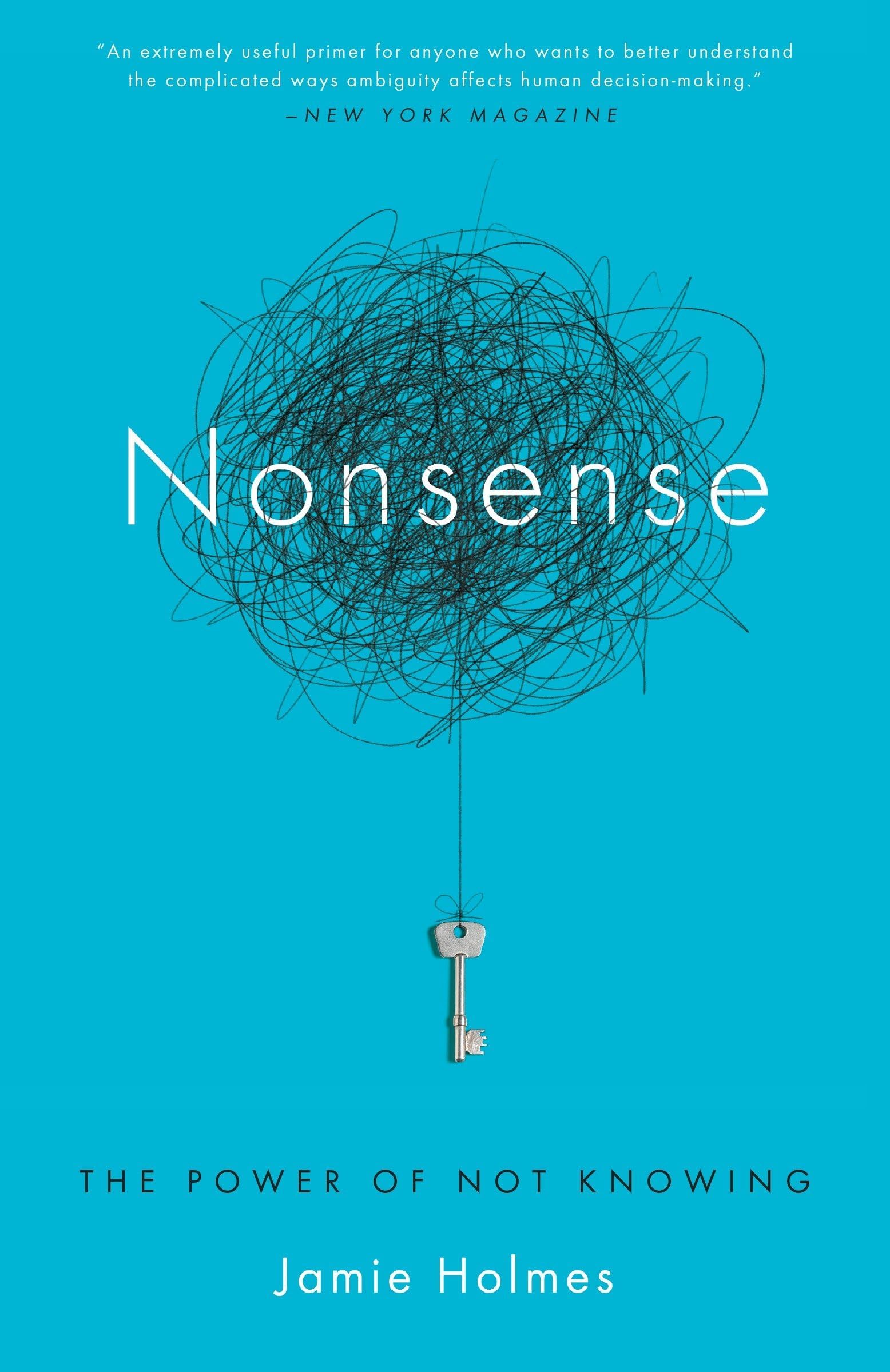
Nonsense: The Power of Not Knowing
Product ID: 63645279
Desertcart purchases this item on your behalf and handles shipping, customs, and support to Senegal.
An illuminating look at the surprising upside of ambiguity--and how, properly harnessed, it can inspire learning, creativity, even empathy Life today feels more overwhelming and chaotic than ever. Whether it's a confounding work problem or a faltering relationship or an unclear medical diagnosis, we face constant uncertainty. And we're continually bombarded with information, much of it contradictory. Managing ambiguity--in our jobs, our relationships, and daily lives--is quickly becoming an essential skill. Yet most of us don't know where to begin. As Jamie Holmes shows in Nonsense , being confused is unpleasant, so we tend to shutter our minds as we grasp for meaning and stability, especially in stressful circumstances. We're hard-wired to resolve contradictions quickly and extinguish anomalies. This can be useful, of course. When a tiger is chasing you, you can't be indecisive. But as Nonsense reveals, our need for closure has its own dangers. It makes us stick to our first answer, which is not always the best, and it makes us search for meaning in the wrong places. When we latch onto fast and easy truths, we lose a vital opportunity to learn something new, solve a hard problem, or see the world from another perspective. In other words, confusion--that uncomfortable mental place--has a hidden upside. We just need to know how to use it. This lively and original book points the way. Over the last few years, new insights from social psychology and cognitive science have deepened our understanding of the role of ambiguity in our lives and Holmes brings this research together for the first time, showing how we can use uncertainty to our advantage. Filled with illuminating stories--from spy games and doomsday cults to Absolut Vodka's ad campaign and the creation of Mad Libs-- Nonsense promises to transform the way we conduct business, educate our children, and make decisions. In an increasingly unpredictable, complex world, it turns out that what matters most isn't IQ, willpower, or confidence in what we know. It's how we deal with what we don't understand. Review: Five Stars - Good txn Review: Very mind provoking, but a bit rambling at times ... - Very mind provoking, but a bit rambling at times. However the answer to one of the problems posed would only be correct in a US context as our plugs will not fit. Read the book and you will understand what I mean!
| Best Sellers Rank | 2,239,587 in Books ( See Top 100 in Books ) 15,507 in Higher Education of Biological Sciences |
| Customer Reviews | 4.2 out of 5 stars 212 Reviews |
B**T
Five Stars
Good txn
F**R
Very mind provoking, but a bit rambling at times ...
Very mind provoking, but a bit rambling at times. However the answer to one of the problems posed would only be correct in a US context as our plugs will not fit. Read the book and you will understand what I mean!
R**S
“In an increasingly complex, unpredictable world…what matters most is how we deal with what we don’t know.”
I selected the comment by Jamie Holmes to serve as the subject of this review because he cites one of the greatest challenges all of us face today. For example, one of the most important information needs is knowing what we think we know but, in fact, don’t. So many times we make decisions based on assumptions or premises that are inadequate or incomplete, if not flat-out wrong. When told that he was believed to be the wisest man on earth, Socrates replied that if it were true, it was because “The only true wisdom is in knowing you know nothing." Holmes cites dozens of primary and secondary sources to support his “simple claim” that "what matters most isn't IQ, will power, or confidence in what we know. It's how we deal with what we don't understand." And I again presume to suggest that we cannot deal with something unless and until we recognize that we really do not understand it, although we may be certain that we do. Not everyone who says "Got it!" in fact gets it but may well think they do and there's the problem. In this context, I am reminded again of a Jordan Peterson comment that Holmes quotes: "The fundamental problem of life is the overwhelming complexity of being." Peterson praises the capacity of mind to eradicate vast swathes of information, albeit accurate information that is nonetheless irrelevant to and thus useless in the given circumstances. He calls this capacity of the mind "the miracle of simplification." (Albert Einstein once recommended that everything be made as simple as possible "but no simpler.") I agree with Holmes: "the only way we can manage the flood of perception is by creating and automatic ally deferring to working theories of what we are going to encounter -- beliefs about the world, in the broadest sense." These are among the several dozen passages of greatest interest and value to me, also listed to suggest the scope of Holmes’s coverage: o Ambiguity overview (Pages 9-12) o Arie Kruglanski (11-14, 73-75, 86-87, 88-90, and 243-244) o Sense making (19-61) o Dorothy Martin and alien sightings (47-56) o Traumatic events and reappraisal (65-73) o Urgency (65-82) o Misreading intentions (83-110) o Need for closure scale (86-89) o Trisha Torrey (111--114, 117-118, and 124-129) o Misdiagnosis (111-123) o Medical overtesting (120-126) o Strategy of ignorance (130-154) o Fashion forecasting (130-134, 139-141, and 145-152) o Ambiguity tolerance and strategy of ignorance (134-139, 143-144, and 151-152) o Business strategies (136-139) o Uses of uncertainty (157-178) o Gary Pisano (159-161 and 173-175) o Benefits of failure (159-163) o Innovations (179-203) o Tony McCaffrey (192-198 and 201-202) o Bilingualism (205-223) The challenges to which Jamie Holmes refers throughout his lively and eloquent narrative are indeed complicated and are certain to become even more so in the months and years ahead. He provides an abundance of real-world situation framed as stories, information, insights, and counsel to help his reader to understand basic principles and options such as how sense making works, including “secrets”; why intentions are misread; when to resist momentum; how to formulate and apply a “strategy of ignorance”; various uses of uncertainty; where to find hidden answers; and what benefits and opportunities appropriate diversity offers. For many executives now struggling to lead their companies through an increasingly more ambiguous as well as volatile and disruptive global marketplace, this is a “must read.”
A**N
Readable, lightweight thoughts on 'not knowing'
This is an increasingly important area, as evidence-based policy and the testing culture of many education systems focus on the value of knowing. Holmes misses out clear identification of the reasons why knowing has become such a strong driver, and why not knowing is more relevant than ever - not least because of the 'VUCA' (volatile, uncertain, complex & ambiguous) world around us. Whilst there are many interesting anecdotes and examples of academic research, the author fails to connect their relevance to his central theme.
J**S
Enjoyable summary of how we cope with uncertainty and ambiguity
This is a very readable account of what happens when we confront uncertainty and ambiguity - when our understanding of the world breaks down, when the causal relations we expect to hold are upturned. Basically - we do whatever we can to regain a sense of certainty, of comprehension. An example will illustrate this (drawing on the example Jon Elster gives of cognitive dissonance in Explaining Social Behavior ). Say you buy an expensive ticket for a show you expect to enjoy. Then you don't enjoy the show. Your expectations are challenged. One way you could resolve this is by revising your perception of the event itself ('Maybe it wasn't so bad - yeah, I loved it!'). Alternatively, you can alter your beliefs ('They lost it years ago - and the ticket wasn't so expensive anyway...'). Either way, you regain the congruity between the value you ascribed to the ticket, and what you actually derived from it. This may seem to exhaust the possibilities for regaining a sense of certainty - but one of the fascinating findings from the research summarised by Holmes is that we can also attempt to compensate by reaffirming our certainty in other areas - completely removed from that in which we experienced the certainty-undermining event. So, for example, students who are reminded of their morbidity subsequently proclaim their political views more strongly. After the earthquake in San Francisco in the early 20th century, people tried to compensate by creating more certainty in the status of their relationships: both marriages and divorces increased. Holmes also looks at the relevance of our aversion to uncertainty and ambiguity in the areas of decision making - particularly in relation to: * high stakes hostage events (how low tolerance of ambiguity led to the tragic end of the Waco siege), * anticipating vs. reacting to market trends (looking at how Zara shortened time-to-market, foregoing the need for costly investments based on shaky predictions) and * health (where our grasping for certainty can lead to harmful overtesting). Much of the advice he gives can be summarised as 'being open-minded is better than being close-minded' - which seems quite trite. But it's the depth and breadth of the exploration into why this is the case that made this a worthwhile read for me. He also discusses the importance of ambiguity for creativity - citing interesting research which suggests that speaking more than one language, or having experience living in more than one culture, can increase one's capacity to tolerate and exploit ambiguity and uncertainty. This has benefits for creativity (which he suggests thrives on the representation, exploitation and resolution of uncertainty), and also creative thinking more generally. The style of the book is well-written stories and case studies, which makes it very readable, but I would have appreciated some more consolidation and summaries of the material covered and the main points and advice - hence four rather than five stars. But it's still a very good read which I'd recommend to anyone interested in the subject of how we deal with the fact that (spoiler alert!) we can't know everything we'd like to about how to get by in the world (gutted, right?).
1**1
Disappointing: Doesn't Live up to the Hype
Jamie Holmes 'Nonsense: The Power of Not Knowing" disappointed me, given the other reviews I had seen and the general buzz that this book has seemed to generate. First of all, Holmes does not provide his own account of how to deal with ambiguity. Rather, the book is a collection of stories ranging from the MotoGP to the fashion industry to the Yom Kippur war in which different individuals face ambiguity and respond to it in either (stereotypical) bad or good ways. Holmes does well in making explicit the lessons we are supposed to draw from each story. However, what would have been most interesting - the particular arguments in favour of each conclusion on the basis of each story - is entirely absent. Second, given the generality of the lessons that Holmes wants to teach us and the claims he wants us to consider or accept, many of the stories are redundant. Yes, they serve the purpose of illustrating each lesson. But, strictly speaking, they are not necessary. A good example is the following. Holmes alludes to the interesting (philosophical) difference between 'risk' and 'ambiguity'. In the former, we can assign probabilities to the different possible outcomes of our action/an event, whereas in the latter we don't even have sufficient information to assign probabilities. However, after having presented the distinction, Holmes doesn't do anything with it. That is a real shame given that normative uncertainty (and acting under it) is currently a hot topic in decision-theory. Most helpful in Holmes' book I found his inclusion of Arne Roets and Alain van Hiel their version of the need-for-closure scale. By answering fifteen questions, scoring each question between 1-6, you can come to a total score that will inform you about your own need for closure. In my view, this should have formed the starting point for the book, after which Holmes could have discussed different strategies of lowering your scores on this, when and why closure might be a virtue, etc. But this is not the case. A missed opportunity, in my view.
H**R
Wonderful read
Amazing! Totally recommend.
W**N
Great discussion book
This was our book group selection for Sunday January 17, 2016. We did enjoy the book and the discussion though a larger than normal number of us were absent for not reading the book or travel purposes. I found it amazing how focused many were on the 15 questions that are supposed to measure how tolerant you are of ambiguity. I found the questions too ambiguous to be valuable especially since they are self-graded questions. How ambiguous that makes it! When pressed I chose three as my rating for me for all of them giving me a score of 45. But even in the discussion ensuing I found everyone taking the questions in such ambiguous ways that what was most obvious was that all of the members of the group were really very comfortable with ambiguity. Considering they are also all members of the Anchorage Unitarian Universalist Fellowship – perhaps the sect with the most ambiguous principles – that should not have been in doubt. So what is the take away of this interesting selection of stories about how individuals more tolerant of ambiguity end up doing better in certain situations? From events like Waco, finding Nazis, selling clothing, and dealing with cultural differences, the measures seem to indicate more power to those who are either genetically predisposed to deal with cognitive dissonance well instead of getting angry or antsy to those who perhaps can learn to have such an acceptance disposition by learning multiple languages (perhaps the most interesting chapter to me) we get the sense that acceptance of complexity is the more mature, more progressive, characteristic to have.
R**I
Interesting read
Enjoyed the book, enjoyed the whole premise and it was very well-written. I'm hoping it will be a helpful reminder for me, during these rather unpredictable times, that not knowing what's coming is not necessarily a bad thing.
G**P
some very good observations on ambiguity and how we try to resolve ...
Very interesting book, some very good observations on ambiguity and how we try to resolve it. Well written and engaging.
S**Y
The Next Malcolm Gladwell
I loved Jamie Holmes writing style because I love Malcolm Gladwell's. Engaging, immersive anecdotes that reveal the major themes at deeper and deeper levels. Extremely well researched. Once I was done reading the book, I started reading it again from the beginning to let the themes sink in at a deeper level. This book has important implications for how we teach our children. Do our students always expect problems to have one clear answer? Based on most classrooms, the answer is "yes." How do we prepare our students for the ambiguity of the real world? I am discussing this book with my teaching colleagues for how to change our classrooms.
Trustpilot
1 month ago
2 weeks ago