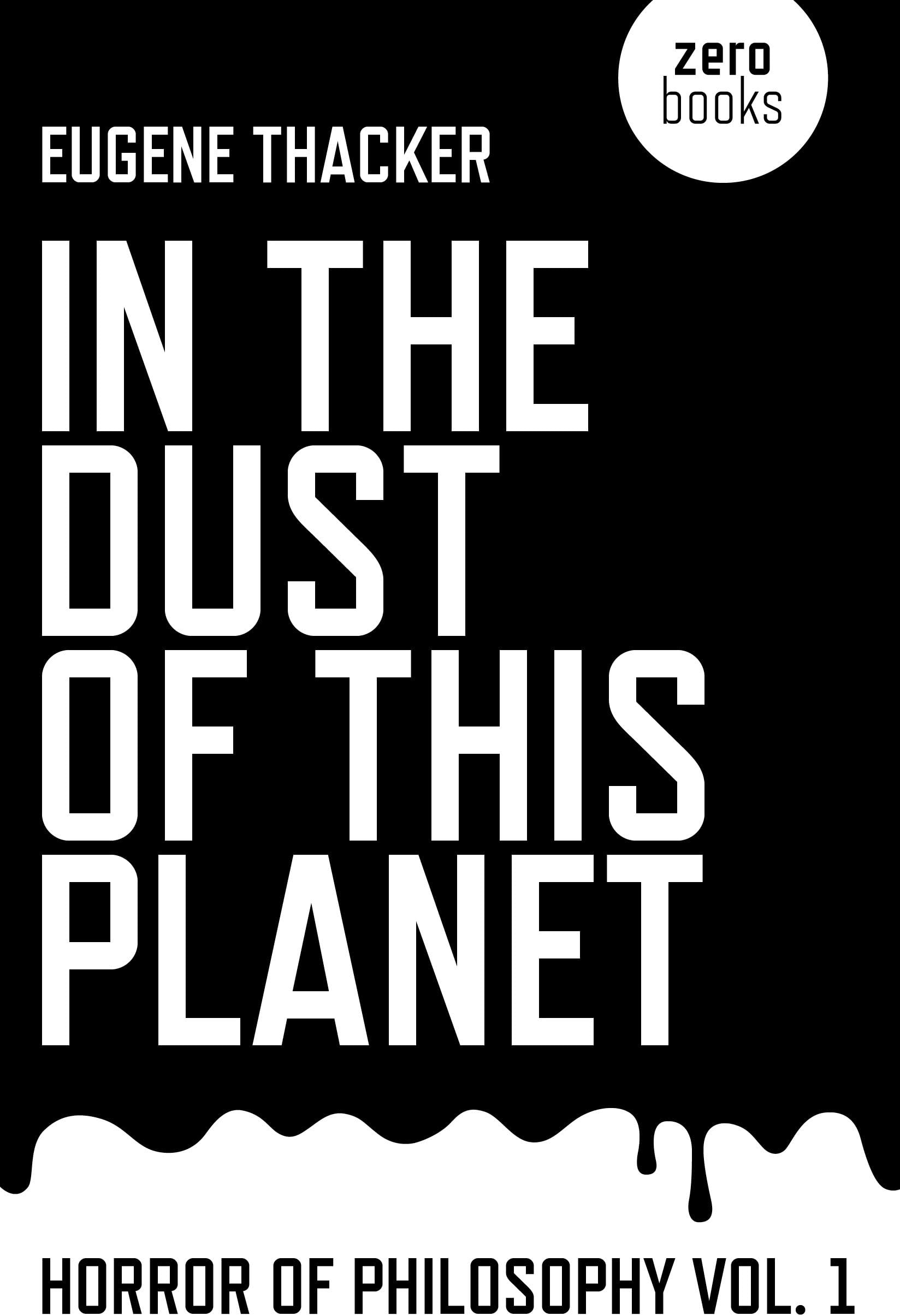
In the Dust of This Planet: Horror of Philosophy (Volume 1)
Product ID: 6181759
Desertcart purchases this item on your behalf and handles shipping, customs, and support to Senegal.
#1 desertcart Best Seller in Philosophy Criticism. "Thacker's discourse on the intersection of horror and philosophy is utterly original and utterly captivating..." Thomas Ligotti, author of The Conspiracy Against the Human Race The world is increasingly unthinkable, a world of planetary disasters, emerging pandemics, and the looming threat of extinction. In this book philosopher Eugene Thacker suggests that we look to the genre of horror as offering a way of thinking about the unthinkable world. To confront this idea is to confront the limit of our ability to understand the world in which we live -- a central motif of the horror genre. In the Dust of This Planet explores these relationships between philosophy and horror. In Thacker's hands, philosophy is not academic logic-chopping; instead, it is the thought of the limit of all thought, especially as it dovetails into occultism, demonology, and mysticism. Likewise, Thacker takes horror to mean something beyond the focus on gore and scare tactics, but as the under-appreciated genre of supernatural horror in fiction, film, comics, and music. This relationship between philosophy and horror does not mean the philosophy of horror, if anything, it means the reverse, the horror of philosophy: those moments when philosophical thinking enigmatically confronts the horizon of its own existence. For Thacker, the genre of supernatural horror is the key site in which this paradoxical thought of the unthinkable takes place. Review: In Dust We Trust - If you're a horror or black metal fan with an interest in philosophy, you're going to enjoy this short book immensely. You can tell the author really loves the subject and he treats it serious, with an appropriate amount of cheekiness. Hardcore analytic philosophy fans might find this to be less rigorous than they might like since It kind of has a comp lit close reading approach (which is what the author's PHD is in), but it's provocative and enjoyable. I'm a pretty deep fan of this stuff and I found page after page of new books and music to explore that I'd never heard of. True Detective super fans should check this out as it served as inspiration for the development of Rust Cohle. Read this book with Tomas Ligott's Conspiracy Against the Human Race, Albert Camus' Myth of Sisyphus, and a few of your favorite H.P. Lovecraft stories for the full effect. Review: A beautifully weird read - As a writer, this book has helped me flesh out a few interesting ideas surrounding horror and magic. The idea of the "world-without-us" is something that has rattled in my brain for a few years now and I was happy to have Thacker validate and give structure to the illusive black ocean always lapping just around the next corner of my thoughts. A few of his arguments become dense and confusing, and there are moments where he leaps for his conclusions; but there are more fun, provocative, and mind-bending moments than not. Also, the simple cover art is bizarrely iconic and really drew me to the book. It's great. It's a wonderful book, and not nearly dark or depressing as its recent reputation has it pegged as. "In The Dust of This Planet" is a beautifully weird read.


| Best Sellers Rank | #363,597 in Books ( See Top 100 in Books ) #42 in Philosophy Methodology #96 in Philosophy Criticism (Books) #123 in Gothic & Romantic Literary Criticism (Books) |
| Customer Reviews | 4.2 out of 5 stars 475 Reviews |
C**T
In Dust We Trust
If you're a horror or black metal fan with an interest in philosophy, you're going to enjoy this short book immensely. You can tell the author really loves the subject and he treats it serious, with an appropriate amount of cheekiness. Hardcore analytic philosophy fans might find this to be less rigorous than they might like since It kind of has a comp lit close reading approach (which is what the author's PHD is in), but it's provocative and enjoyable. I'm a pretty deep fan of this stuff and I found page after page of new books and music to explore that I'd never heard of. True Detective super fans should check this out as it served as inspiration for the development of Rust Cohle. Read this book with Tomas Ligott's Conspiracy Against the Human Race, Albert Camus' Myth of Sisyphus, and a few of your favorite H.P. Lovecraft stories for the full effect.
D**L
A beautifully weird read
As a writer, this book has helped me flesh out a few interesting ideas surrounding horror and magic. The idea of the "world-without-us" is something that has rattled in my brain for a few years now and I was happy to have Thacker validate and give structure to the illusive black ocean always lapping just around the next corner of my thoughts. A few of his arguments become dense and confusing, and there are moments where he leaps for his conclusions; but there are more fun, provocative, and mind-bending moments than not. Also, the simple cover art is bizarrely iconic and really drew me to the book. It's great. It's a wonderful book, and not nearly dark or depressing as its recent reputation has it pegged as. "In The Dust of This Planet" is a beautifully weird read.
C**H
Exceptionally satisfying, Deeply engrossing
Deeply unsettling, yet somehow also comforting. By deconstructing the way we consider our world through the lens of the horror genre, Thacker creates a piece of nihilist philosophy that doesn't feel obnoxiously glum or self loathing. Deeply analytical and carefully researched, this book is an excellent way for those new to nihilist philosophy or philosophy in general to dip their toes into the ancient art of placing ourselves in a physical and moral universe. As a lover of the horror genre, this book makes me feel as if my love for the macabre is not only valid and founded, but deeply rooted in my own subconscious understanding that my place in the cosmos is essentially meaningless. And the horror genre is a way in which we cope with that meaninglessness. Also, Glenn Beck hates it, so there's a reason to read it right there.
D**R
For Academics and Graduate Students
Thacker's book was informative, within the framework of a fairly narrow criteria, but it might have been better titled: In the Dust of this Book, for it was as dry as dust. For academics this might be a good book, but, honestly, there was nothing really new and inspiring here and written in a very dry, unengaging style. Worth a look for those interested in the philosophy of horror but it seems unlikely any others would find it engaging or useful...let alone inspiring. Recommended for graduate students and academics concerned with the philosophy of horror. Rating: 3 out of 5 stars.
D**A
Well written
Interesting read.
C**N
Esoteric, Enigmatic, and Educative
Esoteric in every sense of the word. This book is a very niche exegesis on the intersection of horror and philosophy. The analysis of cultural horror genre lead this work into some theological labyrinths that require the acceptance of several layers of illusive elucidation. I enjoyed the book, but began reading under the assumption that its subject matter would deal more with general nihilistic, solipsistic themes only to learn that the focus is almost entirely on that of what our creation of horror says about us. Eugene Thacker has written an incredible book here—his thorough understanding of the subject matter is evident. I look forward to reading his "Cosmic Pessimism," as perhaps that book is what I anticipated from this one.
V**O
) That's what we humans are good at.
Tough book. Cuts through our "world-for-us" fantasies right through. WARNING: May cause depression and nihilism. Yet the fact that Eugene writes the book and we read it somehow brings us back to our convenient fantasy land: yeah, maybe nothing makes sense in life, and nothing is comprehensible, but at least we can talk and fantasize about it ;) That's what we humans are good at.
E**N
A must for the philosophy enthusiast.
Not your entry level philosophy book, but even beginners may find it engaging as Thacker uses elements of pop culture as jumping off points for his musings. If you get the e-book, you may find the quick dictionary-search function to be quite handy, I know I did ^_^
I**E
El libro más extrañamente estimulante y entretenido que hayas leído sobre filosofía.
Olvídate de este libro si buscas un libro de texto o un catálogo de pensamiento filosófico del terror. No, este no es un libro de mera consulta. No, Eugene Thacker no pretendía escribir un macutazo. Este libro es un paseo por distintos autores que han tratado el horror en la filosofía. El mundo-sin-nosotros, el terror de lo inefable y desconocido, la solemnidad de la física allende las constricciones físicas y psíquicas del ser humano tienen cabida en esta obra amena y sin embargo concienzuda. En su seno contiene no sólo la filosofía tradicional, sino también expresiones artísticas y hechos de la cultura popular que, inopinadamente, cobran coherencia llevados de la mano de Thacker.
G**R
浅い
哲学とホラー、自分の好みのものの重ね合わせに飛びついたが、いかんせん考察が緩くて心に響かない エロゲ批評空間(ニッチな興味ですいません)にある文章レベルじゃないか? 哲学書もホラーもどちらも中途半端に読んでると思える。で、ファッション的に書き流してる感じ エロゲ批評の書き手はそれなりにやりこんでて情熱はあるよ
M**E
Very good book!
Fast shipping, good book! Thanks!
C**N
pretentious rubbish
I am a natural pessimist and misanthrope. So I thought this would be right up my street. Alas no. I was horrified at the level of non-scholarship - if you really cannot even distinguish a singular from a plural form in Latin, then why use Latin terms??? And why chuck in a few terms in German and ancient Greek when clearly you don't read those languages correctly (or even at all??). Prententiousness, that's why. Trying to be clever. And failing. In any case I would much rather read Schopenhauer, Cioran, or Nietzsche themselves (and in the original), or watch all those classic horror films yet again, and formulate my own opinions. Definitely NOT recommended for those with decades of reading and life experience. (This applies equally to the other two in this series as well - I have read them all and disliked the lot for the above reasons).
G**N
The good kind of horror
I love this book. It is an good read for a book on philosophy. On could argue that it is middlebrow at best which probably is accurate, but it opened my horizon never the less. If you are looking for an pop-cultural intro into modern nihilism (or are stuck in a self-harming downwards spiral of "entry level" nihilism) you are likely to enjoy it too.
Trustpilot
1 month ago
3 weeks ago