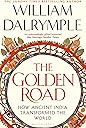
The Golden Road: How Ancient India Transformed the World
Product ID: 612678363
🌏Global ancient influence mapped
🏆Multiple History Book of the Year Awards
📚Instant Sunday Times Bestseller
Desertcart purchases this item on your behalf and handles shipping, customs, and support to Senegal.
🌟 Unlock the ancient secrets that shaped our world—don’t miss the Golden Road!
The Golden Road by William Dalrymple is a critically acclaimed bestseller that explores India’s profound influence on global civilization over 1,500 years. It highlights India’s role in spreading revolutionary ideas like zero, Buddhism, and architectural innovation across Eurasia. Combining rigorous scholarship with engaging storytelling, this book offers a fresh, global perspective on ancient history, making it essential reading for history enthusiasts and cultural connoisseurs alike.

| Best Sellers Rank | 30,035 in Books ( See Top 100 in Books ) 1 in Religious Art, Architecture & Photography 30 in Non-Western Philosophy 40 in Art History by Theme & Concept |
| Customer Reviews | 4.6 out of 5 stars 2,023 Reviews |
T**N
The Golden Road: How Ancient India Transformed the World by William Dalrymple
William Dalrymple’s The Golden Road is a masterful exploration of India’s profound and far-reaching influence on the world over a millennium and a half. This book is a testament to Dalrymple’s lifelong scholarship and his ability to weave together history, culture, and storytelling into a compelling narrative. It’s a must-read for anyone interested in understanding how ancient India shaped the world we live in today. A Vast Empire of Ideas Dalrymple meticulously details how India, for over 1,500 years, was not just a cultural powerhouse but also a confident exporter of its civilisation. From art and religion to technology and mathematics, Indian ideas traveled far and wide along what Dalrymple aptly terms the “Golden Road” – a network of trade and cultural exchange that stretched from the Red Sea to the Pacific. The book highlights India’s contributions to global civilisation, such as the creation of the numeral system (including the revolutionary concept of zero), the spread of Buddhism across Asia, and the architectural marvels like Angkor Wat, the largest Hindu temple in the world. Dalrymple also delves into lesser-known but equally significant influences, such as Indian astronomy, music, dance, and mythology, which left an indelible mark on the ancient world. A Global Perspective on India’s Legacy What sets The Golden Road apart is its global perspective. Dalrymple doesn’t just focus on India in isolation; he situates it at the heart of ancient Eurasia, showing how Indian ideas interacted with and transformed other cultures. For instance, he explores how Indian trade helped fund the Roman Empire and how Indian religious and philosophical ideas shaped the spiritual landscape of China and Southeast Asia. Dalrymple’s writing is both scholarly and accessible, making complex historical processes easy to understand. His vivid descriptions and engaging storytelling bring the past to life, making the reader feel as though they are traveling along the Golden Road themselves. A Few Practical Considerations While the content of the book is exceptional, I did find myself returning the hardback edition in favor of the Kindle version, which was £10 cheaper, and the paperback, which was £12 cheaper. For a book of this length and depth, the digital or paperback formats are more practical and economical, especially for readers who prefer a more portable option. Final Thoughts The Golden Road is a brilliant and enlightening read that sheds light on India’s often-overlooked role as a global influencer in ancient times. William Dalrymple’s passion for the subject shines through on every page, and his ability to connect the dots between India’s past and the modern world is nothing short of remarkable. Whether you’re a history enthusiast, a lover of Indian culture, or simply curious about how ancient civilisations shaped our world, this book is an invaluable addition to your library. Just be sure to opt for the Kindle or paperback edition to save a few pounds without compromising on the richness of the content. Highly recommended!
B**L
The Golden Road review
Superb book. Very interesting and informative explaining the development of the first universities in the World by the Buddist in and around India and how this knowledge spread to China and other parts of asia. Many europeans are unaware that the zero was invented in India as well as the numerals we use. An excellent read.
R**R
Good read
I was a good intro for me, the Roman and Middle Eastern elements were 5 stars but the sheer density of info in the south East Asian and Chinese elements where my brain struggles with the names end up making it a 4. Could have also done with more more maps to keep the context relevant to my view of the geography
P**N
g
The Golden Road: How Ancient India Transformed the World Kindle Edition by William Dalrymple (Author) . A most interesting book, beautifully written and obviously the product of deep research. However, for the average reader, even one with some knowledge of eastern history, there is so much detail that the only way to approach the book is to skim read and find the general drift. This is very worthwhile. So we look at a well-documented claim that India rather than China, in the first few hundred years of the common era, was the exemplar of soft power. We see how India introduced Buddhism into China and how that Indian soft power faded with insurgent Islam, but not before India had left its footprint all over South East Asia. His claim was that India, along with Greece, was an intellectual power house, particularly in the mathematical and related sciences and that this knowledge was transmitted to Europe via Baghdad. The book was an eye opener and raises questions about its influence in the future, though there are some nice very subtle digs at the Indian Government's policy of sectarianism and its implications.
H**O
Important and informative book.
For years we lived under the assumption that Europeans discovered all of those important scientific and astrological discoveries back in the middle ages, only to discover more recently that they were mostly already known to the Arabs (and sometimes the ancient Greeks!). This time it's the turn of India. What India did in past times for the world is very revealing. Great book, and easy reading.
E**Y
Brilliant author - never disappoints.
Dalrymple is a wonderful storyteller - it is like settling back, comfortably, and taking a smooth journey into the past that transformed the present. Have now bought several copies as gifts. And have also downloaded it on audible for a long car journey from Scotland to London and back.
T**N
Erudite,scholarly but very easy to read.
A very fine book,goes into a lot of detail about Indian Culture,Religion and Art and how they spread to other countries, but is never boring.Dalrymple is an expert on the subjects he writes about..His book "The Anarchy"is an eye-opening account of how the East India Company effectively plundered India for decades and "Return of a King"is a history told almost like a thriller of "The Battle for Afghanistan"in the 19th.Century.Anyone interested in these subjects who hasn't read Dalrymple are in for a treat if they buy his books
N**N
What an ambitious Book!
As an avid reader of Dalrymple’s many earlier books, I approached this with great enthusiasm, but frankly found it a difficult, but nonetheless worthwhile read. Reading it did not flow freely, as all his earlier works have gripped me from the start, and I felt I had to work at it to get through it to the end. Given the scope of this condensed History of Indian culture, it is unsurprising. I do feel I learnt a huge amount from reading it, and believe that I probably need to reread it again to fully absorb and understand the wisdom it is trying to transmit. So a book for a Desert Island, not a quick holiday read.
A**R
E
Excelente!!
K**T
Indiens Einfluß auf die Entwicklung Menschheit. Sehr interessant
Von 250 vor Christi Geburt bis ins Jahr 1200 danach verbreiteten sich die indische Künste, Religion, Astronomie, Musik, Tanz, Literatur, Mathematik und Mythologie vom Roten Meer bis zum Pazifik und beeinflusste so das Römische Reich, Persien, China und viele andere Gegenden der damals bekannten Welt. Auf der Suche nach immer mehr benötigtem Gold eröffneten sie Wege auf denen neben dem Gold auch der Buddhismus, Tee, Seide und auch viele kulturelle Güter hin und her reisten. Das vorliegende Buch erzählt diese Geschichte in 10 großen Abschnitten mit wechselnden Schauplätzen Zu jedem der 10 Kapitel gäbe es noch einiges anzumerken, aber da gibt einem der einhundertseitige Endnotenapparat viele gut Hinweise. Daneben gibt es noch ein umfangreiches Glossar und eine noch umfangreichere Bibliographie. Und es gibt drei Blöcke von Bildern, von denen sich der letzte in den Endnoten befindet. Herr Dalrymple weiß wirklich viel über indische und chinesische Geschichte und er schreibt sehr verdichtet, so dass gelegentliche Lesepausen notwendig werden - insbesondere, wenn man die Endnoten von Vornherein mit einbezieht. Es ist erstaunlich, welche Menge an Informationen hier auf vergleichsweise kleinem Raum untergebracht ist - und wieviel davon zumindest für diesen Leser tatsächlich noch neu gewesen ist. Wie z.B., dass wohl ein Inder die doppelte Buchführung erfunden haben, womit sie im Endeffekt die Grundlagen für die eigene Kolonisation ab den 18. Jahrhundert durch die Briten vorbereitet haben. Ein sehr informatives Buch, das einmal mehr zeigt, dass Globalisierung eigentlich schon immer Teil des menschlichen Geschichte gewesen ist. Ganz dringende Leseempfehlung
S**I
A Remarkable book.
William Dalrymple's extraordinary scholarship is in full display in this remarkable book. The book is a 600 page tome, two fifths of which is devoted to notes, bibliography and glossary. It is this latter part of the book that lends credibility and authenticity to the book. It requires a great skill to create a coherent and compelling narrative purely from the primary sources. A good many historians populate the narrative with their own opinions but Dalrymple has been sincere to the primary sources. A term " Indosphere" is introduced at the very beginning of the book which translates to the influence India exerted or had over several countries/kingdoms in the world in the matters of Science, Mathematics, Astronomy, religion, Art, Music, Medicine etc without wielding sword. It was soft power in action. This is told over 10 crisply written chapters. Some parts of the history mentioned are well known like Pallavan era but some we have not heard or just consigned to foot notes in other history books. For example the huge role played by Xuanxong and Wu Zetian, the first and the only Empress in the history of China in the spread of Buddhism from India to China is well documented in the book. I listen to the Empire podcasts quite regularly hosted by Dalrymple and Anita Anand and while reading the book it appeared like Dalrymple was reading into my ears directly. That was a bonus. A splendid book and easily, for me one of the best in this year.
D**M
Magnificent!
Before I comment on this magisterial work, a protest to the publisher: I cannot imagine a worse binding for this book. The exterior is heavy card stock—and even with an embossed finish, feels cheep—hardly fitting for a book titled The Golden Road! The binding is so tight that it is almost impossible not to break as you seek to open the pages to read this magnificent work and review the carefully chosen images (three sections worth). It reeks of cost cutting and is simply a disgrace by the publisher. Dalrymple deserves better. Shame on you Bloomsbury. Now to the book: The content and writing is simply magnificent. Dalrymple truly has a profound capacity to communicate in writing (and orally, as in his podcast with Anita Anand, “Empire”). The Golden Road reads like a coffee time discussion and, at times, like a novel. History has rarely been so engaging and enjoyable! I recognize my praise is effusive. But Dalrymple is truly a master. I learned so much from each and every chapter: How Octavian’s victory over Marc Antony and Cleopatra opened the door for profound trade between India and Rome—so much trade that some Roman leaders became concerned at the scope of the wealth making its way to India. How Indian concepts like “zero” profoundly influenced western thought and philosophy. How the “Indosphere” emerged initially at sea, following monsoon winds to the west (Africa) and east (SE Asia and China); then, how it expanded across land under the reign of Ashoka in the fourth century BCE. How the great library of Nalanda rivaled Alexandria in terms of both size and influence. How Buddhism, born and developed in the subcontinent became dominant across Central Asia and especially China, transforming a whole society while back in the subcontinent it diminished under the growing influence of Hinduism. How Hinduism amazingly spread to SE Asia at the same time Islam swept across Asia into the subcontinent, and led to the world wonder Hindu temple, Angkor Wat, in what was, and is now, a predominantly Buddhist society. There are so many gems in this work! Ultimately, the invitation is to rediscover India and her rich history—to stop overlooking the profound role India played (plays!) in this world. I couldn’t recommend The Golden Road any more highly.
A**I
Imperdibile per gli amanti di Storia dell'Asia
Testo eccezionale per chiarezza, competenza, completezza.
Trustpilot
1 month ago
2 weeks ago