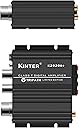
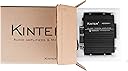
🎧 Small amp, big vibes — power your space with precision and style!
The Kinter K2020A+ Class T amplifier harnesses the original Tripath TA2020-020 chip to deliver efficient, distortion-minimized 20W per channel output. Its compact design and included 12V 5A power supply make it ideal for DIY audio projects and small-room setups. Featuring gold-plated RCA inputs, improved speaker connectors, and adjustable bass/treble controls, this limited-edition amp offers professional-grade sound customization in a sleek, space-saving package.


| ASIN | B077Z7DBRT |
| Best Sellers Rank | #182,880 in Electronics ( See Top 100 in Electronics ) #1,103 in Audio Component Amplifiers |
| Brand | Kinter |
| Brand Name | Kinter |
| Customer Reviews | 4.4 out of 5 stars 1,370 Reviews |
| Item Dimensions | 4.72 x 5.79 x 1.65 inches |
| Item Weight | 1 Pounds |
| Item dimensions L x W x H | 4.72 x 5.79 x 1.65 inches |
| Manufacturer | Kinter |
| Minimum Supply Voltage | 12 Volts |
| Model | K2020A+ |
| Mounting Type | Surface Mount |
| Number of Channels | 2 |
| Output Power | 20 Watts |
| Part Number | K2022A+ |
| Specification Met | CE |
| UPC | 651814994414 |
| Voltage | 12 Volts |
| Warranty Description | 1 Year Warranty |
A**L
Update: Worth the money, decent amp, just buy it already - it's 10 cups of coffee
Update - the amp performance still bothered me, too many positive reviews here so I did more testing. I tried yet another set of speakers, some Paradigm Atoms that seemed to be sized well for the T2020. I also dragged out my AudioSource Model 2 so I could baseline the Atoms. Turns out the Atoms sound fine with the Kinter. So why didn't the Klipsch sound fine? I expect the two 6" woofers were just a bit much for the Kinter and the 12V factory supply and that's why the bass suffered. Also the tweeter in the Klipsch is way louder than the Atoms - I didn't not hear the switching noise as loudly with the Atoms but clearly heard it with the Klipsch. How does the T2020 compare with the AudioSource on the Atoms? It's probably 90% as good according to my tin ears. Bass was fine, treble was fine, nothing fuzzy or distorted sounding; totally acceptable for the price of the T2020. What about the switching noise? Well turns out I was probably hearing some inter-mods aliasing down in the audio range. With the volume all the way down and the audio input cable disconnected from the source you can see an 870KHz oscillation on the speaker outputs from the class D driver. I tried to get a scope shot of the aliased lower frequency noise but the best I could do was a 32KHz-ish scope shot. My hearing rolls off sharply above 13KHz but you can definitely hear idle "hiss" if your tweeters are any good. Is it a problem? Well I will leave that up to you to decide, as a studio monitor this is probably not your amp but to fill a room with sound, you will probably never hear the hiss. How well did it do with bass and high frequency? Well I did some scope shots to get you some data. These were taken in parallel with the speaker acting as a load and you can see the switching hash at high frequencies to be sure but you can't really perceive it. The 40Hz looks fine on the scope and the 20KHz looks a little hashy but hey - that's how class D works, not much you can do about it. I included some shots of the AudioSource so you can see the difference. The sine wave was from a function generator app on an iPhone for both amps. The AudioSource has the higher p-p voltages and the cleaner output obviously. What about the minimus 7s? Well they stink compared to the Paradigms of course but that's kinda apples and oranges. When I put the minimus 7s on the AudioSource they sounded similar to the Kinter so I began to suspect there was a speaker problem. The woofer surround looked fine when it was mounted in the speaker but when I removed the drivers I could see a crack at the base of the foam, which is why the bass suffered so badly in these units. So I put in some generic 4" woofers and the minimus 7s sound ok now on both the AudioSource and the Kinter. To be honest the Kinter sounded slightly better as you could boost the bass with the tone controls to match the tiny speakers. Bottom line - buy this amp if you have reasonable expectations and reasonable speakers, it sounds fine and it is worth the money. If you are pushing too big a driver you might be sad, but for a modest system the T2020 does just fine. Oh and this is not a paid review, I bought this thing. Also bought a DAMGOO bluetooth amp with the TPA3116D2 part in it. That amp sounds fine as well given the cost, same comment on the hiss, but no scope shots of it yet. ================= original review below =================== Wanted to like this amp based on the many reviews but they didn't deliver at all on sound quality. Initially I hooked it up to a pair of Minimus-7s figuring they should be well matched and used my iPod as the source. Started with the tone knobs both on mid range. The high end was super bright and clear but bass was muted. Fine, cut back on the treble knob and cranked up the bass and the amp delivered a fuzzy and muted thump for every bass drum kick. Ok - maybe the surrounds on these speakers are bad? Nope - the drivers had been replaced and the foam was all good. Ok maybe the crossover is bad, I'll try a different speaker. So I hooked up a known good Klipsch RC3 center channel speaker which has 6" woofers in it. Cranked the bass up again and it started to come through but still felt very thin. For something like a cello or standup bass notes you can probably get away with it, but for any music with a backbeat and some punch this amp falls flat on its face. Also there is a continuous 13KHz hiss coming out of the speakers, either with or without an audio source - regardless of volume level. Very noticeable, not acceptable. The final straw was when I plugged the iPod back into the Cambridge Soundworks model 88 radio I was trying to replace. Night and day difference, the model 88 has tons of bass punch compared to this amp, and my model 88 has had a long and hard life in the shop and has been rode hard and put away wet. It has a tiny 4" driver and it put our more bass than the alleged 20W into the RC3. If you own Klipsch speakers you know how loud they get and how efficient they are, it's kinda their "thing". If this amp can't drive a Klipsch, what the heck can it drive? Maybe I got a dud, or maybe all the hype was too good to be true, don't really care. Don't buy this amp unless you long for the sounds of a paper dash speaker with a whizzer cone in your clapped out Chevy II, and a photo flash unit charging up next to your head.
D**W
While searching around I happen to see someone recommend this Kinter limited edition amplifier as the only one ...
I ordered this because I missed out on the original Tripath 2020 craze from a couple years ago. It appears that the class-T amplifier chips from Tripath are no longer being made and all the other mini amps out there have migrated to the "lesser" TI (Texas Instruments) chips. While searching around I happen to see someone recommend this Kinter limited edition amplifier as the only one still using the Tripath chips, so I jumped on the chance to own one. The amp comes securely packaged, and includes a good quality power brick in the box. Not included / what you need to add is a pair of speakers, speaker wire, a 3.5mm or RCA cable, and a sound source. My source is a desktop PC, so the 3.5mm audio jack was a nice surprise as I expected I would need to hunt around for an RCA adapter! I made all the connections and powered it on - you will hear a "click" from the speakers when turning on and off. I have connected a pair of Polk bookshelf speakers. The sound quality is great! With using the "direct" setting on the AMP I find the sound warm and full. There is perhaps a bit too much mid-bass by default, but I believe this is the tuning of the speakers more than the amp. Both stereo channels are working great, and the power produced is more than enough. I keep the amp volume knob at 20% and use the PC volume slider to adjust up/down as needed. One thing I like is the amp does not require a threshold to start playing, so even at extremely low volumes the speakers continue playing as expected. Bottom line: Discrete amp provides more flexibility, upgradability, and better overall sound than a comparable set of powered PC speakers at a similar cost. Pros: Hi quality Tripath amp Low cost / good value Includes RCA and 3.5mm audio inputs Quality power supply included Plenty of power for entry / mid bookshelf speakers Cons: Bright led in the volume knob Click/Pop sound when power is switched on/off Always on / no power saver (note, I prefer this as mentioned in the review it will play even at very low volumes)
D**N
When I thought to myself the following night that perhaps having a second one might be fun for a blu tooth set up meant for listening ...
When I spotted this little amplifier on amazon the other night (3/8/2018) there were 16 left. When I thought to myself the following night that perhaps having a second one might be fun for a blu tooth set up meant for listening while in the shower? They were completely gone already. I expected them to go fast, but damn! Ok, so I bought this to use for testing mostly. I have three pairs of Dayton Audio B652-Airs that I purchased a while back to use for the '5' in our 5.1 surround sound set up in our theater room. The B652-Airs get great reviews, sound especially good for their price, and are ones that have a good following among those who like to modify inexpensive speakers in order to get better performance from them. I wanted to do the same, so I needed an amp. This one has the infamous/extinct Tripath TA2020-020 amplifier chip, came in at a good price, and already had a few positive reviews... so home to me it came. Initial impression: It was packaged well with no excessive stuff inside. In the regular brown cardboard box with the company logo and slogan/motto on it? was a double-sided one page operating manual, a power supply with its wall plug, the amplifier, and some squishy foam to keep everything safe. No excess, but probably more than what I was expecting for the 30 bucks I paid including shipping. The amp: Its a nice, simple amp. Everything is clearly labeled and everything is sturdily mounted. Nothing on it wiggles or is loose. It is certainly well built from what can be learned from the outside. All the knobs are easy to turn AND get to, something that is not always easy to accomplish for a guy with large hands. The performance: Obviously an amplifier's performance is best measured with scientific equipment, none of which I have. An initial 30 minutes of listening had my ears telling me the audio sounded pleasant on pleasant sounding speakers, nothing sounded muted or stuffy or electric (think about cheap pocket radios and the audio that comes out of them to understand my use of the term "electric"). I found myself wanted to find time to keep listening and skip doing other things I needed to do because I was enjoying just listening to music. One thing I always check for is excessive 'hiss' when a speaker is hooked up to an amp that isn't playing anything or connected to an audio source. While there certainly is some with this amp as with most, it is nothing that is noticeable from more than a foot away or less with the amp turned to full volume. If you made it this far down? I realize I'm leaving a review on a limited edition amp that has already sold out and may never return. But if you are reading this and it becomes available again? And you're on the fence about making the purchase? Don't be. Just buy it. Its more than worth the 30 bucks, and you'll be happy that you did. 5 stars hands down. Also, I like to see photos in the reviews I read, so I've included a bunch for anyone who may be interested. I didn't take the time to measure the dimensions of the amp, but I've included a Pepsi can for size reference. Thanks for reading, hopefully this was helpful to someone out there.
A**Y
Not convinced the Tripath is worth the extra cost over the Texas Instruments
I've been an audio enthusiast for about 15 years now. There are primarily two products that I credit for kicking off my interest in sound equipment: Koss PortaPro headphones and the Dayton Audio DTA-1 T-class amplifier. I bought the Dayton when I went off to college and wanted a simple, cheap, but quality audio setup and that little amp blew me away. The clarity and detail that it offered was a revelation. It used a T-amp, and I credited a lot of it to that. Anyways, I recently replaced my SMSL that I've used at my desk for years and wanted something cheap and simple but still offering good quality audio. Dayton discontinued the DTA-1, but I still wanted to revisit my past with a T-class amp and this fit the bill. I'm using a Creative Sound Blaster Play 3 (another brand I remember fondly from my past) as a DAC feeding this amp and Dayton Audio MK402 speakers. The DAC is new to me, but I know these speakers very well and know how they can and should sound. I've only been playing around with this setup for a few hours, but I have mixed feelings (though generally good). I wouldn't disuade someone from this amp, but I have experience with Kinter's Texas Instruments-based amplifiers and I think those provide just as good of an experience for less money. While I can't A/B them properly, my gut is that the Texas amp has slightly more detail resolution and seems to push harder before distortion reveals itself. On the other hand, my gut also tells me that the soundstage with this T-amp is more expansive (not that I ever thought the Texas was lacking). I'm still happy with this amp, but if I could go back knowing what I know now, I'd probably just get the Texas Instruments amp and pocket the difference. In fairness, I haven't ruled out that the DAC is the culprit. I've disabled all processing, but maybe it's just a colorful DAC. Setting aside the sound signature, there are two things about this amp that kinda bug me: 1) The tone controls are not good. The bass adjustment is good and works as expected, but the treble adjustment brings a lot of the mids along with it. I like a bright sound, and the treble knob affects the upper mids more than I think a treble knob should. It makes it difficult to find a balance of sparkly treble without also bringing upon a nasally quality in the upper mids that my ears seem to be particularly sensitive to. Most people like a U-shaped response curve and this tone control is just poorly suited to facilitating that. The treble adjustment needs tightening up. Adding a mids band would be great, but very few (if any) amps in this class offer that. 2) I don't like the blue power LED around the volume knob. I knew this would have it because I've had multiple amps with this chassis, but I just wish they'd either ditch it or allow you to turn it off. It looks cheap and chintsy--very Fast and the Furios/Need For Speed Underground-esque. The rest of the amp is of sufficient quality for the price and looks decent enough (very utilitarian, which I personally like), so it's a relatively small complaint. Overall my experience is positive. My expectations were probably just a little too high for a DAC/amp combo that cost $60. I can't help but feel like I'd get just as good (or better) an experience by going with the Texas Instruments model for less money.
K**.
A nice amplifier even on high end speakers
This review (Jan 2020) is for the newest version Kinter tripath 20 watts/channel amplifier. I tested this amp with my studio monitors, which are a pretty awesome Paul Carmody design rated at 80W per channel, 8 ohms. While probably some people will find it useful, I have no interest in using the built-in treble/bass EQ , so I can't comment on that. I appreciate the fact that there is a selector switch to turn it off and take it out of the signal path -- awesome design choice!! (There is an audible increase in volume from this amp when the EQ is deactivated.) The test: I played a few punchy EDM reference tracks through this amp and ran the volume knob at 1/3, then 1/2, then a bit less than 2/3. I do not enjoy over-the-top volume levels but I do enjoy feeling the bass a tad. At all settings this amplifier is really very good. It is in fact a bit punchier, and with a bit fuller low end at identical loudness settings, than a "classic" early 90's era amplifier that I own. Of course an 80 or 100 watt per channel full-sized amp will go louder for sure. But I really enjoyed the sound of the Kinter tripath. it is a solid sounding amplifier and has enough transient current sourcing capability to deal with punchy tracks where kick drums and similar excursions are important. The sound does have something nice (but very subtle) about it, which might be the "tripath warmth" that others commented on. For near field monitoring at my desk I found the volume of this amp quite adequate and the distortion free at all settings. Of course it would make no sense to compare maximum volume on this amp with the maximum of an 80 or 100 watt amp, so I won't do that. Likewise I have no interest in cranking this amp up until I hear audible distortion, and at maximum settings the THD likewise won't compare with that of a good quality 80 or 100 watt full sized amplifier. But that is to be expected for *any* 20 watt per channel amplifier, so expectations have to be realistic. It is an excellent 20 watt per channel amplifier, really excellent. The best I have listened to by far. Several of the reviews have commented on noise, but no, in my experience there is no such noise. I found quite the opposite -- it is a totally quiet, noise free amplifier. If your recording is noise free, this amplifier does not introduce anything audible. One review commented that this amp is a lousy headphone amplifier -- I want to address that. It's not a headphone amplifier at all. There is no place anywhere to plug a set of cans into. The 3.5 mm jack in the back, next to the RCA connectors, is an input. If there were any lack of definition, bass, or punchiness, I would have heard it. Is it going to sound as good as a NAD? No, no, of course not. But it's a solid product, no problems at all.
S**L
great for price
Summary: Great sounding little amp for the price. More detail: Is it audiophile quality? Hmmm. Compared to what? Certainly I have not heard anything in this low price range that is this good and I've heard more expensive sound much, much worse. But spend more, get more - SURE! Definition on the same set of speakers (I tried a set of Klipsh bookshelf speakers as they were handy...) isn't as good as expensive amps I own, but this wasn't an expensive amp so that's not fair. For the money, average user will probably be blown away by the great sound from this little guy. Audiophines less so, but will still probably admit it is a great sound for the money and dollar-for-results are pretty impressive. It is only rated at 20W per channel, so you can't expect to be driving crazy big speakers, but small-ish and relatively efficient bookshelf speakers should work fine in a small room. I don't think they are fibbing on 20W x2 ... it's not a monster, but it's not anemic at all either. fit and feel: power switch is fine, doesn't feel mushy or cheap. Adapter appears good quality. Connections fine though I'd rather have had banana plugs for speakers ... but spring-retention thingies are working okay. Bass and treble pots are smooth and do their thing. Tone-defeat button does it's thing too, nothing exciting here. Volume pot turns very smoothly and very easily, but feels stable, no wobbling around or such. Could use better marking on volume dial to see setting as it has only a small detente, BUT a dab of fingernail polish or mark from a sharpie marker will fix this. Case looks good, no defects, mars or blemishes in finish. I found the sound to be fairly neutral at baseline. Definition seemed very good. I felt it would be good for classical, jazz, pop, etc.. For metal, R&B ... maybe not. Tone pots adjusts it as expected, but I felt if you moved things more than a little touch up or down, the sound got too "monkeyed with" sounding, but that's what I usually think of such heavy adjustments. For little tweaks, such as to match speakers, small Bass/Treble adjustments are fine and don't degrade sound. Just don't think you can spin up the bass pot all the way and turn it into some sort of bass-blasting monster that still sounds good across the rest of the frequency range. I didn't find it overly loud, but its 40W total seemed to have plenty of power for small applications / smaller spaces and most important to me, it seemed to stay CLEAN as I cranked it up a bit. This would be a great amp for a small space where you want decent sound but don't want do spend a lot. Think dorm room, office, kid's room, home gym, workshop, maybe even driving outdoor speakers for the deck (but put the amp indoors and run wires out through walls/doors/etc - it doesn't look at all weatherproof). However, while it >can< be the heart of a budget system, you are probably going to drop at least $100, probably over $150, on speakers to reach it's potential. Sure, it will drive cheaper speakers and you can certainly do so for that just-mentioned budget system or to get started. Just realize then your speakers will be the weak link and NOT this amp, so don't blame it. Overall, for what it is (a small and inexpensive 20W x2 class T amp), it performs amazingly well and exceeds my expectations in the quality of sound it pumps out.
C**X
Fantastic little stereo amplifier! Hits way above price sound quality wise!
This Kinter amplifier is exactly what I was looking for, and it truly sounds amazing! I needed a simple integrated amplifier that I could attach both my CD player and hi-res portable music player to in our laundry room (my wife and I do a lot of laundry). I tried this amp out with 3 sets of home speakers, first a pair of floorstanding high end Magnepan MMG's, then a pair of high end Polk Audio Monitor 10's, and lastly a small pair of Micca MB42X, which is what I will have in the laundry room. I tried the amp with the more expensive speakers (since I am a longtime audiophile) just out of curiosity, to see how good it is. I tried all kinds of music from rock, jazz, classical, and neo-flamenco and latin guitar, and the verdict is that this is a fantastic sounding amplifier, despite the rock bottom price! The detail and timbre of this amp is very natural, and it drives my speakers to a very good sound level with more than ample 'kick' to the bass frequencies. It is a very quiet amp too, with no discernable noise in between songs. That is a very good thing! Now mind you, this Kinter amplifier does not sound as good as my McIntosh or Fisher 500C tube receiver, but it comes close in many regards! It is a 'musical' amplifier, especially for a 'Class D Tripath' unit, and from what i've read, this is the one to get, since it has better circuitry and a real internal heat sink, as compared to the cheaper made Class D units. In summation of my review, I have to say that this amp hits way above it's meager price-point, sound quality wise, and it put a smile on my face. I know most people say "you get what you pay for", but this amp sounds way more expensive than it is, and is one of the best audio bargains out there today! Especially for someone who wants to put together a super inexpensive stereo system 'on the cheap'. For under one hundred dollars, one can now buy an amp like this one, and a pair of great sounding low priced speakers like the fantastic Dayton Audio B652 Airs (with a ribbon tweeter), and be in 'audio heaven'! My only minor quibble is that the volume/treble/bass controls feel very cheap and a bit flimsy. I wish Kinter would have provided aluminum knobs instead of the cheap plastic ones, but at this price point it's not an issue for most people.
A**R
Very bad build quality, scratchy pot, static noise, left channel cuts out, obnoxious blue light
I own two legendary Sound Impact Tripath 2024 amps which are now 20 years old and still unmodified. They sound good and haven't skipped a bit in two decades. So I decided to buy another amp while I still can (Tripath manufacturer is out of business) which is based on the more powerful Tripath 2020 chip. What a mistake! The sound is sort of okayish if you only listen at very low volumes, but then you miss on music details and soundstage. The volume pot goes from 7 to 5 o'clock. It's really useful up to 11-12. After that the amp starts to emit clearly audible hum and noise whenever there's no signal or quite parts of music, and if you crank it past 1 o'clock the noise and static are audible even though the distorted music is loud. My Sonic Impacts have weaker main chip (on paper) and weaker power supply, yet they play louder due to their clean sound. This Kinter unit is no match or replacement for them. On top of that, the pot is scratchy past 12 o'clock, and the left channel sometimes cuts off for a second or two with some crackling noise when the volume is raised. RCA outputs are reversed, red should be white, white should be red. It seems all are factory made like that. Good hint about the quality. Obnoxious blue led light! There's a big plastic transparent circle around the volume knob which lights up if the unit is powered up. It's so bright and strong that you can't leave it on at night if you put this unit in your bedroom audio system. Totaly unnecessary. The power plug doesn't insert all the way into the socket. About 2-3 mm stays visible. To make this unit somehow better it needs to be modified, parts replaced with quality items, but then there are much better amps for that total price which you don't have to touch with your soldering iron. For just $17 more you can buy a TB10D with power supply. I doubt longevity of this amp. Disappointment.
C**Z
Excelente Inversión!!!!!
Excelente equipo de audio! Los componentes internos Texas Instruments son digitales producion un audio HI FI único para audiofilos!
S**A
Great sound in a tiny package!
The sound is pretty amazing. The interface is simple, easy to setup, and operate. The unit is very light, so it's best if it can be mounted somewhere, otherwise every time you try to push a button or rotate a dial, it moves. The markup was a bit steep though (reason for docking a star), still a great purchase.
A**R
Pops and crackles even with no source plugged in
I bought this amp to replace an older Lepai that had given up the ghost, since the current Lepai or Lepy models don't use a tripath anymore and as a clone of those amps it fits the mounting holes I already had on my desk. It made my speakers buzz and whine softly from the moment I plugged it in, even without a source connected. Unfortunately I procrastinated a few months before setting it up and was well past the return period so I had to live with it. Tonight I woke up to the kind of popping and crackling noises that sounded like a bonfire and panicked thinking my apartment was about to burn down. Turns out there was no fire, I had just forgotten to turn this piece of junk off before going to bed and it was feeding loud static through my speakers. Since I won't be falling back asleep any time soon after that adrenaline surge, I'm instead writing this to warn other buyers: spend your money on something else.
S**F
Stopped Working - No Warranty Response
Was working fine and now no sound. Switch with another amp and sound works fine. Kinter has not responded to request for replacement? Buyer Beware!!!!
Trustpilot
2 weeks ago
1 day ago