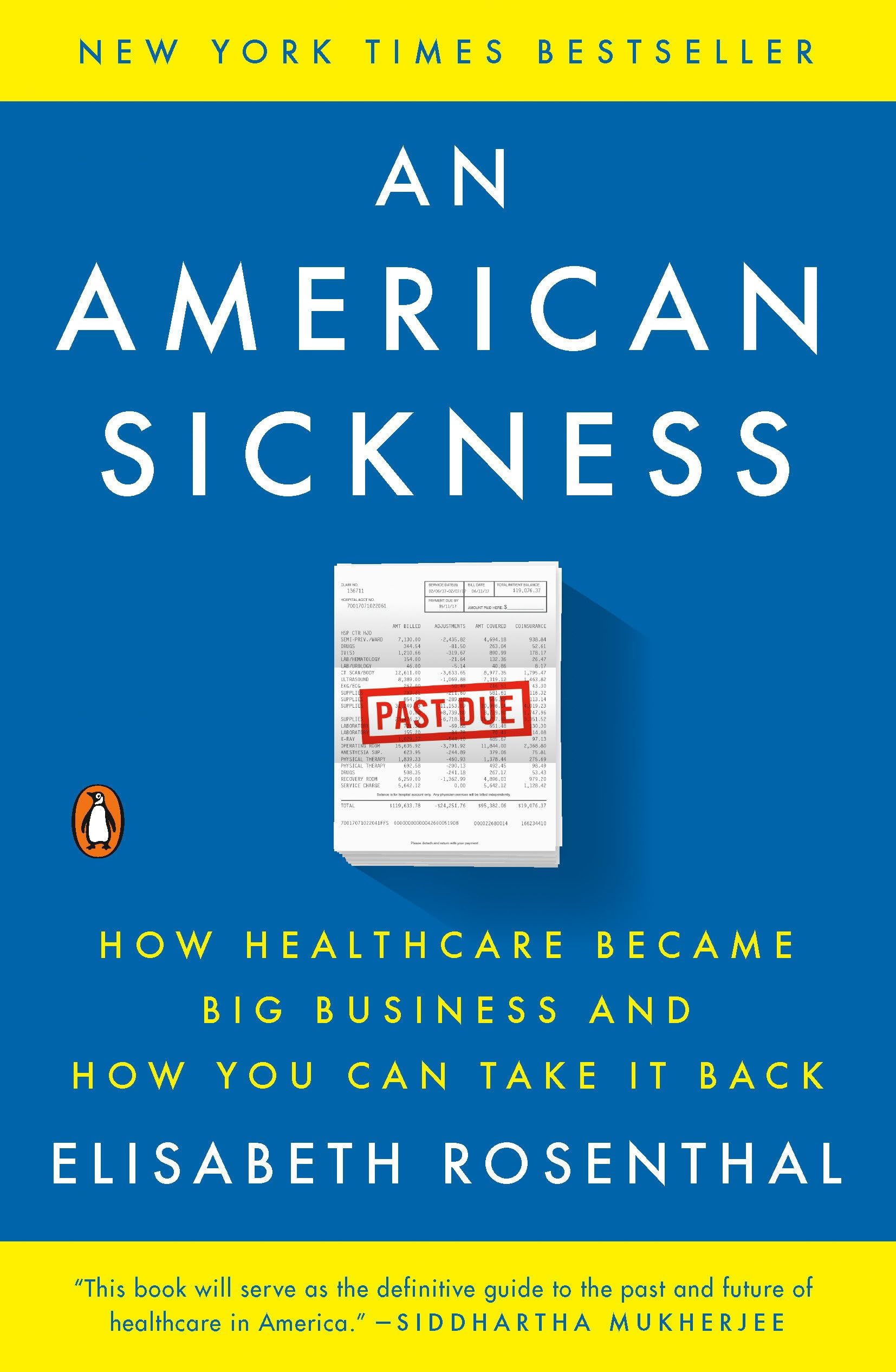
An American Sickness: How Healthcare Became Big Business and How You Can Take It Back
Product ID: 59522743
Desertcart purchases this item on your behalf and handles shipping, customs, and support to Senegal.
A New York Times bestseller • A Washington Post Notable Book • Named a Best Book of the Year by The Wall Street Journal and NPR "This book will serve as the definitive guide to the past and future of health care in America.” — Siddhartha Mukherjee, Pulitzer Prize-winning author of The Emperor of All Maladies and The Gene At a moment of drastic political upheaval, An American Sickness is a shocking investigation into our dysfunctional healthcare system - and offers practical solutions to its myriad problems. In these troubled times, perhaps no institution has unraveled more quickly and more completely than American medicine. In only a few decades, the medical system has been overrun by organizations seeking to exploit for profit the trust that vulnerable and sick Americans place in their healthcare. Our politicians have proven themselves either unwilling or incapable of reining in the increasingly outrageous costs faced by patients, and market-based solutions only seem to funnel larger and larger sums of our money into the hands of corporations. Impossibly high insurance premiums and inexplicably large bills have become facts of life; fatalism has set in. Very quickly Americans have been made to accept paying more for less. How did things get so bad so fast? Breaking down this monolithic business into the individual industries—the hospitals, doctors, insurance companies, and drug manufacturers—that together constitute our healthcare system, Rosenthal exposes the recent evolution of American medicine as never before. How did healthcare, the caring endeavor, become healthcare, the highly profitable industry? Hospital systems, which are managed by business executives, behave like predatory lenders, hounding patients and seizing their homes. Research charities are in bed with big pharmaceutical companies, which surreptitiously profit from the donations made by working people. Patients receive bills in code, from entrepreneurial doctors they never even saw. The system is in tatters, but we can fight back. Dr. Elisabeth Rosenthal doesn't just explain the symptoms, she diagnoses and treats the disease itself. In clear and practical terms, she spells out exactly how to decode medical doublespeak, avoid the pitfalls of the pharmaceuticals racket, and get the care you and your family deserve. She takes you inside the doctor-patient relationship and to hospital C-suites, explaining step-by-step the workings of a system badly lacking transparency. This is about what we can do, as individual patients, both to navigate the maze that is American healthcare and also to demand far-reaching reform. An American Sickness is the frontline defense against a healthcare system that no longer has our well-being at heart. Review: Provocative work- must read for patients - An American Sickness is a timely and authoritative work which describes the dysfunctional United States Health Care (USHC) System. Rosenthal lays out how USHC has evolved into an intricate, layered system which benefits the numerous special interests that make up this bureaucracy, at the expense of the patient. This book should be read by those involved in health care policy, in hospital administration and in medical study including doctors. Most of all, it MUST be read by patients! The overarching theme is that the USHC system is designed to profit all the stakeholders except the patient. As such, this system is now 17-18% of GDP compared with 10-11% of GDP in the developed countries of the world. Despite this bloated investments, US health care metrics are far inferior to other nations including life span over 60 years old and the % of population covered. This is what happens when financial profits Trumps health care. Rosenthal provides numerous real-life vignettes demonstrating how pricing vagaries and inequities, lack of billing transparency and consistency have victimized patients and cost them in terms of their living standards. What other industry can charge hundreds of thousands of dollars without bill itemization; can charge patients hugely different prices for the same procedures within a single hospital; can raise prices a hundred-fold on common drugs? The answer- The USHC system which is unique in the world and the US people are paying the price. The second half of the book provides defensive strategies for the victims; the patients. Rosenthal methodically outlines the important questions to ask doctors, hospitals and insurers. She provides the steps to take when those ridiculous bills are inevitably sent. Most importantly, this book is a “call to action” for the American people to contact their Representatives and to insist that science and humanistic health care once again become the bedrock of the medical system. All rational people can agree that price transparency for hospital billing, for drugs and implants and for doctors charges should be a Right. In addition, the cost details should be coupled with transparency on the medical outcomes such as readmission rates, infection rates, and patient satisfaction scores. If these demands are made and changes implemented, prices will invariable decrease in line with other industrialize countries. Bravo Dr. Elisabeth Rosenthal for providing this provocative work- An American Sickness: How Healthcare Became Big Business and How You Can Take It Back. Review: Educating yourself is the first step - American Sickness by Elisabeth Rosenthal is an exhaustive, detailed look at the American healthcare system. The author examines every facet of healthcare, going back to the beginning in order to understand how we have gotten to where we are. If there is one overriding theme that one could point to as the cause of skyrocketing healthcare costs, it is greed. Our healthcare system has morphed from a patient-centric system to one where profits come before patient care. The first half of the book is a history lesson. What were things like before there was health insurance? When did things change from a need to protect people to one where maximizing profits became the primary goal? Along the way, the author uses real-world examples culled from actual patient bills to illustrate just how out-of-control things have become. The second half of the book looks at what needs to happen in order to gain control of costs. The author offers a wide array of solutions. The first step is to be more proactive with your own healthcare. Ask questions. Challenge unethical practices. One example the author gives is a patient who is visited by an anesthesiologist. The anesthesiologist stops by the patient's hospital room. "How are you doing?" "Fine, thanks."Okay, let me know if you have any questions?" The anesthesiologist leaves and the patient finds out later that he or she was charged a $500 consultation fee. The second step in controlling costs is government intervention. There are going to be a lot of people who are going to argue against this. The government shouldn't be in control of my health. Regulations hamper innovation. The truth is that the benefits of sensible government intervention and regulations far outweigh any negatives. For example, a government-controlled fee schedule would prevent wide disparity in charges for the same procedure. A national health database would allow patients to have their health records stored in a single location, accessible to healthcare providers anywhere, eliminating duplicate and unnecessary tests. Many of the problems we have today are the direct result of politicians bending to the demands of political donors over the interests of their constituents. What about the Affordable Care Act? The author calls it a good first step. Unfortunately, Republican opposition and efforts by industry PACS have weakened its effectiveness. There are hundreds of examples of outrageous charges and bills from actual patients. One that stood out for me involved a plastic surgeon who charged $50,000 for three stitches in a toddlers face. The parents of the child not only complained to the hospital, the doctor, and to their insurance company, but they also sent a copy of their complaint to a plastic surgeon professional group. The pressure from the complaint eventually led to a final bill of $5,000. This is one book where I listened rather than read. The deluge of facts and figures were easier to consume. I highly recommend this book. I especially recommend this book to the regulators and healthcare professionals who are in the best position to make the changes needed.

| Best Sellers Rank | #13,872 in Books ( See Top 100 in Books ) #2 in Health Insurance (Books) #4 in Health Policy (Books) #7 in Health Care Delivery (Books) |
| Customer Reviews | 4.6 out of 5 stars 1,750 Reviews |
M**V
Provocative work- must read for patients
An American Sickness is a timely and authoritative work which describes the dysfunctional United States Health Care (USHC) System. Rosenthal lays out how USHC has evolved into an intricate, layered system which benefits the numerous special interests that make up this bureaucracy, at the expense of the patient. This book should be read by those involved in health care policy, in hospital administration and in medical study including doctors. Most of all, it MUST be read by patients! The overarching theme is that the USHC system is designed to profit all the stakeholders except the patient. As such, this system is now 17-18% of GDP compared with 10-11% of GDP in the developed countries of the world. Despite this bloated investments, US health care metrics are far inferior to other nations including life span over 60 years old and the % of population covered. This is what happens when financial profits Trumps health care. Rosenthal provides numerous real-life vignettes demonstrating how pricing vagaries and inequities, lack of billing transparency and consistency have victimized patients and cost them in terms of their living standards. What other industry can charge hundreds of thousands of dollars without bill itemization; can charge patients hugely different prices for the same procedures within a single hospital; can raise prices a hundred-fold on common drugs? The answer- The USHC system which is unique in the world and the US people are paying the price. The second half of the book provides defensive strategies for the victims; the patients. Rosenthal methodically outlines the important questions to ask doctors, hospitals and insurers. She provides the steps to take when those ridiculous bills are inevitably sent. Most importantly, this book is a “call to action” for the American people to contact their Representatives and to insist that science and humanistic health care once again become the bedrock of the medical system. All rational people can agree that price transparency for hospital billing, for drugs and implants and for doctors charges should be a Right. In addition, the cost details should be coupled with transparency on the medical outcomes such as readmission rates, infection rates, and patient satisfaction scores. If these demands are made and changes implemented, prices will invariable decrease in line with other industrialize countries. Bravo Dr. Elisabeth Rosenthal for providing this provocative work- An American Sickness: How Healthcare Became Big Business and How You Can Take It Back.
E**I
Educating yourself is the first step
American Sickness by Elisabeth Rosenthal is an exhaustive, detailed look at the American healthcare system. The author examines every facet of healthcare, going back to the beginning in order to understand how we have gotten to where we are. If there is one overriding theme that one could point to as the cause of skyrocketing healthcare costs, it is greed. Our healthcare system has morphed from a patient-centric system to one where profits come before patient care. The first half of the book is a history lesson. What were things like before there was health insurance? When did things change from a need to protect people to one where maximizing profits became the primary goal? Along the way, the author uses real-world examples culled from actual patient bills to illustrate just how out-of-control things have become. The second half of the book looks at what needs to happen in order to gain control of costs. The author offers a wide array of solutions. The first step is to be more proactive with your own healthcare. Ask questions. Challenge unethical practices. One example the author gives is a patient who is visited by an anesthesiologist. The anesthesiologist stops by the patient's hospital room. "How are you doing?" "Fine, thanks."Okay, let me know if you have any questions?" The anesthesiologist leaves and the patient finds out later that he or she was charged a $500 consultation fee. The second step in controlling costs is government intervention. There are going to be a lot of people who are going to argue against this. The government shouldn't be in control of my health. Regulations hamper innovation. The truth is that the benefits of sensible government intervention and regulations far outweigh any negatives. For example, a government-controlled fee schedule would prevent wide disparity in charges for the same procedure. A national health database would allow patients to have their health records stored in a single location, accessible to healthcare providers anywhere, eliminating duplicate and unnecessary tests. Many of the problems we have today are the direct result of politicians bending to the demands of political donors over the interests of their constituents. What about the Affordable Care Act? The author calls it a good first step. Unfortunately, Republican opposition and efforts by industry PACS have weakened its effectiveness. There are hundreds of examples of outrageous charges and bills from actual patients. One that stood out for me involved a plastic surgeon who charged $50,000 for three stitches in a toddlers face. The parents of the child not only complained to the hospital, the doctor, and to their insurance company, but they also sent a copy of their complaint to a plastic surgeon professional group. The pressure from the complaint eventually led to a final bill of $5,000. This is one book where I listened rather than read. The deluge of facts and figures were easier to consume. I highly recommend this book. I especially recommend this book to the regulators and healthcare professionals who are in the best position to make the changes needed.
J**G
The most important book you will read this year
The provision of health care in the United States is currently in the spotlight. Unfortunately, the entire industry has been in decline for decades, neither political party seems to have the ability to make the required structural changes, and thus too many residents of this country are one medical procedure away from financial peril. The first part of the book is mesmerizing, as Rosenthal picks apart each component of the medical-industrial complex, illuminating the roles of the FDA and other government agencies as well as the greed of medical center conglomerates and everyone's favorite target, big pharma. Why are many of us, care providers and patients alike, ignorant of prices? (Hint: it's not our fault.) Why do medications, including those that have been in service for decades, cost so much less outside the United States? (Innovation is not the reason.) While Martin Shkreli was grabbing headlines, likeminded souls were similarly scheming to extract every possible cent from hapless consumers and their insurers. In the race to riches, most of us wind up as collateral damage, some of us bankrupt despite having "decent insurance that was supposed to cover everything." In the second part of the book, Rosenthal enumerates the steps that individuals and care providers can take to address the problems while we wait for deliverance from healthcare purgatory. Her lists of questions are thoughtful, but simply not practical for most people in this country who live outside a metropolitan area and don't have the luxury of interviewing multiple care providers and hospitals until they find a match. Nor do most individuals have the flexibility to move to another country where the care is affordable. Rosenthal does not spend much time on big picture solutions, though she points to a few countries who have figured it out, alludes to single payer systems, and notes that we'd be better off if we focused more on maintaining health -- right now, that's not profitable -- rather than treating sickness. HMOs like Kaiser may seem ideal to Rosenthal, but she overlooks the fact that an organization which serves as both insurer and provider will tend to focus on the former and do its best to ignore the latter, famously refusing to order diagnostic tests. The book is impressively researched, with footnotes and the bibliography consuming more than 1/3 of the space (on my Kindle, the body of text ended at the 61% mark). For that, and for the anecdotes that may give you new insights into this particular and most American sickness, it is worth your time.
C**D
A wonderful and informative book that everyone should read who cares about the direction of healthcare in the United States.
An American Sickness is an excellent synopsis of how we got to where we are with healthcare in the United States. Healthcare has gradually become a $3 trillion business that has shifted from affordable care for Americans to healthcare dictated by profit models that were previously only seen in America’s largest corporations. Elisabeth Rosenthal, an M.D. herself, takes a bipartisan approach in placing the blame squarely on members of both parties as they have been the benefactors of the largest lobbying group in the United States: healthcare. Members of both parties have been allowing the travesty of out of control healthcare costs to rise in the United States while other developed nations, with similar and often better care, have healthcare costs significantly lower in comparison. This book will make you appreciate the good intentions of the Affordable Care Act (ACA), with many of these intentions defeated by powerful lobbying groups from not only the medical insurance lobby but the hospital, pharmaceutical, and medical device lobbies as well. If you believe that repealing the ACA or Obamacare is the answer then you may possibly gain another perspective upon reading this book. The growing costs of healthcare in America is a problem that Americans are increasingly becoming burdened with and the answer is government intervention against those who espouse “free markets” in the healthcare industry, which has directly led to the rising costs of healthcare. Rosenthal lists the principles of the current “dysfunctional medical market” which is what drives the narrative of her excellent book: 1. More treatment is always better. Default to the most expensive treatment. 2. A lifetime of treatment is preferable to a cure. 3. Amenities and marketing matter more than good care. 4. As technologies age, prices go up rather than fall. 5. There is no free choice. Patients are stuck. And they’re stuck buying American. 6. More competition vying for business doesn’t mean better prices. It can drive prices up, not down. 7. Economies of scale don’t translate to lower prices. With their market power, big providers can simply demand more. 8. There is no such thing as a fixed price for a procedure or test. And the uninsured pay the highest prices of all. 9. There are no standards for billing. There’s money to be made in billing for anything and everything. 10. Prices will rise to whatever the market will bear.
A**S
Invaluable, If Horrifying. Read It and Act
This is a must-read book for anyone involved with or interested in the American health care system, which means most of us. Ms. Rosenthal is a medical doctor as well as a New York Times reporter. In this book, she examines American health care in all its gory detail, achieving a clear and compelling explanation of why we pay twice as much for healthcare as other rich countries, and get far worse results. The answer is simple and straightforward: money, as the author shows in detail, via overall statistics, and via personal anecdotes. The book also provides an extraordinary amount of information that will be of use to patients -- or more accurately in the current context, consumers of medical care. Finally, Ms. Rosenthal proposes a number of steps that we as individuals, as groups, and as a society could do to change things. The book can be depressing, upsetting, or angry-making in places, when it makes it clear how much the conversion of healthcare into a business has shaped and distorted our system, and how much damage that has done to individuals. Overall, however, it is a very valuable effort. I expect to consult it before future encounters with the medical system. The overall conclusion is right there in the subtitle -- "How Healthcare Became Big Business". So is the assertion that we can do something to change it. The book grew out of a series of articles in the New York Times by Ms. Rosenthal, is an MD as well as a brilliant researcher.
T**J
Most important book of you are medical consumer
As a medical professional, and a medical consumer, I think it is vital for all to read this book. Especially new medical students. You will question what your doctor prescribes at every turn. You will seek choices from your pharmacy rather than being a sheep that just follows because that's what you were told And that's a good thing. Be savvy health consumers. Thank the author for exposing these things. Because as you can read in the book, the government agencies are not always on your side to protect you. So look out for yourself. In response to the section on physical therapy, as a PT, I will comment.....yes, costs by hospitals for PT services are likely inflated. And yes, PT clinics will run a racket on charging for modalities like ice and heat and exercise with an unskilled aide. Insurance contracts hardly reburse for a visit anymore. Say a PT office charges $175 for a visit, which they will it only see $35 off from the insurance company. It's no good on all sides. A reason why I work for myself and don't involve mywelf with insurance, so I can devote 100% of myelf to my patient....no aides, no extra charges for modalities and wasting their time sitting their on ice. But I will say, PR is actually under referred to. Yes, most get it post surgically. But say for chronic pain, or pelvic floor issues, prenatal and postpartum....these are all sorely under referred to PT, especially in the wake of failed surgeries and the opioid epidemic. PT can be a much more conservative and effective route that teaches patients how to live well. Most PTs take extra time to help their patients, unlike a doctor that might only get 3 to 15min with a patient. It can be life changing.
W**T
Good read!
Eye opening view of how broken our health insurance system is.
B**.
Good snapshot into the history of of American healthcare
As a relatively recent graduate of medical school and an aspiring pediatrician, I believe this book should be required reading for all medical students and anyone training to join the healthcare system. This book is well written, and it offers a snapshot into the history of how American healthcare has become the behemoth it is today. With this information not readily discussed in medical education, it would be a welcome discussion to arm trainees with information about where it all started and how to be a conduit of change for the future. While I enjoyed the History and Physical approach to the structure of Rosenthal's work, I hope it is not lost on the average non-medical reader. I have two major concerns with this book. Firstly, it feels as though Rosenthal has neglected the population as a whole when trying to address how to take back one's healthcare. This book and her how-to approach does not seem to account for the millions of people living in the United States who might not find this book or her recommendations accessible. From those who are already too sick to play an active role in taking back their healthcare to those who might not even find this book approachable, I believe her guidance is only helpful for a select population of Americans. Secondly, I appreciate her emphasis in the beginning on starting the system anew if it were possible and her guidance on how to contribute to change, but I believe much of what she is trying to address is like putting a small bandaid on a fire hose. She does well by addressing how the many facets of American healthcare from pharmaceutical and insurance companies to healthcare systems and education have contributed to where we are today, but she grossly neglects discussing how very sick the American population is. Our overwhelming burden of illness including obesity, diabetes, and heart disease, to name a few, is a major contributor to the rising cost of care. I know the latter is enough to write a completely separate book on, but I would have liked to read more about how ill our population is, the worsening trajectory of this problem, and how Americans can play an active role in their personal health to manage and potentially avoid disease.
B**B
Must read on US healthcare
Insightful details. Problems in the healthcare system have been oulined very well
V**N
An excellent overview of a health system that
An excellent overview of a health system that, like the Curate's egg, is good in parts, and shocking bad in others. Written in non-technical language, the text shows in great detail how the US health care system was 'captured' by vested interests to the detriment of middle and working class Americans. It also examines the limitations of 'Obamacare', showing how the Republican majority in Congress weakened and diluted Obama's health care reforms. The final part of the text is a handbook an how the consumers of health care can agitate and lobby for a fairer health care system, one that does not threaten families with bankruptcy from health bills. A good read.
A**A
Phenomenally written!
This book is the foundation of all healthcare systems and showcases the issues and impacts from the US to worldwide! a must read!
G**E
A very well-written work
This is as strong a critique of American medicine as I have read.
J**N
Very sad but educational stories and useful strategies
This book does not have a systematic introduction on the US healthcare system. So you may not be able to get a big picture on the system. But the stories of individual patients who suffered in this system, the author's reflections on the problems of the system and genuine suggestions on how to protect and voice yourself as a patient in this system are very informative and helpful!!! Strong recommendations!! Great book!
Trustpilot
1 month ago
1 week ago