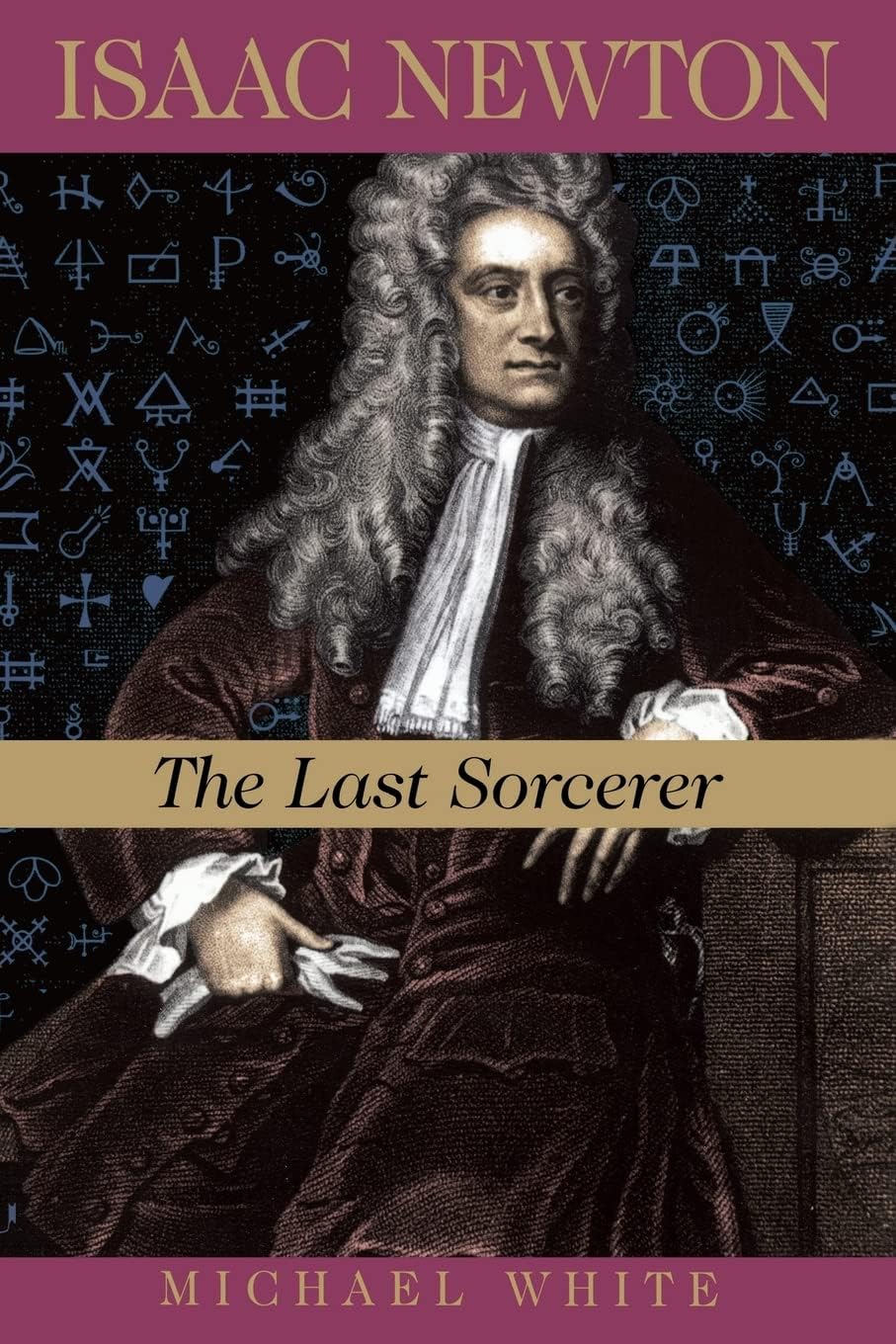
Isaac Newton: The Last Sorcerer (British Commonwealth, United States, United Nations, 1993)
Desertcart purchases this item on your behalf and handles shipping, customs, and support to Senegal.
Description
Unknown to all but a few, Newton was a practicing alchemist who dabbled with the occult, a tortured, obsessive character who searched for an understanding of the universe by whatever means possible. Sympathetic yet balanced, Michael White's Isaac Newton offers a revelatory picture of Newton as a genius who stood at the point in history where magic ended and science began.
Specifications
| Asin | 073820143X |
| Dimensions | 6 x 1 x 9 inches |
| Edition | First Edition |
| Isbn 10 | 9780738201436 |
| Isbn 13 | 978-0738201436 |
| Item Weight | 1.33 pounds |
| Language | English |
| Print Length | 423 pages |
| Publication Date | April 6, 1999 |
| Publisher | Basic Books |
| Reading Age | 10 - 13 years |
Reviews
User
Fascinating!
I was attracted to this book by a moronic blogger on another site who tried to rationalize the idiocy of "Intelligent Design" by arguing that Isaac Newton believed God created the universe! Another blogger recommended "The Last Sorcerer" as a rebutal to that comment.Michael White's scholarship is well-researched, incisive and thoughtful. He reveals the history of the awakening of scientific thought and inquiry of the 17th and 18th centuries in a readable and interesting manner.His descriptions of Newton, Hooke, Waterhouse, Huygens, et al, who opened the doors to the modern scientific method are easy to follow and carefully organized. Sir Isaac, indeed as much a man of God as he was a man of his time, was nonetheless largely responsible for the beginning of the end of superstition and ignorance and the awakening of inquiry and experiment.This is a good read for anyone interested in where we've been and how we got to where we are.
User
Also invented the reflecting telescope and was constantly investigating all sorts of things like light. He's called a sorcerer b
Insightful and interesting. A super-genius who invented calculus to prove that the Earth moved around the Sun. Astronomers already believed that to be true but couldn't prove it. He was shielded from the Catholic Church because he lived in England who had broken from the Catholic Church. Also invented the reflecting telescope and was constantly investigating all sorts of things like light. He's called a sorcerer because he even investigated sorcery and probably got mercury poisoning because it was said to central to alchemy (his careful scientific research dispelled the popular belief that alchemy was possible using the methods and equipment available at the time). He was a cold unfriendly man who couldn't relate to other people. This book is well written and gives you the scoop on a man most educated people have heard of but don't know as a person.
User
Interesting
Very interesting but a lot of information about other scientists that is a little too in-depth. A few paragraphs on each would have been enough but the author goes on for pages and pages about each one.Mr Newton was a very interesting person.I’m glad I found a biography that brought him to life wrinkles, quirks and all.
User
Truly excellent, balanced biography
I have a fascination for all things Newton. This book is a great resource and as well as a totally absorbing story about one of the greatest minds in European history. This is a also a fascinating window into another time.
User
This is an excellent biography of Isaac Newton and his coworkers with an emphasis on their work with alchemy.
This is an excellent biography of Isaac Newton and his coworkers with an emphasis on their work with alchemy.It also discusses the ancient Royal Society of London which was a natural philosophy group made up of the great minds at Cambridge, England. Two of the contemporaries include Robert Boyle and Robert Hook the fathers of chemistry and microbiology.It emphasizes their work in alchemy in their relationship with Isaac Newton
User
Five Stars
I had no idea that this paragon of materialism was in fact an "alchemist".
User
Inaccuracies make the reading doubtful
I haven't finished the book. When reading it I found that the author is not accurate in descriptions of physical ideas. For example, he does not distinguish between distance traveled in free fall and speed of the object when describing Galileo's discovery (p. 79).The chapter 2 is called "The changing view of Matter and Energy" which mainly describes development of ideas on matter but not energy. The latter concept was developed much later after Newtonian time and was not known to Newton or Galileo.So the reader who is in science profession finds this disturbing and this puts under question historical propositions in the book about Newton's life where one may not have knowledge of. Thus, I question whether the material presented in the book about Newton's life are really accurate.
User
Flows like a novel
This work is carefully documented and quite detailed, however it presents the man's life as if read in a novel. The life of Sir I is not an easy one to tell because of the intricate nature of his character; yet, for me, it was an informative, enjoyable read. Once read, you will come away with a deeper understanding of the complex mind of this great scientist.
User
Newton was not always a very rational person he always was eager to discover something else!
The book contains accurate information about Newton and his time. The bibliography is very complete. The reading of this book is very engaging
User
book
very good book
User
Spectacular, but not a light read.
I've just finished this amazing book. As I am in the lucky position to be a room guide at his birthplace, I wanted to find out more detail about the man and his life after he left Woolsthorpe. It's known to be the 'hardest read' of the biographies that are currently available, but I only found this out when I'd reached page 280!The detail in this book is overwhelming at times, and I struggled to understand the descriptions of the scientific theory (not being a scientist), but the biographical aspect is quite astonishing in its' depth and, sometimes, in the leap of the authors imagination. There is a great deal of speculation, which is written immaculately, but is still not evidenced. I don't believe some of the detail would stand up in a modern court! It's to be expected, as the great man died a long time ago, but still - take the facts where they are and take the speculation with a pinch of salt. I have done.However, I thought it was an incredible read and I have found it to be very thorough and well written. The depth of research is obvious, as is the passion of the author for the subject. There is more to know about Sir Isaac Newton and I'm looking forward to continuing my studies. Hopefully my next read will be as enlightening and enthusiastic as this has been. It has brought a whole new level of appreciation of the place where he was born and I have many tales to tell the visitors that visit.
User
Entertaining and informative
The biography gives an entertaining and informative account of Newton's life through the lens of his life long obsession with alchemy and his deeply held Arian religious beliefs. The author makes a lucid case that it was these two passions (however misguided), along with Newton's thirst for knowledge, that drove Newton to his scientific discoveries.The book is not overly scientific. It does not go into the mathematics or describe any of Newton's theories in great detail. Depending on your view point this may be a strength or a weakness, but it does make the biography easily accessible to readers who do not have a scientific background.The biography also paints a lesser known side of Newton - namely Newton the civil servant. As warden and then master of the Royal Mint the biography gives an entertaining account of Newton as he tries to restructure the Royal Mint and increase efficiency, while simultaneously bringing to justice currency counterfeiters with almost a religious zeal.However, I found the most enjoyable sections of the biography to be the accounts of Newton's feuds with other well known historical figures of the time - namely: Robert Hooke, John Flamsteed (First Astronomer Royal), and Gottfried Leibniz. Most enjoyable was his battle with Leibniz, and the battle for the title of "discoverer of Calculus". This gave an insight into the dark side of Newton and his ruthlessness when dealing with adversaries.Overall a great read and highly recommended but personally I would of liked to of seen a little more scientific detail (in particular at least a mention of the second most famous equation in all of physics - F = ma).
User
Science as a byproduct of alchemy.
Science didn't happen overnight. This is an excellent study of the usefulness of alchemy to chemistry. It might also be a cautionary tale.
Common Questions
Trustpilot