
Desertcart purchases this item on your behalf and handles shipping, customs, and support to Senegal.
🥑 Eat smart, live longer: The science of food that your future self will thank you for!
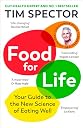
Food for Life is the definitive, science-driven guide to nutrition and gut health by Professor Tim Spector, featuring cutting-edge research and practical advice. As the #1 Sunday Times bestseller and winner of the Fortnum & Mason Special Award, it empowers readers to navigate the complexities of modern eating, exposing the risks of ultra-processed foods and promoting sustainable, health-supporting choices. With over 1350 positive reviews, this book is a must-have for anyone serious about transforming their diet and wellbeing in 2026.



| Best Sellers Rank | 8,179 in Books ( See Top 100 in Books ) 3 in Allergies 7 in Food Allergies 9 in Ecological Pollution |
| Customer Reviews | 4.4 out of 5 stars 2,645 Reviews |
R**R
Highly redcommended
With 1350 positive reviews, it seem redundant to write another so, apart from recommending it highly her are a few brief observations: 1. The chapter summaries at the end of each chapter are very useful 2. At the back of the book, pages 422-448, there are some tables which are extremely useful. 3. Apart from stressing the need to eat for good healthy, it points strongly to good gut food. 4. It points out that the immune system cannot be boosted but it should be supported and maintained. 5. Page 25 has an interesting section on essential Vitamin D - natural sunshine is much better than supplements and, in Winter, egg yolks, oily fish, sunbathed mushrooms (shiitake and button) and fortified foods are good sources.not enthusiastic about supplements (which many doctors recommend). 6. It will open, eyes on ultra-processed foods (UPFs) - industrial formulations manufactured from substances derived from organic sources. They contain little or no whole foods, which Spector recommends. 7. Little or no evidence suggesting eating quality meat in moderation is a health risk but that processed meat products are definitely bad for health. 8. Meat alternatives and lab-grown meats are part of our future. 9. Eggs are a great source of protein; a good egg sinks, a bad egg floats. 9. Half the fish we buy is fake. 10. Regular processed meat consumption is associated with increased heart disease and probably cancer. Be prepared to be educated, informed and change your eating habits ... an probably live a longer, healthier life.
M**7
So insightful for healthy eating
Everyone should read this! So useful for healthy eating. I prefer the audio version as the font is quite small in the book. Lots of nuggets of information the food industry doesn’t want you to know in case it dents their profits
N**L
Puzzling remarks on Vitamin D
UK government website of as recent as 2021 has published recommendations that everyone in the UK should be taking 400 international units of Vitamin D daily as we simply can't make enough of this vital substance (ie are Vitamin D deficient) between Oct and March in this part of the world. Unless, of course you can afford to sun yourself in warmer climates during Winter holidays, which most of us can't... Everyone I know who takes Vitamin D in the Winter has noticed a reduction in common infections. Anecdotal data, I know, but consistent nonetheless. Not sure why Tim is so against this vital supplement, in spite of his earlier disappointments. Seasonal Vitamin D supplementation is not an optional indulgence in the northern hemisphere and not everyone can afford the sunkissed mushrooms only sold in luxury supermarkets... Also not convinced in the reliability of the self-selected Zoe app participants data. Sounds inclusive and democratic on the surface, but lots of variables seem tricky to control for, such as the socioeconomic background, availability of time and technology. I tried filling it in during the first COVID months but simply didn't have the time to carry on. That's telling me that a busy clinician like me might be self-selected out... Otherwise, lots of useful info as expected, really worth a read. I particularly value the stance on ultra processed foods and not pushing any extreme diets.
S**.
Interesting
Interesting
T**K
Food for life
Very interesting and informative
S**B
Misleading information
I would recommend buying this book although a number of assertions made in the book are not backed up by any references. This means doing your own studying to check if the book is correct or not, or deciding it's not proven. We know people in the UK do not get enough vitamin D from sunshine in the winter which is a serious problem. This book suggests on pages 232, 233 getting your vit D supply from mushrooms that are fed on daylight but it does not state how much vitamin D is required. In “The Vitamin D debate with Professor Spector” video he said 95% of the population have reasonable functional levels of vit D and do not need vit D supplements. The only daylight fed mushrooms in my local Yorkshire supermarkets are Chestnut mushrooms which only have 200 IU per 100 grams which is not enough to meet even the UK Department of Health and Social Care standards of 400 IU/day. The USA standards I feel are a bit more realistic of 600 IU and over the age of 70 (which I am) of 800 IU. I like to keep my vit D at high optimum levels (i.e. 125 - 200 nmol/L in the blood - UK units) so I supplement my food with vit D3 capsules which are essential for many reasons. I get health issues if my levels are too low i.e. blood levels below 25 nmol/L. So in the winter my vit D3 capsule/food intake is 4,000 IUs per day plus vit K2 (200 micrograms). Very high vit D dosage can be toxic so I have been monitoring my levels for the last 10 years. The book says “eating two portions of fish per week is not needed for health”. The body requires high amounts of EPA and DHA (omega 3 acids). Foods that have high levels of EPA and DHA are mainly from fish, algae and some meat products. Being a pescatarian, I cannot get EPA, DHA or vitamin D from organic meat. Those in the highest quartile of Omega-3 in their body compared to the lowest quartile live 5 years longer!! Although some plant foods (e.g. walnuts) have high levels of ALA which can be converted by the body into EPA and DHA the converted amounts are very small indeed. Only about 8% of ALA is converted to EPA, and about 4% is converted to DHA. ALA is also a form of omega-3 and is a life saving nutrient in its own right. The NHS recommends 500 milligrams of EPA and DHA per day. The American Heart Association recommends 6 ounces (i.e. 170 grams) of fatty fish/week e.g. mackerel has 9 grams of EPA and DHA i.e. 1,285 milligrams per day. More recently the paper “The influence of dietary and supplemental omega-3 fatty acids on the omega-3 index: A scoping review” suggests 1,000 to 1,500 milligrams of EPA plus DHA as triglycerides (e.g. fish, good supplements) daily for at least 12 weeks to get to an optimal level for reduced risk of chronic disease, most notably cardiovascular disease. A number of the USA experts (e.g. Rhonda Patrick) take 2 to 4 grams of fish Omega-3 per day. Getting high sugar spikes can be a very serious health problem. The book does not stress enough the importance of exercise after a meal which significantly reduces the intensity of these sugar spikes. I also follow Glucose Revolution book by Jessie Inchauspe. The book notes section is fairly up to date i.e. 2022 references. So I was surprised it did not mention the 2020 paper “Associations of fat and carbohydrate intake with cardiovascular disease and mortality: prospective cohort study of UK Biobank participants” that shows the optimal amount of macronutrients of sugar, starch, fibre, different type of fats and protein. Most people have far too much omega-6, which can increase inflammation and disease, and not enough omega-3. Ideally need 2:1 ratio of omega-6:omega3. Also on the theme what is the optimal amount of macronutrients, I did not see a reference to the 2017 paper “Food groups and risk of all-cause mortality: A systematic review and meta-analysis of prospective studies”. This paper shows the optimal amount of whole grains, refined grains, vegetables, fruit, nuts, legumes, eggs, dairy and fish per day. For heart and stroke issues, the diet needs to be slightly different, e.g. paper "Food groups and risk of coronary heart disease, stroke and heart failure: A systematic review and dose-response meta-analysis of prospective studies". Also the 2022 paper "Estimating impact of food choices on life expectancy: A modeling study" is well worth looking at. Getting the right amount of macronutrients is a serious issue. I would have found it useful if the book had given examples of what an optimal diet would look like per day for a week or more, because each day there will be different amounts of macronutrients. For example Day 1: 400 grams of vegetables (1 big tomato, 1 sweet pepper, mixed salad leaves, sauerkraut, kimchi, half avocado, small bowl of vegetable soup); 200 grams of legumes (big cup of beans, lentils, peas); fruits 300 grams (1 apple, kiwi, berries); whole grains 100 grams (1 whole wheat sourdough slice, bowl of whole oat grains); 1 handful of walnuts (30 grams); 20 grams of seeds (flax seed, chia seed); 100 grams of Kefir; 20 grams feta cheese, 100 grams of oily fish (e.g. sardines); tea and coffee. Day 2: .....etc,.... Note that below the age of 65, protein intake should be low but higher after that age. Certain of the above foods may give you a high sugar spike because of your glycaemic response so I would suggest getting a glucose monitor to check.
G**N
Benchmark reading in human nutrition
I was lucky enough to see Dr Tim Spector presenting to a scientific audience many years ago. That talk opened my eyes to the significance and complexity of the human microbiome and permanently changed my perspective on food. There is a lot of snake oil being sold in the food industry. As a scientist and epidemiologist dedicated to the objective study of nutrition and the microbiome, Tim Spector is well-placed to debunk many of the myths and fantasies we are all spoon-fed by commercially interested parties. In ‘Food for Life’ he aims to think about the science behind food not only in relation to our own individual health, but also societal and environmental health (Henry Dimbleby’s outstanding ‘Ravenous’ provides a complimentary read in this same area). I found ‘Food for Life’ a hugely compelling read. It comes across as a bit of a heavyweight tome at first, but most chapters have an easily digestible short summary of bulleted key points at the end. On Audible it comes in over 16 and a half hours and heavy hardback at over 500 pages ... I know because I loved it so much I bought it twice! This is going to have a permanent place as a reference point in my kitchen. Essential reading for anyone at all interested in evidence-based decision-making when it comes to making choices about their food choices. Brilliant.
S**T
More of the same from Tim!
I'm still only 35% of my way through this book on Kindle but I feel I've read most of it before on previous books from Tim. He seems to be more confident in his distrust and dislike of Ultra Processed Food, enough for me to give it serious thought! He does seem to contradict himself when he talks about plant-based meat substitutes as they seem to be more (ultra) processed foods! I'm going to press on with the book as I'm learning something every time I pick it up!
H**I
Educational read on the food we all eat
Addresses many misconceptions about the food we eat, essential reading
H**H
Book arrived dirty and bogies on it!!!!
Book arrived absolutely filthy, second hand looking and actual bogies all over it!!! Disgusting.
M**A
Já é o quarto exemplar q compro, o livro é muito bom! Dei pra vários de meus amigos.
Livro super informativo sobre alimentos e como se alimentar de forma a aumentar a qualidade de vida
B**N
Lots of fact based science
Very informative
J**K
Essential food wisdom for a healthy life.
The author puts his decades of medical expertise along with the Zoe clinical research studies of. 100,000 participants which he has led to tell you how to add ten or more healthy years to your life. A strong advocate of microbiome health which is in turn for your heart and brain.
Trustpilot
1 month ago
2 months ago