Food, Inc.: A Participant Guide: How Industrial Food is Making Us Sicker, Fatter, and Poorer-And What You Can Do About It
Product ID: 5597347
🌱Focus on real, organic food
📈Top-ranked nutrition guide
📚Insight-packed essays
Desertcart purchases this item on your behalf and handles shipping, customs, and support to Senegal.
🌱 Reclaim Your Plate: The Truth Behind What You Eat
Food, Inc.: A Participant Guide is a compelling collection of essays that critically examine the industrial food system's impact on health, environment, and society. Featuring insights from leading experts, this used book in good condition serves as an essential companion to the acclaimed documentary, empowering readers to make informed, healthier food choices and challenge the status quo of American food production.
| Best Sellers Rank | #273,524 in Books ( See Top 100 in Books ) #1,132 in Nutrition (Books) #1,898 in Performing Arts (Books) #9,528 in Social Sciences (Books) |
| Customer Reviews | 4.5 out of 5 stars 251 Reviews |
K**A
A Flawed Yet Very Informative Book
Its rare that I learn as much about a subject as I have from Food, Inc. Accordingly, even though this is far from a perfect book, I give it my highest rating. The "book" is actually a series of essays written by a selection of very knowledgeable persons and groups, detailing the adverse effects of the industrialization of the food industry. Each of the articles takes a slightly different tact, but collectively, they comprise a very effective attack on the large, multinational food and farming corporations and the governmental agencies which are supposed to be regulating them. The book describes their decimation of the environment, the adverse effects of their practices on the health of our citizenry (obesity and the effect of the pervasive use of pesticides, hormones and antibiotics), the harm their activities cause to the economies of the poorest of the third world nations (and the resulting increase in malnutrition and starvation), and their shameful disregard for even the most basic welfare of the animals that grace our dinner plates. On the negative side, many of the essays are duplicative, and others are obvious and repetitive. Additionally, the editors who selected the writings don't even make a pretense of subjectivity. Notwithstanding these negatives, the book nonetheless very powerfully and effectively argues that when it comes to farming, agriculture, and other aspects of the food business, the old ways are most certainly the best.
J**B
It's Time To Redefine What Food Is In America
Watching Food, Inc. was a life-changing experience for so many of us who are committed to the idea of living a healthy lifestyle centered around consuming real, whole foods that are preferably sourced locally where we live and without all the modern-day industrialized practices that dominate much of what is called "food" in the United States in the 21st Century. This powerful documentary shone a great light on problems like factory farming while extolling the virtues of choosing more organic vegetables and grass-fed meats for optimal health and longevity. It's a deep subject that warranted even further discussion which is why FOOD INC.: A PARTICIPANT GUIDE was created. Featuring many of the major players from the film--namely Eric Schlosser, Michael Pollan, Marion Nestle, Joel Salatin, and more--this book includes some poignant essays designed to make you think about how Americans typically buy what they think is "food" and what REAL food looks like by stark contrast. It's funny, our grandparents from just a couple of generations ago didn't have to call what they ate "real food"...they simply called it "food." It's time we return to those days again and books like this one along with the companion DVD Food Inc.: A Participant Guide: How Industrial Food is Making Us Sicker, Fatter, and Poorer-And What You Can Do About It will help make that happen.
G**H
Food, and its production is more complex than you think.
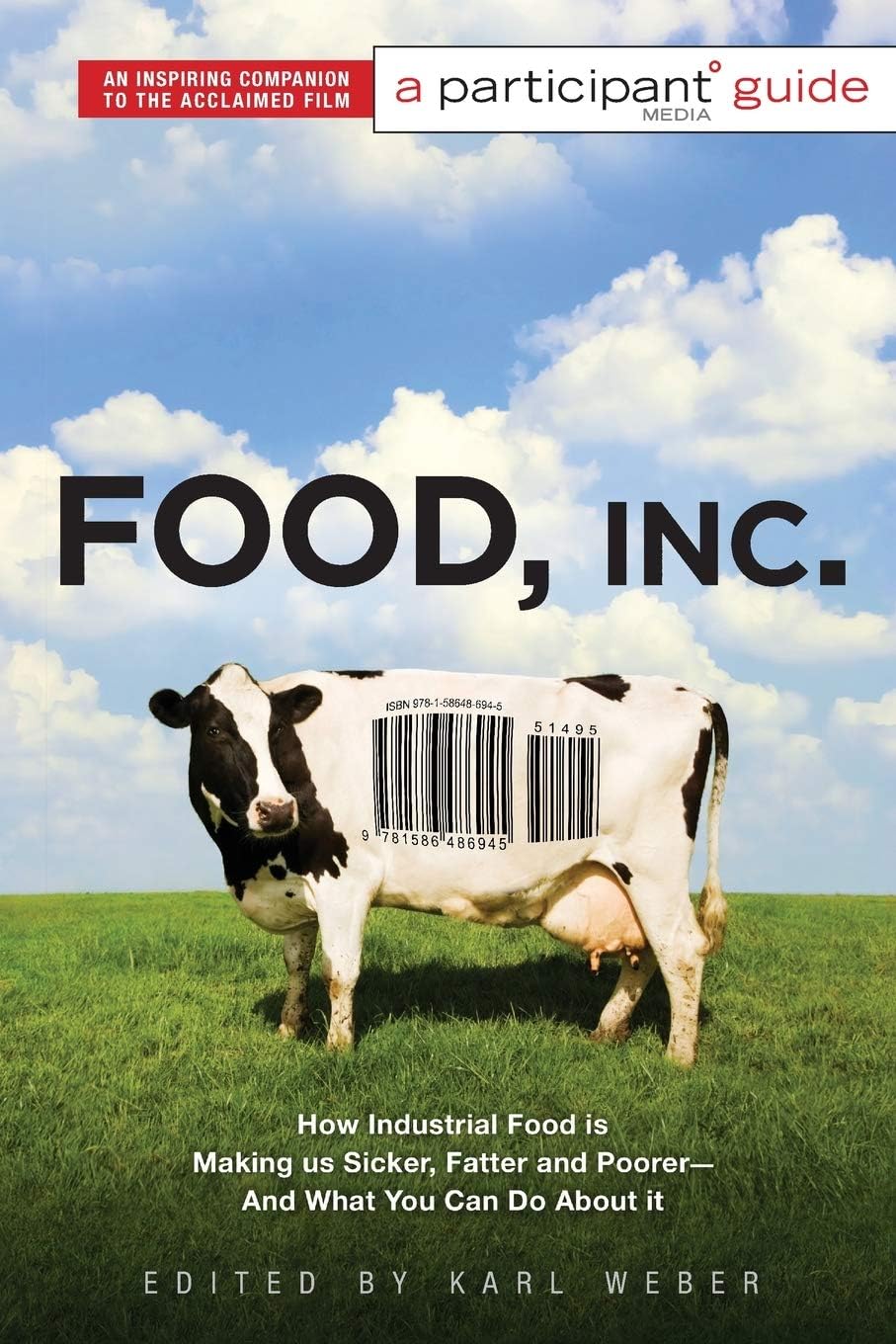
This book is a companion to the movie of the same name, and for maximum benefit you need access to the movie, however is it useful and informative by itself. If you are interested, really interested in what you eat and what our food choices (or forced lack of choices) mean, this is a good, easy read. The UPC on the cow on the cover (cleverly the UPC for the book) says a good deal about our modern food system; it provides food that is largely manufactured, processed, grown or raised in ways that are at stark contrast what most of us think looking at foods in the grocery store. In many cases, as the subtitle says, it is making us sick, fat and poor, and doing much the same to the rest of the world. Another excellent book, more detailed, for further reading on this general topic, would be "The Omnivore's Dilemma" by Micheal Pollan, which I also bought from Amazon.com.
R**M
Must Read, Must See Movie ASAP
I bought the book because I didn't think that the movie was going to play around here but than I found out that it was and WOW!!! The book and the movie go hand in hand. Our lives have changed as a result for the better. We need to know where our food is coming from and when we find out we must make a choice as to whether we are going to continue to poison ourself and promote the horrible things done to the animals, food, farmers and factory workers (when we buy these things we are promoting them) or make the changes and only eat what we grow ourselves without pesticides and such, organic, and from farmers who are raising happy cows, chickens etc that are eating what they should and treated with respect. I look forward to feeling good when I am old due to making the changes necessary so than I will not have the cost of meds (not that I would use them) to treat the illnesses I get due to poor diet. We will never eat fast food again or buy meat from the grocery store now that we know what we are actually eating (feces, ammonia, hormones and antibiotics to name a few). Ignorance is not bliss. Americans are poisoned and you can see by looking around you at all the health problems. Go see the movie (documentary) and get the book because the books always have more in them. It actually cost less to eat healthy when you consider the cost later in life from eating badly, it cost your health and money because you have to now treat your health problems with expensive meds. Choose your health over your cravings please. God provided us with things that grow naturally. Fruits, veggies, nuts, grains etc and we don't need poisonous pesticides. Meat is good if it is humanely slaughtered and feed the right diet minus the hormones and antibiotics. Support the local farmers. Here is the link to see the trailer for the [...]
C**Y
Very insightful!
I recommend this book - if you haven't already seen the movie. It's a real eye-opener on how our food is processed and the fallout of what happens to us as a nation after years of consuming foods with poor nutritional value or with no nutritional value. We consume it because it's cheap and easy - but there's a terribly high cost to taking the easy way out. After reading this book, I really think we need to re-evaluate how we eat and what we eat and where it comes from. We need to take care of our children's nutrition to avoid the epidemics of diabetes, obesity and heart disease. This book is not preachy - it simply illustrates how the food industry has evolved and what we need to do to change this unhealthy trend. The first step is knowledge. Awesome book!
D**E
This book enhances the documentary.
I've been in the food industry for a number of years, so there isn't much that surprised me in this book. I had to get it for a class that I'm in, so I had to read it even though I never would have picked it up on my own. It is a great companion to the documentary. It almost feels like the commentary and deleted scenes section of a DVD put into book form. You get a chance to learn more about the people involved in making the film and get a better background about why the film was made. I rated it 3-stars because, for me, it is just okay. Someone that is actually a part of the intended audience, an uniformed consumer, may get more out of it than I did.
O**R
Food Inc.
Just saw the film and ordered book. I don't understand why people think organic is so expensive. It's not the same product as the nonorganic version. Scientifically speaking,. it's a different substance. It has more nutrition in it. And why do people think healthy food takes all this time to prepare? You just eat a peach, not a candy bar. Smart choices don't cost more time - they just require a different mentality than buying into the corporate-controlled marketing mindset. And staying out of the supermarket. You want to talk about spending too much - the supermarket is The Worst Place to go. It's ALL about making you spend money. On soda, on chips. Please also read The End of Overeating by Kessler about hypersaturated foods supermarkets always try to sell you. And those people featured in the film - the Hispanics who eat at McDonald's? I don't understand why they aren't buying food from the taco truck, like in my neighborhood. Bean burritos are filled with nutrition. And they're cheap. Nonetheless point made. Why are we paying for corn subsidies that line the pockets of giant agribusiness and THEN we still have to pay AGAIN for diabetics, etc. ...not only do we have the world's most ridiculous healthcare "system", the agribusiness corporate interests have given us the world's most ridiculous food system. Read Exposed and you will see how Europeans haven't bought into this toxic melange in healthcare and in food. It's a wonder we Americans are even living. Wake up America! We've got to act soon. Before we spend ourselves to death treating all the problems the food industry has created and the health insurance industry is only too happy to surgically intervene in. Frankenworld!
M**T
Changed the way we eat
First it was the movie, then, wanting more information, I bought the book. It has changed our entire approach to eating and now we are practically vegetarians - and even eat a lot of vegan dishes. I do not use packaged or prepared meals and we rarely eat meat at all - especially never chicken and ground hamburger. This book has sensitized us to every type of food including fish, so I do the research on salmon to make sure we only buy wild caught (not wild farmed.) We also grow our own vegetables now and surprisingly, we do not miss meat. In fact, when we do eat it, it's always somewhat disappointing as our taste for vegetables and whole grains now dominates our preferences and these are infinitely more flavorful (IMO). So, we owe a lot to these authors and are grateful for the research and the book. I'm still a little surprised that many people have not heard of this book, so that motivates me to write this review. Highly recommended.
A**P
Informative, a great read.
I loved the movie, and having reading to augment the information was fantastic. Not every article was relevant to me, but I really enjoyed the vast majority of them. I would highly recommend the read if you are interested in food.
C**N
A lire!
J'ai pas lu le bouquin mais j'ai vue le DVD. Ce documentaire est a voir absolument. Reportage édifiant sur l'industrie agro alimentaire et ses dérives très dangereuses pour notre santé.
J**S
Corporate Food
An eye opener to an industry allowed to do what it wants to sell you whatever it takes to get you to give over your cash. A lobby with more power than you can imagine. And naturally politicians willing to do anything for "their" constituents. Good read if maybe a bit repetitious pertaining to the pervasiveness of the industry in pulling the wool over the average Dick and Jane.
C**D
Three Stars
aware of most of the things written but good to see it in print
M**T
It starts well
I was thrilled with this book during the first 2 or 3 chapters. They were powerfully and accesibly written. Subsequent chapters disappointed, and were more a means for the airing of very specific and narrow concerns. They were too detailed and confined in their scope, and were more a critique of industry practices, rather than having a direct bearing on the food we eat.
Trustpilot
1 month ago
2 weeks ago