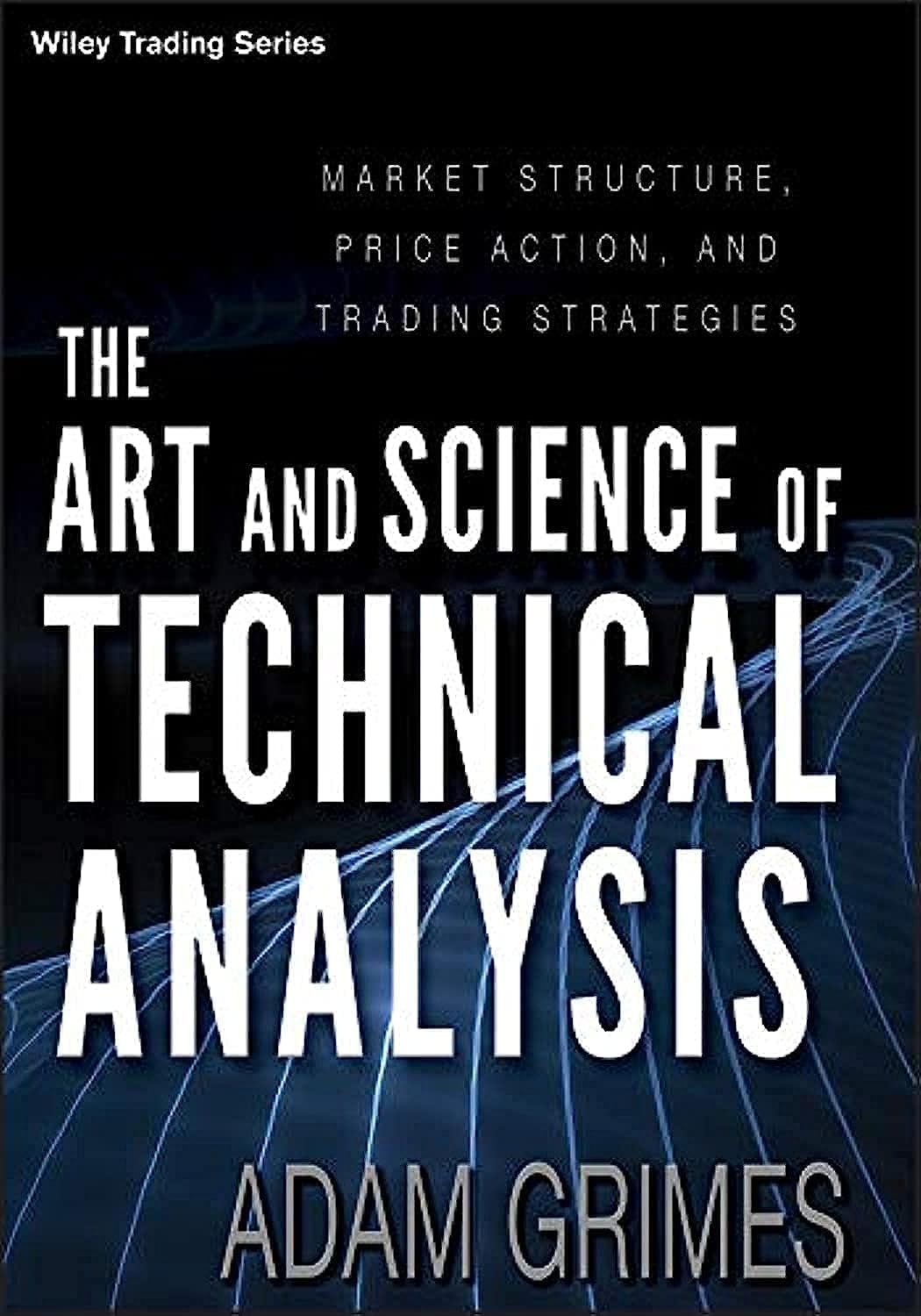


The Art and Science of Technical Analysis: Market Structure, Price Action, and Trading Strategies (Wiley Trading)
Product ID: 5523271
Desertcart purchases this item on your behalf and handles shipping, customs, and support to Senegal.
A breakthrough trading book that provides powerful insights on profitable technical patterns and strategies The Art and Science of Technical Analysis is a groundbreaking work that bridges the gaps between the academic view of markets, technical analysis, and profitable trading. The book explores why randomness prevails in markets most, but not all, of the time and how technical analysis can be used to capture statistically validated patterns in certain types of market conditions. The belief of the book is that buying and selling pressure causes patterns in prices, but that these technical patterns are only effective in the presence of true buying/selling imbalance. The Art and Science of Technical Analysis is supported by extensive statistical analysis of the markets, which will debunk some tools and patterns such as Fibonacci analysis, and endorse other tools and trade setups. In addition, this reliable resource discusses trader psychology and trader learning curves based on the author's extensive experience as a trader and trainer of traders. Offers serious traders a way to think about market problems, understand their own performance, and help find a more productive path forward Includes extensive research to validate specific money-making patterns and strategies Written by an experienced market practitioner who has trained and worked with many top traders Filled with in-depth insights and practical advice, The Art and Science of Technical Analysis will give you a realistic sense of how markets behave, when and how technical analysis works, and what it really takes to trade successfully.
| Dimensions | 7.4 x 1.7 x 10.2 inches |
| Edition | 1st |
| Isbn 10 | 1118115120 |
| Isbn 13 | 978-1118115121 |
| Item Weight | 2.18 pounds |
| Language | English |
| Print Length | 480 pages |
| Publication Date | July 3, 2012 |
| Publisher | Wiley |
User
A great guide book for swing traders. Belongs to the "Classics" category in time to come.
This is a truly good book. If you are an experienced trader, you will be able to understand the many great wisdoms in this book. I read this like a textbook and have many of the pages highlighted.If I have to list any misgivings for this book, I will point to chapter 3 where Adam talks about Elliott waves but the figures following (Figure 3.1 and 3.1) incorrectly drew the impulses as 3 waves when the correct structure should be 5 waves. This should be corrected in future editions of this book.The second misgiving will be more of picking bones out of eggs: the last chapter on MACD has a few charts that can be a few pages away. This is just an organizational issue and poses mild inconvenience when trying to refer the chart to the text. The chapter itself is great though and helps me correct a grave misunderstanding of MACD: regarding the fast line being a 2nd derivative of momentum.Like I said, if you have been in the markets for at least a few years, you will see the many nuggets of wisdom scattered throughout the pages. For an amateur, this book will probably seems to lack "value" as it doesn't seem to contain as many topics on technical analysis compared to other TA books. Thus, this book is really more of a guide that specialised in guiding you through a few very focused methodology of trading (really more for swing trading) as opposed to a reference book on TA where you can find formulas for different indicators.In conclusion, I would say these:1) This book is more geared towards swing trading and it does so brilliantly.2) While it is a simple book with many great trading wisdoms, it is not really for beginners if only because a new trader will not be able to harvest them as an experienced trader would (sorry about this). I will only recommend this book for anyone who have at least 5 years of trading experience in order to really appreciate it.3) Take note that there is a mistake regarding Elliott waves as mentioned above.I have never writtened such a long review for a book but this book is worth every moment writing a comprehensive review for. This is certainly a book that belongs in the "Classics" category in time to come.
User
Close to as Good as it Gets
Grimes' work, and make no mistake, this IS a "work", is as close to as good as it can honestly get in this genre. While written in simple accessible style, this is no breezy weekend read. One of the most sage bits of advice comes right at the start: when finished, go back and study certain chapters again.The reader that will get the MOST out of this contribution, in my view, is someone who already has a bit of mud on their boots from the trenches. In the appendix he provides a "Primer" aimed at the novice. But it is SO basic (how to place an order) that the gesture seems more to mollify an anxious publisher's jacket writer than serve the book's main audience. If you just now got the "what are orders" part down, the take-homes of the book will be pretty fuzzy for awile. And the extra burdens of interpretation and active management a bit much to expect. There are other more full length primers out there. A (precious) few quite good.This book is different. And that is what makes it special. While it IS a fairly comprehensive trading overview, the FOCUS of the book is interpreting and acting on largly uncluttered price action. Few books, even on technical analysis, narrow in on such a basic start point. And Grimes does so with organized, well expressed, non-contradictory prose. In other words, a treat.Rather than remain safely high on cliche and low of detail, the book is rich with specific set-ups and engaging commentary.Grounded in evidence based, probability founded science, it emphasizes the ART of making sense of it all. Of reasoned interpretation and discretionary decisions. This is refreshing. Many of the best books out there, as cognizant as Grimes of the disastrous effect of human nature, emotion and misjudgment, stress the opposite tact. The only hope is creating an "objective" testable system that marginalizes faulty judgment and emotion. The fact of the matter is, subjective opinion's effects are STILL and always, everywhere. The day that ends - no more market. Yet each tiny choice changes each participant's outcome. Gaining a lasting TRUE edge is key. Yet, given the high degree of randomness, this is extraordinarily illusive and very hard work.Faced with this sober reality, his own approach is that of a swing trader. But in the more accurate, not popular sense. I recently put down Dave Landry's Layman's Guide. Both look at simplified price action and quite similar initial set-ups. Both advocate swing trading expectation (at least initially) and grabbing partial profit quite early. Where they DIVERGE in goals and trade management I find quite stimulating. Read!I will just say Landry's hybrid swing-trend blend SEEMS the more logical. A great compromise. The purer swing style coached by Grimes however is certainly more instinctual. More importantly it SEEMS the more realistic and prudent. Grimes makes you ask yourself how time-LIMITED a given entry set-up or bullish chart pattern is likely valid for. Dispite popular mantras, the more "miss than hit" challenge of PURE long term trend trading (enduring deep drawdowns that MUST be made up by sufficient extraordinary runs), is easier said than done. Especially in our times. Grimes' insight, no, the very market structure he helps YOU see evolving, is like having a probability gauge, however slight, as you navigate your OWN way through the wall of fog known as the right margin.Reviewers offering NOTHING but accolades can be suspected (sometimes with reason) to be the author's mom or of his/her customer fan base. So here are two knocks. Sorry son: First. He suggests short and long versions of much of the book's preferred patterns would basically be mirror images. Flip them and away you go. Really? Sometimes no doubt. But the implications and thus psychology can be dramaticaly different. Affecting the volatility and compression of the action. And therefore "how it go'na look". Especially around possible signifigant tops and bottoms.2nd "beef": Record such a detailed personal Trading Diary that you include EVERYTHING right down to "what you had for breakfast"?? For future result analysis? I nearly choked on my cheerios, blurting: "Give me a break Adam!" Indeed elsewhere he echoes Nassim Taleb about the tendency of humans to see correlations and patterns where there are none. Such a tendency provides an endless boon for "the industry" and an ever present risk for traders. In equal measure. Yes yes his POINT is okay: As we are the main part of our trading equation: know thy state and self (warily).Truly digesting THIS WORK, a diary can expect to show not only improved performance correlation but whetted appetite for MORE such nourishing fare. As the author would agree, no book is "all you need". It never is. But for this one's refreshingly GROUNDED discussions on SEEING risk and recognizing possibley superior set-ups at that hard right edge: My first 5 stars. Sail On!
User
Great Book. A Worthwhile Read and Will Be Useful as a Reference Tool.
I liked this book a lot. I have followed the author's writings since his days at "SMB Capital". His new work is at adamgrimes.com/blog. In my opinion, all of the author's work is worth reading. The book, "The Art and Science of Technical Analysis", is pretty hefty at over 400 pages. For me, there is a TON of relevant information within this book, so much that it's difficult to review, but I'll try.The author starts right in with an explanation of "Expectancy" and "Market Edge". What, in the author's opinion, defines a "trader's edge"? It's made clear in the book that the opinion is that market's, MOST of the time, are very efficient. The reason I emphasize "most" is because it's the opinion of the book that edge is defined as being aware of the moments when the market is NOT efficient and in that zone is where trading edge exist. This concept is covered in the first 5 pages and the remaining 400+ pages the attempt is made to present or make clear when markets are not being efficient. The author states early on that psychology is important and critical, but one can have the best mental attitude and emotional discipline and yet, without an edge, he/she will lose. The bottom line, as stated directly in the book, is that one MUST have edge, a clear statistical edge, and if this doesn't exist, everything else is futile. This entire book is about creating that edge.Charts are broken down at first by showing simply swing pivot points. Then the moves within the swing are broken apart. Then the author gets into multiple time frame trading. How the higher time frame "controls" the lower time frame. I do a LOT of this in my own trading and it's very interesting. None of this is new per se, it's the author's approach that is new. I think what I'm trying to say is that we might know about multiple time frame trading, but if someone enables us to see something we haven't seen before then I think this is worth the time.The author then gets into the "Wykcoff Market Cycle". There are 4 parts to this cycle and most traders I'm sure are aware of "Accumulation", "Markup", "Distribution" and "Markdown". Most traders are aware of this but it's the interface between the end of one cycle and the beginning of another on which the book concentrates. The author states that it's the miscalculation of these phases where losses and dangerous trading situations exist. A considerable amount of time is spent on deciphering these transition modes. These insights, for me, were new, interesting and seem valid.The next part of the book is on "Market Structure". The first stop within this section is "trends". The author talks about what defines a trend and talks at length about trend trading, but also in this section "range trading" is discussed. The author states that failed breakouts are one of the most common patterns in trading. How to determine a failed breakout from a "legitimate" breakout is very difficult but I really believe that the author's insights into this area of trading can be very helpful.As you go deeper into the book you see, and the author explains, there are 4 types of trades. There is trend continuation, trend termination, support and resistance holding and support and resistance failing. Now, these are the 4 types of basic trades but there are countless permutations of these formations. Each of these 4 types of trades is more appropriate during one market cycle then another. It can get confusing. This book does a more than adequate job at clarifying these trades.The next part of the book gets into "Practical Trading Templates". In this chapter/section the author list trading patterns, or rather potential trading patterns. There's a lot here, but essentially there are Primary and Secondary patterns. The Primary trades are breakouts, pullbacks and trades from "failures".The author then devotes a chapter to "Tools For Confirmation". This chapter I liked a lot since one of my several weaknesses as a trader is staying with the trade to fruition. I especially like his analysis of multiple time frame confirmations. I like the concept of paying attention to the highest time frame and then going down from the top.There is an entire chapter on Risk Management.In the appendix the author analyzes certain indicators, one of them being the MACD. He states that any trader should know his tools inside and out. They should know how the tool was designed and exactly what it is and what it's intended to be. I use MACD in my trading and I'm guilty of the exact type of ignorance about which the author speaks. I read this segment many times and I think it's excellent.All in all, this is a meaty book and I read it twice. I'm still re-reading certain parts and I took a lot of notes and underlined a lot of points. I don't write many reviews and as far as trading books go my feeling is that they are long on price and short on relevance. I don't feel that about this book at all. The points are presented in a unique way and I like that. It makes me think about trading differently and enables me to see something I've looked at many times in a different way. That is certainly worth the price of a book. I'm working with some of the points and it will take some practice. In my opinion, this is definitely a worthwhile read. The author's blog is also a worthwhile read. Hope this helps.
User
This book is for sure different than any of all those I have read before on this topic
This book is for sure different than any of all those I have read before on this topic. Adam Grimes has mastered the art to accomplish all of the following and merge it into an easy readable trading book without being ever at risk to oversimplify or being shallow:- Analyzing market structure- Dissecting it into small understandable pieces- Explaining those pieces to new traders, but also giving interesting new views or comments to more experienced traders- Putting them back together to better understand the big picture- Putting them into a practical contextPro:Practical trading templates – he manages to draw a clear picture of his approach and set-ups without ever being dogmatic or disqualifying different approaches or opinions.Statistical analysis of trade results – very nice introduction on how to analyze your resultsAt no point in time is he trying to upsell anything, nor does he make reference to any commercial offerings, tools etc. You can go to his blog/website and get a) a flavor of his style and b) a lot more examples, thoughts, stories etc. and as of latest a complete free trading course without any intent to upsell etc. This puts seriously at risk my belief that there is no free lunch…He is never dogmatic, always humble in his style, words, approach, and accepts that there are tools which may not work for him, but maybe for othersContra:As per his own comments in his blog, this book was initially supposed to be 900 pages and was subsequently condensed into 450. I feel it is a pity of “losing” 450 pages of high value content.A few notes:Part I – Foundation of TA:Edge – finally somebody who clearly states that you need an edge to win over the long run. Anybody who says or believes something different can stop reading here and buy some “get rich overnight w/o any effort” book. He also manages to transmit how small and vulnerable to many factors these edge in reality will be.Market cycle – Nice introduction on the market forces and the 4 basic trades: trend continuation, trend termination, S/R holding, S/R breaking. Everything else are nuances or mixes of them, and while trading is much more complex than this, the basic understanding of it helps you put everything into a context.Part II – Market StructureTrends, trading ranges and interfaces between them.Clear words and observations. Luckily, he manages to build the bridge to explain the underlying market structure and the relevant charts, without being dogmatic or boring on certain candle formations or other factors such as MA retracements, S/R points etc.Part III – Trading StrategiesBy far the best I have ever read.Practical trading template – it is exactly what it says, clear concise template style set-ups over 50 pages showing his main templates with all the different nuances, potential entry strategies etc.Tools for confirmation – Adam recognizes a certain value in certain indicators, but first of all stresses out the need to understand the indicator used in what it is measuring and how it is calculated, to ensure it is properly embedded in your approach. Again, he is not dogmatic, e.g. he explains while Keltner channels are arguably “better” than Bollinger bands, but is flexible in leaving the final decision to the reader.Trade Management – I liked a few new thoughts on where to place the stopsRisk Management – nothing new here for anybody who read a few of the serious trading books. For the new trader it should still be eye-opening.Trade examples – trading templates put into practice with a selection of not only text book examples, but also others with not so clear set-ups which are much closer to reality and even losing trades after text book set-ups.Part IV – The individual, self-directed traderThe trader’s mind – again, probably nothing new for the experienced reader, but that does not make it less relevant, true or interesting for anybody.Becoming a trader – Together with the chapter on trading templates probably the main differentiator to other trading books or so called. He clearly outlines the importance of a process and the relevant record keeping and journaling and then gives a very interesting insight into analyzing your trading results in order to find flaws and start improving.
User
why don't earlier?
It's the best book by far, and I can say that since I've read more than 20 books of trading. Why didn't Grimes write it before? I study it for 15 minutes every day -I,m in the nineth review- Every trade I take I first read the book's pattern that should fit it.Said that, however there's an important thing I'm concerned about: due to the quality of the text, I signed up the website he advises, but there, he doesn't prescribe his medicine. Only in a month with his tips I've lost 400 euros (I'm spanish) and more important he doesn't apply what he sais in his book.In addition I miss a further explanation with the indicators where you can find some contradictions.
User
A remarkable book on technical analysis
This book is remarkable in that its content is truly comprehensive. I have read a few books on market structure and price action before this book, and none of them covers so many topics within the market structure domain. This is also a very rare book that explains crucial concepts systematically, logically, and clearly. I was surprised by how much I have learned by studying it for the past two months.The book first introduces the fundamental concepts of Wyckoff's market cycle and covers many tradable characteristics of the trend, trading range, and interfaces between them. Once the reader understands the fundamental concepts, the author proposes many trading ideas and strategies throughout the entire market cycle. Moreover, the author enhances the reader with real trade examples arranged based on the market cycle. He does not just show you the successful cases but highlights the failure cases as well. This book also complements John Magee's book very well. I was puzzled by chart patterns' price target measuring rules as to why they work. Adam's book has thoroughly explained MMO. This explanation let me have the aha moment.By now, most people will think the book is pretty complete already. But the author has gone far beyond and above. The author further demonstrated the relationship among different time frames and shown in great detail how the different time frames interact with each other, and how to combine these info to increase the success rate of the trades.The book further surprises the reader by its exceptional discussion on risk management. Instead of boring readers with mathematic formulas, the author laid out a practical risk framework based on Kelly's criterion that is simple enough to follow and easily simulated. I instantly figured out how to program these Monte Carlo simulations on my PC to meet my needs. As a self-directed trader, it isn't easy to quantitatively evaluate and improve our trading performance. This book has provided a number of practical approaches to address this issue effectively. The appendix also studied the indicators in great depth. The SMA and EMA remind me of the FIR and IIR filters in digital signal processing along with the Nyquist frequency for sampling.Trading in the financial market is like walking into zombie land. People get greedy when seeing the food and are fearful when hearing the screaming of the zombies. This book amazingly presented tools and strategies to help people navigate in this land with high probability.In summary, this is a remarkable and fantastic book. Thank you, Adam, for sharing your in-depth knowledge in trading and thoughtful thinking by writing such a resourceful book.
User
Intelligent
A long read and a little challenging, but if you can get through it it's actually intelligent and interesting with a wide range of trading and probability science, along with phycology.
User
Diced much too fine
Undoubtedly, human-powered, individual technical trading, as the author introduces The Art and Science, is hard. Take this review with that in mind - I expect no significant expertise in the field to come or be easy and this is not a critique on literary excellence or factual depth.What bothers me about the book is that paring back the nearly infinite number of variables that is the aggregate of instantaneous market action and the resultant seas of technical stock data to say, a purely arbitrary and relatively paltry fifteen hundred or five hundred or one hundred (insert your own number here; it matters little), and then expecting to apply even half a hundred technical analysis tools to that insurmountable data on Grime's other early stated basis - which is to spend a little over a second for each chart view across 500 stocks in a single sitting - is simply mathematically impossible.I'm 100 pages deep in the book and already I find a baffling number of technical advice hedges and counter-advice, which tells me what I as a novice trader already knew: There is such a sizable degree of complexity in what portends to be predictive trading that really the only way to make money is to climb aboard the overall market's trend, assuming it has one at any one instant, and get in either long as it rises or short as it trends down. Again, assuming even that's possible outside of guessing.From Grimes website, quoting the book:"It is critical that traders understand the subtleties of every tool they use. They should know how they react in every possible market environment, and furthermore, must understand the complex interactions between multiple tools. This may lead to an approach that disregards a lot of information that many traders assume to be useful, but, for instance, why would you use indicators that do not add to your analysis? Why would you listen to news that is old news and is already fully priced into the market? Why would you try to guess how complex fundamental factors might influence the price if you do not have the skills to fully understand those fundamentals?"After you've used every tool you can, and after knowing how to react to every possible market environment, and after grasping every complex interaction between those multiple tools, how can you possibly BUT find all that information already priced into the market, I ask.Like the book, this appears to be useful-appearing advice...but only theoretically. You cannot employ thirty or a hundred trading tools across those theoretical fifteen hundred candlesticks and trend variables - or five hundred or whatever number of them you care to use - and then compare to even five of Grime's innumerable observations and do it either efficiently or with some reasonable degree of success. All that data takes all day to examine but a portion of and you're still back to that slim percentage of daily or hourly winners versus losers.Therefore what Grimes has done in The Art and Science is indeed to compile a comprehensive view of so-called technical analysis, but it is not, in sum, anything approaching a knowledge set that lends to it use as anything other than an encyclopedia of rather unassociated raw observations, each hedged against the other such that no real patternability is ever proved except by relative chance. Less than an encyclopedia, it is like "analyzing" the weather to find it comprised of chaotic "patterns" from which you can divine scant order and from scant order, virtually no predictability, and then writing the points down, each more or less notated as a rough guess.Unless you are a weather supercomputer, or in the markets an algorithm, it's impossible. I look at the calendar to more or less know that on average it'll be warmer in summer. I look at the DOW and S&P now to know I'll lose money when I'm in at the wrong time and place.Art and Science is an exhaustive reference work to allow you to use hindsight to perhaps label what just happened with a term that will just as likely fail to apply the next time that phenomenon appears to prepare to occur again. It could be an different "pattern" emerging entirely, one that undoubtedly Grime's book will, in some other of its many chapters, elaborate upon.A few things are certain: Chaotic systems occur, markets are indeed efficient, and stock traders eventually end up writing books for a reason. Kudos to Grimes for a comprehensive work, one written pleasantly and readably.The Art and Science has a use. I just can't figure out what it might be. Have I just called technical trading impossible? I suppose I have and that's not Grime's fault; it's mine. It's just that below a certain point you can't call diced onion, diced onion anymore. You have to demonstrate some degree of feasibility to call anything art and science instead of a thousand ways to throw darts at the board.
User
Excellent Book
Whether you are just starting out on your trading journey or you are looking to improve your skills, Adam’s book, The Art and Science of Technical Analysis, is an excellent choice. This book provides deep insight into how markets move and how to take advantage of those moves. In addition, practical issues such as risk management and formulating a trading plan are discussed. For me, the section on trading plans was particularly useful as it was not covered in sufficient detail in any of the other books I had read. Finally, the section on becoming a trader is a reality check - trading is more difficult than it seems and achieving consistent returns takes time, a good strategy, and serious discipline. What I especially enjoyed about this book is how cohesive and well-thought-out the material is. This might not be immediately apparent on the first read but it becomes very clear on the second read. Every detail fits into a greater framework and certain concepts come back full circle as you progress through the chapters. More than once I’ve had moments of thinking “Ah, that makes a lot of sense!”. All in all, this book has taken me from trying to find my way in a sea of indicators and various half-baked trading strategies to approaching trades in a systematic, strategic manner. I highly recommend this book!
User
Five Stars
Great.
User
Excellent content, very poor materials quality
The book's contents are fine. I have read other comments and it's true that some experts may find it too basic, but for me, being no expert, I thinks it's perfect!The problem is with the quality of the materials in general. The paper is kind of dark, but at the same time you can see what is on the other side of the page. Its binding is very bad because it's not woven in an old fashion, just glued with cheap materials, and the hardcovers are extremely light; they won't last. In conclusion, this book was not meant to last. Being said that, it is not worth the price. Of course, this is not the author's fault, you can guess then who is responsible...
User
The best book on technical analysis ever
One of the things I was concerned with when I went into trading was whether if trading principles can stand up to the scrutiny of statistical validity; I found comfort in this book as Grimes has conducted a lot of research with massive data behind his principles. It is easy to understand, and chock-full with tons of valuable information.What I like about the book is that Grimes is willing to confront the issue of "efficient market hypothesis" (an academic theory that you cannot beat the market) head on, with his unique insights. It's been said that finding the unique combination of a good trader and a good teacher is nearly impossible, and I have found it in this book.As one of the posters said below, this book will eventually join the tomes of trading "must reads"... I highly, highly recommend that you grab it!
User
Must have in a Trader's library
An exhaustive writing on the market structure and the nature of market.It touches upon all the aspects of trading.The book covers the fundamental aspects of trading which is very useful and imperative for success.
Trustpilot
4 days ago
3 weeks ago