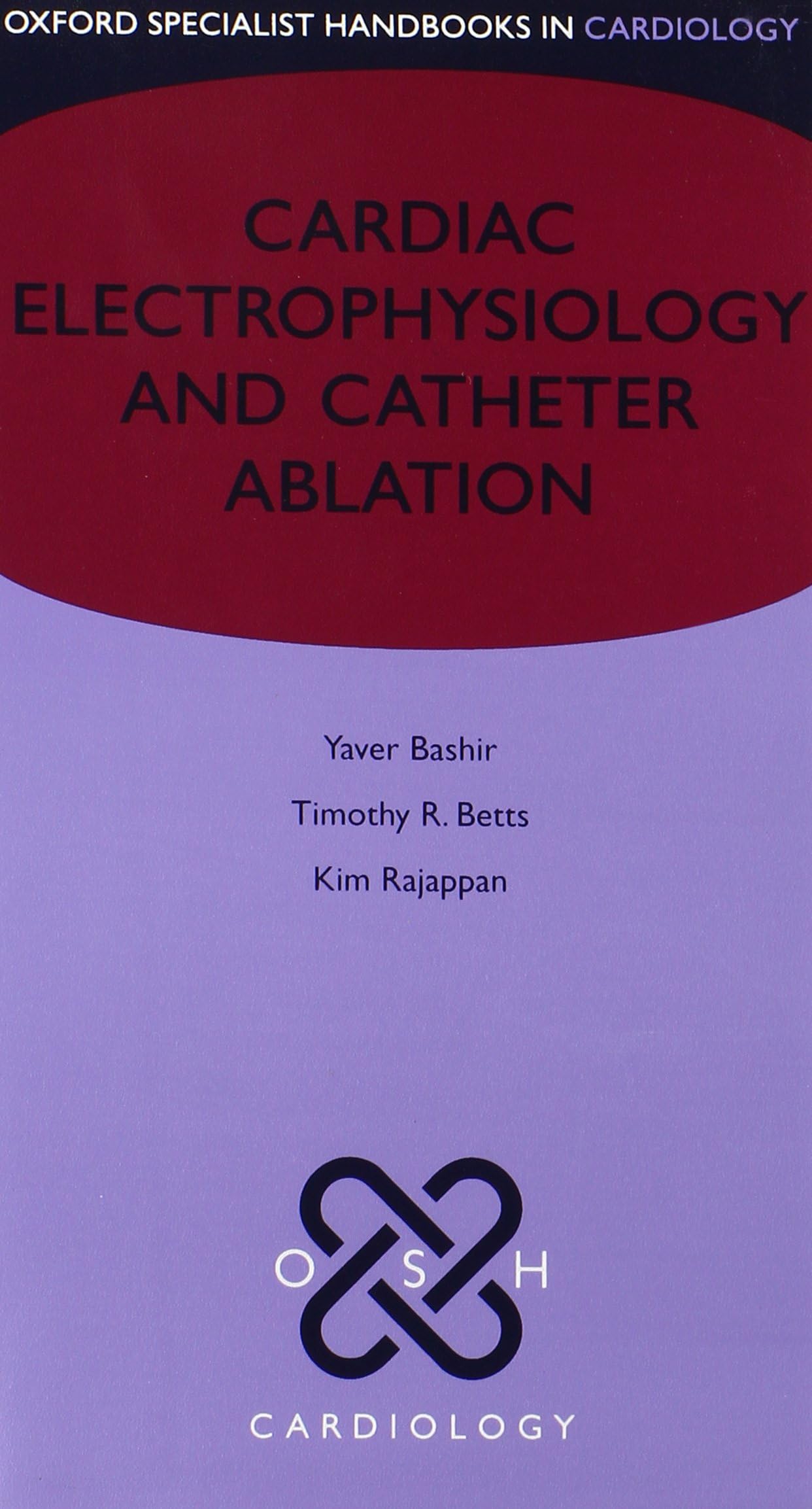

Cardiac Electrophysiology and Catheter Ablation (Oxford Specialist Handbooks in Cardiology)
Product ID: 52705483
📚Comprehensive Guide
🔬Cutting-Edge Research
🩺Expert Insights
Desertcart purchases this item on your behalf and handles shipping, customs, and support to Senegal.
📖 Elevate Your Cardiology Game with Expert Knowledge!
The 'Cardiac Electrophysiology and Catheter Ablation' handbook is a definitive resource published on June 24, 2010, designed for cardiology professionals. It offers in-depth coverage of electrophysiological principles, catheter ablation techniques, and practical applications, making it an indispensable tool for enhancing clinical practice.
| Best Sellers Rank | 2,001,855 in Books ( See Top 100 in Books ) 1,699 in Medical Research & Equipment 16,499 in General Medical Issues Guides 30,445 in Medical Sciences A-Z |
| Customer reviews | 4.7 4.7 out of 5 stars (17) |
| Dimensions | 18.42 x 2.29 x 10.16 cm |
| Edition | 1st |
| ISBN-10 | 0199550182 |
| ISBN-13 | 978-0199550180 |
| Item weight | 318 g |
| Language | English |
| Print length | 576 pages |
| Publication date | 24 Jun. 2010 |
| Publisher | OUP Oxford |
A**R
Same as a new book
Really a new book & not used
D**S
Excellent Delivery
I liked it most.....
I**4
great little book
I wish I had bought this years ago, very handy reference book and very easy to read. Can not recommend it enough :-)
L**T
Great reference!
This is a great reference. It really has bulk of what you need to know about EP from a user perspective in a handy pocketbook format! It's an easy to use reference to specific chapters and dip in and out of it. It's also handy to have the ribbons built into the book to use as bookmarks. My only criticism would be the lack of color in the diagrams - without the color the point the authors are making isn't readily apparent. I've actually met the authors and they are highly experienced. There are some facts that are a bit out of date about one of the 3D mapping systems but they do a good job of giving a balanced perspective. This book was recommended to me by a physiologist whose colleagues use this as an EP bible!
A**R
Five Stars
Good read
S**K
Four Stars
the book to travel with
E**R
Review from Cardiology News, June/July 2011, Volume 14, Issue 5
Cardiac electrophysiology has always been a complex subspecialty in cardiology and this aspect often discourages trainees from becoming involved beyond a basic understanding. It is hard for the uninitiated to know where to begin when faced with one of the many large text books available on the subject. The Oxford Specialist Handbook on Cardiac Electrophysiology and Catheter Ablation lends itself perfectly to the beginner, whether trainee in cardiology or an allied professional including cardiac physiologists, nurses or radiographers. However it also provides sufficient depth and complexity to be a useful on a daily basis at any level as a companion in the electrophysiology laboratory, outpatient clinic or on the wards. The book is divided into four sections. The first covers essential background information on such topics as the electrical system of the heart and arrhythmia mechanisms. Also included is an introduction to invasive electrophysiology, the trans-septal puncture and 3-dimensional cardiac mapping. The second section provides a systematic approach to diagnostic testing in the electrophysiology laboratory with guides to investigating patient with narrow and broad complex tachycardias and assessing those patients at risk of sudden cardiac death or with bradycardias. Section three explores the epidemiology, anatomy and pathophysiology of commonly encountered arrhythmias and the final section gives a very practical step-by step approach to the ablation of these common arrhythmias and how to assess the success of the procedure. Throughout, the book is well illustrated with over 200 diagrams, fluoroscopic images, electrograms and anatomical maps. Although the electrograms are drawn rather than actual examples, they are of excellent quality. The middle part of the book contains colour copies of some of the illustrations which are particularly helpful as the black and white 3D maps are difficult to understand by those unaccustomed to using these systems. Overall this book provides a comprehensive guide to the investigation and treatment of supraventricular and ventricular arrhythmias. It is a highly useful day-to-day guide and may stimulate the reader to explore the subject further in the more traditional textbooks or wider literature when more detail is required. Dr David A Begley, Consultant Cardiologist/Electrophysiologist, Papworth Hospital.
J**S
Como becario de Electrofisiología, el libro es básico para sentarse ante el polígrafo y afrontar el estudio. Sin entrar en disquisiciones bibliográficas ni mecanísticas, aborda los tipos de arritmias, su diagnóstico diferencial y ablación, con trazados de ejemplo, y enfocados a resolver las dudas más básicas y trucos esenciales. Imprescindible para rotantes y becarios..
B**N
Very clear explanations. No beating around the bush with flowery words and straight to the point. Also, a very portable resource book with easy to look up pages. Thanks.
T**Q
Excellent and precisely written. Easy to read and retain. Start topics including EPS from scratch.
J**P
Escrito por profesionales que no esconden ni un solo truco fruto de muchos años de experiencia. Faltaba un libro de manejo práctico y situaciones de la vida real.
Trustpilot
3 days ago
2 weeks ago