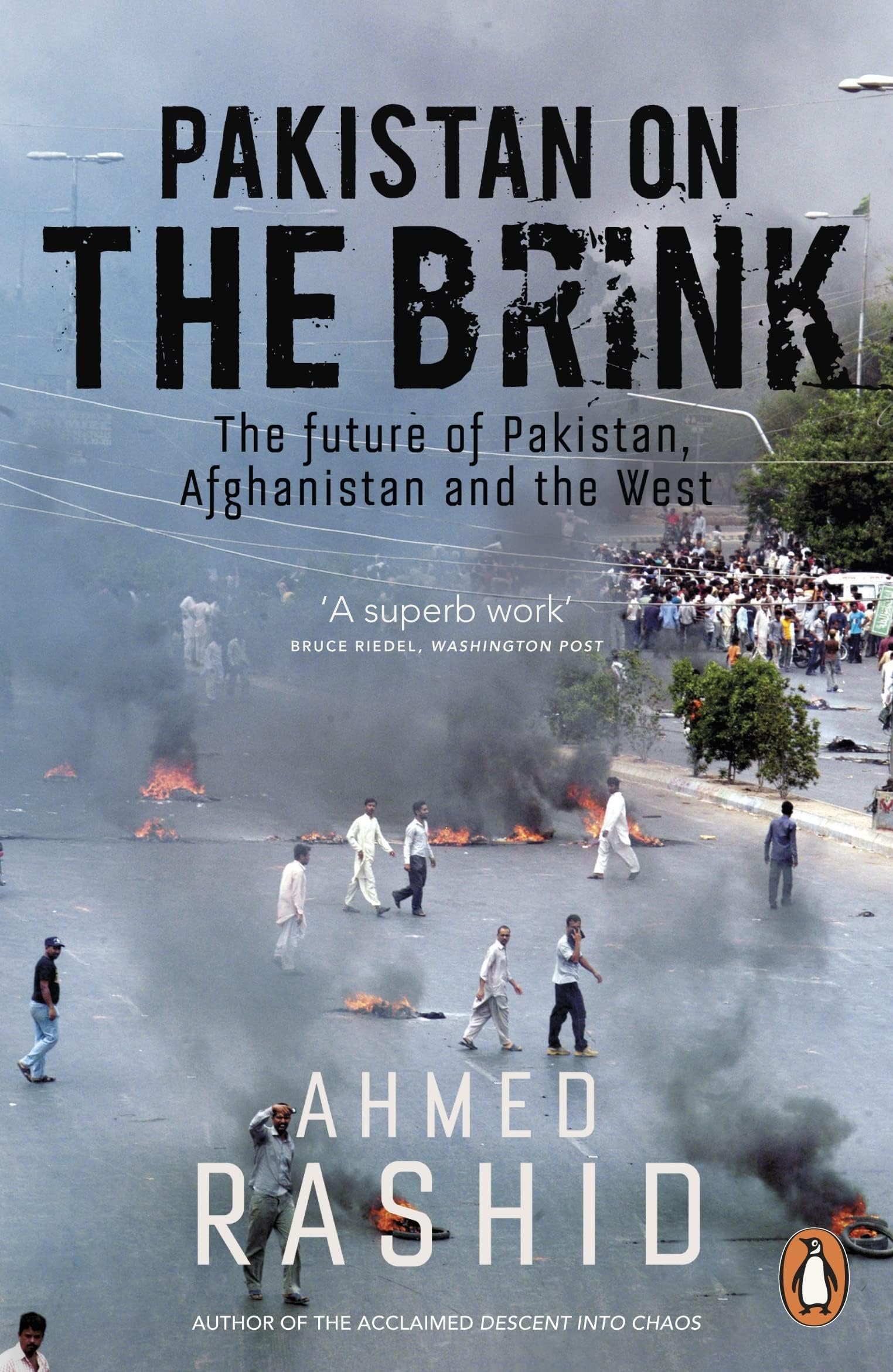
Pakistan on the Brink: The future of Pakistan, Afghanistan and the West
Product ID: 48562009
Desertcart purchases this item on your behalf and handles shipping, customs, and support to Senegal.
Ahmed Rashid, author of Descent Into Chaos and Taliban , charts the latest developments in the dangerous trajectory of one of the world's most strategically important, and volatile, countries - and the effects on its neighbours and us all 'An expert's examination of the volatile region that gives the world's policy-makers their biggest nightmare' Christina Lamb, Sunday Times What does the future hold for the world's most unstable region? With Bin Laden dead, Pakistan threatened by internal power struggles and the US and Britain beginning withdrawal from Afghanistan, there is no better guide the possibilities - and dangers -than Ahmed Rashid. In his follow-up to Descent into Chaos, he examines the changing casts of characters in this story, the future of the Taliban and international terrorism, and the political manoeuvring both within Pakistan and Afghanistan and among Western allies, offering a way forward for all countries involved. Ahmed Rashid is a Pakistani journalist based in Lahore, who has covered Afghanistan, Pakistan and Central Asia for a variety of publications since 1979. He is the author of five books - the best selling Taliban, Descent into Chaos: The US and the Disaster in Afghanistan, Pakistan and Central Asia , Jihad and The Resurgence of Central Asia . He writes for the Financial Times , the New York Times , the New York Review of Books , , BBC Online and Pakistani publications. Foreign Policy magazine chose him as one of the world's most important 100 Global Thinkers in 2009 and 2010. In 2008 he won Spain's prestigious Casa Asia prize for contributing most about Asia to the Spanish people.The following year he was presented with the prize for best columnist in the Spanish press by King Juan Carlos at a dinner honoring him. In December 2009 he was appointed a member of the board of New York's Committee to Protect Journalists. He has also served on the Board of Advisers for the International Committee of the Red Cross for five years. His books have won numerous prizes. His website is: www.ahmedrashid.com 'This excellent book provides a much-needed update on what has happened in Afghanistan and Pakistan ... Rashid has an eye for the big picture as well as a journalist's nose for detail' Daily Telegraph 'A powerful and pacey primer' Spectator 'A meticulous, reliable and authoritative chronicler ... Unlike many journalists Rashid has the courage to outline how he believes the catastrophic situation in his homeland (Pakistan) and its neighbour, Afghanistan, can be improved' Jason Burke, Observer Review: Detailed Contemporary Portrait of a Troubled Region - By the authors admission, the chapters of this book are essentially standalone essays. With that said, they complement each other very well, and when read as a whole the book provides a detailed briefing on the current state of play between Pakistan, Afghanistan and the West. I have no doubt that Ahmed Rashid's knowledge of his topic extends to the highest level, and as you'll see when reading the book, it has allowed him a unique level of access to key politicians and policymakers. Yet the book makes for a very accessible read with little need for any specialist knowledge prior to reading. For the potential reader: the historical context of the issues discussed is only briefly touched upon (if at all), but this is perhaps a strength, and no doubt a deliberate decision by the author, in pursuit of a concise portrait of the contemporary situation and likely prospects for the future. Of particular merit: The opening chapters are notable for their coverage not only of Pakistan (as their titles would suggest), but of the deep and complex relationship between Pakistan and Afghanistan, and go a long way to helping us understand why the road to peace in Kabul runs largely through Islamabad, as they say. Chapter four concentrates on the failure to hold free and fair elections and establish legitimate governance in Afghanistan, and the necessity of doing so if any real progress is to be made. Pakistan's sectarian geography and the preponderance of the Taliban in certain areas had meant that electoral turnout among certain groups was virtually non-existent: one of the key factors behind the military surge into Taliban-controlled areas of southern Afghanistan prior to the 2010 parliamentary election. The fifth chapter illustrates the intense infighting in Washington over policy in and for Afghanistan, and levels a strong critique of ISAF strategy, arguing that the strong focus on Helmand may have been detrimental. Rashid posits that a more sound strategy would have been to fully secure Kabul and then gradually expand outwards. In the concluding chapter, Rashid offers his analysis of what the future might hold. Commenting on states of Central Asia (Kyrgyzstan, Tajikistan, Uzbekistan), India and China, and also Iran, the author illustrates the wider regional picture, detailing what is at stake for these countries and what their roles might be in moving forward. The Arab Spring, although geographically distant from Pakistan, is argued as a potential threat should a similar sentiment take root among Pakistan's jobless and frustrated youth, while the threat of sectarian revolt and the detrimental impact of 'capture or kill' raids are also covered. Ahmed Rashid's book excels by not focusing on the particular details of one country or the other, but in analysing them together, on the basis that their futures are intractably linked. Rashid's key contention is that in many ways Pakistan's current position is more perilous than that held by Afghanistan, and that, following Richard Holbrooke's footsteps, Washington and the West must rethink their current strategy toward Pakistan, for the status of Pakistan's fragile democracy is perhaps the key arbiter of Afghanistan's prospects for a stable and democratic future. Review: Readable, journalistic, informative - Useful background reading to supplement the thin reporting of the mass media. Readable and not too long (212pp). Notes refer mainly to journalistic sources and are quite informative, though no bibliography as such. Some handy maps. I would read other works by this writer to improve my knowledge of current affairs.
| Best Sellers Rank | 1,008,977 in Books ( See Top 100 in Books ) |
| Customer Reviews | 4.2 out of 5 stars 165 Reviews |
R**P
Detailed Contemporary Portrait of a Troubled Region
By the authors admission, the chapters of this book are essentially standalone essays. With that said, they complement each other very well, and when read as a whole the book provides a detailed briefing on the current state of play between Pakistan, Afghanistan and the West. I have no doubt that Ahmed Rashid's knowledge of his topic extends to the highest level, and as you'll see when reading the book, it has allowed him a unique level of access to key politicians and policymakers. Yet the book makes for a very accessible read with little need for any specialist knowledge prior to reading. For the potential reader: the historical context of the issues discussed is only briefly touched upon (if at all), but this is perhaps a strength, and no doubt a deliberate decision by the author, in pursuit of a concise portrait of the contemporary situation and likely prospects for the future. Of particular merit: The opening chapters are notable for their coverage not only of Pakistan (as their titles would suggest), but of the deep and complex relationship between Pakistan and Afghanistan, and go a long way to helping us understand why the road to peace in Kabul runs largely through Islamabad, as they say. Chapter four concentrates on the failure to hold free and fair elections and establish legitimate governance in Afghanistan, and the necessity of doing so if any real progress is to be made. Pakistan's sectarian geography and the preponderance of the Taliban in certain areas had meant that electoral turnout among certain groups was virtually non-existent: one of the key factors behind the military surge into Taliban-controlled areas of southern Afghanistan prior to the 2010 parliamentary election. The fifth chapter illustrates the intense infighting in Washington over policy in and for Afghanistan, and levels a strong critique of ISAF strategy, arguing that the strong focus on Helmand may have been detrimental. Rashid posits that a more sound strategy would have been to fully secure Kabul and then gradually expand outwards. In the concluding chapter, Rashid offers his analysis of what the future might hold. Commenting on states of Central Asia (Kyrgyzstan, Tajikistan, Uzbekistan), India and China, and also Iran, the author illustrates the wider regional picture, detailing what is at stake for these countries and what their roles might be in moving forward. The Arab Spring, although geographically distant from Pakistan, is argued as a potential threat should a similar sentiment take root among Pakistan's jobless and frustrated youth, while the threat of sectarian revolt and the detrimental impact of 'capture or kill' raids are also covered. Ahmed Rashid's book excels by not focusing on the particular details of one country or the other, but in analysing them together, on the basis that their futures are intractably linked. Rashid's key contention is that in many ways Pakistan's current position is more perilous than that held by Afghanistan, and that, following Richard Holbrooke's footsteps, Washington and the West must rethink their current strategy toward Pakistan, for the status of Pakistan's fragile democracy is perhaps the key arbiter of Afghanistan's prospects for a stable and democratic future.
J**C
Readable, journalistic, informative
Useful background reading to supplement the thin reporting of the mass media. Readable and not too long (212pp). Notes refer mainly to journalistic sources and are quite informative, though no bibliography as such. Some handy maps. I would read other works by this writer to improve my knowledge of current affairs.
M**S
The book is disappointing and I hate to say this because Ahmed Rashid is a very ...
The book is disappointing and I hate to say this because Ahmed Rashid is a very likeable person. However, the books is extremely dull, dreary and lacking coherence. The author seems to criticise the Pakistani military establishment for distinguishing between good and bad Taliban whereas simultaneously suggesting that the only way to have peace in Afghanistan is by cutting a deal with the Taliban. This might just be sub-conscious but it shows that this hasn’t been thought through. To find this a tolerable read, you really have to be deeply interested in the subject of Afghanistan and the tragedy of the Pakhtuns that they find themselves divided between two states. Perhaps because the author is Pakistani, he seems to be unable to see (or is unwilling to see) that the long term “solution” lies in weaning Pakhtuns away from fundamentalism promoted by the Pakistani military and towards ethnic nationalism. This means that the Pakhtun areas south of the Durand line must be unified with Afghanistan in a single unified state. This would bring the chaos and destruction to an end. But it is precisely the fear of this which makes the Pakistani military continuously fuel fundamentalism for its own ends – with disastrous consequences for Pakistan itself.
J**Y
Rashid delivers again.
As I have come to expect from this author, this is a thought provoking, intelligent and very informative update on the situation in Pakistan and Afghanistan. It is also a deeply personal account with a compassionate voice reasoning for democracy flowing through each chapter. The final chapters where Rashid contrasts the irrationality of much of what is happening in Pakistan (the blasphemy law being an extremely illuminating example) with the potential of developing as a balanced nation state along the lines of Turkey, with good trade relations with neighbours and working democratic institutions, tie many loose ends together. An impressive and very acessible book.
M**N
great
great
J**D
Interested in Pakistan?
If you are interested in Pakistan's recent history and its future, read this book. You will probably feel depressed after your read - although perhaps you feel like this about Pakistan already. You might develop your own ideas about the best way the country could move forward, as I did.
A**R
Very informative and interesting
A very interesting read
W**I
This book is well written and as far as I ...
This book is well written and as far as I can tell well researched. The downside really is that a lot of the text is only relevant to the time it was written, this is because it's essentially a collection of news-like articles looking at factors and situations from a specific moment in time (the time the author is writing at). If I'd have bought this book 4-5 years ago I probably would have found it incredibly beneficial to read but now things have moved on and most of it's observations about the 'present situation' or 'what will likely happen next' are no longer relevant.
C**A
come al solito, esauriente
come gli altri testi di Ahmed Rashid sulla questione Af-Pak, anche questo molto esauriente, d'altronde Rashid è uno dei massimi esperti in materia
A**R
Informative and Insightful
This book is very informative, gives you good insight into what happened in this region of the world in the period of 5-7 years that this book covers. The author has given detailed account of what all the regional/global players were up to. You can't get this much info just by watching news, they are generally myopic. However, this book covers the length and breadth of events in Pak in such detail that you can put the pieces together and try and understand the overall picture.
F**R
Guter Überblick
Das Buch gibt einen guten und kritischen Überblick über die Interessen und Strategien der wichtigsten Akteure Pakistan, Afghanistan, Indien und der USA. Es ist spannend geschrieben und gut strukturiert.
S**Y
Excellent insight into a real problem
Having finally finished reading the book, I find that the book is a high resolution insight into specific problems related to Pakistan and Afghanistan. The author has high credibility due to his years of work on the subject. The book details exactly why it will be difficult to achieve peace in Afghanistan. Pakistan's involvement has been relatively recent in the long history of Afghanistan. The Soviet invasion of Afghanistan gave Pakistan new ideas and all of these have failed consistently. In spite of the failure to achieve "strategic depth" over the past few decades, Pakistan continues to pursue a path that has extremely high risk. At risk is the well being of the country itself... For Pakistan, it's almost as if the globalization of the late 80s and 90s didn't happen at all. The country failed to create new industries, generate new power or strengthen civilian government. Pakistan has a huge advantage in it's geographic location. Prior to the land grab of 1947, traders of Sindh and Punjab actually played a huge role in the Asian markets. Their trading activities and connections with other wonderful empires (Persian, middle eastern, etc.) is well documented. But the creation of Pakistan, the destruction of it's minorities, the radicalization of it's people, the destruction of it's middle class, the destruction of it's agricultural class over the past 40 odd years has taken a toll. Anyone who was capable of true governance (the Sikhs, Sindhis and Tribal elders in NWFP and Balochistan) have all be killed, converted or driven out of the country. The lesson here is that countries cannot be created simply on the ideals of hatred. The author ends with an interesting example of Turkey. Turkey made a smooth transition from a military government to a civilian government. It's an Islamic country with high tolerance for it's minorities and lives at peace with it's neighbors. There was a time when Pakistan viewed Turkey as a role-model. They've gotten very far from it.
さ**ん
アフガニスタン・パキスタンの近況と展望
本書には、オバマ政権以後のアフガニスタンとパキスタンの状況に関する9つのエッセイが収められています。オバマ政権誕生時には、アフガン問題の解決に向けて大きな期待が寄せられていましたが、現実には、アフガン・タリバン、パキスタン・タリバン、ハッカーニ・ネットワーク、パキスタン軍、パキスタン政府、アメリカ軍とCIA、ホワイトハウスと国務省が、それぞれの思惑である時は協力し、ある時は足を引っ張り合ってきた実態を著者は明らかにしています。また、この混乱に乗じたアル・カイーダ系過激派についても述べられており、その脅威はこの地域だけとは限りません。著者のオバマ、カルザイ、ザルダリ各政権に対する評価は厳しく、最後の章は、2014年に予定されているアメリカ軍とNATO軍の撤退に向けて各政権がすべきことは何かで締め括られていますが、その内容は前著のDESCENT INTO CHAOSとあまり代わり映えせず、結局、この問題の解決が、多少の進展は見られるものの、遅々として進んでいないことがわかります。アフガン問題の重要性を再認識するためにも、一読をお薦めします。
Trustpilot
2 months ago
2 weeks ago