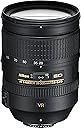
Desertcart purchases this item on your behalf and handles shipping, customs, and support to Senegal.
📸 One lens to rule your entire shoot — zoom, stabilize, and focus like a pro!
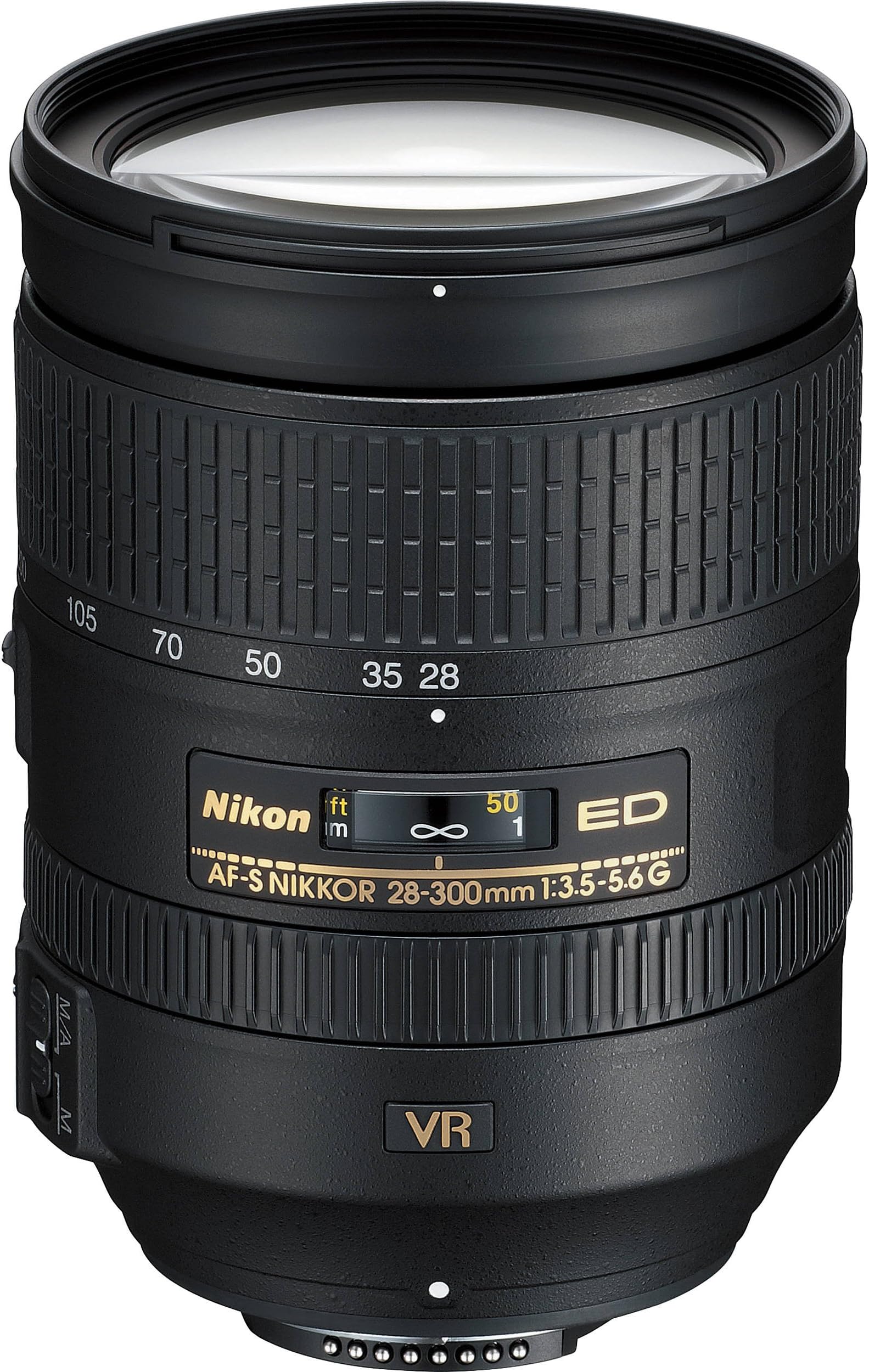
The Nikon 2191 AF-S NIKKOR 28-300mm f/3.5-5.6G ED VR Lens is a powerhouse super-zoom designed for Nikon DSLR users who demand versatility without compromise. Featuring a 10.7x zoom range, advanced Vibration Reduction for up to 3.5 stops of shake correction, and a Silent Wave Motor for quiet autofocus, this lens excels in both full-frame and DX formats. Enhanced with Extra-low Dispersion glass and Nano Crystal Coating, it delivers sharp, vibrant images with minimal distortion and flare. Weighing just 800 grams, it’s the perfect all-in-one travel companion for professionals and enthusiasts alike.


| ASIN | B003ZSHNEA |
| Best Sellers Rank | 79,823 in Electronics & Photo ( See Top 100 in Electronics & Photo ) 856 in Camera Lenses |
| Box Contents | AF-S FX NIKKOR 28-300mm f/3.5-5.6G ED Vibration Reduction Zoom Lens for Nikon DSLR Cameras, CL-1120 Soft Lens Case, HB-50 Bayonet Lens Hood, LC-77 Snap-on Front Lens Cap, LF-4 Rear Lens Cap |
| Brand | Nikon |
| Brand Name | Nikon |
| Camera Lens | The Nikon AF-S NIKKOR 28-300mm f/3.5-5.6G ED VR Lens is a versatile zoom lens with a 10.7x FX-format zoom range, covering focal lengths from 28 to 300mm. It features a constant maximum aperture of f/3.5-5.6, with Nikon's Vibration Reduction system for up to 3.5 shutter speed, enabling blur-free handheld shooting. The lens is equipped with a Silent Wave Motor for accurate and quiet autofocus, and i… |
| Camera lens description | The Nikon AF-S NIKKOR 28-300mm f/3.5-5.6G ED VR Lens is a versatile zoom lens with a 10.7x FX-format zoom range, covering focal lengths from 28 to 300mm. It features a constant maximum aperture of f/3.5-5.6, with Nikon's Vibration Reduction system for up to 3.5 shutter speed, enabling blur-free handheld shooting. The lens is equipped with a Silent Wave Motor for accurate and quiet autofocus, and includes two Extra-low Dispersion elements to control chromatic aberrations. It also features Nikon's Super Integrated Coating and Nano Crystal Coat for enhanced light transmission and reduced flare. The lens is ideal for travel and outdoor photography, offering a balance of stability and versatility. Camera lens description The Nikon AF-S NIKKOR 28-300mm f/3.5-5.6G ED VR Lens is a versatile zoom lens with a 10.7x FX-format zoom range, covering focal lengths from 28 to 300mm. It features a constant maximum aperture of f/3.5-5.6, with Nikon's Vibration Reduction system for up to 3.5 shutter speed, enabling blur-free handheld shooting. The lens is equipped with a Silent Wave Motor for accurate and quiet autofocus, and includes two Extra-low Dispersion elements to control chromatic aberrations. It also features Nikon's Super Integrated Coating and Nano Crystal Coat for enhanced light transmission and reduced flare. The lens is ideal for travel and outdoor photography, offering a balance of stability and versatility. See more |
| Colour | Black |
| Compatible Camera Models | Nikon D3500, Nikon D5600, Nikon D7500, Nikon D850 |
| Compatible Mountings | Nikon F |
| Compatible mountings | Nikon F |
| Customer Reviews | 4.5 out of 5 stars 973 Reviews |
| Exposure Control Type | Automatic |
| Fixed Focal Length | 300 Millimetres |
| Focal length description | 28 à 300 millimeters |
| Focus Type | Auto Focus |
| Global Trade Identification Number | 00018208021918 |
| Has Self-Timer | No |
| Image Stabilization Type | Optical |
| Item Part Number | JAA808DA |
| Item Weight | 800 Grams |
| Lens Coating Description | Super Integrated Coating |
| Lens Design | Zoom |
| Lens Mount | Nikon F |
| Lens Type | Zoom |
| Lens type | Zoom |
| Manufacturer | Nikon |
| Manufacturer Part Number | JAA808DA |
| Maximum Aperture | 5.6 f |
| Maximum Focal Length | 300 Millimeters |
| Maximum Shutter Speed | 7.5 seconds |
| Maximum focal length | 300 Millimeters |
| Media Type | Picture |
| Minimum Aperture | 38 |
| Minimum Focal Length | 28 Millimeters |
| Model Name | AF-S 28-300 mm f/3,5-5,6 ED VR |
| Model Number | 2191 |
| Model Series | AF-S NIKKOR |
| Number of Diaphragm Blades | 9 |
| Number of Items | 1 |
| Number of Packs | 1 |
| Photo Filter Size | 77 Millimeters |
| Real Angle Of View | 53 Degrees |
| UPC | 018208021918 017854565456 |
| Viewfinder Type | Optical viewfinder |
| Water Resistance Level | Not Water Resistant |
| Zoom Ratio | 10.71:1 |
V**R
Great lens, worth every penny!
I have two Nikon D7000 cameras, a Nikon 35mm F1.8 prime, a Nikon 50mm F1.8 prime and also the Nikon 18-200mm VR lens. After careful consideration, reading the reviews and looking at the images taken by others, I decided to buy the Nikon 28-300mm because I hope to upgrade at some point to a full frame camera like the Nikon D4 and this lens can be use on both full frame and DX models. The D7000 is a DX camera so with the crop factor the Nikon 28-300mm becomes efectively a zoom of 42-450mm (with reference to the 35mm film format). I have read some negative reviews regarding this lens with comments like, It's too big and heavy, lens creepage when tilted downwards, lens distortion at both ends of the zoom range and that the focus is soft. Ok let's take a look at these points of criticism:- Yes, if you are only use to the standard kit lens like the 18-55mm, then this lens will seem big and heavy to you, but remember this is a super zoom lens and it has a lot of glass in it to do what it does and although it is has a weight to it, I found it not to be so heavy as to be uncomfortable to use and on the D7000 I find the balance to be good overall. Another point to consider that you don't have to carry a load of other lenses with you to cover the range of zoom that this lens covers, so as a walk about lens this lens is great. What about lens creep? I have never experienced it myself on either the 28-300mm, or the 18-200mm, in any case Nikon now includes a zoom lock on the lens, so there should not be a problem when the lens pointing downwards in one's camera bag. What about lens distortion? If you have a Nikon D7000, there is an option in the camera's menu settings, switch the `Auto Distortion Control' to `ON' and the distortion is virtually eliminated. If your camera does not have this option you will see some barrel distortion and maximum zoom and pincushion distortion at the wide-angle setting, depending on the subject you are photographing. If it is objectionable one can always correct it in your photo editing software. Remember no zoom is perfect, top professional lenses are better and have less distortion, but they cost a whole lot more and their zoom range is far more limited. What about lens sharpness? The colour rendition and contrast of the 28-300mm (and 18-200mm) I find to be as good as my prime lenses, the prime lenses are a little sharper when stopped down, but the difference isn't that great in reality and if the image is found to be a little soft one can easily correct this with your photo editing software. People may comment that their prime lens is a lot sharper, but then their prime lens cannot zoom from 28-300mm can it now? A top professional lens will perform better if you can afford it, but their zoom range is a lot more limited and you will need two or more lenses to cover the zoom range that this lens covers. Overall, I find the lens sharpness to be good throughout the zoom range, both on the 28-300mm and the 18-200mm and when you consider the range of this zoom, I think Nikon have done a really good job and that why I give five stars in this review. One really big advantage with this super zoom is that one can go from wide to full zoom instantly and so never miss a shot. Another advantage is that you don't have to carry a bag full of lenses with you and because one is not changing lenses all the time, there is less risk of dust getting into your camera to contaminate you camera's sensor. What about Bokeh, those nice blurred backgrounds? Bokeh is limited due to the relatively small maximum aperture of this lens, if Bokeh is of critical importance, one could purchase a prime lens with a maximum aperture of F1.8 or better, or a zoom with a maximum aperture of F2.8, however such zooms tend to be very expensive. Which zoom should I get for my DX camera, the 28-300mm, or the 18-200mm? If one is not planning to go to the full frame format, I would recommend the Nikon 18-200mm, if you do decide to go for the Nikon 28-300mm for use on a DX camera, one will also need a wide angle lens in addition to the 28-300mm. If you already own a the standard kit lens such as the Nikon 18-55mm, this will help cover the wide angle side of things. If one is going to upgrade to the full frame format, then I would recommend the 28-300mm. Whatever lens you go for, make sure that you put a good quality lens protector such as the Hoya Pro 1 Digital MC Protector. This is a low profile, multi-coated filter which will protect your expensive glass. I have come across people who have used a cheap filter, which is not even multi-coated and they wonder why they get poor results. Is the Nikon 28-300mm (and the Nikon 18-200mm) worth the money? Every penny in my view, especially if you can acquire it at a good price.
P**R
What a great lens!
I must admit up-front that I am newly digital, so I may have my quirks and strong opinions being a very very late convert from manual SLR film cameras... I guess I always liked the medium and had real trouble letting go. The D800 I own is as good as any of my film kit though, no its better, and that was hard for me to acknowledge at first until I actually held it in my hands and shot with it. This little lens is the perfect partner for my medium format FX digital camera, so if you buy one lens let this one be it... Why? Because it offers unmatched versatility in focal length and portability without compromising as much as you might expect in the results, while saving you loads of money on building a collection of lenses that in my view don't justify the cost vs benefit factor... simply put you broadly covered with this lens, and its stunning quality: - Its surprisingly small and compact, it weighs only about 1kg and is solid and well built... ideal for event photography, or outdoors. - Excellent at low light, it really performs beyond my expectations, although the full frame format does help here. - Sharp throughout, and fast, excellent autofocus - 28-300, that's amazing versatility! Unmatched maybe, when you consider how short and compact a lens it is... This means it is the perfect lens for landscape and wedding photography, and also performs exceptionally at both ends of the range so I can't really fault it! - Some minor criticism I have read were unfounded in my view... Thinking theoretically about low light, speed and bokeh I also went and bought the AF-S NIKKOR 50mm f/1.4G prime lens believing I wouldn't have this area covered properly... That 50mm prime is also a superb lens, its supposed to be unmatched in low light, however after using both these lenses in anger I am hard pressed for a real reason to switch lenses when shooting to my 50mm lens because the quality and speed of this lens is generally close enough to that one... On that note someone else also mentioned it doesn't achieve the desired bokeh, but I find the results actually very pleasing and comparable to using my 50mm prime when at full aperture in aperture priority mode, and you have the added benefit of a faster autofocus and VR... trust me its pretty good, so unless you the fussy type and nit pick about fractions and theoretical margins, you won't be disappointed. - Everyone has a preferred style of working, one thing I love about a lens like this is having the benefit of being able to adjust my focal length incrementally as I please, its not everyone's deal I know, but my experience with portraits is that especially between adults and children I do sometimes like some variation in focal length to get the most pleasing result I love this lens, what a bargain in my view!
D**E
Good walk-around lens
I've had this lens for a couple of months now, and used it quite a bit on my D610 camera. I've been very pleased with it. Because it covers such a wide range of focal lengths it can be the only lens you need when out for the day. I do quite a bit of hiking and switch between landscape and wildlife shots. Because this lens can do both wide angle and telephoto I'm ready for anything. Often you miss a shot because of the need to change lenses - not with this one. Are there downsides to such an enormous range of focal lengths? Of course. The lens is probably not quite as sharp as more limited range zooms or prime lenses, and there's a lot of distortion. The latter is easily corrected either by the camera if you shoot jpeg, or in post-processing if you shoot raw (I use Lightroom). The slightly lower sharpness might put off "pixel peepers" who will blow up their pictures to enormous magnifications and look at small details. However, if like I do you think that a good photograph is made through good composition and capturing the right moment, then this lens does a perfectly good job. The maximum aperture of f3.5 at the wide end and f5.6 at 300mm means it's not great for low light, but the VR does give you at least a couple of extra stops so it's not a big problem. The main disadvantage is its size and weight. It can get heavy carrying it round all day (but so can carrying a bag of different lenses). Because it's so big, it's not very discreet. For city photography I tend to prefer a couple of prime lenses. To sum up, if you want a lens that more or less covers all the focal length range you need, and you're interested in taking interesting photographs rather than in technical details like ultimate levels of sharpness, buy this lens and you won't be disappointed.
M**S
Versatile lens and great fun to use
I use this lens as a hobbyist but also for my business to take product shots. I am very happy with the image quality but more than anything I love the versatility and not having to change lenses often. Obviously it doesn't let as much light in as primes so you do need to watch your shutter speeds, it's easy to get camera shake at longer focal lengths. VR does help with that but you'll find it eats the battery life quite quickly. In the studio it is fantastic for product shots where I can zoom in and out in Liveview to frame the subject perfectly. For my purposes the sharpness is sufficient and I am hard pushed to tell the difference between shots taken with this versus a prime but then I'm not obsessive about image quality. Overall I highly recommend this lens. The only downside is the weight, when I switch back to say a 35mm prime my D750 suddenly feels as light as a feather!
D**S
Nikkor 28-300 mm
Having reviewed many opinions on this lens, I was swung by Ken Rockwells review and it appears people have warmed to this lens! I've mounted on a D800 and have capture some great shots so far! Even at 300mm to capture a Robin on a postbox from a fair distance. It's heavy but I think it's worth the money and I like the fact that you can leave the lens on all day in most environments ! I like the lock function at 28mm to just point and shoot, focus speed is not lightning quick but for what I use the camera for its perfect! I'm not a pro but at my level I would highly recommend.
I**E
Nikon AF-S 28 - 300mmm
The delivery of this item was first class and the quality of packing to protect the product over and above Nikon's packaging was very good. When I had opened the package I was delighted with the obvious quality of the item. Now having used it for a while, I am delighted with the results and although the limited bottom end f-stop at 3.5, this lens allows me to fit it to my full frame camera body. With the range of 28 - 300 it means that on a casual day out I do not have to carry all my other lenses. I, just yesterday, read an article in Professional Photographer magazine passed to me by my son. This was an issue recommending gear for Christmas and this lens was highly recommended for build quality design and results. Can't argue with any of the comments made, I am still very happy.
T**S
Great, versatile and not too heavy.
Having just bought a D700 to partner my D300 I wanted an all purpose 'take anywhere' FX lens. This lens is of course a compromise covering the vast range of 28mm to 300mm yet for my purposes it provides me with the quality of pictures i want, and more importantly the camera is always available without the last minute need to change lens. I love it and will use it extensively in my world travels where many shots are taken in poor or almost non existent light (hence the wonderful D700). Great, versatile and not too heavy so far. Excellent value when bought through Amazon.
G**K
Accept the limitations and this is a fantastic lens
Having a lens that covers this range always has some compromises. Put that aside and this is a traveller dream unless you need a light lens, it does everything very well rather than superbly. Focus is quick rather than fast, the ability to go 28 to 300 is amazing and at either end you have images that are very good, play a bit and they are excellent. It will never match a batch of prime lenses of a couple of f2.8 zooms, but for the money & convenience it is a very, very good lens. Just remenber it is 0.8kg.
I**K
USEFUL LENS
I've been using the new Nikkor 28-300 for a while on my D700 for almost 90% of my work, and am very happy with it. This lens produces very sharp and contrasty pictures with lots but easily corrected distortions; is solid build, reliable and especially useful for walk around and travel photography without changing lenses. Doing this last in the middle of a trip means dust spots in your fragile sensor and waste of valuable time. I have read mixed posts in the web about how excellent or how awful this lens is. Ken Rockwell says "This 28-300mm VR is Nikon's next gotta-have-it lens. It does everything, and it does most of it very, very well. The 28-300mm VR is much better than I expected". Other "specialists" categorize it as a lesser lens. So, what's going on here? I have compared my results (not scientifically, of course) against those of the very high ranked Nikkor 24-70 f/2.8, and, guess what? I get more keepers with the former. Why? With this I have a wider range of focal lengths, and its VRII image stabilizer allows me to hand hold the camera at quite low shutter speeds, neither of what the later can do. The 24-70 is a remarkable lens, no doubt, and at 70mm f/2.8, vs. f/5.0 at the same 70mm in the 28-300, there is a 1+2/3 EV's loss, but the VR stabilization compensates for some 3 to 4 EV's, and with the amazing low light performance of the D700, I can gladly exchange the f/2.8 luminosity for the 300mm usefulness. I only miss the f/2.8's "bokeh". I love photography; I've been behind a viewfinder for almost 50 years, and have used lots of cameras and lenses. My interest is in good photography, not technical oddities; even so, I like to use the best equipment I can get. The tests made by expert technicians are usually done in ideal lab conditions, with sturdy tripods, perfectly controlled illumination and still subjects. They are strictly correct and I can't argue with their results. But, if you are like me, listen to my advice: use the camera/lens combination that's useful and practical for you, and allows you to capture the very best photos, and this lens fulfills almost all of my needs and expectations. And remember that the lens and the camera are mere instruments; is your brain that creates the image.
F**R
Great lens, I use it for damn near everything ...
Great lens, I use it for damn near everything I shoot now, I use to juggle prime lenses trying to get the right zoom, missed tons of great shots in the process (especially weddings) since getting this baby its made photos a breeze, It has an intense zoom range for getting all distances. At weddings I like to be able to quickly snap to a moment and grab the shot. With prime lenses I was running and tripping over things to get a shot, now i just zoom like a sniper and bang got it. I have take shots with the 35mm the 50mm and 80mm prime lenses of 12 different scenarios then switched off and took the same shots with my 28-300mm and even after going into lightroom and zooming in I don't see a difference in detail whatsoever, if there is a difference its microscopic. The prime lenses focus speed was faster, thats what the big difference was for me and the aperture could could go much lower on the primes. I generally shoot all my business stuff around f/8 so I don't need super low apertures so it wasn't a problem for me. Overall I have sold my primes and only use this until something better comes out, Worth every penny!
T**Y
Havent used it much but great quaity
I only recieved this lens last week, and have not had much of a chance to use it. Just messing around at home though it seems to take tac sharp photos. The build quality is what you would expect from Nikon... Tough and always ready for action... Again I would only use this lens with a tripod as the weight of the lens and D780 gets heavy being handheld for any length of time... But seems to be a very good lens and looking forward to getting out to put it through its paces
M**I
Soddisfatto
Ha soddisfatto le apettative !
T**4
Polyvalent et performant, comme prévu
Voici un objectif que je possède depuis maintenant 3 mois couplé à mon D600. Ce que j'aime : - excellent piqué, dès la pleine ouverture - très lumineux - rapide - discret - range vraiment intéressant même si un 24 aurait été un plus sur le 28. - optique d'excellente qualité Ce que j'aime moins : - lourd pour un objectif de tous les jours - Pare-soleil de forme particulière ayant tendance à accrocher tout ce qu'il trouve dans le sac durant le transport - Vignettage quand même marqué à 28mm (facilement corrigeable en traitement DXO). - Distorsion marquée aussi à 28mm (idem) Bref je ne regrette pas du tout mon choix, préférant un seul objectif à un duo 24-70 70-300, d'une part plus onéreux et surtout plus encombrant, qui à terme décourage de prendre le 70-300 dès qu'on doit se déplacer...
Trustpilot
1 month ago
2 weeks ago