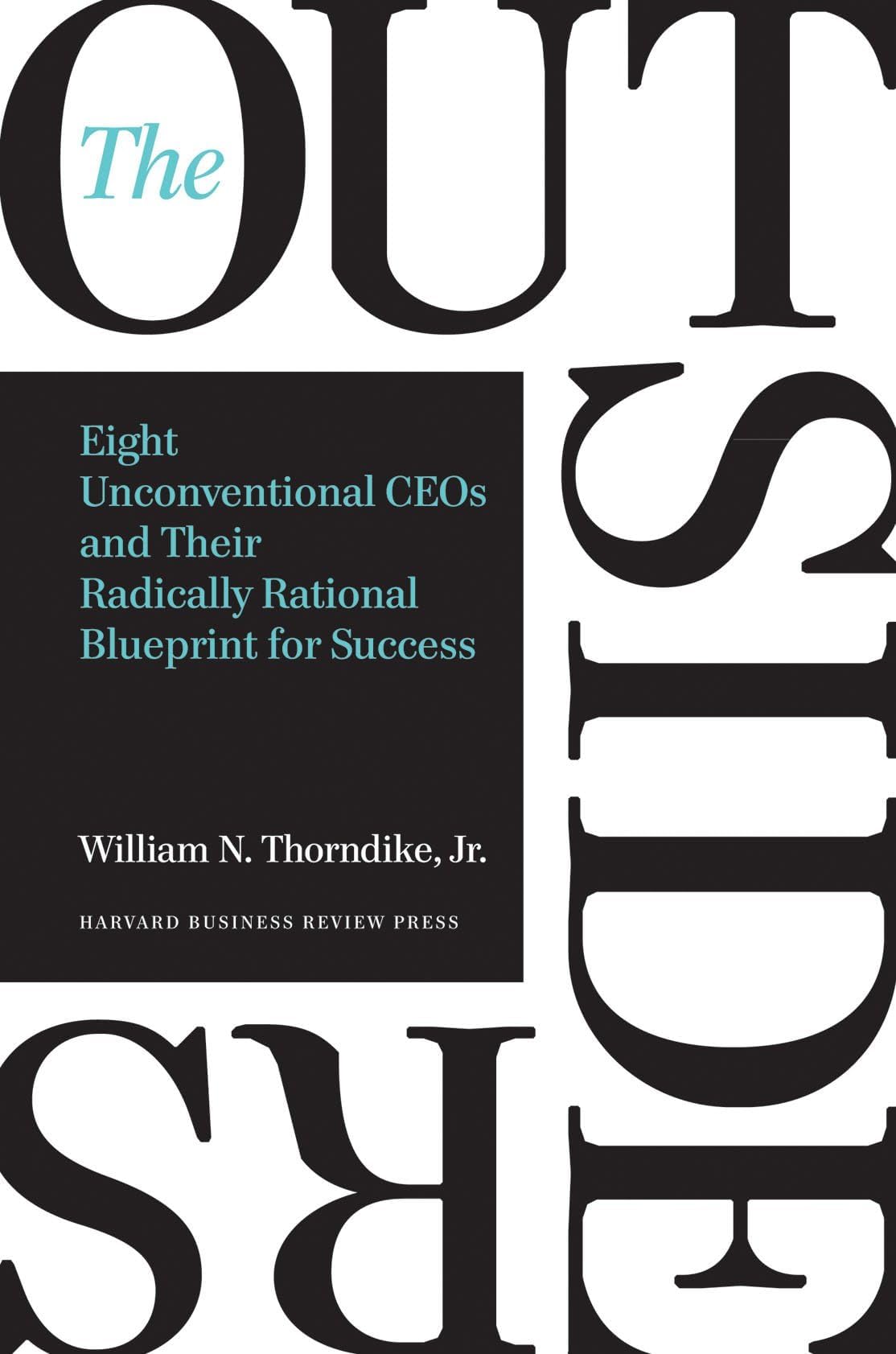
The Outsiders: Eight Unconventional CEOs and Their Radically Rational Blueprint for Success
Product ID: 4750130
Desertcart purchases this item on your behalf and handles shipping, customs, and support to Senegal.
An outstanding book about CEOs who excelled at capital allocation.” Warren Buffett #1 on Warren Buffett’s Recommended Reading List, Berkshire Hathaway Annual Shareholder Letter, 2012 Named one of 19 Books Billionaire Charlie Munger Thinks You Should Read” in Business Insider. A book that details the extraordinary success of CEOs who took a radically different approach to corporate management.” Charlie Munger, Vice-Chairman of Berkshire Hathaway Corporation Thorndike explores the importance of thoughtful capital allocation through the stories of eight successful CEOs. A good read for any business leader but especially those willing to chart their own course.” Michael Dell, chairman of the board of directors and chief executive officer of Dell What makes a successful CEO? Most people call to mind a familiar definition: a seasoned manager with deep industry expertise.” Others might point to the qualities of today’s so-called celebrity CEOscharisma, virtuoso communication skills, and a confident management style. But what really matters when you run an organization? What is the hallmark of exceptional CEO performance? Quite simply, it is the returns for the shareholders of that company over the long term. In this refreshing, counterintuitive book, author Will Thorndike brings to bear the analytical wisdom of a successful career in investing, closely evaluating the performance of companies and their leaders. You will meet eight individualistic CEOs whose firms’ average returns outperformed the S&P 500 by a factor of twentyin other words, an investment of $10,000 with each of these CEOs, on average, would have been worth over $1.5 million twenty-five years later. You may not know all their names, but you will recognize their companies: General Cinema, Ralston Purina, The Washington Post Company, Berkshire Hathaway, General Dynamics, Capital Cities Broadcasting, TCI, and Teledyne. In The Outsiders , you’ll learn the traits and methodsstriking for their consistency and relentless rationalitythat helped these unique leaders achieve such exceptional performance. Humble, unassuming, and often frugal, these outsiders” shunned Wall Street and the press, and shied away from the hottest new management trends. Instead, they shared specific traits that put them and the companies they led on winning trajectories: a laser-sharp focus on per share value as opposed to earnings or sales growth; an exceptional talent for allocating capital and human resources; and the belief that cash flow, not reported earnings, determines a company’s long-term value. Drawing on years of research and experience, Thorndike tells eye-opening stories, extracting lessons and revealing a compelling alternative model for anyone interested in leading a company or investing in oneand reaping extraordinary returns. Review: Must read for anyone managing money! - Brilliant read, well written and loaded with wisdom. This book must be mandatory reading material in all B-schools and for accountants / investment managers. Review: Extraordinary Book - As a businessperson, I have read many, many books over the years that have helped me hone my business thinking and become better at business. As an investor, I also have read so many books that have helped me become a better value investor. Rarely, however, have I found books that have helped me do both at the same time. Roger Lowenstein's book on Warren Buffett, Pat Dorsey's two books on creating protectable value in a business, Howard Mark's book on investing, perhaps the David Clark/Mary Buffet series on value investing, all come to mind. Mr. Thorndike's book not only falls into the third category, but has made its way to the top of my keeper list. it is simply extraordinary, and I could not recommend it more highly. Why did I like it so much? Because it explains, in the most straightforward of ways, in the clearest of prose, (1) the hallmarks of a good business (strong, steady, predictable cash flow, as the sine qua non and core focus), (2) the possible sources of cash and uses of cash in a business that taken together generate cash flow in simple algebra (sources less uses equals cash flow), (3) the strategies flowed by 8 business leaders in managing that flow of capital so that the math works out the right way, (4) the incredible similarities in the strategies pursued by these leaders in working with cash flow and the tight correlation to increases in shareholder value, (5) the mindset of these leaders that separated them from the pack, (6) the ability of this group to decentralize, tune out the outside noise and ignore the "institutional imperative" and (7) the common intense focus shared by these leaders on a small set of metrics (all pretty much proxies for measuring cash flow and thus return on equity. If I had to consolidate those conclusions into a single core principle that came through with crystal clarity for me in this book, it would be that strategic, rational management of cash flow against clear benchmarks may be the single highest priority for leadership in any business. And as a corollary, that so few businesses seem guided by an intense focus on cash flow with its corresponding contribution to shareholder value. I also was so impressed that the conclusions presented in the book were not simply the musings of a very intelligent thinker, but rather were grounded in the most thorough of research. I likely still would have found much of value even without the research foundation, but that aspect provided even more credence to the analysis presented in the book. I spent Saturday of Labor Day Weekend reading through this volume as if it were the latest action thriller (geeky, I know). I simply couldn't turn the pages quickly enough, and look forward to returning to its teachings time and time again. It will have a very important place on both my investing and business bookshelves in the years to come. As Mr. Thorndike says in an interview that I read after reading the book, it would be wonderful if the top business schools would teach more (or, perhaps at all) about management of cash flow as a critical business priority of the CEO that should never under any circumstances be delegated down or away. I think he may have well written the textbook.

| Best Sellers Rank | #7,051 in Books ( See Top 100 in Books ) #10 in Strategic Business Planning #13 in Systems & Planning #76 in Leadership & Motivation |
| Customer Reviews | 4.6 out of 5 stars 4,253 Reviews |
M**K
Must read for anyone managing money!
Brilliant read, well written and loaded with wisdom. This book must be mandatory reading material in all B-schools and for accountants / investment managers.
R**S
Extraordinary Book
As a businessperson, I have read many, many books over the years that have helped me hone my business thinking and become better at business. As an investor, I also have read so many books that have helped me become a better value investor. Rarely, however, have I found books that have helped me do both at the same time. Roger Lowenstein's book on Warren Buffett, Pat Dorsey's two books on creating protectable value in a business, Howard Mark's book on investing, perhaps the David Clark/Mary Buffet series on value investing, all come to mind. Mr. Thorndike's book not only falls into the third category, but has made its way to the top of my keeper list. it is simply extraordinary, and I could not recommend it more highly. Why did I like it so much? Because it explains, in the most straightforward of ways, in the clearest of prose, (1) the hallmarks of a good business (strong, steady, predictable cash flow, as the sine qua non and core focus), (2) the possible sources of cash and uses of cash in a business that taken together generate cash flow in simple algebra (sources less uses equals cash flow), (3) the strategies flowed by 8 business leaders in managing that flow of capital so that the math works out the right way, (4) the incredible similarities in the strategies pursued by these leaders in working with cash flow and the tight correlation to increases in shareholder value, (5) the mindset of these leaders that separated them from the pack, (6) the ability of this group to decentralize, tune out the outside noise and ignore the "institutional imperative" and (7) the common intense focus shared by these leaders on a small set of metrics (all pretty much proxies for measuring cash flow and thus return on equity. If I had to consolidate those conclusions into a single core principle that came through with crystal clarity for me in this book, it would be that strategic, rational management of cash flow against clear benchmarks may be the single highest priority for leadership in any business. And as a corollary, that so few businesses seem guided by an intense focus on cash flow with its corresponding contribution to shareholder value. I also was so impressed that the conclusions presented in the book were not simply the musings of a very intelligent thinker, but rather were grounded in the most thorough of research. I likely still would have found much of value even without the research foundation, but that aspect provided even more credence to the analysis presented in the book. I spent Saturday of Labor Day Weekend reading through this volume as if it were the latest action thriller (geeky, I know). I simply couldn't turn the pages quickly enough, and look forward to returning to its teachings time and time again. It will have a very important place on both my investing and business bookshelves in the years to come. As Mr. Thorndike says in an interview that I read after reading the book, it would be wonderful if the top business schools would teach more (or, perhaps at all) about management of cash flow as a critical business priority of the CEO that should never under any circumstances be delegated down or away. I think he may have well written the textbook.
E**O
Unique but Imperfect.
In my opinion, this is a book on Applied Corporate Finance. As those who ever took a Corporate Finance class know, the basic premise on which that discipline is built is Maximization of Shareholder Value. Well, this book is about exactly that. According to Corporate Finance theory, the maximization of shareholder value is achieved by following three principles -the Investment Principle, the Financing Principle, and the Dividends Principle. The Investment and Dividends Principles are what in the book the author calls Uses of Cash (Capital Allocation). The Financing Principle has more to do with what the author refers to as the Sources of Cash (asset divestitures, issues of equity/debt, etc). Questions related to operations efficiency are only covered superficially, but that's fine. From the get go, the author is honest about the focus and scope of the book. The book is unique in the sense that there are not many books on Corporate Finance case studies. This book is exactly that. Each of the CEOs/Companies profiled here is a separate case, dealt with in separate chapters. I like that. It is also a well-written, well-researched book. It is an entertaining read and, on top of everything, it has the endorsement of Warren Buffett. You cannot ask for much more than that. Oh wait! Yeah, the presentation is pretty nice. I like good looking, elegant hardcover books. Now, why am I holding back one star? See below: 1- The book is kind of dogmatic about certain rules deemed as universal (e.g., never pay dividends, never issue new shares, etc). If things were so simple, then Corporate Finance would not exist as a discipline. 2- The author kind of pounds on Jack Welch as someone who, even though successful, has not accomplished the same level of results that the CEOs included in his book did. Well, guess what, you cannot compare apples to oranges. Jack Welch was the CEO of GE. These other CEOs took over when their companies were very small, and completely unknown. I'm not saying the they do not deserve credit for what they accomplished. All I'm saying is that you cannot expect GE's stock price to grow at the same pace small cap stocks grow. Scale is important. So, when adding Jack Welch into the mix, the relevant question is no longer who grew the stock price the most, but who generated the most profits (in absolute dollar value) for their shareholders. Again, scale is important. It's not the same to be the president of the US than the president of Uruguay. I guess the ultimate goal of the book is not so much to teach Corporate Finance lessons but to help value investors select good CEO's. "Good" in this sense means CEO's who are focused on maximizing shareholder value in the long term. In other words, CEO's whose interests are in line with those of the owners of the company. Now, this might be an outdated approach since good Corporate Governance practices are nowadays widespread, which ensures that the compensation of executives is tied to business results. Not to say that there are still not principal-agent issues around, but it is definitely not as pervasive of a problem as it was decades ago. Hope this helps. Cheers!
A**T
Capital allocation is the principal thing
This is timeless! Provided insight into how human capital and monetary capital allocation was done, by neophytes in particular industries to create great outcome!
M**B
Great Book!
If you never picked up a book and only got information through financial media outlets you would think the best CEO’s ever were Jack Welch, Donald Trump, Mark Cuban, and a few others that love media attention. I’ve always been obsessed with reading business biographies, especially on those CEO’s that are rarely interviewed on CNBC. Often times these less visible CEO’s have track records far greater than their counterparts. I want to learn how they grew their companies and built shareholder value. The Outsiders is a great book that looks at eight CEO’s who produced above average returns for shareholders over the long term. In most cases these CEO’s were not attention junkies and were not only great capital allocators but also time allocators. Over 29 years Tom Murphy of Capital Cities produced a 19.9% compounded annual return. Over 27 years Henry Singleton of Teledyne produced a 20.4% compounded annual return. Over 17 years Nick Chabraja of General Dynamics produced a 23.3% compounded annual return. Over 46 years (to 2011) Warren Buffett of Berkshire Hathaway produced 20.7% compounded annual returns for shareholders. These CEO’s as well as four others in the book were not your cookie cutter capital allocators and did not fit the mold of most business books you read today. Every one of the CEO’s was a first time CEO (no past history of success) and more than half had very little industry experience before taking over as CEO. I found these two things very interesting especially has it relates to microcap investing. So often I’m trying to find great management in microcap, which can be difficult if there is no prior resume. In all instances the Outsider CEO’s led decentralized organizations empowering others to make decisions and they were great capital allocators. Outsider CEO’s ran high cash flowing businesses, which allowed them to take on debt (few ever issued equity) to make the strategic acquisition or to buy back stock when it was historically cheap. All but one of the eight companies bought back 30%+ of outstanding shares over a period of time. Some took on debt to buy back shares at depressed levels. For those that did use equity to make acquisitions they always knew when to do it (when the stock was expensive). There are many more takeaways from the book, but you’ll just have to read it. I found the book very easy to read and in many cases reinforced management principles I’ve always felt were important. You will enjoy The Outsiders.
G**N
Must reading.
Pleasant and informative to read. Great history lesson. Wish I had read this when I was younger. Take it to heart. Make it part of you DNA.if
Y**N
Will change the way you think about a CEO's role, but flawed methodology
This is book is a great read that will make you think. The thesis of this book is that what separates a great CEO from a mediocre or merely good CEO is how they allocate the firm's capital (i.e. how they raise capital and how they invest it). For example, The Washington Post company has been harmed by trends in the media business less than it's newspaper peers because instead of re-investing profits into their newspaper business, they bought into other industries with brighter long-term prospects. And of course, there is the all-time classic example of the fact that Berkshire Hathaway began as a textiles company, with Warren Buffett deciding to take the cashflow from that declining business to invest in other industries with better long-term prospects. Another hallmark of the outsiders CEO's is how they radically push responsibility down the chain. Their headquarters are spartan and thinly staffed. If you're interested in an even more radical approach to this thinking, you may enjoy the book Maverick by Ricardo Semler. The reason I gave this book 4 stars and not 5 is because of the flawed methodology. It's possible that other CEO's acted the same way as the Outsider CEO's but went bankrupt. We don't know. Thus there is likely some amount of survivorship bias, especially in light of how many of these CEO's used debt to finance acquisitions and share buybacks (although generally they selectively used leverage). I would have liked to see a section of the book where this limiting factor was acknowledged and discussed. For a more detailed look at this common flaw of business books, please read Phil Rozensweig's book The Halo Effect.
B**G
Wonderful book on the importance of capital allocation
Seth Klarman once said that Ben Graham’s works were “the north star” of investing, and I would argue that Thorndike’s “The Outsiders” is the north star of managerial capital allocation. The eight CEO’s profiled in this book all resisted the institutional imperative and subsequently compounded capital at 20%+ returns over ~20+ year time periods. While share repurchase programs are often taken for granted today, it wasn’t that long ago that they were viewed as a novel form of financial voodoo, practiced by a select few, as profiled in this excellent book. Unfortunately today’s repurchase programs bear little relevance to those of yesteryear. Today, repurchase programs are more commonly used as a way to offset dilution from options, and lack a point of view on valuation, more commonly destroying than creating value. The best CEO’s use repurchases and equity issuances opportunistically, as an additional avenue of shareholder value creation. Perhaps Steve Wynn said it best, upon being questioned on the timing of a repurchase program and subsequent equity issuance. “When we did the equity -- It is a job and you can take this as a final statement on the subject going forward. It is the job of the board of directors and especially the CEO to take advantage of market and that market movement is extreme. Now, when a company increases its value by 50% in 60 days, that's an unnatural movement to value and the market also goes the other way sometimes. These unnatural movements -- no company gets to be worth twice as much in 60 days as it was before to any intelligent person. When that happens, we take advantage of it. If everybody is hungry for shares, we let them have it. And if the shares goes down, we buy them. That policy is a statement of policy for this company. Period.” The Outsiders offers a playbook of long-term value creation. The book should be mandatory reading for all corporate finance courses taught in business school, although smarter minds than I have had said similar things about Ben Graham’s works, and he still remains persona non grata. Purchasing this book is likely one of best capital allocation decisions you will make!
R**Y
Very interesting
Great book, fast read, worth buying, will force any entrepreneur to self evaluate.
S**G
Damaged and weathered product delivered
H**N
Interesting reading
Excellent book for those seeking financial advice and examples from leading CEO’s
V**R
Gut
Gut
A**V
good insights of the US corporate world in later part of the last century.
Good and practical lessons learnt. Gives insight of the US corporations between 1950 to 2000. A great read for leaders.
Trustpilot
2 days ago
2 weeks ago